Showing posts with label island. Show all posts

Friday, 15 May 2026

Friday Five: Books Read in April

  1. City of Vengeance by D. V. Bishop (Macmillan)This is the first in a planned series featuring Cesare Aldo and the city of Florence, and I would be happy to read more about both. This is the time of the Medicis, when Alessandro, Duke of Florence, murdered by his cousin, Lorenzino de’ Medici, was succeeded by Cosimo de’ Medici. There are murders, family feuds, personal grievances, religious disputes and secrets around every corner.With multiple plots, subplots, and frequent switches between character and locations, the story is almost deliciously Shakespearean. Cesare Aldo is our unlikely hero, a former soldier, with a war-injured knee, now a member of the Otto di Guardia (the eight), the city’s most feared criminal court. While ruthless when required, he has a (poorly kept) secret of his own. He is homosexual, a ‘crime’ punishable by death. Ambushes, chase sequences and vivid descriptions of the Renaissance city keep the pages turning rapidly, while digressions about the nature of power and control give the novel a contemporary aspect.
  2. Madame Burova by Ruth Hogan (Two Roads) - Nice cover; shame about the cloying middle-class morality and condescending judgement. Madame Burova is a tarot reader who takes over from her mother Shunty Mae to run their sea front booth in Brighton and also works at the local holiday park, meeting lots of 'interesting characters'. Meanwhile, Billie, a young woman in London whose entire individuality seems to rely on the fact that she wears a jaunty bowler hat, finds out that she is adopted and travels to Brighton to uncover the truth of her origin story. The author makes her point so often that the characters have no personality of their own, and there are pages of exposition and creaky prose littered with unnecessary adjectives. The period setting of 1973 to which we frequently flash back is practicably indistinguishable from the contemporary sections; what world does this author live in? We are firmly in the 'what could ever make a woman give up her precious baby' territory and authorial attitudes I thought had been left behind last century. 
  3. Witches: What Women Do Together by Sam George-Allen (Penguin Random House Audio Publishing Group) - I listened to this one as it is read by the author and they kept me company on car rides and bus trips. The premise is the fear that patriarchy has of women, especially when they get together, leads to their need to silence, censure, denigrate and ridicule us. From sport to music, to communication and activism, women's activities are seen as lesser by society. The greatest success of the patriarchy is pitting women against each other - women are easier to control (and sell things to) and compress into one of the very few ways to 'acceptably' be a woman if they are isolated. Conversely, they are often forced into the 'community and caring' roles, which are naturally underappreciated and underpaid, because they are 'women's work'. The allure of a network of connected women is what lies behind the pull of Wonder Woman and the fear of The Handmaid's Tale. This is admittedly a western-centric view of society - because that is the one in which the author and I live - which celebrates the power and pleasure of being among women. 
  4. Wild Dark Shore by Charlotte McConaghy (Penguin Random House Australia) - The world setting of this novel makes a mark right from the start. A man and his three children live on a remote island halfway between Australia and Antarctica (it's called Shearwater and clearly based on Macquarie), which is rich in marine wildlife and home to the world's largest seed bank. A woman is washed ashore while looking for her husband who was working there and left increasingly mysterious messages. As the family nurse her back to health, she realises that the island hides secrets and as the sea levels rise, all the inhabitants are threatened. Part mystery; part eco-drama; part psychological treatise on isolation, preservation and growth, this book is patchy in places but memorable as a whole.

Friday, 6 March 2026

Friday Five: Books Read in February

  1. The Deep Blue Sea by Terrence Rattigan (Nick Hern Books) - A very fine play set over the course of a day in a shabby London flat in the 1950s. The play begins with the discovery of Hester by her neighbours and landlady after she has failed in an attempt to take her own life by gassing herself. It soon becomes apparent that the source of her anguish is her relationship with Freddie, a former RAF pilot, who cannot love her as she wishes to be loved. Her husband, Sir William, a respectable judge, is reluctant to grant her a divorce on the grounds that he now cares for her more than ever. But is it enough or is it just because she is "simply a prized possession that has now become more prized for having been stolen."? While others tip-toe around her predicament, it is the straight-talking struck-off doctor, Mr Miller from upstairs, who is able to force her to face reality. The play is a great expose of social mores across ever-widening chasms of class and culture.  
  2. The Wife and the Widow by Christian White (Affirm Press) - A well-written, suspensful and engaging novel with plenty of intrigue that examines the consequences of hiding feelings and burying emotions. When Kate's husband, John, dies, part of her grieving process is to return to their holiday home on a fiction island (which seems remarkably like Bruny Island), that "represented a cold exclamation mark at the end of a sentence." As the title suggests, there is another viewpoint from which the story is narrated, that of Abby, the wife, with husband Ray. There is of course the secret life aspect that is no surprise when it surfaces, some aspects of the novel are unoriginal and over-explained, and it’s difficult to tell whether the occasional gender-reductive viewpoint is that of the character or the author, or both. Overall, however, sharp writing, original similes and colloquial appeal make this an intense and compelling thriller which is hugely readable and atmospheric.
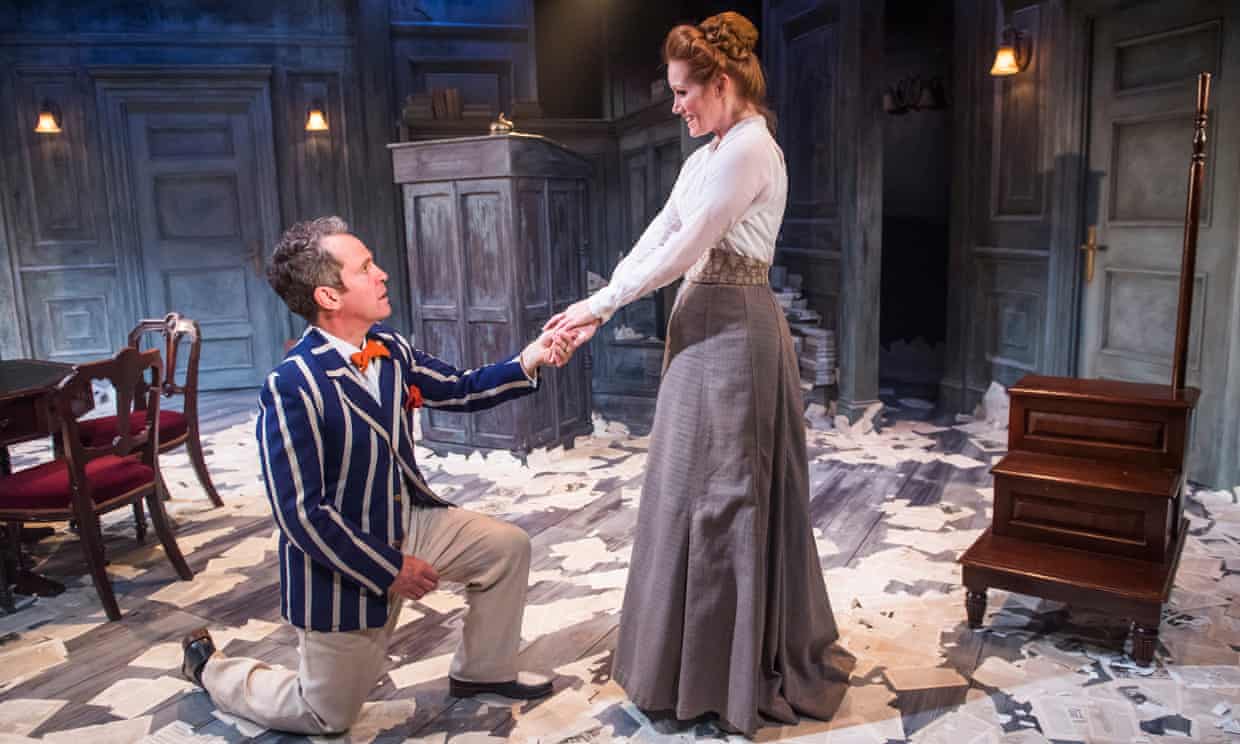
  3. Tom Hollander as Henry Carr and Clare Foster as Cecily in Travesties, directed by Patrick Marber in 2016
  4. Travesties by Tom Stoppard (Faber) - The characters in this sublime play include Tristan Tzara (Dadaist who wears a monocle), James Joyce, Lenin, and Henry Carr – based on a real character from history who performed in The Importance of Being Ernest, directed by Joyce when they all live in Zurich. Carr then sued and was counter-sued by Joyce over nonpayment of tailor’s bills due to Carr’s insistence on wearing sartorially elegant trousers for the production, and Joyce believing he had not been reimbursed for ticket sales. This is mentioned in a minor footnote in Ulysses, and Stoppard picked it up and turned it into a play. In much the same way as in Rosencrantz and Guildenstern are Dead, the characters of Gwendolyn and Cecily from Ernest come to the fore, and in similar fashion to Arcadia, time and place overlap – like a derailed toy train that must be set back on its rails – this is also in part due to Henry Carr being old and senile (we see Old and Young Carr, both played by the same actor), and an entirely unreliable narrator – he may not even have been the consulate he believes he was/is. There are so many layers of understanding and allusion – recycling and reappearing like the Dadaist anti-structure which removes meaning, context and cause – that it needs to be read and deserves to be seen.
  5. The Good Husband of Zebra Drive by Alexander McCall Smith (Abacus) - As with all the novels in the No. 1 Ladies' Detective Agency series (this is the eighth), the crimes themselves - a person stealing stationary supplies, three suspicious deaths in a hospital at the same time in the same bed - are secondary to the characters, their development (or otherwise) and relationships to each other. Mma Makutsi is greatly looking forward to her future life with her fiancé, and she bridles at her apparent lack of authority with Mma Ramotswe. Meanwhile, Mr J. L. B. Matekoni is bored with his job and asks to take on some detective work. He lands the role of investigating for Mma Botumile, who suspects her husband is having an affair. She is the “rudest woman in the whole of Botswana” so he wouldn’t be surprised, although he tells himself he must not judge. He asks what car her husband drives so he can follow him after work and see where he goes, but she only tells him it is a red car, which horrifies him – how can she not know the make and model? Of course, he follows a different red car and investigates the wrong man. Charlie, the apprentice, buys a Mercedes Benz and leaves Mr J. L. B. Matekoni’s garage to become a taxi driver. He is distracted by dreams of greatness and girls, and his fledgling business fails to launch. And, once again, we return to the comforting bush wisdom of Mma Ramotswe, who believes that women make better detectives because they observe more detail and have natural intuition. “There was room in this world, Mma Ramotswe thought, for things done by men and things done by women; sometimes men could do the things done by women, sometimes not. And vice versa, of course."