Showing posts with label Florence. Show all posts

Tuesday, 26 May 2026

Renaissance Ripper: City of Vengeance


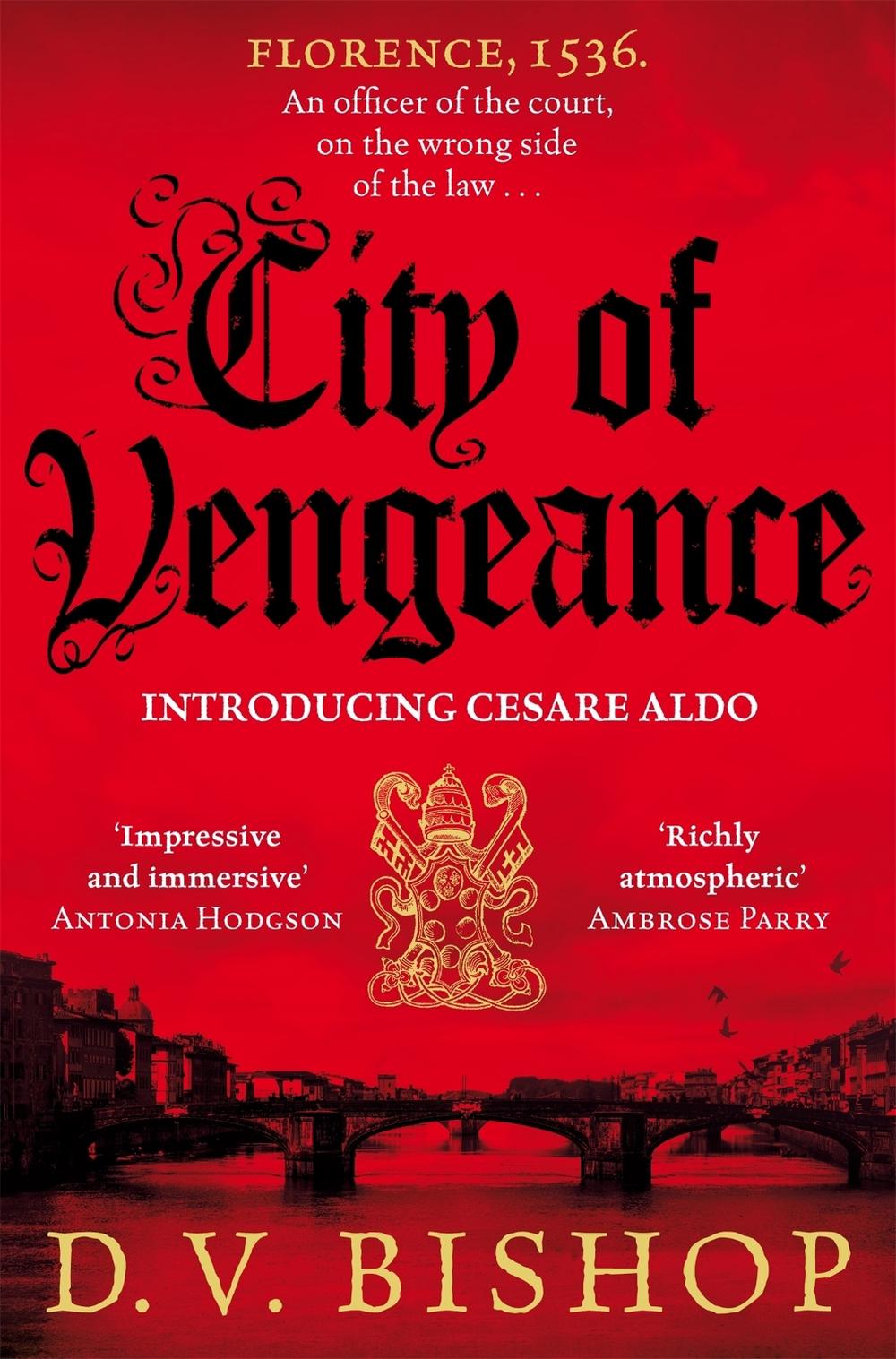
City of Vengeance by D. V. Bishop
Macmillan
Pp. 400

The city in question is Florence, and there are some good descriptions of the narrow streets and the crowded bridges. A map reveals the layout of the city in the sixteenth century, with many landmarks which still stand, such as the Duomo, the Ponte Vecchio and the Bargello, while others such as Le Stinche (the prison in the eastern quarter) have since been demolished.
“Florence: a jumble of grand palazzos and humble hovels, bustling marketplaces and quiet piazzas, churches and workshops, all elbowing one another for room. Above them loomed the Duomo, terracotta bricks divided into vertical segments by columns of pale stone, keeping a proud watch amid the plumes of smoke billowing from the city’s chimneys.”

This is a world where courtesans hustle for business among the wealthy men at court, secrets are round every corner, and the murder of a Jewish moneylender (Levi) barely raises an eyebrow, until a ledger of unpaid debts is stolen, leading to the Duke to make the Wildean quip, “The murder of one moneylender is bad for business. The murder of two is bad for the whole city.” With practically his dying breath, Levi forbids his daughter, Rebecca, from marrying his apprentice, Joshua. Another body, found beaten to death, turns out to be a man dressed as a woman. Meanwhile there is courtly intrigue as this is the time of the Medicis, when Alessandro, Duke of Florence, murdered by his cousin, Lorenzino de’ Medici, was succeeded by Cosimo de’ Medici. “Killings in Florence were not infrequent and were usually personal, fuelled by family, love, hate or greed.” With multiple plots, subplots, and frequent switches between character and locations, the story is almost deliciously Shakespearean.    


Cesare Aldo is our unlikely hero, a former soldier, with a war-injured knee, now a member of the Otto di Guardia (the eight), the city’s most feared criminal court. While ruthless when required – “Cesare Aldo took no pleasure from killing, but sometimes it was necessary” – he has a (poorly kept) secret of his own. He is homosexual, a ‘crime’ punishable by death. Although historically, this sentence was rarely executed, it makes a sufficient plot point for his blackmailer to warn that if discovered, “you’ll be hung from the gates, your body set on fire, and your ashes hurled into the Arno. That’s what the likes of you deserve.” Several set pieces and action scenes bring the novel to life. Florence is “a labyrinth for those who didn’t know it well, The Duomo and the Arno were helpful landmarks, but often hidden from view among the narrow streets and close buildings.” The opening chapter contains a thrilling ambush, and the chase sequences are full of evocative detail.

“The approach to the bridge [Ponte Vecchio] was choked with sellers hawking poultry, fish and produce to potential buyers, all of them arguing about prices. The aroma of fresh bread filled Aldo’s nostrils as he passed a baker. In the next doorway three youths were playing dice, pushing and shoving at each other, shouting to be heard above the babble of voices. Ahead the bandit had to swerve around a trader holding live chickens high in the air, one in each fist, proclaiming their price a bargain. The birds clucked and protested, flapping their wings, feathers fluttering down.”

Other locations are also described according to their geographical and historical features. The little village of Le Casette owes its existence to its position beside an easy place to ford the river Po. “The tallest building was the church with its bell tower, while the coach house and stables stood across the dirt road from it. Salvation and God on one side, drink and the potential for devilment on the other – it was often the way.”


The explanations of the legal machinations incorporate daily reports being made, denunciations being filed, and the quality of justice being questioned. “Explaining a dead body to the Office of Decency was always a nightmare. The court’s officials turned a blind eye to most things, if their vision was clouded with enough coin. But a corpse was too much, even for the greediest of them.” One of the wealthy merchants, Landini, has a very modern right-wing viewpoint:

“For every moment of triumph, there was always an official ready to interfere. Florence had dozens of different courts overseeing every aspect of city life. Didn’t the guilds do enough to bring prosperity to the people? Well, not all the people, but certainly to those who deserved it. Anyone who couldn’t – or, more likely, wouldn’t – work could always go to church for alms. It was the way of things, and some things never changed.”

Morally and politically, there is a balance between acceptance of the status quo and the potential for change. “At times Florence stumbled beneath the influence of those who did not have its best interests at heart. Mad monks that held sway over the people and their fearful souls. Wilful men clouding minds with talk of a republic where all might be equal. Guilds and merchants battling for financial supremacy. Armies fighting for territory. Kings and cardinals grappling for control.” 

Aldo concedes, “The people could have all the will they wanted, but the future of Florence would always remain in the hands of the few.” The struggle for influence and power, is only achievable by certain strata of society. Maria, Cosimo’s mother bemoans, “To be a woman in this world was hard enough; to be a mother and a widow was worse still. All the responsibility and none of the power.” Women, Jews, homosexuals, illegitimate children, in fact anyone but the sanctioned elite, must get by as best they can. “We do what those like us have always done. We live, we drink, we love, we fight, and we endure. The fools in charge do their worst, and we try to survive. Tomorrow will come, whether we welcome it or not.”


On the other hand, choices are important and no fate is inevitable. Doctor and love interest, Orvieto, tells his patient, Aldo, “Doesn’t matter how often I tell you to rest; what happens next depends on you. It’s the same with this conspiracy. You can warn those in danger, but they must decide how to respond.” Aldo has his own views on jeopardy. “There was no prudence in avoiding danger, because danger always came. Better to calculate the risk and act decisively.” 


The author cannot disguise his political or religious views, literally repeating himself. Early in the novel Aldo remarks, “Changing the minds of those with faith was almost always a lost cause.” Later, as he questions whether so many churches are necessary in Bologna when the coin could be better spent helping the needy, the constable, Strocchi, is uncomfortable with this reasoning. “Aldo chided himself for breaking his own rule: never argue with men of true faith, as changing their minds was almost always a lost cause.” Fearing Aldo is on a revenge mission, Strocchi warns, “You might be able to kill a man in his bed, I can’t. It is for God to take a life.”


Bishop animates this time and place with fictional features based on fact. Aldo explains to Cosimo, “Myths are stories told many times. The truth is usually still inside them.” This is the first in a series featuring Cesare Aldo and the city of Florence, and I would be happy to read more about both.


Friday, 15 May 2026

Friday Five: Books Read in April

  1. City of Vengeance by D. V. Bishop (Macmillan)This is the first in a planned series featuring Cesare Aldo and the city of Florence, and I would be happy to read more about both. This is the time of the Medicis, when Alessandro, Duke of Florence, murdered by his cousin, Lorenzino de’ Medici, was succeeded by Cosimo de’ Medici. There are murders, family feuds, personal grievances, religious disputes and secrets around every corner.With multiple plots, subplots, and frequent switches between character and locations, the story is almost deliciously Shakespearean. Cesare Aldo is our unlikely hero, a former soldier, with a war-injured knee, now a member of the Otto di Guardia (the eight), the city’s most feared criminal court. While ruthless when required, he has a (poorly kept) secret of his own. He is homosexual, a ‘crime’ punishable by death. Ambushes, chase sequences and vivid descriptions of the Renaissance city keep the pages turning rapidly, while digressions about the nature of power and control give the novel a contemporary aspect.
  2. Madame Burova by Ruth Hogan (Two Roads) - Nice cover; shame about the cloying middle-class morality and condescending judgement. Madame Burova is a tarot reader who takes over from her mother Shunty Mae to run their sea front booth in Brighton and also works at the local holiday park, meeting lots of 'interesting characters'. Meanwhile, Billie, a young woman in London whose entire individuality seems to rely on the fact that she wears a jaunty bowler hat, finds out that she is adopted and travels to Brighton to uncover the truth of her origin story. The author makes her point so often that the characters have no personality of their own, and there are pages of exposition and creaky prose littered with unnecessary adjectives. The period setting of 1973 to which we frequently flash back is practicably indistinguishable from the contemporary sections; what world does this author live in? We are firmly in the 'what could ever make a woman give up her precious baby' territory and authorial attitudes I thought had been left behind last century. 
  3. Witches: What Women Do Together by Sam George-Allen (Penguin Random House Audio Publishing Group) - I listened to this one as it is read by the author and they kept me company on car rides and bus trips. The premise is the fear that patriarchy has of women, especially when they get together, leads to their need to silence, censure, denigrate and ridicule us. From sport to music, to communication and activism, women's activities are seen as lesser by society. The greatest success of the patriarchy is pitting women against each other - women are easier to control (and sell things to) and compress into one of the very few ways to 'acceptably' be a woman if they are isolated. Conversely, they are often forced into the 'community and caring' roles, which are naturally underappreciated and underpaid, because they are 'women's work'. The allure of a network of connected women is what lies behind the pull of Wonder Woman and the fear of The Handmaid's Tale. This is admittedly a western-centric view of society - because that is the one in which the author and I live - which celebrates the power and pleasure of being among women. 
  4. Wild Dark Shore by Charlotte McConaghy (Penguin Random House Australia) - The world setting of this novel makes a mark right from the start. A man and his three children live on a remote island halfway between Australia and Antarctica (it's called Shearwater and clearly based on Macquarie), which is rich in marine wildlife and home to the world's largest seed bank. A woman is washed ashore while looking for her husband who was working there and left increasingly mysterious messages. As the family nurse her back to health, she realises that the island hides secrets and as the sea levels rise, all the inhabitants are threatened. Part mystery; part eco-drama; part psychological treatise on isolation, preservation and growth, this book is patchy in places but memorable as a whole.

Tuesday, 9 December 2008

Travels and tribulations 3

Meanwhile, back to Italy...

We leave Florence behind and head north on the autostrada. Cars hurtle past at ferocious speeds and the weather conditions are appalling. The rain pelts down, the mist and fog rise to shroud us in our own invisibility cloak, and the temperatures plummet. The road snakes into the mountains over viaducts and through numerous tunnels. Apparently the surrounding lakes and villages are extremely picturesque, but we can’t see a thing.

At the end of the autostrada we call into Longereno for a coffee – they don’t do Americano and the bloke behind the counter tells me I am having an espresso, which I do – wow, that wakes me up! Apparently they have a marathon here every year to commemorate a slip that washed away a large part of the village and several people. Today they are having not a lot, except a crowd of folk in the café laughing and joking as they knock back several glasses of vino tavola – fair play to them; there’s not much else to do in this weather.

We continue to Pieve di Cadore, which Him Outdoors has picked as a point to stay from where we can explore the nearby mountains. It is siesta time and everything is closed which of course upsets Him Outdoors, although it happens every day. We drive to a lagola to wait for opening hours. Later I discover the lagola is a natural spa with spring water bubbling up from beneath, but with torrents of rain cascading from above, it is hard to spot.

We wait until a tourist information is open and we book a hotel through them. It is dark and dingy – the heavy wooden furniture and solemn chintz furniture don’t help. The girl at the desk (the owner’s daughter I presume) is extremely surly, the hot water is reluctant, the shower poky, and the bedside light broken. Unsurprisingly, we are the only guests there and I feel like a character in a John Irving novel.

Him Outdoors buys some maps from the local tabacci and he pours over them, plotting and scheming routes which cheers him up until he realises he hasn’t got enough time to mount all the assaults he plans. Out in the little town we find a birreria where they serve glasses of vino rosso for 1.50 Euro with a bowl of crisps. A group of old men play cards in a back room where frescoes of jolly monks look down from the walls, beer in hand.

We then stumble across a pizzeria which is packed – so this is where the good folk of Pieve hang out. Our pizzas are delicious along with our demi-carafe (mezzo) of red wine. The flames leap and twist in the pizza oven keeping everyone warm, which is a good job as it is cold outside. I am wearing four layers, two of them wool, and shivering when still.

Back at the hotel the owner has returned. He speaks Italian (obviously) and German but no English or French. We manage to establish that he wants to see our passports. It transpires it is not so unusual for people to speak German in this region. Just north of here is Sappada, a German-dialect-speaking (Bavarian/Tyrolean) island, founded about 1,000 years ago by refugees from the Tyrol, perhaps attracted by the rich mineral deposits there. This might also explain why we keep thinking these villages look Austrian.

Friday, 28 November 2008

What to buy in Tuscany/Rimini

In Rimini my sister finds a pair of leather boots lined with sheepskin for 39 euros, marked down from 120 euros. She is pleased with her bargain and puts them on at once hoping to be more seasonably dressed – Italians don’t sell things out of season, which is why there are no sandals on display.
A saleswoman breaths down her neck in another shop where she tries on hats and leather jackets – the goods turn to tat the further we walk from our hotel. She reckons we must be at the posh end.

Buying food is an experience – there are shelves of pasta twists and twirls and packets of alluring biscotti. Jars of marinated things glisten in anti-pasti paradise although I don’t want to look too closely as one of the delicatessens reminds me of an eighteenth century medical laboratory – I’ve seen too many pictures of pickled specimens.

You have to weigh your own fruit and veg in the supermarket, while punching into the machine the details of what you’ve got in your basket. Fortunately there are pictures as well which help you select the appropriate sticker. It’s a great game – my nephew would love it!


Later, in Florence, we spend many hours strolling through the markets of San Lorenzo, eyeing up the leather goods, pashminas and silk ties. We buy a stylish leather jacket for Him Outdoors, a bright green handbag for me (‘But will it go with anything?’ Men!)

We buy presents for mums and brothers, but keep our hands firmly in our pockets after we’ve had a drink. Never buy anything unless you’re completely sober; that’s my motto. Actually, I’ve only just made it up, but I quite like it and I think I’ll keep it!

There are shops selling extremely expensive paper embossed with the Florentine lily. It looks a lot like the French fleur de lis but is different and they get very upset if you make the blundering mistake of calling it such. The Florentia paper is of the highest quality, and the highest price, and is I'm sure, well worth it, but beyond our budget so I make do with a leather bookmark.

I love the toy shops which, although full of an alarming array of rubbish, have some classic shiny wooden toys that gleam from the shelves. Like something Gepetto's workshop, they wait for you to turn your back so that they can come to life. I try to catch them at it, by just pretending I'm not looking, but they have me sussed and stay fimly put.

At the Mercato Centrale I am impressed by the fish counters with their bright red tuna, tentacled squid and octopus, and other creatures of the sea. There are bins of porcini and sun-dried tomatoes which are ridiculously cheap by non-Mediterranean standards.

We drift through aisles of fresh produce, buying cheese; ham; bread; wine; pesto and olives – staples of a meal negotiated in our stumbling and stunted Italian. We find a park bench to sit on and eat our simple meal, pushing in the cork (they seem reluctant to switch to screwcaps) and swigging from the bottle like cheerful vagabonds.

Friday, 21 November 2008

Imagining Siena

We park outside Siena and walk in through one of gates in the walls – Siena is a car-free city, being the first European city to banish motor traffic from its centre in 1966. Proceeding to Il Campo, we stock up with tourist information brochures and sit at a café at the edge of the square for a cappuccino and to get our bearings.

Il Campo is scallop-shaped and slants on nine sections (for the members of the Council of Nine) from the Fonte Gaia (the Happy Fountain) to the Palazzo Comunale, which is sparse and elegant, dominated by the tower – the Torre del Mangia. The streets radiate in circles which swirl around and can make navigation difficult, but this hardly matters as it is pleasant to wander about the city admiring the buildings and sculptures.

The cathedral is one of Italy’s greatest gothic churches – small in comparison with Florence’s but civic rivalry led Florence to try to do everything bigger and better.

Legend states that Siena was founded by the son of Remus and so the symbol of the wolf feeding the twins Romulus and Remus is as ubiquitous as it is in Rome.

There are fountains and squares, palaces and churches everywhere but we don’t go into any of them – we just walk around the streets remembering to look up.


Every building has a coat of arms; a statue; a painted façade; a frescoed ceiling; ornate shutters; a tether for a horse; a decorative door, archway or window.


I get quite carried away with the doors and windows, and we have to buy a new memory stick for the camera to accommodate my happy snapping. Incidentally, camera shops share premises with opticians which I thought was a bit odd at first, but makes perfect sense really as they’re both concerned with lenses and visuals.

Siena is a city of imaginings. Twice a year (2nd July and 16th August) it hosts Il Palio – a series of colourful pageants and a wild horse race around Il Campo. Ten horses and their bareback riders (representing the town’s districts) tear three times around the perimeter of Il Campo (it is covered with packed dirt) while the spectators are fenced into the centre.

Even if a horse looses its rider it can still win the event and claim the coveted and fiercely contested Palio (silk banner). The only rule is that the riders mustn’t tug at the reins of other horses. I can imagine the clatter of their hooves around the piazza; the screaming and cheering of the fans; and the snapping of banners in the breeze.

I can imagine secret trysts and assignations in sun-drenched, high-walled courtyards where ancient frescoes look down on lovers whose murmurings are accompanied by the soft splash of fountains.


I can imagine the dim alleyways were perfect places to plot and scheme with an accomplice or to lure an acquaintance to be dispatched.


Siena still maintains its mediaeval gothic glory, leaving the flashy Renaissance to its Florentine rival, with whom it was frequently at war. It is allegedly the home of panforte – a rich cake of almonds, honey and candied fruit, which was created for Crusaders to take to the Holy Land – but we make do with enormous slices of pizza which we eat in the square.

Wednesday, 19 November 2008

Florence AM

I love seeing a city wake up – the blare of horns as folk head off to work; cyclists and pedestrians negotiating the traffic, while an old man serenely pushes his wife under rugs in a wheelchair down the main street.

Shutters rattle up and the wise buy bottles of water to see them through the day, which is deceptively cool at present.

Gloves are displayed in windows; the sharp smell of leather beckons on the crisp air.

The gold glistens behind heavy wooden shutters; the papal bankers are keeping their secrets hidden in a private, hedonistic confessional.


The duomo and the tower of the Palazzo Vecchio cut cleanly into the pale blue sky; their precise incisions not yet blurred by the midday haze.

A man stands at the counter of a tripai eating lampredotto; hot chilli sauce drips from his fingers and he snorts from his nostrils and shakes his head violently in a semblance of penance.

The crowds have not yet formed between the solemn alcoves of the Uffizi where the sightless marble statues stare past tempestuous humanity.

The faded Italian flag shades of the cathedral are pastel and sharp like the tangible flavours of the mounds of ice-cream; tantalising pyramids of pineapple, strawberry, lemon, raspberry, chocolate, pistachio studded with fruit and labelled with exotica. Their geometric lines will melt to puddles of kaleidoscopic colours by afternoon.

As I rub the shiny snout of the Fontana del Porcellino I see its clouds of white breath evaporate in the morning air. Grazie! I will return to Firenze!

Wednesday, 12 November 2008

View from Above

It might not be the best idea to race up the campanile with a bottle of Chianti inside us, but that’s what we do. There are 414 steps and a sign warns that there is no lift. The steps are steep, narrow and, in many cases, spiral, causing lots of stops to let others pass going the opposite way and to catch our breath.

The view from the top is incredible and quite literally breathtaking.

A combination of wine, heat and dehydration sends me all giddy and I start shaking and worrying about what might fall over the edge. Meanwhile, Him Outdoors is merrily scampering about, delighting over the red roofs, and trying to locate distant landmarks on his map.

He especially likes the roof-top terraces we can spy on from above and watch people eating their lunch.

We clatter back down the steps and view Giotto’s Bell Tower with whole new eyes.


We head to the Piazalle Michelangelo above the city for the sunset. The buildings go pink and the lights twinkle on. We share a beer and think it’s all very romantic – walking back to the hotel tired but happy.

Monday, 10 November 2008

Florentine Sights

Him Outdoors has a culture limit, so I have to choose my sights wisely. On my last visit to Florence (about 20 years ago) I went to the Uffizi and the Galleria dell'Academia so on today's touring, I visited some different haunts.

Galleria Michelangiolo
The Leonardo da Vinci exhibit features machines reproduced and built to the specifications in his codices. There are prototypes for bicycles, helicopters and hangliders, diving bells and military equipment.

Wanting to please his investors he sketched improvements on cannons and catapults although his own feelings about war were far from favourable. There are hammers and cogs and hydraulic lifts; he is a forerunner of Mr. Otis, working out a safety cog that would prevent weights from falling back as they were being hoisted up.


He was an illegitimate child with no prospects (so a History Channel documentary intoned) and he made his name by sucking up to potential wealthy patrons, such as the Medici family – with works after being accepted as an apprentice at Verrucchio’s workshop. Many of his most fanciful and innovative designs centre on the enigma of flight, which fascinated him, and a whole room is dedicated to his airy creations.

His greatest notable achievement was to design the system of pulleys and cranes for lifting heavy objects that enabled the golden globe to be placed atop the duomo. Hence, despite secret accusations of sodomy – which caused him to be taken away and ‘questioned’ in the dead of night – he was to become Florence’s favourite son.

Museo del Bargello

This is apparently ‘Italy’s most comprehensive collection of Tuscan Renaissance sculpture.’ Danti, Cellini, Michelangelo, Donatello and Giambologna are among the weighty names represented. In many cases one of the ‘names’ would make a sculpture of someone or something, and then another ‘name’ would do one of the same thing so there are multiple versions of mythical figures all over Florence.

The building was originally the residence of the chief magistrate, then it was a police station complete with torture equipment and the city’s gallows. Now it houses many ancient statues in marble, sandstone and bronze, plus casts and models in wax, terracotta and plaster cast copies.

These statues are about 500 years old and the productivity of some of the sculptors is incredible, especially when you consider they were also busy fighting teenage mutant ninja turtle crimes.

I especially like Danti’s Beheading of John the Baptist. It’s massive and the configuration of the three bronze figures is remarkable. This used to be outside the baptistery but has been removed and placed in here for safekeeping.

I also like Michelangelo’s drunken Bacchus, although his patrons didn’t and they refused to accept the work. With his unsteady gait and unfocused expression, he looks exactly like many a reveller I have seen down the pub on a Friday night. Except with fewer clothes.

There is a fantastic work of Jason (complete with golden fleece), by Peter Francavilla, Donatello’s St George, and Giambologna’s beautiful bronze bird sculptures and fabulous Winged Mercury. I also like Vincenzo Gemito’s bronze statue of a fisher boy.


Donatello’s David is a counterpoint to Michelangelo’s arguably more famous one. They are too different for me to pick a favourite.

Many sculptors depicted their patron, Cosimo I de Medici, usually kitted out in gladiatorial attire and sitting mightily astride a powerful steed – clearly they knew which side their panini was buttered.

I race through the rooms of Persian rugs, ivory carvings, iconic paintings of Madonna and child, and painted ceramics – all are wonderful I am sure, but they are not my thing. My attention is definitely diverted by the statues, and I prefer those of classic and mythological leanings rather than the saints, crucifixions and madonnas.

Cathedral Maria del Fiore

Built to supercede those of rivals in Siena and Pisa, this is free to enter (as long as legs and shoulders are covered) although you have to pay to go up into the duomo or down into the crypt, so we don’t.
Despite the stained glass windows (by Donatello, Andrea del Castagno, Paolo Uccello and Lorenzo Ghiberti) and the awesome (and I really do mean that in it’s true sense) frescoes on the dome, the interior of the cathedral is strangely unadorned compared with the fabulous façade.

Friday, 7 November 2008

Travels and Tribulations 2

The travel hassle begins again. Taxi to Rimini train station; 12 Euros. Waiting on the platform for an hour – Him Outdoors still has dodgy guts and is doing a lot of groaning. We find a seat on the train to Bologna and a place to store our luggage which is very fortuitous as the train soon fills up; standing room only.

We are at one end of the carriage and when the train pulls into the station at Bologna and the doors don’t open, it turns out to be the wrong end. We have to clatter and bang our cases (never travel with a bike!) all the way down the aisle then negotiate a way across the station to the Aerobus (5 Euros) to the airport.

Here we pick up a car and drive to Florence; quite a baptism of fire for Him Outdoors on the wrong (right) side of the road. There are lots of tunnels (of course you never check where the lights are on a hire car that you pick up in broad daylight!) and lots of trucks whizzing by very close. He keeps drifting right and we are missing the trucks by inches. I don’t wish to turn into my mother (sorry, mum), but I keep flinching and telling him to keep his eyes on the road when they are drawn to the glorious Tuscan countryside.

We find our hotel relatively easily. It’s a delightful villa, quite peaceful, surrounded by trees and a half-hour walk out of town. We dump our bags, the bike and the car and then thankfully walk into town.
I take Him Outdoors on a quick walking tour and we race through the sites – Ponte Vecchio, dazzling with its array of gold jewellers; the Uffizi , outside which I point out the Room With A View moment (there are lots of people taking photographs but the beautiful view is ruined by a massive crane in the way); and the Palazzo Vecchio, which he decides is his favourite building.

The Piazza della Signoria is as I remember, with all its fabulous sculptures including Ammannati’s fountain of Neptune, Giambologna’s statue of Cosima I de’ Medici and his Rape of the Sabine Women, and (my favourite) Cellini’s Perseus, having just slain Medusa. There are also copies of Michelangelo’s David and Donatello’s Mazocco, the heraldic Florentine lion.

We pass the Bargello; Casa di Dante (where the poet supposedly lived); Orsanmichelle; and the cathedral, campanile and duomo. It’s all incredibly impressive stuff, and quite breathtaking. The Lonely Planet writes,

“The French writer Stendhal was so dazzled by the magnificence of the Basilica di Santa Croce that he was barely able to walk for faintness. He’s not the only one to have felt overwhelmed by the beauty of the city – Florentine doctors reputedly treat a good dozen cases of ‘Stendhalismo’ each year.”

A very short queue beguiles us to duck into the baptistery – the first one of which was built in the 5th or early 6th century AD; this one was reconstructed in the mid 11th century. Bronze doors, marble floors and mosaics on the roof add to the majesty of the place which is credited with launching the Renaissance.

We wend our way through the streets and walk back more leisurely to the Piazza Pitti – the Pitti were the rival family to the Medici; the Palazzo now houses a number of museums – and Café Bellini where we have a beer and pizza. The pizza here are thin and crispy and swimming in sauce and mozzarella. I have one with artichokes, olives and ham – bellisimo!

I collapse into bed but I find it hard to sleep as my mind is full of images and cultural icons crowding in upon each other. Or maybe it’s the cheese.