- The Morningside by Téa Obreht (Weidenfeld & Nicolson) - The Morningside is an apartment building in a future dystopian world in an unnamed country where rising sea levels have flooded much of the land. Silvia is an eleven-year-old child whose mother manages the apartment. They are refugees who have arrived as part of a humanitarian scheme which sends children to school but offers little else in the way of welfare. She encounters another girl, Mila, who seems to have much more privilege, and they have adventures which are hauntingly unpleasant. The world created is sketchy as seen through a veil of imagination and terrifying fairy tales (Silvia's aunt Ena tells her magical folktales) and the young person narration shifts the reader’s focus. This is true magical realism in which the reader should go with the flow rather than swim against the (rising) tide.
- Bury My Heart at Wounded Knee by Dee Brown (Vintage) - Written as social anthropology, this book studies each Native American tribe's relation to and treatment by the American government. The litany of lies, deceptions, broken promises and massacres are overwhelming as the settlers keep pushing West, plundering resources and dispossessing the Indigenous population of their land and livelihood. We know the names of Sitting Bull, Crazy Horse, Red Cloud and Geronimo, and this fills in their stories with ever-depressing detail. It has an elegiac tone as it focuses on defeat and victimisation. "Their musical names remained forever fixedon the American land, but their bones were forgotten in a thousand burned villages or lost in forests fast disappearing before the axes of twenty million invaders." While this book, first published in 1970, undoubtedly changed the way Native Americans were viewed (savages and brutal warriors), the narrative maintains a tragic death of their culture rather than propounding the vibrancy of their survival.
- Psykhe by Kate Forsythe (Vintage) - This begins as an interesting history then rapidly descends to teen-fantasy quest using the myth as a narrative structure. Natalie Haynes, Kamila Shamsie and Madeline Miller are all doing interesting things with myth – Kate Forsythe is not. She tells the story of Eros and Psyche as a template for the Beauty and the Beast fairytale, set in the fifth century BC. Her focus on Estruscan life draws unfavourable parallels with Ursula Le Guin's Lavinia, as she offers up recognisable history without contemporary interest, and the fantastic descriptions of lavish settings are strangely underwhelming, like those of biblical tales. She then attempts to retrofit feminism with passages about the lack of self-determination for women, but succumbs to a conventional narrative in which the supposed passion and desire present more like coercive control. "He had never let me see his face; he had come and left in darkness, he would not let me know his name. I had been kept locked in, forbidden to see or speak to anyone else.” It is rather perfunctory and lifeless and adds little to the ever-increasing canon of mythical revisionism.
- The Safekeep by Yael van der Wouden (Penguin) - Living in a colonised country, one notes strong parallels with the themes in this novel of contested ownership and possession. Isabel lives in the family house in the Netherlands with no real understanding of its origin or how they came by it. She and her younger brother, Hendrik, mockingly discuss their older sibling, Louis, knowing that he will inherit the home when he marries, and that Isabel merely inhabits it on suffrance until that time comes. When Louis, dumps his graceless girlfriend, Eva, on her doorstep, Isabel is initially repulsed by and later drawn into a relationship with her, which is almost Chekovian in its repressed passion and unspoken trauma. There is aching loneliness and explosive sexuality in this stifling millieu of 1960s middle Europe with a focus on atmosphere and undercurrents rather than superficial storytelling.
Friday, 10 July 2026
Friday Five: Books Read in June
Friday, 5 June 2026
Friday Five: Books Read in May
- Flowers for His Funeral by Ann Granger (Headline) - In the seventh of the Mitchell and Markby Cotswold whodunnits, we encounter rural mansions, village pubs, unfriendly locals, hidden shelters in the woods, and crumbling masonry. When Markby runs into his ex-wife Rachel at the Chelsea Flower Show, he would not believe that her present husband, Alex, would wind up dead moments later, and yet when that happens, he and Meredith (Mitchell) head to Rachel's village to help find the killer, convinced the cause of death was not simply a heart attack. Malefis Abbey, where Rachel lives, is a picture-book murder house, "Its Gothic windows and fantastic chimneys all looking odder than ever among the surrounding trees, suggesting a secret and sinister castle in a fairy-tale." There are some woeful stereotypes as the streetwise Londoners have to deal with the cunning country folk, and suspects are on the list merely because of their foreign nature - "Forgiveness was not much in the tradition of the Middle East. Vengeance was." I'm still not sure what the relationship is between the two main sleuths - friends with benefits? - but the author is at pains to point out how solid, sensible Meredith is completely at odds with flighty, demanding Rachel.
- Question 7 by Richard Flanagan (Penguin) - Chekov's Question 7 is a short story incorporating misdirection as a parody of children's mental arithmetic puzzles: "Wednesday, June 17, 1881, a train had to leave station A at 3am in order to reach station B at 11pm; just as the train was about to depart, however, an order came that the train had to reach station B by 7pm. Who loves longer, a man or a woman?" Flanagan uses the concept of this non-sequitur to write about his past, his father, nuclear fusion, the affair between H.G. Wells and Rebecca West, science fiction, Tasmanian tigers, half-life, extinction, ur-texts, Hiroshima, near death experiences, and other chain reactions. There is a lot to consider, and some of it feels like the unedited ramblings of a man who has won many literary prizes. Some of the aphorisms feel like homilies - "The past is always most clearly seen by those who never saw it"; "Experience is but a moment. Making sense of that moment is a life"; "Sometimes we discover that we live in the dreams and nightmares of others and we dream anew." He strings these together in a way which initially seems profound but may equally not be. Trent Dalton and Tim Winton write in the same manner of short apparently punchy sentences - it is the way of the male Australian literati, but it leaves me largely unmoved.
- Everything's Fine by Cecilia Rabess (Picador) - The theme of this story might be to question whether opposites can be together if they do indeed attract in the first place. Josh is preppy, Conservative (with a large C) and white; Jess is from an entirely different background, motivated by morals rather than money, and the only black person in their economics class at their Ivy League college. They have a whirlwind and tempestuous relationship which matures over a length of time (reminiscent of David Nicholls' One Day in that regard) but the cracks appear when Jess is forced to admit to her friends that her boyfriend is a Republican and Josh doesn't understand why she might be upset that he owns a MAGA hat with all its connotations of "racism, hatred and systemic inequality". There's a lot of lecturing as the politics are personal, and Jess tries to ignore the signs - "Everything's fine". She knows her father would be horrified to learn about her boyfriend's ideals, and Josh tells her, "It's better to be happy than right." Is it? Or is it true that "Love conquers all, except geography, and history, and contemporary sociopolitical reality"?
- Chinaman: The Legend of Pradeep Matthew by Shehan Karunatilaka (Penguin Books) - From the Booker-Prize-winning author (The Seven Moons of Maali Almeida) comes a book he wrote ten years earlier, which has since been republished in the light of this acclaim. The sort of shaggy dog story follows retired sportswriter and cricketing tragic, W.G., as he attempts to track down his hero, spin bowler Predeep S. Matthew. W.G. believes Matthew, international representative for Sri Lanka, was the greatest cricketer ever to walk the earth, but his name has been largely erased from the records due to high-profile personality clashes and disciplinary actions. Now that W.G. knows he is dying, he wants to uncover the bowler's story and publish it in a book as his final magnum opus. Alongside the cricket (and there is a lot of it with pen and ink drawings of different ball deliveries) is his personal relationships, with his long-suffering wife, estranged son and ragtag mob of besties. The setting in Sri Lanka is fascinating geographically and politically as the country is torn apart by civil war and the pronunciation of a word can get you killed, and when the novel moves to New Zealand for its denouement, it is no less vibrant. There is much to admire, even if cricket is not your thing, as the tale is deliberately obtuse. After all, a Chinaman is not just a rare bowling action designed to deceive the batter, it is also a term meaning gullibility in Sri Lankan dialect. How much to be swept up in the narrative is entirely up to the reader.
- The Long Night by Christian White (Affirm Press) - A young woman is kidnapped and taken to a cabin in the woods. A mother paints her trauma onto canvases - the pictures are pretentious and her explanations of them even more so - and displays her art in galleries when her world is rocked by the abduction of her daughter. The novel mines every trope of the horror film (cabin in the woods; person in back seat of the car; lightning flashes; well on property; trap for young women; trying to remain silent and still while being crawled on by insects), of which Em is entirely aware, having watched them all and enjoying them dispassionately. “I don’t like being scared, exactly – I like being scared on my own terms. Something about the fear makes me feel safe and in control, like I can hold the monsters at arm’s length.” Once again, women are victims of male aggression, but they also save themselves and each other which may go some way to redressing the balance. "They're both breaking down: both bruised and mud-streaked and drenched. The night has peeled them back to the bone, like so much hanging tree bark. "It is very well constructed with alternating chapters which get shorter, each one finishing on a cliff-hanger, and a clear timeline as sections are divided into hour stamps: 7pm; 10pm; Midnight; 2am; 4am; Dawn, which plays into the long night of the title. However, White has done this seemingly concurrent narrative that turns out not to be thing before in The Wife and the Widow, so the ‘twist’ is not a surprise.
Tuesday, 26 May 2026
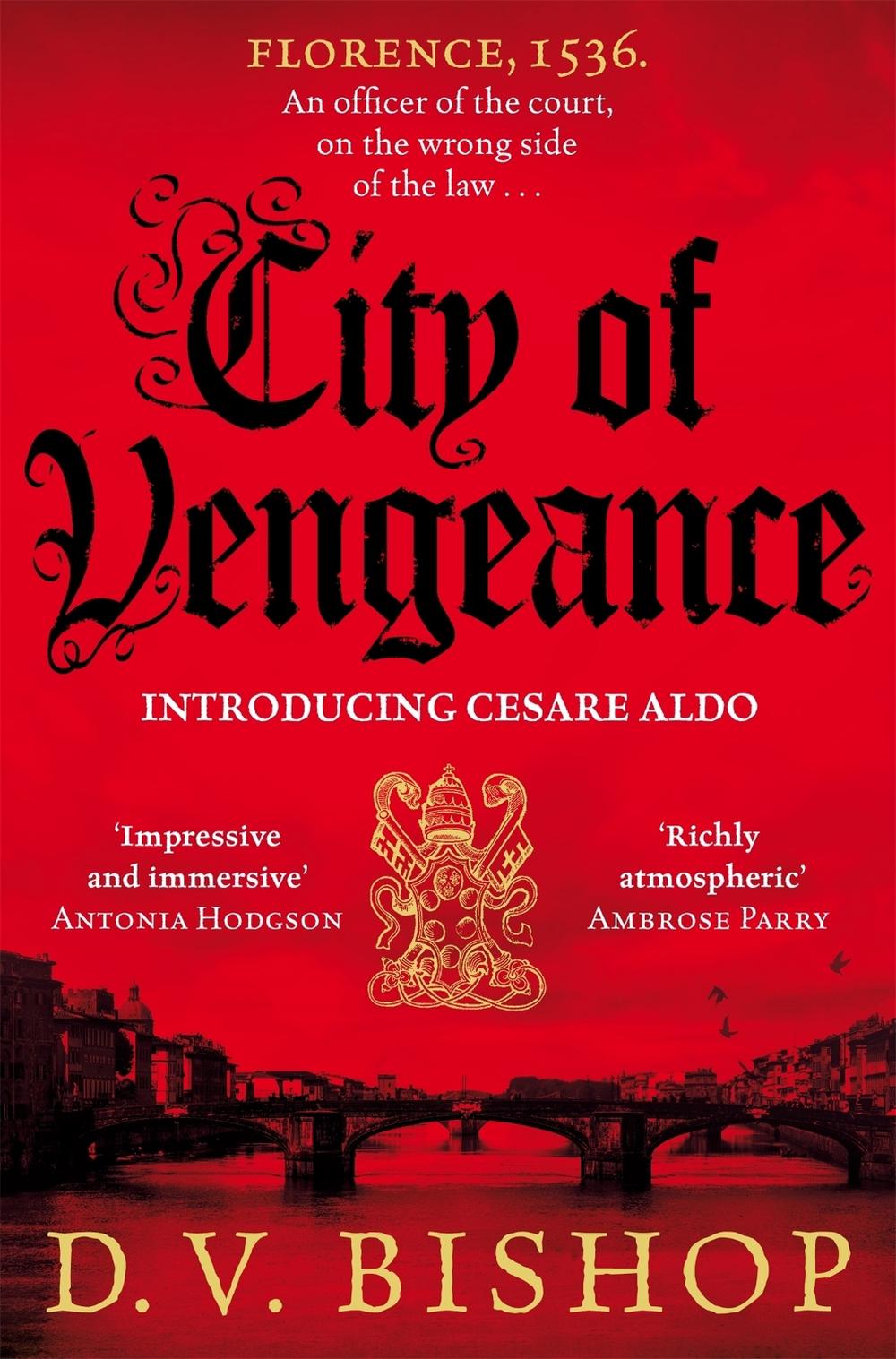
Renaissance Ripper: City of Vengeance
“Florence: a jumble of grand palazzos and humble hovels, bustling marketplaces and quiet piazzas, churches and workshops, all elbowing one another for room. Above them loomed the Duomo, terracotta bricks divided into vertical segments by columns of pale stone, keeping a proud watch amid the plumes of smoke billowing from the city’s chimneys.”
This is a world where
courtesans hustle for business among the wealthy men at court, secrets are
round every corner, and the murder of a Jewish moneylender (Levi) barely raises
an eyebrow, until a ledger of unpaid debts is stolen, leading to the Duke to
make the Wildean quip, “The murder of one moneylender is bad for business. The
murder of two is bad for the whole city.” With practically his dying breath, Levi
forbids his daughter, Rebecca, from marrying his apprentice, Joshua. Another
body, found beaten to death, turns out to be a man dressed as a woman. Meanwhile
there is courtly intrigue as this is the time of the Medicis, when Alessandro,
Duke of Florence, murdered by his cousin, Lorenzino de’ Medici, was succeeded
by Cosimo de’ Medici. “Killings in Florence were not infrequent and were
usually personal, fuelled by family, love, hate or greed.” With multiple plots,
subplots, and frequent switches between character and locations, the story is almost
deliciously Shakespearean.
Cesare Aldo is our unlikely hero, a former soldier, with a war-injured knee, now a member of the Otto di Guardia (the eight), the city’s most feared criminal court. While ruthless when required – “Cesare Aldo took no pleasure from killing, but sometimes it was necessary” – he has a (poorly kept) secret of his own. He is homosexual, a ‘crime’ punishable by death. Although historically, this sentence was rarely executed, it makes a sufficient plot point for his blackmailer to warn that if discovered, “you’ll be hung from the gates, your body set on fire, and your ashes hurled into the Arno. That’s what the likes of you deserve.” Several set pieces and action scenes bring the novel to life. Florence is “a labyrinth for those who didn’t know it well, The Duomo and the Arno were helpful landmarks, but often hidden from view among the narrow streets and close buildings.” The opening chapter contains a thrilling ambush, and the chase sequences are full of evocative detail.
“The approach to the bridge [Ponte Vecchio] was choked with sellers hawking poultry, fish and produce to potential buyers, all of them arguing about prices. The aroma of fresh bread filled Aldo’s nostrils as he passed a baker. In the next doorway three youths were playing dice, pushing and shoving at each other, shouting to be heard above the babble of voices. Ahead the bandit had to swerve around a trader holding live chickens high in the air, one in each fist, proclaiming their price a bargain. The birds clucked and protested, flapping their wings, feathers fluttering down.”
Other locations are also described
according to their geographical and historical features. The little village of Le
Casette owes its existence to its position beside an easy place to ford the
river Po. “The tallest building was the church with its bell tower, while the
coach house and stables stood across the dirt road from it. Salvation and God
on one side, drink and the potential for devilment on the other – it was often
the way.”
The explanations of the legal machinations incorporate daily reports being made, denunciations being filed, and the quality of justice being questioned. “Explaining a dead body to the Office of Decency was always a nightmare. The court’s officials turned a blind eye to most things, if their vision was clouded with enough coin. But a corpse was too much, even for the greediest of them.” One of the wealthy merchants, Landini, has a very modern right-wing viewpoint:
“For every moment of triumph, there was always an official ready to interfere. Florence had dozens of different courts overseeing every aspect of city life. Didn’t the guilds do enough to bring prosperity to the people? Well, not all the people, but certainly to those who deserved it. Anyone who couldn’t – or, more likely, wouldn’t – work could always go to church for alms. It was the way of things, and some things never changed.”
On the other hand, choices are important and no fate is inevitable. Doctor and love interest, Orvieto, tells his patient, Aldo, “Doesn’t matter how often I tell you to rest; what happens next depends on you. It’s the same with this conspiracy. You can warn those in danger, but they must decide how to respond.” Aldo has his own views on jeopardy. “There was no prudence in avoiding danger, because danger always came. Better to calculate the risk and act decisively.”
The author cannot disguise his
political or religious views, literally repeating himself. Early in the novel Aldo
remarks, “Changing the minds of those with faith was almost always a lost
cause.” Later, as he questions whether so many churches are necessary in
Bologna when the coin could be better spent helping the needy, the constable,
Strocchi, is uncomfortable with this reasoning. “Aldo chided himself for
breaking his own rule: never argue with men of true faith, as changing their
minds was almost always a lost cause.” Fearing Aldo is on a revenge mission, Strocchi
warns, “You might be able to kill a man in his bed, I can’t. It is for God to
take a life.”
Bishop animates this time and
place with fictional features based on fact. Aldo explains to Cosimo, “Myths
are stories told many times. The truth is usually still inside them.” This is
the first in a series featuring Cesare Aldo and the city of Florence, and I
would be happy to read more about both.
Wednesday, 29 April 2026
Horror in Another Dimension: Strange Houses
This is the first of three (so
far) short novels by Uketsu, translated to English from the original Japanese
by Jim Rion. According to the publisher’s blurb, the author, Uketsu, is “an
enigmatic YouTuber and author, specializing in horror and mystery, who has
exploded onto the literary scene in Japan, where his books have sold millions
of copies. He only ever appears online, wearing a mask and speaking through a
voice changer. His true identity is unknown.” A sort of viral Banksy if you
will.
The story begins with the
narrator explaining, “I’m a freelance writer, my speciality being stories of
the macabre. Given this line of work, lots of people approach me with their
personal experiences of the eerie and the unpleasant.” He goes on to tell a
story with a blanket level of detail, in which floor plans and family trees
take up half the book – refreshingly, there is no need to flick back to the
beginning pictures to follow along. The floor plans reveal hidden passages and secret
rooms for nefarious business. Most of the text is written as play dialogue,
which contains all the exposition so there is very little description. There is
an element of Edgar Allen Poe’s short stories; thrilling creepy tales that can
be read in a day or two.
In keeping with detective
fiction rules that all clues must be mentioned, there are plenty of apparent irrelevancies,
but also deliberate omissions. Despite exhuming some standard tropes, the Japanese
horror story is certainly different. Sub-headings within chapters are almost like
a child’s first reader: A Message from a Friend; An Unexpected Email; The
Mysterious Space; Daydream; Two Bathrooms; The Article; A Grisly Discovery;
Differences; The Letter; The Hidden Room; The Sign. The tale deals with dismembered
bodies, curses, murderous children, blackmail, and the importance of succession
and illegitimacy. One character fairly remarks, “I can see how it all fits
together, but… isn’t it all a little far-fetched? It’s so convoluted.” Japanese
horror is built on this sort of thing, and there is already a film - released in Japan in 2024.
The murders themselves seem quite
matter of fact. “The Katabuchi family has been murdering people for generations.
I don’t know why, but it has become a tradition.” When a character suspects her
father is involved, the narrator notes, “It was not the kind of truth that most
people could have accepted so calmly, but she seemed surprisingly untroubled.”
He, himself, hardly seems more disturbed, as he ponders where a child was
killed, but not why they were killed at all. He casually discusses horrific customs,
such as, “Mabiki. ‘Thinning the garden’. In Japan, there was once a
tradition of aborting babies or even killing children to keep down the number
of mouths to feed. The practice lasted into the late nineteenth or even early
twentieth century in some communities.” When the ending appears to be
inconclusive, and his colleague “flashed a broad grin”, he allows himself to
feel “a twinge of irritation at his total lack of concern.”
Training children in macabre cults and brainwashing them into murder adds a particularly chilling element. “He had an unhealthy pallor, and his expression was as blank as if it had never known emotion… He never took any action of his own volition and never expressed any of his own feelings or desires.” The whole scenario is highly implausible, but this is the breeding ground for horror. “It sounds wild, but we already know the Katabuchi family is not a normal one.” Investigating murder by looking into floor plans brings a new angle – in many dimensions – to a standard genre. They may be compact crimes, but they are far from cosy.
Wednesday, 25 March 2026
How well can you really ever know anyone? The Wife and The Widow
With a wry aside to the power
of fiction on susceptible minds, Kate first learns something may be amiss when
she discovers her husband was skipping work and “reading horror novels by this
mad American – Lovecroft? Something like that.” White examines the consequences
of hiding feelings and burying emotions, suggesting that suppressed memory will
never remain that way, even when counselled, “Put it someplace out of the way,
in a room behind a locked door. Then all you have to do is not go in that
room.” Kate remembers that John told their daughter they had to confront their
fears; after all, “If they didn’t talk about the monsters in this world, then
they wouldn’t be ready for them when they jumped out from under the bed.”
When Abby asks her husband why
he hadn’t previously spoken to her of his fears, and dreams, he replies, “Come
on Abby, I’m not one of your girlfriends. Men aren’t like that.” Later he
relates his reading matter, “I started reading Tolstoy but couldn’t get into
it. Vonnegut and Salinger were both pretty good. Didn’t mind Jane Austen either
– bet you’re surprised to hear that one?” It’s difficult to tell whether this
gender-reductive viewpoint is that of the character or the author, or both.
While appealing to the common
denominator – we all consult Dr Google, right? “Her left foot ached with what
the internet had diagnosed as either gout, a corn, or foot cancer.” – there are
some aspects of the novel which are unoriginal or overexplained. We all know
what TMI is and don’t need it spelled out. Similarly, the story of Orpheus and
Eurydice is used to indicate the consequences of broken trust and looking back.
This must be one of the most overworked myths in recent literature, and the
fact that it needs to be explained suggests a level of disrespect for the
reader.
On the other hand, the author
deals well with the subject of grief. “Since John’s disappearance, such simple
things had become near impossible. Preparing meals, for example, now seemed
like a bizarre foreign custom, needlessly complicated.” Kate cannot easily see
a way forward. “She baulked at people who said things like life’s too short
and time passes in a blur and Jee-zus, is it Christmas already? Life
was long, time moved too slow, and anyway fuck Christmas.” Her friend advises
her how to cope with the aftermath. “You keep moving. You eat, you take a bath,
you shave your legs and you keep looking forward. Guilt, fear, grief, they’re
all like moss. If you slow down long enough, it’ll start to grow and it won’t
stop until you’re covered.” Apart from the bit about shaving your legs –
another male writing about women trope – this is an interesting metaphor.
At other times, the similes
are so original as to almost be jarring. “She was quiet, like a duck slipping
through a pond.” A false person speaks “words like a backdrop in a Hollywood
studio, held together by balsawood and coated in cheap paint.” While waiting
for news, a character smokes with attitude. “He sucked on the cigarette hard
and fast, as if he was hoping to develop lung cancer before dinnertime.” The
colloquial is ever-present as the ferry doors opened and “spat the Lexus out
like a dislodged chunk of meat” or fact is sifted from fiction. “Around here,
rumours are like holey buckets. They don’t hold water.”
The characters and setting are
distinctly Australian. Abby practices taxidermy on roadkill her friends bring
her, and the tools of her trade, pelts and glassy eyes are all fabulously
macabre. It is set on a fictional Victorian (Australian) island out of season where,
“The island represented a cold exclamation mark at the end of a sentence.” The
atmosphere is frigid and grim, or as Abby puts it, “It’s colder than a fairy
penguin’s pocket.”
Overall, this is an intense and compelling thriller which is hugely readable and atmospheric. It is only White’s second novel and already he is being described by The Age as a master of the art of misdirection.
Wednesday, 28 January 2026
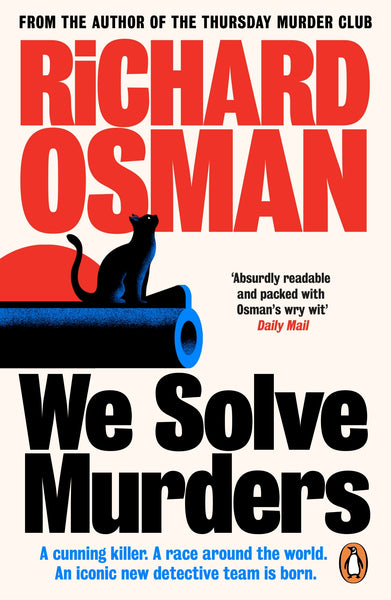
Everyone Knows Tipping Point: We Solve Murders
It is a fast-paced thriller
packed with guns and humour. Influencers are being murdered in a spat between
money launderers, but no one really cares about influencers because they are so
shallow, until we meet Bonnie Gregor, one with a family and a conscience. Amy
is meant to be protecting famous author, Rosie D’Antonio who loves flirting –
with danger and men – as they encounter lots of action in multiple locations. The
New Forest; South Carolina; Dubai; St Lucia; County Cork. “Amy has been in
mortal danger in many countries over the last few years, but St Lucia has to be
one of the most beautiful.”
There is a cast of hundreds –
François Loubet; Henk van Veen; Jeff Nolan; Susan Knox; Max Highfield; Felicity
Woollaston; Jo Blow; Andrew Fairbanks; Bella Snachez; Mark Gooch; Gary Gough;
Tony Taylor; Rob Kenna; Mickey Moody; Vasily Karpin; Eddie Flood; Carlos Moss;
Kevin the ex-Navy SEAL – and it’s quite hard to keep track of who is whom. It
doesn’t really matter though, as the action, locations and opportunity for
cameo roles all combine to make this novel a dying-to-be-made-into-a-film
script, with actors queuing up to play the characters. I read recently about a
woman who said she thought being an assassin was a reasonable career due to the
number of TV shows, books and films about them. “Needs must, and murder’s not
so difficult. Wear gloves, and don’t drive the getaway car too fast.”
Pedantry provides humour, such
as when Rosie asks Henk if he has proof “in that little envelope of yours?” He
replies that is “not a little envelope, it is an A4,… and yes, I have proof in
this normal-sized envelope.” A character quotes Eric Cantona, revealing the aimed-at
demographic, while another ruminates on property prices. “If he was moving to
the village today, he wouldn’t be able to afford it. The only way anyone can
afford to buy a house these days is to have bought it fifteen years ago.” There
is an allusion to modern social interaction as François Loubet sends emails via
Chat GPT in the style of “a friendly English gentleman”. “Most communication is
by message or email. High-end criminals are much like millennials in that way.”
Meanwhile, another character is obsessed with road routes.
“The
journey had been a pleasant surprise, if Tony Taylor is honest. The A31 turned
out to be clear as a bell – couldn’t believe his luck there. M27, no major
problems. The traffic backed up around Junction 2 of the M3 – but when doesn’t
it? The usual fun and games on the M25, but then clear from Junction 9 all the
way to Letchworth Garden City. So, all in all, Tony couldn’t complain. Should
have taken two hours and twenty-three minutes, actually took two hours and
fifteen minutes.”
It may ostensibly be about Amy,
but Richard Osman proves he relates more to middle-aged men than he does to
young women. Steve knows crisp flavours, road routes and daytime TV. “Sometimes
Steve wonders what world Amy is living in. Everyone knows Tipping Point.”
Even when Steve loses his cool with Henk, he does so with self-deprecation. “I’ve
put my priorities on hold for a number of days now. I’ve been tied up, I’ve
been threatened with a gun, I’ve been in a helicopter, and I’ve eaten kale.” Steve
is spoiled, however, by having flown on a private jet. “This private jet – it’s
a Learjet – is slightly smaller than the ones he has become used to in the last
week and he is feeling a little cramped. He’s also just found out there is no
private chef, and he had really been looking forward to a bacon sandwich. So,
just as cat food has been ruined for Trouble [after the cat ate leftover roast
chicken], so air travel has forever been ruined for Steve.”
Friday, 6 December 2024
Friday Five: Books Read in November (Yes, it's actually just four)
- The Scent Keeper by Erica Bauermeister (St Martin's Griffin) - This novel blends whimsy, magic realism, coming-of-age self-discovery, fairy tale archetypes and young adult fiction. Emmeline is raised by her father, alone on an island which can only be reached once a month when the tide is right. He has a machine, which can capture scents and print them onto slips of paper, like a Polaroid camera for images. He puts these scent papers into small glass bottles, stoppered with different-coloured wax. The scents do not last forever, and he begins to burn them individually to release memories, until a tragic accident forces Emmeline to leave the island and return to the mainland. Emmeline’s father has educated her through stories, foraging and fishing, sitting her down for a lesson every morning. There is an element of Miranda and Prospero, and her awakening to the brave new world enables the author to indulge in the trope of an ‘alien identity’ discovering and describing technology. She learns to read people through their scent, like a dog does. When rescued and taken to school, Emmeline is bullied for being different and for her intense sense of smell and her natural style – she doesn’t understand falsity and masking. Later, her mother, Victoria takes her to a make-up counter and buys all the products after the ‘transformation’. Emmeline goes to work for her mother creating scents to make people spend money. Often she omits a significant element, to force the body to fill that absence. "And what if that missing thing could make a person need to buy the things around them?” Of course, the skill is used for capitalist gain, but the sentiment is true for art – visual, performance and written – the best leaves something for the audience to do; to provoke a response rather than telling them exactly how they should think and feel. Many aspects of the novel are unconvincing, and it is not enough to pass this off as magical realism when they relate to plot points. Neither is it satisfactory to suggest they don't matter as this is a coming-of-age young adult fairytale, with Emmeline learning to 'be her own person'. Who else would she be?
- In Memoiram by Alice Winn (Viking) - In Memoriam is reminiscent of Atonement and Testament of Youth as it covers the doomed generation of young men who went to war and never returned, either because they were killed or changed irrevocably. Also discernible are elements of Pat Barker’s Ghost Road novel, wherein, like the WWI poetry we all studied in school with the benefit of hindsight and distance, we can plot the way innocence, ideology and excitement turned to disgust, betrayal, anger and frustration. Our characters transform from schoolboys worried about their families and duty to wounded and embittered cynics whose promise was destroyed by a class system into which they had no input. And at its heart it is a love story between Gaunt and Ellwood, two young men coming of age in a time when homosexuality was still illegal. Winn writes in linear style, with sharp, clear sentences, avoiding excessive adjectives, but with a profoundly moving poetry. There are echoes of Blackadder Goes Forth in the trench talk, where there is resentment of the upper class automatically being made officers and promoted to captains, having authority over men much older and more experienced than them. Meanwhile the men are falling without class distinction in a horrifically mundane manner. “At nine, they went over the top. West’s head was shot off before they had gone two feet. Elwood paused to look at his brains. Pritchard had always said he didn’t have any, but there they were, grey and throbbing and clotted with blood.” The section set in a prisoner of war camp is almost a comic diversion. “It’s astonishing how well an English boarding school prepares one for prison.” All the prisoners are bored, chatty and trying to escape, while the guards are generally good-natured and long-suffering. In Memoriam is Alice Winn’s debut novel. It may not be an original topic, but it is excellently written. She writes captivatingly about things of which she can have no first-hand experience: life in the trenches, male sex, and English public schools with a ring of authenticity. I look forward to her next offering.
- Dancing Cockatoos and the Dead Man Test by Marlene Zuk (W.W. Norton & Company) - Subtitled, How Behaviour Evolves and Why It Matters, this book answers that question immediately. “If we assume that intelligence is predetermined, we are less likely to think interventions, say in the form of social programs to improve learning in children, will be effective. On the other hand, if we assume everything can be altered by our actions, we may blame the victim, as is sometimes seen in the suggestion that those with cancer or other serious diseases could have avoided their plight by diet or exercise, or that people can just think their way out of depression.” The nature/ nurture question is repeatedly addressed as a 'zombie idea' - one that keeps springing back to life no matter how many times it has been disproved. Most recently (in 2017) a New York Times article titled ‘The Unexamined Brutality of the Male Libido’ argued that we are simply stuck with brutish men who can't or won't examine their destructive sexuality because it's just basic male behaviour. The book also questions the theory of exceptionalism, which puts humans above other species and supposes that other species are intelligent or sophisticated the more they are like us. “It doesn’t make sense to simply pick on an animal, no matter how beloved, and try to rank it according to a scale that only works in a single dimension or on humancentric traits… In other words, dogs are good at things that make sense for dogs to be good at.” The idea of lizard brain is popular because it allows us to classify less-desirable behaviours and dismiss instincts as a holdover from the past. It is simple to understand, doesn't require complicated scientific explanations, and is completely untrue. What is true is that environment and genes interact to produce behaviour; as illustrated in a fairly devastating section on animals kept in captivity, or in the chapter on gender. This book is full of explanations, stories and science, and it is fascinating reading.
- Orphia and Eurydicius by Elsie John (Harper Collins) - In this adaptation of the Greek myth, the sex of Orpheus and Eurydice are switched, but it also concerns the story of a true love of equals without society's gender-ascribed roles. Orphia learns fighting from her brother (Apollo) and poetry from the muses; her poems make flowers bloom and waters move. As Calliope, the muse with responsibility for epic poetry, instructs, "No riches on earth compare to the arts. Tell me - what is it to feel, to express, to take delight, to see oneself reflected, to experience the stories of others?" Many of the stories Orphia learns are different from the male-centric myths that have been handed down: Hera, Medea, Atalanta and others all have greater agency. The gods use mortals as playthings and their assistance - like the advice of the Oracle - is to be treated with caution. Orphia plays games with Eurydicius and they converse as equals, as she notes, "He was gentle, and sweet; thoughtful and quietly kind. They were not the qualities that men prized, but I thought they were among the greatest qualities a man could have." When Eurydicius dies, Orphia uses her poetry as a challenge and a weapon in her desire to return to him, and when she goes to the Underworld she refuses to go gentle into that good night. "I will speak the two of us into legend, if I have to draw each letter from my own marrow. I will become poetry as I die." This is a beautiful retelling of a classic myth incorportaing poetry, creativity, unconventional love, and the courage of women who refuse to be silenced.
Wednesday, 25 September 2024
Believe: Small Gods
The story opens in the city of Omnia, whose chief god, Om, has been reduced to a pitiful existence in the form of a turtle because no one really believes in him anymore. Gods need belief to live and thrive, and they fear becoming small gods, barely existing out in the desert wastelands with no believers at all. Om’s religion exists to perpetuate itself, with its rituals and vicious punishments and wars presided over by the psychotic Deacon Vorbis, like a sort of Inquisitor.
One simple lad, Brutha, does believe in Om, and hears him telepathically when
tending to his melon patch. Brutha’s belief is just enough to sustain Om,
although the god has a lot of explaining to do. Brutha tells Om that according
to The Book of Ossory as dictated to Ossory by Om, Om is
omnipotent, but Om counters that not only did he not dictate these words, but “Don’t
even remember anyone called Ossory.” He denies he chose anyone to tell his
story. “They chose themselves”.
Furthermore, Om admits that he may have not strictly
told the truth when he said there was no other god than him. “I exaggerated a
bit. But they’re not that good. There’s one of ’em that sits around playing a
flute most of the time and chasing milkmaids. I don’t call that very divine.
Call that very divine? I don’t.”
The novel was written in 1992, but its discourse on certainty
in religion and politics feels particularly pertinent in our post-truth world
thirty years on. “Fear is strange soil. Mainly it grows obedience like corn,
which grows in rows and makes weeding easy. But sometimes it grows the potatoes
of defiance, which flourish underground.” Philosophers gather in town squares
and brawl in bars over esoteric topics. Discussion can quickly escalate to
argument followed by war, which is often binary and almost always arbitrary. While
uncertainty can be troubling, it can also bring comfort with the knowledge that
there are no absolutes. One character opines, “You don’t know. That’s
what stops everyone going mad, the uncertainty of it, the feeling that it might
work out all right after all.” Another counters, “Last night there seemed to be
a chance. Anything was possible last night. That was the trouble with last
nights. They were always followed by this mornings.”
Tuesday, 17 September 2024
Both a Womb and a Brain in Tudor Times: The Witch of Eye
Margery Jourdemayne was accused of ‘false belief and witchcraft’
and burned at the stake at Smithfield Market in 1441. In this novel, she tells
Jenna, “I often think a woman’s main problem is that she has both a womb and a
brain. Society dictates that her womb is the more important of the two. But I’m
not sure that’s true.” Jenna is a simple milkmaid, so she regards this cynical
viewpoint with disbelief, as it allows the author to propound her feminist
leanings.
Jenna, meanwhile, is merely a cypher, and her story,
although it has a happy ending and delivers her from a life of domestic abuse
and drudgery, is not particularly colourful or arresting. There is a further Huckleberry
Finn moment where a character (in this case Jenna) is not told some
life-changing information (that her abusive husband, from whom she is hiding,
has died) because the male protagonists enjoy being able to control the reveal.
The ongoing battle between Beaufort and his nephew Gloucester wrangling over strategy and kingship forms a backdrop to the narrative. This is an interesting novel if the reader is already aware of these individuals and this particular period. Otherwise, it is somewhat lacking as a romance and there are probably much better-written works about these historical characters.
Tuesday, 10 September 2024
A Load of Old Jacksons: Night Blue
The short work is split into three parts; the middle
one narrated by an arts student who worked as a conservator when Blue Poles
was in storage; the other parts narrated by the painting itself. This feels
much like a creative writing exercise that might have worked as a short story
but stretches the limit too far for a novel, even such a short one.
Rather than leaving subtle ripples across the surface,
information about the painting is dropped into the text like a boulder in a pond.
It is self-consciously Australian and determined to prove it. “I am as ill-equipped
for the world of politics as a koala is for a swimming pool”. When not handing
out essay notes about art, it delivers discourses on history and politics; “You
may guess I am referring to the dismissal of the Whitlam government by
Governor-General Sir John Kerr. You may know this as a major event in Australian
history. But if you don’t, allow me to sketch the details as gleaned from the
tour guides.” We are now expected to believe that a painting can give us a history
lesson.
The middle third tries to introduce an element of
mystery: “Don’t be too sure the narrator is the narrator.” This new participant
in the story is a woman who sits daily in front of the artwork and writes
reflectively in her journal. We’ve all known (and done our best to avoid)
people like that who pretentiously attempt to mark out their territory and
their uniqueness. She is suffering from loss and trying to make sense of it
with shallow epithets such as, “Grief was a dream you couldn’t make yourself wake
from” and “What we trust as memory is really a story we tell ourselves, a story
that comes as much out of our future, as out of our past.”
Our conservator wants to celebrate more female artists,
which is laudable, although there must be a better way. She refers to Grace
Cossington-Smith, and Helen Frankenthaler and suggests Jackson Pollock have a co-creator
– was Blue Poles the work of more than one person? There is a suspicion
that there may be a footprint on the work that isn’t his and that it belonged
to a woman, perhaps his partner, Lee Krasner. It is of paramount importance to
her to discover something new about this painting, but because she might not,
she makes enigmatic excuses for the lack of fact and certainty. “I will come to
it, or it will come to me, or else it will not and I will leave a gap. There is
nothing wrong with a gap in a story, or a gap in a painting for that matter, a
sense of completion can be a limiting thing, a choking thing.”
Friday, 2 August 2024
Friday Five: Books Read in July
- Redback by Howard Jacobson (Black Swan) - I struggled with The Finkler Question, so thought it was worth giving Howard Jacobson another go; he is well-known for being funny and writing award-winning fiction. I suspect, however, his may be a style of humour (self-indulgent, middle-class, academic white man) that has passed me by. Think Tom Sharpe and Kingsley Amis, but more Jewish. Dense paragraphs, picaresque style, random characters, anxious first-person narrator, excessive hyperbole, roughly linear narrative peppered with tangents, flashbacks and digressions, and a barely-there storyline all appear to be hallmarks of the author's practice. The plot, such as it is, is that Karl Leon Forelock receives a double-first in Moral Decenies from Cambridge, is recruited by the CIA, and heads to Australia as a spy where he attends a lot of parties and makes sweeping generalistions about the country and women, whom he clearly doesn't understand. While he claims to have resolutely, "kept my nose out of politics", he feels entitled to comment on such matters, occasionally with amusing results. “Liberal in Australia, incidentally, means Conservative (unlike in England where it means nothing very much in particular), and is not to be confused with Labour. Which also means Conservative only not to quite the same degree.” Written in the 1980s, and set in the 1960s, the tone of this novel is very much last century.
- An American Marriage by Tayari Jones - The winner of the 2019 Women's Prize for Fiction is an extremely engaging and accessible novel, narrated by the main three protagonists. Celestial and Roy are happily and newly married when he is arrested and sentenced to twelve years in prison in Louisiana for a crime Celestial knows he didn’t commit. She finds comfort in her childhood friend, Andre, Roy’s best man at their wedding. As their feelings develop, Roy’s conviction is overturned and Celestial has big decisions to make. Celestial is an artist; Roy is a business executive – they are not the blue-collar stereotypes of the American South, but because they are African-American, their lives are destroyed by a system which is prejudiced against them. On the evening of the alleged crime (a woman was raped and claims Roy was the perpetrator and, as a black man in the wrong place at the wrong time, he is almost automatically convicted) Roy and Celestial had had a big fight. This is their last interaction before he is hauled away by the police, and the situation throws their 'perfect' marriage into question. Jones has expressed that her novel is a version of The Odyssey, with Celestial playing the role of the waiting wife, unsure how to handle the return of her man. The men are infuriating as they fight over Celestial - "You don’t have to pee on her like a dog marking your territory. Have some manners.” They may well have suffered hardship and institutionalised racism, but that does not excuse their machismo and their sexism. This was a favourite of Oprah, Obama, and books clubs all across America.
- The Windsor Knot by S.J. Bennett - This is the first in what has become a series of cosy crime novels, described as ‘Miss Marple meets The Crown’ in which the Queen solves mysteries. It was written in 2020, when the author went on a writer’s retreat during the pandemic to write something else entirely and came up with this instead. It’s highly implausible but thoroughly entertaining, as we are told, “The Queen solves mysteries. She solved the first one when she was twelve or thirteen, so the story goes. On her own. She sees things other people don’t see – often because they’re all looking at her. She knows so much about so many things. She’s got an eagle eye, a nose for bullshit and a fabulous memory. Her staff should trust her more.” At the behest of Prince Charles, the Queen hosts a ‘dine and sleep’ for Russian dancers, composers, and selected glitterati. When a pianist is found strangled the next day, hanged by the cord of his dressing gown in a wardrobe at Windsor Castle, the optics aren’t good. Initially it appears that it may have been a case of autoeroticism gone wrong, although the aides are hesitant to alert the Queen to this fact. She, meanwhile, tells Prince Philip that she is unshockable because “I’ve lived through a world war, that Ferguson girl and you in the Navy.” The MI5 suspect political involvement, but the Queen disagrees and sets out to solve the crime herself. Which, of course, she does.
- Murder in Paradise by Ann Cleeves - Set on Kinness, an island off the coast of Scotland (bleak and misty with 'traditional values' and sheep), this is billed as a George and Molly Palmer-Jones mystery, but George is on his own, and Molly is back at home. George works with Sarah instead, a new bride who has just got married to Jim and returned to the island (where he grew up) for celebrations. It is difficult for her to adjust as everyone has secret alliances and their own ways of being. There is very little bird-watching (they ring some swans and shoot some geese) and George is cross and irritable with everyone and everything including himself and his feelings about retirement. “How pagan they are still, he thought… They pretend to be Christian, but when they’ve had a few drinks, they still behave like loutish Norsemen.” George is determined to solve the crime – the death of a girl who is believed to have fallen to her death – and even this annoys him. “He felt the weight of responsibility. It was as if the police had given up, and had handed over the task of finding the murderer to him.” The murder seems incidental to the narrative, which is more about adaptability. There is an entire red herring thread about child abuse, but mostly the islanders are afraid of change and the pervasive question is whether they can preserve the island as it is, or does that make it a museum?
- Cassandra Speaks: When Women Are the Storytellers, the Human Story Changes by Deborah Lesser - Inspired by a woman at a conference who was exploring 'the power of myth in modern culture' (basically, my university dissertation), the author decides to look at how female stories are interpreted, such as those of Eve, Pandora, Athena. It has a very Western focus. Her tone is irritating - telling people what to do and treating the audience as if they haven’t considered this before she brought it to our attention. I am not surprised to learn she delivers TED talks; her approach is didactic, individual, and lecturing. She comments,“Everything I knew about European history had to do with wars and kings, trade routes and power plays between religions, royalty and tyrants. Why did we only know and care about those aspects of being human?” Speak for yourself! Maybe stop blaming education from fifty years ago and look into things yourself, like those of us who are interested already have. It may appeal to young people (as the alarming pink jacket suggests) as their first foray into this sphere, but there is nothing in here that I haven't read (in better formats) before.
Tuesday, 23 July 2024
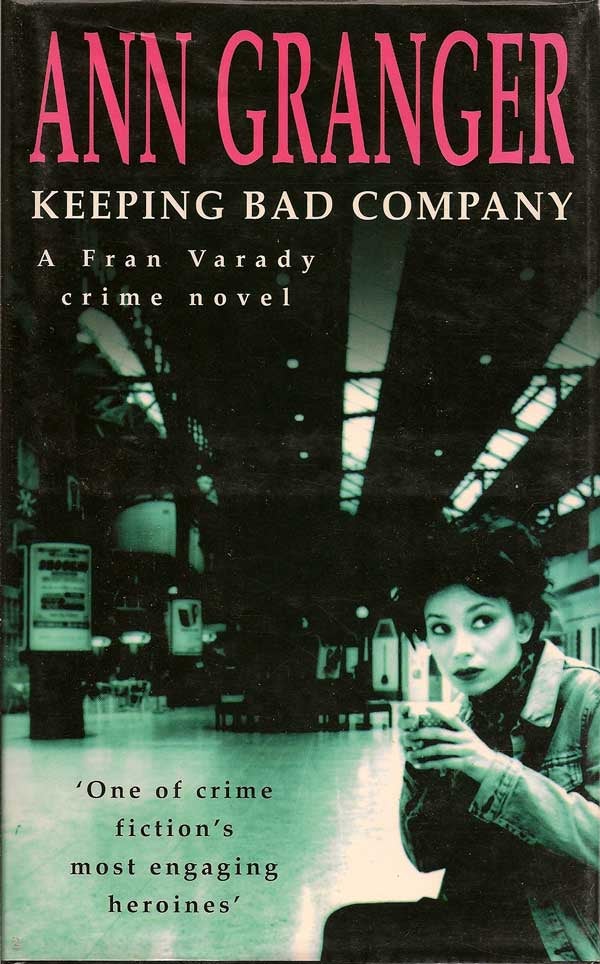
People Matter: Keeping Bad Company
While waiting at a station she buys a cup of coffee for a homeless man, Albie, who tells her he witnessed a kidnapping. She believes him, although no one else seems to, and when she decides to look more closely into the matter, Albie winds up dead. Fran senses she may be in danger herself as she meets kidnappers, ransom hunters, distressed parents, and uninterested police officers. She quickly learns that no one trusts anyone else. She particularly doesn’t trust men, and their violence and intimidation are treated almost casually.
She baldly asserts, “If you’re a young woman and live alone,
as I did, the risk of a stalker hanging around the place is always there. They
see you around the area, follow you home. Sometimes it gets no further than
that. They get bored and seek out other prey. Or they get frightened off.” It
is a depressing fact that she needs to know this information. “Noise is a
weapon. If you can’t do anything else, yell. It disorientates, frightens, and above
all, attracts outside attention.” We were all taught this as young women.
Her
politics are socialist-leaning, and she despises those who can see no further
than their comfortable lives. “It’s a fact that no matter how bad things are,
they can always get worse. Beggars can’t be choosers they say, and I bet ‘they’
are comfortably housed.” Being an artistic and creative type, her motivations
are less consumerist. They assume we all want the things our consumer society
reckons essential to health and happiness. But what about the ability to find
hope and happiness in little things?”
Her world is one of corner shops, basement flats, disused warehouses and greasy-spoon cafes. She refers to one of the pubs she frequents as “resolutely downmarket. That’s what its patrons like about it. Everywhere else around has been gentrified, yuppified or poncified. The term depends on whether you’re an estate agent or one of the Rose’s regulars.” Her language is generally straightforward with the occasional glimpse of imaginative prose.
This is an immediate environment and a likeable
central character, who gets caught up in criminal acts through no fault of her
own. There are seven books in the series of the Everywoman – I shall seek out
more.