Because they are endlessly entertaining. And absolutely bonkers.
Showing posts with label creativity. Show all posts
Friday, 12 June 2026
Thursday, 8 January 2026
Shield Design
As stated in my previous post, we kicked off the new year with a Medieval-themed party (as you do) in which one of the challenges was shield design.
Him Outdoors and I provided the shields (we had made them from cardboard and spray-painted them in background colours) and various craft supplies, and the contestants had to make up a shield. I had previously sent out a link about basic heraldry in case anyone wanted to hone up on knowledge; there were points for the design itself and the acompanying wiffle-waffle. Here are some examples.
![]() |
| The Luminosity with shield |
The Luminosity created this powerful depiction of her family crest with swirly designs, ribbons and sheep. It's bright, expressive, and with personal significance. The next design to feature was also yellow and made reference to the holder's title or family name, but maybe not so much of a crest.
Although hard to see in this image, the design on the right features hand-drawn crucifixes, two upright and two upside down, intermingled with smiley faces, to highlight the ridiculous attempt to force religious conformity onto the medieval peasant class who were just trying to get on with their daily lives. The one on the right scored highly with the judges as it indulges the inner child and playfulness through smiley faces, googly eyes and cartoon animal characters. The use of the ribbon, pom-poms and jingly bells also adds to the tactile nature and auditory sense of fun.
Here we have the importance of description. The very simple design - a single white ribbon and two butterflies belies a complex explanation of the shield representing two parts of the bearer's life: England (the faded quarter from the past) and Australia (the more vibrant three-quarter section at the top in the present). The white ribbon represents a contrail in a blue sky as the transportation occured, and the butterflies indicate the physical transformation.
The explanation for this one is from someone who had clearly read the basic heraldry guidelines so I shall let them tell it.
A background of GULES (red) symbolising the fiery nature of the bearer.
An ORDINARY CHEVRON of SABLE almost equally bisecting the shield indicates affinity with justice and equality.
Une abeille OR et SABLE (the gold/ black bee) RAMPANT surrounded by two bees GUARDANT indicates both a watchful nature and teamwork quality.
Three charges of googly eyes SABLE and ARGENT speak to watchful yet playful characteristics.
Some challengers went with all the things that are important to them. Hence Purple Lady with images of romance, theatre, family, work, leisure activities and cats. Meanwhile others went with the 'white tears of Henry Cockington' in a design that was very much a single entendre.
![]() |
| Purple Lady with shield |
![]() |
| Henry Cockington |
There were blatant appeals to judges with the combination of Liverpool and Burnley football club crests, and a Shakespearean pun, 'a plague on both your horses', involving unicorn heads and coronavirus bobbles. Also (pictured in the group image but no individual photo) was a delightful interpretation of chaos (cats; eyeballs; jingly bells) and the unknown (blank space) summing up that bearer's identity.
![]() |
| Original Gravity with a blatant appeal to the judges |
![]() |
| A Plague on Both Your Horses |
And the winner was... Gindelle with her thoughtful piece reflecting growth (a tree image), transformation (an origami butterly) and the family foundation of her last name in a replica Lego block. Congratulations to all for the (various levels of) effort, fun and creativity!
![]() |
| Gindelle with the winning shield design |
Labels:
cats,
craft,
creativity,
design,
Gindelle,
heraldry,
New Year's Day party,
Original Gravity,
Purple Lady,
shield,
The Luminosity
Friday, 6 December 2024
Friday Five: Books Read in November (Yes, it's actually just four)
- The Scent Keeper by Erica Bauermeister (St Martin's Griffin) - This novel blends whimsy, magic realism, coming-of-age self-discovery, fairy tale archetypes and young adult fiction. Emmeline is raised by her father, alone on an island which can only be reached once a month when the tide is right. He has a machine, which can capture scents and print them onto slips of paper, like a Polaroid camera for images. He puts these scent papers into small glass bottles, stoppered with different-coloured wax. The scents do not last forever, and he begins to burn them individually to release memories, until a tragic accident forces Emmeline to leave the island and return to the mainland. Emmeline’s father has educated her through stories, foraging and fishing, sitting her down for a lesson every morning. There is an element of Miranda and Prospero, and her awakening to the brave new world enables the author to indulge in the trope of an ‘alien identity’ discovering and describing technology. She learns to read people through their scent, like a dog does. When rescued and taken to school, Emmeline is bullied for being different and for her intense sense of smell and her natural style – she doesn’t understand falsity and masking. Later, her mother, Victoria takes her to a make-up counter and buys all the products after the ‘transformation’. Emmeline goes to work for her mother creating scents to make people spend money. Often she omits a significant element, to force the body to fill that absence. "And what if that missing thing could make a person need to buy the things around them?” Of course, the skill is used for capitalist gain, but the sentiment is true for art – visual, performance and written – the best leaves something for the audience to do; to provoke a response rather than telling them exactly how they should think and feel. Many aspects of the novel are unconvincing, and it is not enough to pass this off as magical realism when they relate to plot points. Neither is it satisfactory to suggest they don't matter as this is a coming-of-age young adult fairytale, with Emmeline learning to 'be her own person'. Who else would she be?
- In Memoiram by Alice Winn (Viking) - In Memoriam is reminiscent of Atonement and Testament of Youth as it covers the doomed generation of young men who went to war and never returned, either because they were killed or changed irrevocably. Also discernible are elements of Pat Barker’s Ghost Road novel, wherein, like the WWI poetry we all studied in school with the benefit of hindsight and distance, we can plot the way innocence, ideology and excitement turned to disgust, betrayal, anger and frustration. Our characters transform from schoolboys worried about their families and duty to wounded and embittered cynics whose promise was destroyed by a class system into which they had no input. And at its heart it is a love story between Gaunt and Ellwood, two young men coming of age in a time when homosexuality was still illegal. Winn writes in linear style, with sharp, clear sentences, avoiding excessive adjectives, but with a profoundly moving poetry. There are echoes of Blackadder Goes Forth in the trench talk, where there is resentment of the upper class automatically being made officers and promoted to captains, having authority over men much older and more experienced than them. Meanwhile the men are falling without class distinction in a horrifically mundane manner. “At nine, they went over the top. West’s head was shot off before they had gone two feet. Elwood paused to look at his brains. Pritchard had always said he didn’t have any, but there they were, grey and throbbing and clotted with blood.” The section set in a prisoner of war camp is almost a comic diversion. “It’s astonishing how well an English boarding school prepares one for prison.” All the prisoners are bored, chatty and trying to escape, while the guards are generally good-natured and long-suffering. In Memoriam is Alice Winn’s debut novel. It may not be an original topic, but it is excellently written. She writes captivatingly about things of which she can have no first-hand experience: life in the trenches, male sex, and English public schools with a ring of authenticity. I look forward to her next offering.
- Dancing Cockatoos and the Dead Man Test by Marlene Zuk (W.W. Norton & Company) - Subtitled, How Behaviour Evolves and Why It Matters, this book answers that question immediately. “If we assume that intelligence is predetermined, we are less likely to think interventions, say in the form of social programs to improve learning in children, will be effective. On the other hand, if we assume everything can be altered by our actions, we may blame the victim, as is sometimes seen in the suggestion that those with cancer or other serious diseases could have avoided their plight by diet or exercise, or that people can just think their way out of depression.” The nature/ nurture question is repeatedly addressed as a 'zombie idea' - one that keeps springing back to life no matter how many times it has been disproved. Most recently (in 2017) a New York Times article titled ‘The Unexamined Brutality of the Male Libido’ argued that we are simply stuck with brutish men who can't or won't examine their destructive sexuality because it's just basic male behaviour. The book also questions the theory of exceptionalism, which puts humans above other species and supposes that other species are intelligent or sophisticated the more they are like us. “It doesn’t make sense to simply pick on an animal, no matter how beloved, and try to rank it according to a scale that only works in a single dimension or on humancentric traits… In other words, dogs are good at things that make sense for dogs to be good at.” The idea of lizard brain is popular because it allows us to classify less-desirable behaviours and dismiss instincts as a holdover from the past. It is simple to understand, doesn't require complicated scientific explanations, and is completely untrue. What is true is that environment and genes interact to produce behaviour; as illustrated in a fairly devastating section on animals kept in captivity, or in the chapter on gender. This book is full of explanations, stories and science, and it is fascinating reading.
- Orphia and Eurydicius by Elsie John (Harper Collins) - In this adaptation of the Greek myth, the sex of Orpheus and Eurydice are switched, but it also concerns the story of a true love of equals without society's gender-ascribed roles. Orphia learns fighting from her brother (Apollo) and poetry from the muses; her poems make flowers bloom and waters move. As Calliope, the muse with responsibility for epic poetry, instructs, "No riches on earth compare to the arts. Tell me - what is it to feel, to express, to take delight, to see oneself reflected, to experience the stories of others?" Many of the stories Orphia learns are different from the male-centric myths that have been handed down: Hera, Medea, Atalanta and others all have greater agency. The gods use mortals as playthings and their assistance - like the advice of the Oracle - is to be treated with caution. Orphia plays games with Eurydicius and they converse as equals, as she notes, "He was gentle, and sweet; thoughtful and quietly kind. They were not the qualities that men prized, but I thought they were among the greatest qualities a man could have." When Eurydicius dies, Orphia uses her poetry as a challenge and a weapon in her desire to return to him, and when she goes to the Underworld she refuses to go gentle into that good night. "I will speak the two of us into legend, if I have to draw each letter from my own marrow. I will become poetry as I die." This is a beautiful retelling of a classic myth incorportaing poetry, creativity, unconventional love, and the courage of women who refuse to be silenced.
Friday, 10 April 2020
Friday Five: Easter Cross-Stitch
Everyone who knows me, knows that I have ideas and like to be creative. They also know that I never send things on time. I delivered one of these today, the rest will be late. Oh well, it's the though that counts, right? Happy Easter!
Labels:
creativity,
cross stitch,
Easter,
Friday Five,
ideas
Saturday, 28 March 2020
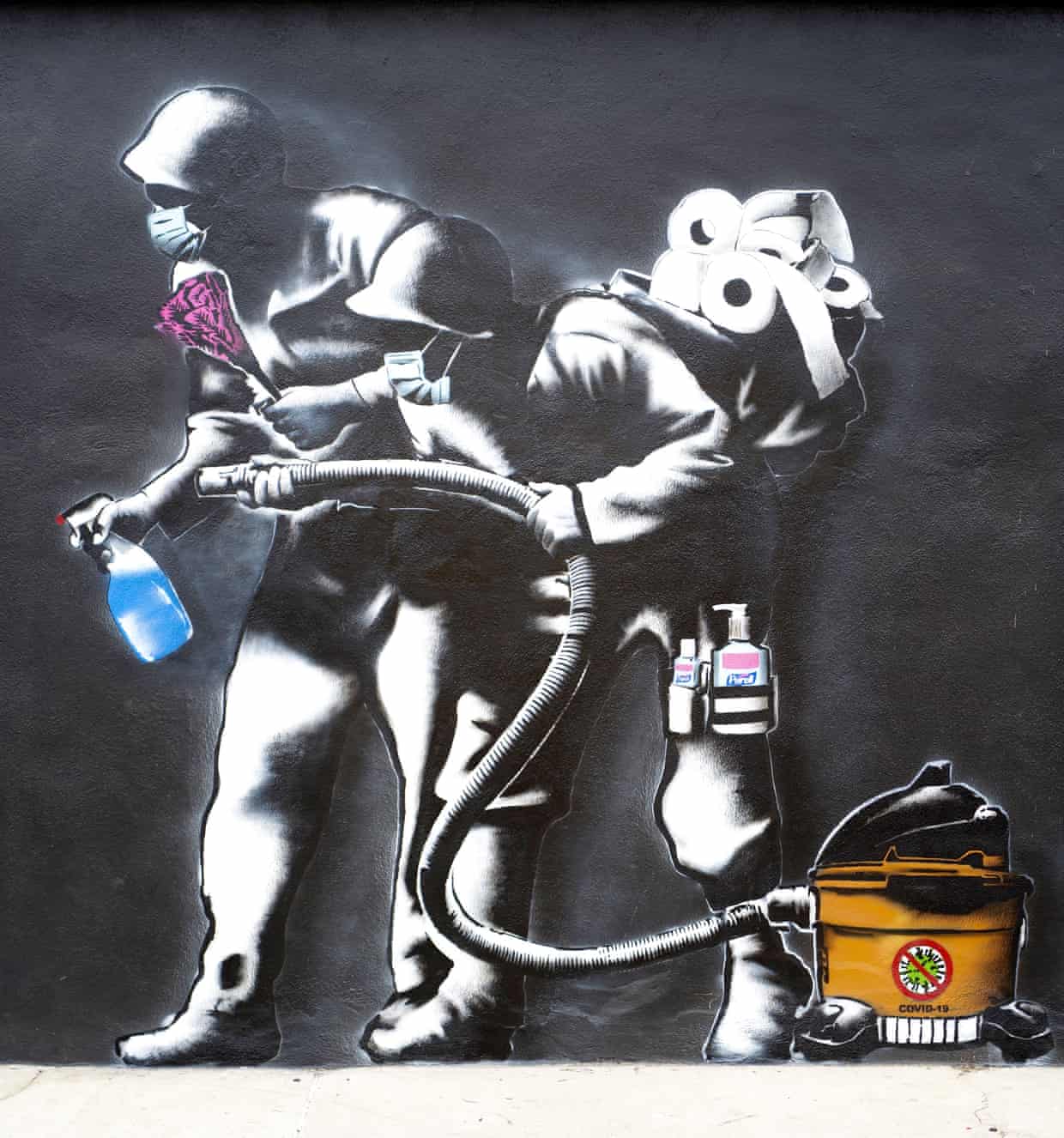
COVID-19: Under Pressure
![]() |
| Street art by @hijackart |
There are posts doing the rounds on social media of how this enforced isolation might be good for some of us. People are proposing that we could take this opportunity to create a new work or learn a new skill. I have seen suggestions that people could paint a picture, learn a language, master an instrument, take up horticulture, or improve their culinary skills. Several well-meaning people have asked if this is not the perfect time for me to write my second novel.
The short answer is 'no'.
My fist novel took me about 25 years to write. A lot of that was research, and a lot of it was reflection. To do this I need to feel safe and have a routine; an acknowledgment that if things don't go well, or if I unearth something painful (believe me, memories of death, bombs, muggings and other trauma are not things I deal with easily), I will be able to mentally and emotionally decompress in my chosen environment (a walk in the hills; a swim in the ocean; a pint or two in the pub with my friends). This is clearly not the case at present.
I cannot speak for everyone - there are far too many people purporting to do that at present for my liking - so I shall speak only for myself. The current situation is causing me extreme anxiety. I cannot sleep. I am having frequent panic attacks which cause shortness of breath and nausea. I have a constant headache and am permanently fatigued.
I worry. I worry about my health and that of my husband (who, performing an essential service, must leave the house every day). I worry about my family - none of them live in the same country as me and I'm not sure when (and in some cases if) I will see them again. I worry about my friends, in different countries around the world with different governments taking different precautionary measures (or not, in some cases). I worry about my community - if I don't support it, will there be one when all this is over? I worry about losing my job. If there is no community and there is no work for me to do, how can I continue; how can I support anyone else? I worry that I am not being a good enough wife, daughter, sister, friend, neighbour, citizen, employee... when did this turn into a competition?
I try not to think too deeply about anything because I will cry, so I am currently existing on a superficial level, or a submerged one. I do not feel safe. I do not feel secure. I know I am lucky to have a house with a garden and access to fresh air and open spaces. I know others are in a far worse position than me. Anyone who has ever suffered with depression will tell you that this doesn't necessarily help. It makes me feel selfish for having these concerns, and that makes me feel like a bad person. It's a very dark vortex into which I do not want to be drawn.
So, no, do not expect anything creative from me at this time. My imagination is not in a good space. There is too much pressure to perform - and no good performances come from fear.
Friday, 2 August 2013
Friday Five: Internet Individuality
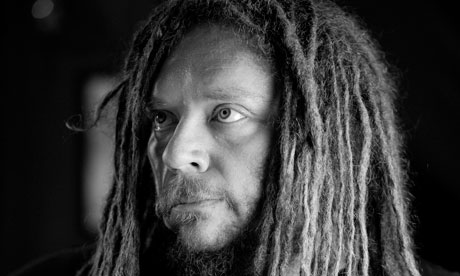
Today's post is brought to you by 'You Are Not A Gadget: A Manifesto' by Jaron Lanier. I have just finished reading this book and my mind is reeling. Lanier is a respected Internet visionary, a gifted computer scientist, and an expert on virtual reality. He is disappointed that the limitless power of the Internet has not been used to reach its exciting potential and has instead been harnessed by homogenous conglomerates or, as he refers to them, 'lords of the clouds'.
Rather than experimentation and creativity, he fears the hive mindset of Internet users encourages mediocrity and degrades personal interaction. But he is not entirely negative - he is a product of the e-generation himself. He suggests some ways we can individually encourage original thought and personality as an antidote to endless mashups of other people's popular culture.
5 Ways you can 'be a person instead of a source of fragments to be exploited by others':
| Jaron Lanier |
Rather than experimentation and creativity, he fears the hive mindset of Internet users encourages mediocrity and degrades personal interaction. But he is not entirely negative - he is a product of the e-generation himself. He suggests some ways we can individually encourage original thought and personality as an antidote to endless mashups of other people's popular culture.
5 Ways you can 'be a person instead of a source of fragments to be exploited by others':
- 'Don't post anonymously unless you really might be in danger.'
- 'If you put effort into Wikipedia articles, put even more effort into using your personal voice and expression outside of the wiki to help attract people who don't yet realise that they are interested in the topics you contributed to.'
- 'Create a website that expresses something about who you are that won't fit into the template available to you on a social networking site.'
- 'Write a blog post that took weeks of reflection before you heard the inner voice that needed to come out.'
- 'Innovate in order to find a way to describe your internal state instead of trivial external events, to avoid the creeping danger of believing that objectively described events define you, as they would define a machine.'
Subscribe to:
Posts (Atom)