- The Scent Keeper by Erica Bauermeister (St Martin's Griffin) - This novel blends whimsy, magic realism, coming-of-age self-discovery, fairy tale archetypes and young adult fiction. Emmeline is raised by her father, alone on an island which can only be reached once a month when the tide is right. He has a machine, which can capture scents and print them onto slips of paper, like a Polaroid camera for images. He puts these scent papers into small glass bottles, stoppered with different-coloured wax. The scents do not last forever, and he begins to burn them individually to release memories, until a tragic accident forces Emmeline to leave the island and return to the mainland. Emmeline’s father has educated her through stories, foraging and fishing, sitting her down for a lesson every morning. There is an element of Miranda and Prospero, and her awakening to the brave new world enables the author to indulge in the trope of an ‘alien identity’ discovering and describing technology. She learns to read people through their scent, like a dog does. When rescued and taken to school, Emmeline is bullied for being different and for her intense sense of smell and her natural style – she doesn’t understand falsity and masking. Later, her mother, Victoria takes her to a make-up counter and buys all the products after the ‘transformation’. Emmeline goes to work for her mother creating scents to make people spend money. Often she omits a significant element, to force the body to fill that absence. "And what if that missing thing could make a person need to buy the things around them?” Of course, the skill is used for capitalist gain, but the sentiment is true for art – visual, performance and written – the best leaves something for the audience to do; to provoke a response rather than telling them exactly how they should think and feel. Many aspects of the novel are unconvincing, and it is not enough to pass this off as magical realism when they relate to plot points. Neither is it satisfactory to suggest they don't matter as this is a coming-of-age young adult fairytale, with Emmeline learning to 'be her own person'. Who else would she be?
- In Memoiram by Alice Winn (Viking) - In Memoriam is reminiscent of Atonement and Testament of Youth as it covers the doomed generation of young men who went to war and never returned, either because they were killed or changed irrevocably. Also discernible are elements of Pat Barker’s Ghost Road novel, wherein, like the WWI poetry we all studied in school with the benefit of hindsight and distance, we can plot the way innocence, ideology and excitement turned to disgust, betrayal, anger and frustration. Our characters transform from schoolboys worried about their families and duty to wounded and embittered cynics whose promise was destroyed by a class system into which they had no input. And at its heart it is a love story between Gaunt and Ellwood, two young men coming of age in a time when homosexuality was still illegal. Winn writes in linear style, with sharp, clear sentences, avoiding excessive adjectives, but with a profoundly moving poetry. There are echoes of Blackadder Goes Forth in the trench talk, where there is resentment of the upper class automatically being made officers and promoted to captains, having authority over men much older and more experienced than them. Meanwhile the men are falling without class distinction in a horrifically mundane manner. “At nine, they went over the top. West’s head was shot off before they had gone two feet. Elwood paused to look at his brains. Pritchard had always said he didn’t have any, but there they were, grey and throbbing and clotted with blood.” The section set in a prisoner of war camp is almost a comic diversion. “It’s astonishing how well an English boarding school prepares one for prison.” All the prisoners are bored, chatty and trying to escape, while the guards are generally good-natured and long-suffering. In Memoriam is Alice Winn’s debut novel. It may not be an original topic, but it is excellently written. She writes captivatingly about things of which she can have no first-hand experience: life in the trenches, male sex, and English public schools with a ring of authenticity. I look forward to her next offering.
- Dancing Cockatoos and the Dead Man Test by Marlene Zuk (W.W. Norton & Company) - Subtitled, How Behaviour Evolves and Why It Matters, this book answers that question immediately. “If we assume that intelligence is predetermined, we are less likely to think interventions, say in the form of social programs to improve learning in children, will be effective. On the other hand, if we assume everything can be altered by our actions, we may blame the victim, as is sometimes seen in the suggestion that those with cancer or other serious diseases could have avoided their plight by diet or exercise, or that people can just think their way out of depression.” The nature/ nurture question is repeatedly addressed as a 'zombie idea' - one that keeps springing back to life no matter how many times it has been disproved. Most recently (in 2017) a New York Times article titled ‘The Unexamined Brutality of the Male Libido’ argued that we are simply stuck with brutish men who can't or won't examine their destructive sexuality because it's just basic male behaviour. The book also questions the theory of exceptionalism, which puts humans above other species and supposes that other species are intelligent or sophisticated the more they are like us. “It doesn’t make sense to simply pick on an animal, no matter how beloved, and try to rank it according to a scale that only works in a single dimension or on humancentric traits… In other words, dogs are good at things that make sense for dogs to be good at.” The idea of lizard brain is popular because it allows us to classify less-desirable behaviours and dismiss instincts as a holdover from the past. It is simple to understand, doesn't require complicated scientific explanations, and is completely untrue. What is true is that environment and genes interact to produce behaviour; as illustrated in a fairly devastating section on animals kept in captivity, or in the chapter on gender. This book is full of explanations, stories and science, and it is fascinating reading.
- Orphia and Eurydicius by Elsie John (Harper Collins) - In this adaptation of the Greek myth, the sex of Orpheus and Eurydice are switched, but it also concerns the story of a true love of equals without society's gender-ascribed roles. Orphia learns fighting from her brother (Apollo) and poetry from the muses; her poems make flowers bloom and waters move. As Calliope, the muse with responsibility for epic poetry, instructs, "No riches on earth compare to the arts. Tell me - what is it to feel, to express, to take delight, to see oneself reflected, to experience the stories of others?" Many of the stories Orphia learns are different from the male-centric myths that have been handed down: Hera, Medea, Atalanta and others all have greater agency. The gods use mortals as playthings and their assistance - like the advice of the Oracle - is to be treated with caution. Orphia plays games with Eurydicius and they converse as equals, as she notes, "He was gentle, and sweet; thoughtful and quietly kind. They were not the qualities that men prized, but I thought they were among the greatest qualities a man could have." When Eurydicius dies, Orphia uses her poetry as a challenge and a weapon in her desire to return to him, and when she goes to the Underworld she refuses to go gentle into that good night. "I will speak the two of us into legend, if I have to draw each letter from my own marrow. I will become poetry as I die." This is a beautiful retelling of a classic myth incorportaing poetry, creativity, unconventional love, and the courage of women who refuse to be silenced.
Friday, 6 December 2024
Friday Five: Books Read in November (Yes, it's actually just four)
Tuesday, 23 March 2021
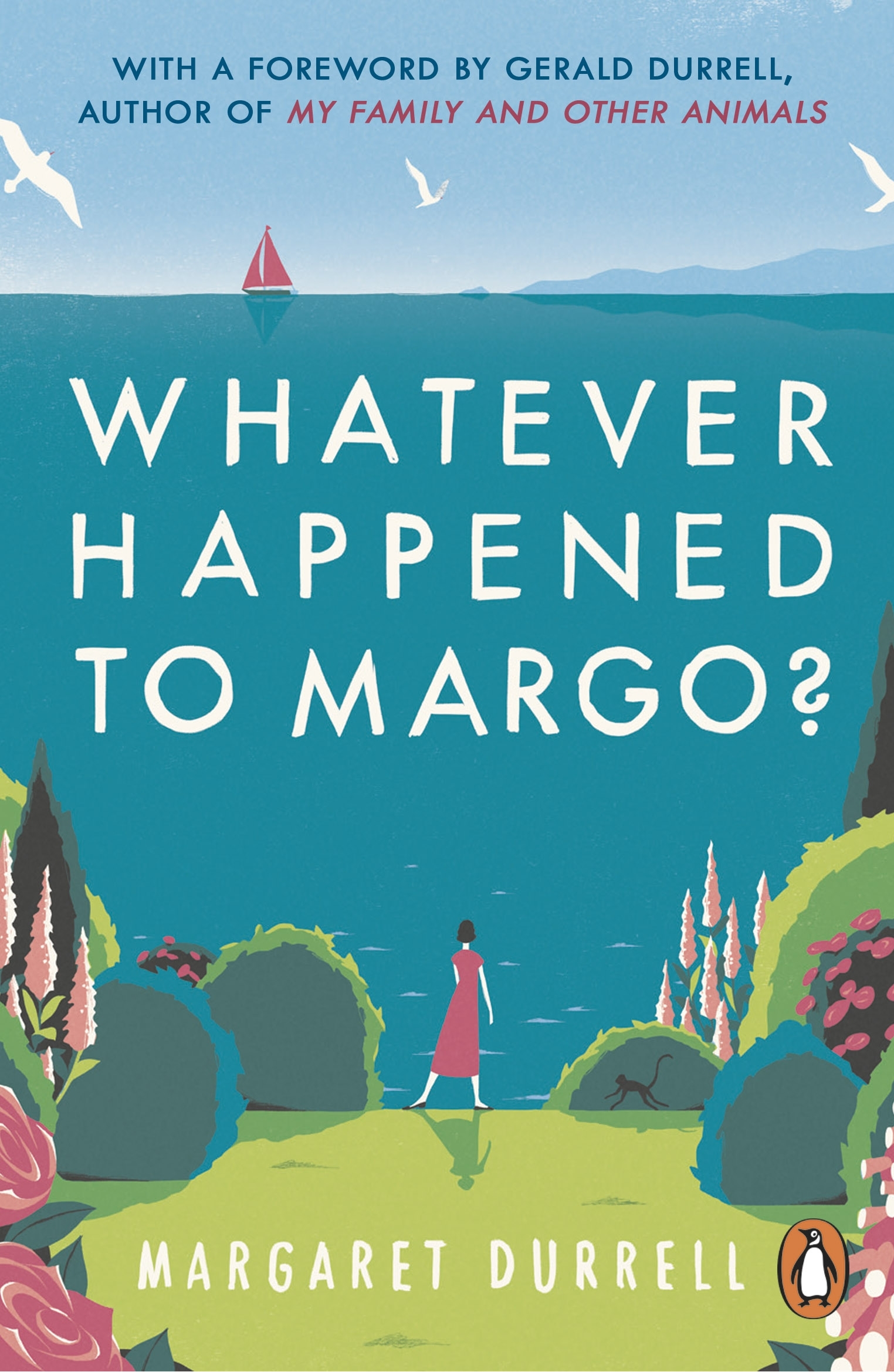
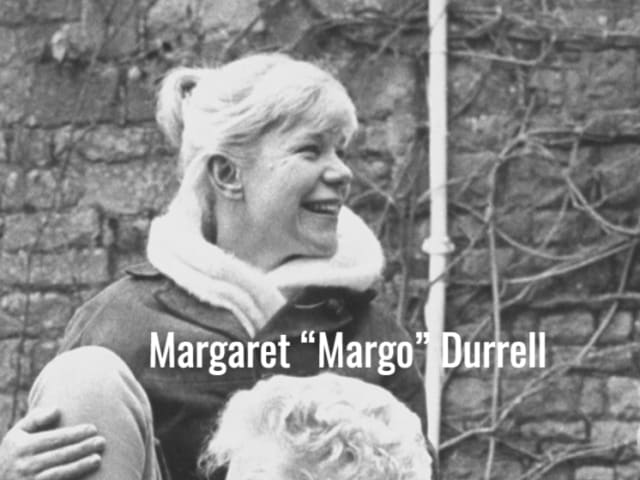
Bigotry in Bournemoth: Whatever Happened to Margo?
After prompting
from an aunt, Margo decides to buy a property across the street from her
mother’s house, with money which was “a legacy from my father – dwindled
somewhat”. She is ‘respectable’ and ‘middle-class’ with a divorce and two male
children to her name, but there is no evidence of actual work. Her plan to take
in a series of lodgers is a decent one especially since (one suspects) she has
no employable talents.
It is 1947 and
attitudes were different then, but the language and assumptions about her
lodgers are quite ugly when related to modern readers. Edward Feather is a
flamboyant red-bearded painter, leading to words like ‘nonce’ and ‘pansy’ being
bandied about and smirks about men who wear tight trousers. Harriet is an
eccentric old lady who accuses others of stealing her belongings while removing
all the lightbulbs in the public spaces; when the residents gather over
psychology books to decide what is wrong with her, at first they think she is
“on the change”, a theory they quickly discount as “she’s too old for such
capers”. Nelson is an obnoxious Billy Bunter type schoolboy (whom we are
supposed to like for some inexplicable reason) and his harassed mother, who
have fallen on hard times as their father/husband is in prison serving time for
assault of her mother; he broke a plate over her head and she had to have
twenty stitches.
Other residents
include a man who abuses his wife – no one does anything until they dislike the
noise – There is also Jane, a spinster, who is mercilessly ridiculed for being
unattractive; a man who comes into money, which makes him a catch; a pair of
musicians, one of whom Margo falls in love with; two glamorous nurses; and a
bloke trying to get a job and a partner with equally limited success – he has a
relationship with an Eastern European woman whom Margo, when she discovers she
is transgender, reports to the police and a psychiatrist. All the women are in
competition for men’s attentions, and the men are all expected to drool over
attractive young females, while making fools of older ones. “It was surprising
what a compliment from another man could do, lifting the drabbest of married
women almost to prettiness.”
In a nod to her
brother’s writings on animals, there are some in the house, including a dog (a
present from her brother, Leslie) that cocks a leg over anything it chooses,
including the baby’s pram. Gerald himself brings a python and a troop of
monkeys for her to look after, and of course they escape with hilarious
consequences. Meanwhile, the insufferable Nelson breeds mice to sell, causing
Margo to display one of her many peculiar views as she remarks that there are
“white mice breeding in the back lavatory like Communist China”.
Wednesday, 16 September 2020
Goodbye to the Greek Island: The Garden of the Gods
These are halcyon days as the children have outstanding freedom in their
unaccompanied travels: Gerry potters about in his boat; Margo swans off to the
mainland; Leslie wanders the countryside with guns; Larry invites complete strangers
to come and stay at their villa.
Gerald Durrell has a highly evocative way of writing that makes the
countryside sound divine, and there are Homeric epithets in his descriptions of
the sea. When he writes of the approaching seasons, his naturalist’s eye
combines with his rustic poeticism and, as always, his main preoccupation is
zoological. “For me, spring was one of the best times, for all the animal life
of the island was astir and the air full of hope.”
He is keen to amass more creatures for his ever-growing menagerie, but
he knows that certain members the family (particularly Larry), do not like his
animal collection so he tries to get Mother and Margo on side, and they often
feel sorry for abandoned animals. One of the peasants, wanting to get rid of unwanted
puppies, buries them alive, by which fact Mother is understandably outraged.
She exclaims, “These peasants! I can’t understand how they can be so cruel.”
The Greeks are examined almost as another species, which can be uncomfortably
racist to a modern reader. Margo has many affairs of the heart, but always with
Greeks rather than English boys (friends of Larry’s), saying of the local
peasant boys, “They’re so handsome and so sweet. They all sing so well. They have
such nice manners. They play the guitar. Give me one of them instead of an
Englishman any day.” On the subject of changing attitudes with time, the family
are remarkably accepting of potential paedophilia, commenting of a guest, Colonel
Velvit, “Since his retirement his one interest in life was the local Scout
troop and, while there were those unkind enough to say that his interest in
Scouts was not entirely altruistic, he worked hard and had certainly never yet
been caught.”
Mother accepts all the guests and offers outstanding hospitality, even
to horrible or boring people, warning Margo, “We’ve never done anything nasty
to anyone that’s stayed with us – I mean, except as a joke or by accident – and
we’re not going to start.” One visitor friend of Larry’s believes he can
levitate and keeps trying, invariably falling through the trellis
Gerry embellishes stories for comic effect, and sees them through a boy’s
eyes, but some of the details are harrowing, such as when a Turk visits them (at
Margo’s invitation) with three wives, aiming to make Margo his fourth.
They live in a weird limbo land without news of the outside world
because, “we did not have the dubious benefits of a wireless and so, for the
most part, lived in a state of blissful ignorance.” Part of this lack of ‘outside
interference’ means they have to rely upon themselves for entertainment, and
they do so with spectacular results. Gerry’s descriptions of the food, drink
and company at these events are exquisite, and his depictions of a bygone era
are sumptuous and appealing. He paints pictures with words that inspired a
generation to travel and take an interest in nature. Some of the attitudes are
outdated, but if he instils a sense of conservationism, they can be excused as
the results of age. It’s tough to farewell these tales of childhood on an
island paradise.
Tuesday, 11 August 2020
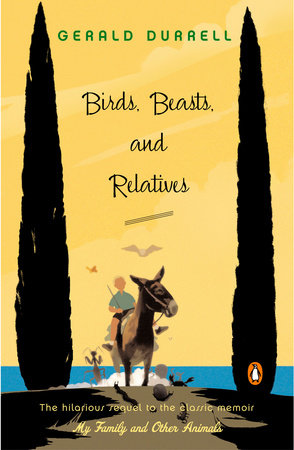
Childhood entitlement: Birds, Beasts and Relatives
Tuesday, 9 June 2020
Idyllic Island Life: My Family and Other Animals
The author evokes a wonderful feeling of a time and place, which could never be replicated. Because this is the memory of a child, it may never even have existed, but, whether returning to this book or encountering it for the first time, the reader feels the comfort of coming home.
Monday, 28 August 2017
Laughing all the way to the Banksy?
The Paddock, Federation Square (the dodgy car park, behind the Fed Square car park). Melbourne
7 October 2016 - 31 January 2017
Some time ago, I found myself in Melbourne, with a Banksy exhibition on my doorstep. I've always been intrigued by Banksy and his art. And, yes, I do think it is art, even though it is stencil and spray-paint and not always even by him. I find his ideas interesting, and warm to the way he takes the personal and makes it political. I know it has been described as crude and simplistic, but I find it inspirational in its clarity. It is direct and accessible and refutes the notion that art is for the elite. It is self-referential and deprecating in equal measure, and literally brings art out of auction houses and into the streets.
![]() |
| I Can't Believe You Morons Actually Buy This Shit (2007) |
![]() |
| There is no exception to the rule that everyone thinks they're an exception to the rule - Banksy |
![]() |
| Have a Nice Day |
![]() |
| Rude Copper |
Lazarides explains that with the ability and skill to exercise a wide palette of contrasting techniques and mediums, these inside works retained the same motifs and ideas that were presented in the outside street pieces. The difference, however, was that they were created with the intention of being viewed within the context of an exhibition environment. While an outside street piece was always created to be transient - there one minute and gone the next - Banksy's inside paintings instead required the scrutiny of a longer view. These artworks would instead potentially be admired for several lifetimes.
![]() |
| Girl with Balloon (gold) |
![]() |
| The Burger King Kid |
"It is not my place to give you my opinion on what these pieces are about. That privilege lies with the artist and I'm pretty sure that isn't something he'd ever do. You as a viewer have as valid an opinion on these works as either me or Banksy. They mean whatever you, the viewer, think they mean - there is no right or wrong." - Steve Lazarides
![]() |
| Flower Thrower (on tarpaulin) |
![]() |
| Dorothy Police Search |
![]() |
| Smiley Grim Reaper |
![]() |
| Smiley Angel Policeman |
![]() |
| Festival |
![]() |
| Barcode Leopard |
![]() |
| Very Little Helps |
![]() |
| Consumer Jesus |
![]() |
| Barcode Shark |
![]() |
| Turf War |
Bullet-proof David; Suicide Bomber (2006)
|

![]() |
| Warning Sign |
![]() |
| Bombing Middle England and Weston-Super-Mare |
![]() |
| La American Flag |
![]() |
| Kids on Guns Hill |
![]() |
| Pooh Bear Trap |
"Imagine a city where graffiti wasn't illegal, a city where everybody could draw whatever they liked. Where every street was awash with a million colours and little phrases. Where standing at a bus stop was never boring. A city that felt like a party where everyone was invited, not just the estate agents and barons of big business. Imagine a city like that and stop leaning against the wall - it's wet." - Banksy


Tuesday, 6 September 2016
Getting to Know 'The Other'
Friday, 20 September 2013
Friday Five: Ugly Animals
![]() |
| Proboscis monkey we saw in Borneo |
The list was compiled by the Ugly Animals Preservation Society which considers it unfair that fluffy pandas and cuddly polar bears get all the attention when other equally endangered animals are ignored because they aren’t so photogenic. This is a worthy cause, but I question their choices (although the blobfish, which tops their list, really is repulsive-looking). So I have made up my own list, and it’s true that fur generally wins in the cute race.
5 Ugly Animals (in my opinon):
- Human babies – come on; what’s attractive about a bright red bald screaming thing?
- Warthogs – need I say more?
- Those hairless dogs with whiskers (Chinese crested) – bald cats are none too attractive either, to be fair.
- Naked mole rats – they are extremely ugly but highly desirable for scientists since it has been discovered that they don’t get cancer.
- Cockroaches – so revolting they may be the only animal I would willingly kill if I could, although they are practically indestructible. And their larvae are repulsive too.


.jpg)