Showing posts with label capitalism. Show all posts

Friday, 20 March 2026

Friday Five: Cross-stitch Monolpoly

I used to love Monopoly. I played it with my best friend and the game went on for weeks. We made up characters for all the locations (sleazy landlord; beautiful heiress; debonair man-about-town; brilliant scientist; that sort of thing) and placed them on levels depending on how often a player visited that square - the winner was the one who got to level 10 (on a bookcase and other furniture in my firend's family room). The game was not about the players but about the locations themselves. I had the American version and she had the British version. We made our own of our home town - of course the streets on which we lived had prime position.

When we played it as children with my father, we let each other off the rent if we landed on a property one of us 'owned', but we always made him pay. And we also gave each other interest free loans if we happened to land on his and couldn't afford to pay up (hence being eliminated from the game). It was him rather than us who perpetrated the board flip complaining, "How on earth did I raise such socialist children?"

In light of all that, I enjoyed this cross stitch kit from Spruce Craft, although I did change the words on the first and last designs. 

Tuesday, 16 August 2022

My Newest Favourite Thing: Fiona Hall's Wrong Way Time


I have seen the works of Fiona Hall before. I think she is innovative and creative with an ability to execute her ideas in an engaging manner. In 2015 her exhibition Wrong Way Time attracted global attention at the Venice Biennale, and the following year I was lucky enough to see it at the National Gallery of Australia, complemented by a collection of Hall's works mainly from the NGA collection.

In Wrong Way Time, Fiona Hall brings together hundreds of elements, each embedded with layers of meaning. Together, the works focus powerfully on the intersecting themes of global conflict, world finances and the environment, which Hall perceives as a "minefield of madness, badness and sadness in equal measure."

Sasha Grishin wrote in The Canberra Times, "The exhibition's 800 items are presented within a darkened space, with walls painted black, as part of a deeply immersive installation. It is a troubling, dark, gothic experience, where the artist appears as a shaman who, through alchemy, transforms the materials drawn from a commonly experienced reality into mystical and wondrous creations. Wall-pieces create an outer boundary and vitrines, which are set up as wunderkammer-like cases or cabinets of curiosities, frame the central space that is occupied by the installation All the King's men."


This installation includes twenty sculptures, knitted out of shredded camouflage fabric from military uniforms of various countries. Ghostly vestigial bodies hang from oversized disfigured heads, forming a disturbing group that represents the foot-soldiers who are casualties of conflict regardless of nationality. Teeth, bones, horns and found objects adorn the mask-like heads and their spectral skeletal bodies. 

According to curator of the NGA, Leigh Robb, "It is an exemplary manifestation of Hall's maverick powers of material transformation and is the culmination of decades of conceptual and material investigation... These hollow people of war and conflict represent the many who have fallen and those who are yet to fall in the name of nationhood. Fiona Hall has shaped the course of Australian art history. Her enduring vision will help us to understand ourselves, each other and these uncertain times."

Sasha Grishin continues, "A major artistic strategy in Hall's repertoire is that of 'bricolage', where the artist improvises with the materials at hand. It is a sort of DIY approach to art making, where the artist will take aluminium sardine and fish tins, US dollar bills, as well as other foreign banknotes, old clocks, model aeroplanes and ships, damaged books, a carburettor, car light and radiator hose, light switches, driftwood, pool balls, mobile phones, camouflage military garments, deer teeth, a zebra hoof, credit cards, bones and horns, together with coal, bread, perfume bottles and living spiders and employs these to create alternative realities. The French term 'bricolgae' comes from the verb 'bricoler' (to tinker) and in some ways this characterises this artist's method of work."


In Tender she slices up US dollar bills to become the threads out of which to build beautifully designed and realised bird's nests. The banknotes are woven into an 86-piece installation accurately replicating the nests of extinct birds from areas logged by American interests. The nests are now bird-less, silent and deserted. The title itself plays with an array of associations from 'legal tender' to emotional tenderness. 

To make Tender, Hall paid face value for thousands of US dollars and sliced them up to weave the nests. As the US dollar is the most valued currency in Third World countries, this work suggests people hunting for the dollar like a bird scavenging for materials to build its nest. The artists is also commenting on one of the prices paid for capitalism - the destruction of the environment. 

Speaking about Tender in 2006, Fiona Hall said, "I knew that shredding the American dollar was for me conceptually an act of revenge for the sorry state our world is in. I don't mean to direct my wrath towards that to the United States alone, but it's the inevitability of the globalised world that we live in that the environment is under enormous pressure. Socially and globally suddenly we are aware of that in a way that we weren't five years ago when I was still making that work.

"It's amazing how quickly the tide has changed. The power of the greenback has really faded in the last few years. Now the greenback suddenly has perhaps come to represent a world and a system that is foundering; a system that used to be watertight and isn't any longer. Now with the financial downturn globally and with all the other political events of the last few years that have changed the idea of America as being a figurehead nation for the rest of the world to aspire to - all of that has changed in the minds of so many of us and I think that our regard of the American dollar in that context is different now."

The work explores the complex relationship between the natural world and human systems of value, trade and exchange. Hall combines the empirical knowledge of a scientist working in the natural sciences, the creative associative imagination of the artist, together with an obsessive and manual dexterity and technical precision.


Another example of her work combining the natural world with capitalism is Leaf Litter (1999-2003) in which paper money or bank notes are used as canvases for delicate x-ray-like paintings of leaves. While money is the bottom line in our contemporary economy and overrides crucial environmental concerns, plants are often the raw material for generating income (and money, made from paper, is also produced from plants). Fiona Hall's witty and elegant work captures this perfectly.


Also adding to the Venice exhibition is the earlier work, Paradisus terrestris (1989-90), made from sardine tins and aluminium cans over a fifteen year period. These otherwise discarded materials have been transformed into beautiful objects as each sardine tin has been wound down to reveal within an embossed depiction of the human form. At the top of the tin grows botanically correct representations of flora; the plant and the body interconnected in form. The connection we as humans have with our natural world is emphasised through ideas of fertility and reproduction, growth and natural cycles.

Holdfast (Macrosystis angustifolia; giant kelp)

As seen in Holdfast (Macrosystis angustifolia; giant kelp), part of the object emulates the natural and jagged textures of foliage, seen branching outwards, growing from the unraveling tin can. The text imprinted on the tin is a jarring reminder of the artificiality of the sculpture.

In a similar vein, endangered marine species have been hand-carved out of single sardine tins and each painted with maritime signal flags to comprise the work, Fleet

Fleet
Vaporised

I loved the way many of the exhibitions were displayed as items in curiosity cabinets. These cabinets of curiosities (wunderkammer) originated in Renaissance Europe as a way of cataloguing the world (or communicating one version of it). Glass cabinets also recall coffins and embalmed corpses; captured forms that we have killed so we can study. It creates a sombre atmosphere, in keeping with the subject matter. In one case (Vaporised) sits a collection of small glass perfume bottles on which are painted skulls to represent disappeared Tamils in Sri Lanka. Fiona Hall writes,
"The world is a very curious place. It's an amazing place and it's filled with curious things in the best sense of the word. And that seems to be accentuated by the way that objects have been displayed in cabinets; an innocent idea that you could actually put all these things in a museum display and you could comprehend the world. In a sense the museum cabinet makes the world somehow more incomprehensible rather than more comprehensible because you've just taken little fragments of it and conveniently left aside the context. And I find that curious as well; the implications of what's not in the cabinet; that are pointed out because of their absence; because of what has been put in the cabinet."  

I also really enjoyed the section of the exhibition, Crust, in which a series of small sculptures carved from baked bread installed on an open atlas represent various tragedies - environmental, cultural and militaristic - that occurred in the region on which it sits. One bread carving is of intricate barbed wire; another, an exploded village on a map of Syria, with tiny bricks of bread strewn across it. Dr Deborah Hart, senior curator at the National Gallery describes the sculpture as, "one of the great miracles of the show that made it through customs. Even Fiona was quite amazed that these had arrived in tact."


The exhibition investigates global politics, world finances and the environment. Other areas of interest for Hall include post-colonial issues, the relationship between culture and nature and the human condition. Hart describes Wrong Way Time as a "very dense exhibition" as it involves works made from an assortment of media including bread, banknotes, cork, aluminium and cuckoo clocks. These curious configurations speak deeply of Hall's practice, which continues to transcend fluidly without restriction.

The artist's choice of materials is never arbitrary, nor are the newly created forms. The large, dramatic wall-piece, Manuhiri (Travellers), looks from a distance like a collection of bones in the form of a strange organic installation. On closer inspection it turns out to be made from driftwood, arranged in a loose mandorla-like pattern.

The artist explains that she collected the driftwood from a beach at Awanui on New Zealand's East Cape, where the Waiapu River flows into the sea. Over-farming has led to wide-spread erosion and the trees have fallen and been swept out to sea, while the waves and tide have returned them to the shore in the form of driftwood. Manuhiri is like a shrine or graveyard of the forest, or in the artist's words, these bits of driftwood appear like "travellers from a former forest life reshaped by the ocean currents and now journeying to another life back in the world of the living."

Manuhiri (Travellers)

One of the strongest parts of the show is Kuka irititja (Animals from another time), where Hall collaborated with 12 women artists from the Tjanpi Desert Weavers of the Central and Western Desert region of Australia: Roma Butler, Stacia Lewis, Rene Nelson, Takiriya Tjawina Roberts, Angkaliya Nelson, Sandra Peterman, Yangi Yangi Fox, Molly Miller, Nyanu Watson, Rene Kulitja, Niningka Lewis and Mary Pan. These women have  long history of making animals woven from the local grasses and other materials from their country, and Fiona suggested they work together to weave a 40-piece installation representing a group of native animals, most of which are extinct in the wild

The work was created in June 2014 at an artist camp at a place near Pilakatilyuru (in the tri-state border region of Western Australia where it meets South Australia and the Northern Territory). The Tjanpi artists have a deep and intricate understanding of their country and were able to incorporate this knowledge into the woven pieces. They drew upon the interrelatedness of people, place and ancestral stories they call Tjukurpa (Dreaming), and from their intimate knowledge of hunting, tracks, and animal behaviour - including that of the predatory feral cat, the top killer of native Australian animals. Fiona as a non-Indigenous Australian brought her own thoughts about the impacts of colonisation on our environment and the animals that inhabit it.

Both the Tjanpi weavers and Fiona Hall share a mastery of weaving with various materials and this shared skill helped to inform the collaboration. The Tjanpi weavers harvested tjanpi (grass) and Fiona supplied Australian and British military printed camouflage fabric to incorporate into the works registering the damaging effects of British colonialisation including atomic testing in the 1950s and 60s on the fragile desert ecosystem and the lives of the Aboriginal people. The artists used each other’s fibres and also added in other found materials to create the final group of work. They are strange, whimsical creations that serve as a commentary on loss and absence.  


A woven helicopter seems incongruous until we read that Hall uses this to refer to the nuclear tests that were carried out at Maralinga by the British Government, with the agreement and support of the Australian Government, between 1952 and 1963. The toxic fallout is believed to be responsible for widespread illnesses across desert communities, the deaths of the weavers' parents and relatives, and the extinction of animal species.  

The exhibition also features several recent works on loan from the artist that were shown in dOCUMENTA 13 (2012). Kassle, Germany. These relate to endangered birds and animals from around the world. Hall reflects on the troubled times we are facing and this concern is ingrained in many of the pieces. The works from Fall Prey incorporate military camouflage material from the country in which the species is found on the International Union for Conservation of Nature (IUCN) List of Threatened Species, and found objects to create curious hunting trophies; a macabre menagerie of near extinction promoting environmental vigilance.

Macromia Splendens/ splendid cruiser,France (2009-11) IUCN threat status: vulnerable
Polyommatus humedase/ Piedmont anomalous blue butterfly, Italy (2012) IUCN threat status: endangered
Cervus elaphus/ red deer, Europe, North America (2012) IUCN threat status: least concern

Another few works that stand out to me are the coal and aluminium sculpture, Untitled, with its implications of seaweed, branches, and lungs breathing pollutants that have come from natural sources, and the potato print and watercolour on khadi paper, Mob Rot, which speaks for itself in a fundamental earthy commentary on corruption and exploitation.  

Untitled (2015)
Mob Rot (2015)
Another exhibit which was not part of the Vienna Biennale, but which I enjoyed all the same, was Morality Dolls - the seven deadly sins (1984). This series of marionette dolls, based on the theme of the seven deadly sins are grotesque yet captivating, assembled from a variety of photocopied anatomical diagrams. Each figure anthropomorphises a vice, with body parts acting as metaphors for each sin. Hall's use of antique medical imagery alludes to the historic nature of these sins. The fanciful forms satirise basic human characteristics which continue to be relevant in a contemporary context. There is a sense of inexorability as these beasts are controlled by someone else pulling the strings. 

It's hard to explain the visceral hold this art has on me, as it appeals to and repels me at the same time. I will leave the last words to a local art reviewer, Sasha Grishin in the Canberra Times.
"Throughout the exhibition there is a combination of immediate high visual impact followed by a slow release of associative meanings that each individual viewer brings to the experience. Although it has become fashionable to speak of 'slow art' , where beyond the immediate 'wow factor' there lies a rich, slowly developing cultural response, Hall's art creeps along at a subversive pace. The high-[pitched dramatic, emotional and intuitive level in her art is to some extent supplemented by its cerebral and philosophical content. It is art that is simultaneously visually exciting and at times intellectually profound." 
There is one more major part of Wrong Way Time, which is Wrong Way Clocks, a body of work that I feel deserves its own post. So I'll get on to that next.

Friday, 22 October 2021

Friday Five: Halloween Cross-Stitch

It does feel very odd to me that the seasons are back to front here and certain festivals occur at the 'wrong' time of the year. Halloween falls between Harvest Festival and Guy Fawkes Night. It occurs as the nights begin to draw in and there are more shadows and misty corners in which things can lurk and our fears and anxieties can grow if left unattended. To me it is tied to the Gaelic festival of Samhain, which marks the end of the harvest season and the beginning of winter or the 'darker-half' of the year. 

As with many things the ancient pagan, mythical, religious roots have largely been consumed by consumerism and capitalism. I dislike that intensely. I do, however, like the idea of making the connections with the liminal world more comforting and less frightening. To this end, I have enjoyed stitching these designs. 

5 Halloween Cross Stich Designs:

Thursday, 5 March 2020

Power to the people!

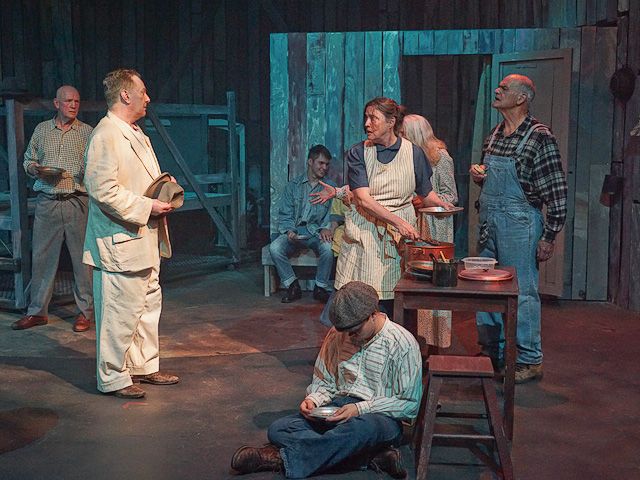
The Grapes of Wrath, Canberra Repertory Society
Theatre 3
13-29 February 2020


The Grapes of Wrath by John Steinbeck (published 1939) is one of those classic great American novels – it is taught in American high schools to the point that everybody knows it, even if they’ve only read the cheat notes or seen the 1940 film (directed by Tom Ford and starring Henry Fonda as Tom Joad) in order to pass the test. And it is a test. Full disclosure: I studied it at High School in New York (U.S.A), and I studied it for my university degree at Manchester (U.K.). It’s a tale that spans continents.

The 1988 play adapted by Frank Galati won the Tony Award for best play in 1990, and in the last thirty years has become a perennial favourite of high school productions. This is both a good and a bad thing, and a context with which to inform the Canberra Repertory production, directed by Chris Baldock.

The plot is fairly simple. During the Great Depression, the Joad family are driven off their land in Oklahoma due to a combination of drought, economic hardship, bank foreclosures and agricultural industry changes. They light out for the West (it is the American Dream, after all) in hopes of finding solid work and good fortune. It is not a spoiler to say things don’t turn out that way.

The set (designed by Chris Baldock; co-ordinated by Russell Brown) drew rounds of applause from the audience. It is a good set, made from pallets and angular constructions which variously represent houses, riverbanks and graves. The scene changes are complex and occasionally clunky, diverting attention from the dialogue or the emotion on stage to appreciation of the artifice.


The jalopy which the Joads load to travel to California is created on stage from flats and loaded up with bags and wheels, although it recalls The Wiggles more than the spirit of desperate adventure. At one point a rain curtain creates a deafening noise over which the actors cannot be heard, and soaks the stage although, strangely, not the actors. I refer to them as actors rather than characters, as this is another of those ‘stepping outside of the scene for the sake of the set’ moments.

The theme of family, friendship and community is one of the most powerful aspects of the story, and initially this is well handled as the multi-generational Joad family bustles about the stage doing chores and preparing a communal meal. It is also nicely contrasted with the isolation felt by Tom Joad (James McMahon) as he returns from a stretch in prison and encounters Jim Casey (Michael Sparks), the ex-preacher, who is struggling to come to terms with his new identity and the situation that has forced them away from all they have known.


As the family and a few extras embark on their journey this sense of community falls apart. Partly this is as members of the clan drop off by the wayside – Noah’s defection as played by John Whinfield is particularly affecting – but also because there is no sense of unity between the company. This should be an ensemble piece, but various actors proclaim and hold forth in a singular way without any perceivable warmth for their fellow cast. James McMahon and Amy Dunham (in a welcome return to the stage as Rose of Sharon) make overtures to the rest of the family, but they are almost rebuffed by a fearsome Ma (Karen Vickery), whose defensiveness is overplayed to the exclusion of the softer side of the matriarch.

Tom, Casey, and also Uncle John (played with hyper intensity by an almost unrecognisable Jerry Hearn), undergo personal, political and spiritual development with sensitivity and depth, dealing with hokey hillbilly dialogue – ‘There ain’t no sin and there ain’t no virtue. There’s just stuff people do’ – in a way that credits the acting and directing skills of all concerned. Considering this is a tale that led many to consider the implications of social economics, the differences between the socialist site and the capitalist camp are understated. Sure, the row of tents looks lovely, and the wire fence is an obvious allusion to camps closer to home, but the imminent threat is absent and the discussions about self-determination, unions, the rights of the worker, and responsibilities of the employer lack passion and are uninspiring.  


Essential qualities such as honour and resistance are given every chance to shine, and they do in solitary monologues but are lost in group moments: the dance and fight scenes are awkward, and the characters are not believable as the rough-and-ready types they represent. It is a stretch to believe in the resilience and perseverance of these average people whom circumstances have made extraordinary and it is not always clear that “We’re the people that live. They can’t wipe us out, they can’t lick us. We’ll go on forever, cos we’re the people.”

That’s not to say that there aren’t emotional scenes: the choices made in the face of starvation and the compassion shown by those suffering personal hurts are at times beautifully portrayed, not least by Dunham in the final scene. The lights fade on a touching tableau, highlighting human dignity; finally the motif of individual sacrifice to the greater good of the community is clear – and that is a wonderful way to finish. Power to the people.


Monday, 28 August 2017

Laughing all the way to the Banksy?

The Art of Banksy
The Paddock, Federation Square (the dodgy car park, behind the Fed Square car park). Melbourne
7 October 2016 - 31 January 2017

Some time ago, I found myself in Melbourne, with a Banksy exhibition on my doorstep. I've always been intrigued by Banksy and his art. And, yes, I do think it is art, even though it is stencil and spray-paint and not always even by him. I find his ideas interesting, and warm to the way he takes the personal and makes it political. I know it has been described as crude and simplistic, but I find it inspirational in its clarity. It is direct and accessible and refutes the notion that art is for the elite. It is self-referential and deprecating in equal measure, and literally brings art out of auction houses and into the streets.


I Can't Believe You Morons Actually Buy This Shit (2007)
And yet an exhibition such as this takes it off the streets and puts it back into the gallery. Artwork such as Barcode Shark, Festival, or Consumer Jesus decry the fundamental ideas of capitalism, while there is, of course, a gift shop, selling these images on t-shirts, postcards and mugs begging the question who is the mug, here? One exhibit actually features t-shirts hung as works of art rather than clothing, further confusing the boundaries between ideology and practicality.


There is no exception to the rule that everyone thinks they're an exception to the rule - Banksy
Consumers of this art are being ridiculed even as they admire it. We must face the consequences of our desire to scorn the herd, just as we are a part of it. And we may want to feel special and different, but we aren't. And that hurts. 

Have a Nice Day
This exhibition was curated by Steve Lazarides, a British art gallery owner. Having studied photography at Newcastle University, he was working on a photo-shoot when he met Banksy and became his agent. He subsequently launched the website 'Pictures on Walls' to promote street artists and urban art. He and Banksy parted ways in 2008 and yet he obviously still champions his former client's work - again one wonders whether the relationship is amicable and mutually beneficial. 

Rude Copper
The majority of the paintings in this exhibition were originally exhibited and sold in some of Banksy's seminal shows, which included two of the artist's most well-known; Turf War which took place in Dalston in East London in 2003, and Barely Legal in Los Angeles 2006.

Lazarides explains that with the ability and skill to exercise a wide palette of contrasting techniques and mediums, these inside works retained the same motifs and ideas that were presented in the outside street pieces. The difference, however, was that they were created with the intention of being viewed within the context of an exhibition environment. While an outside street piece was always created to be transient - there one minute and gone the next - Banksy's inside paintings instead required the scrutiny of a longer view. These artworks would instead potentially be admired for several lifetimes.


Girl with Balloon (gold)
The Art of Banksy features over 80 pieces of original art and screen prints in a pop-up gallery on The Paddock at Federation Square. It does not have Banksy's permission and is therefore an unauthorised exhibition. But if you attack corporations for greed and insist that all work should be public, can you criticise the curators for holding such a show?


The Burger King Kid
"It is not my place to give you my opinion on what these pieces are about. That privilege lies with the artist and I'm pretty sure that isn't something he'd ever do. You as a viewer have as valid an opinion on these works as either me or Banksy. They mean whatever you, the viewer, think they mean - there is no right or wrong." - Steve Lazarides

Flower Thrower (on tarpaulin)
Dorothy Police Search
Many of these spray-painting images have become ironic icons. From the flower-throwing rioter to the American soldier searching Dorothy's basket, the pictures are dripping with sarcasm and subverting authority but also tinged with hope. They seem to say that if we recognise that rampant capitalism is eroding our freedoms and poisoning our communities, then others will too. And perhaps there is a a glimpse of a brighter future. Even the trashed Mini has a stencil of the girl with the hope balloon near the empty fuel tank.


The smiley face features heavily in this exhibition. Now used as an emoji - a symbol of happiness when vocabulary fails - the classic design by Harvey Ball in 1963 represented sunny hedonism to raise the morale of employees at State Mutual Life Assurance Company. In the early 1970s, two brothers based in Philadelphia, Bernard and Murray Spain, added the words 'have a nice day' to sell novelty badges and other paraphernalia to a nation determined to forget the traumas of Vietnam. 

It also suggests the late-80s acid house culture, when the logo appeared on acid tabs implying that one could only have a good time by getting out of one's head because 'real' life was too banal and depressing. Thus a simple child's drawing became hijacked by a number of corporations (Wal-Mart tried to trademark it in 2002) which makes it ripe for inclusion on Banksy's work.


Smiley Grim Reaper
Smiley Angel Policeman
Naturally one would expect a street artist to be anti-capitalist and against rampant consumerism. In this regards, Banksy doesn't disappoint.

Festival
Barcode Leopard
Very Little Helps
Consumer Jesus
Barcode Shark
By taking art from its hallowed walls and desecrating traditional-style paintings Banksy gives art back to the people. He seems to intimate that it should belong to us all, and that we should all be able to see it, rather than it disappearing into the hands of private collectors - which turns full-circle when his own alternative prints are hung in galleries, sold at auction and hidden from public view.

Turf War
Bullet-proof David; Suicide Bomber (2006)


Banksy did a series of 'defaced' work in which stencilled imagery is sprayed upon a found canvas, perhaps purchased from a flea market or salvaged from a dumpster. He was known for sneaking into art galleries and hanging his works alongside Old Masters, complete with interpretive panels explaining the 'hidden meanings'.

Violence and the resulting fear is another common theme - whether painting military weaponry or police brutality towards protesters, he frequently highlights the scaremongering and fear which grips nations. This corporate violence leads to a death of innocence, which he seems to decry - using powerfully deceptive imagery in stylistic silhouettes, such as might be found in a child's picture book. Personal possession, which denies communal appreciation seeks to own and control rather than share.

Warning Sign
Bombing Middle England and Weston-Super-Mare
La American Flag
Kids on Guns Hill


Pooh Bear Trap
"Imagine a city where graffiti wasn't illegal, a city where everybody could draw whatever they liked. Where every street was awash with a million colours and little phrases. Where standing at a bus stop was never boring. A city that felt like a party where everyone was invited, not just the estate agents and barons of big business. Imagine a city like that and stop leaning against the wall - it's wet." - Banksy
His artwork is temporary and ephemeral, but never whimsical. It is often painted over, or dismantled, if it is in the form of installation art. Just before the gift shop was an installation of an old-fashioned sweet shop with jars of sweets, looking like simple treats. On closer inspection they bore copies of his protest images - something to sugar-coat the pill, perhaps?


Obviously the gallery couldn't recreate these impermanent exhibitions, but it included photos and videos of them, to spread the word and the ideas.


He is a keen animal rights campaigner, which makes sense for someone who gives voices to those who need most support. In Sirens of the Lambs, a slaughter wagon full of cuddly toys was driven around the streets of New York. He has previously spray-painted sheep (the RSPCA deemed their treatment was humane) and included a live elephant in a room, which he instructed people not to mention. 

But perhaps his most famous animal creation is the rat; pressed into service for propaganda and sloganeering, it equally represents the trapped commuter we recognise who gets stuck in the maze of making money to survive.


Throughout the exhibition are signs exhorting us to take photos and to share this stuff - art is not the preserve of the elite; it belongs to the masses. And yet we were charged $30 to enter - and there were queues to get into the tent in the 'dodgy carpark' behind Federation Square. 

Is Banksy laughing all the way to the bank? Is he now part of the establishment he set out to rail against? Has he well and truly passed the tipping point? I like his ideas and his presentation of them, so I don't care if he is swimming with the current of the dreaded mainstream. And I get the impression that he doesn't either.