Showing posts with label Paganism. Show all posts

Wednesday, 8 March 2023

International Women's Day: Reclaiming Hekate

At the end of last year I went to the National Museum of Australia to see the excellent exhibition, Feared and Revered: Feminine Power through the Ages. The collection of treasures from the British Museum is touring until 27 August 2023, and I would thoroughly recommend attending if you get the chance. A highlight for me was the marble statue of Hekate from Italy (161-200 AD).


In her book, Feminine Power: The Devine to the Demonic, which accompanies the exhibition, Belinda Crerar writes, "The goddess Hekate is one of the most enigmatic deities of the classical world. Her reputation as the infernal 'goddess of witchcraft' has become cemented in modern popular culture and stretched back to classical belief, but it is a narrow characterisation of a complex and multifaceted ancient divinity. To the Greeks and Romans, Hekate was associated with liminal times and places, and, importantly, stood between life and death at the entrance to the underworld; yet her powers encompassed protection and guidance." 


Hekate's famous triform image appears in Greek art from the fifth century BC onwards. The statue in this exhibition shows her with three bodies and three faces, each young, with flowing hair and crowned diadems. In her six hands she holds a roe and the handles of torches and daggers. Her flaming torches, common attributes in both sculpture and painting, situate her in darkness, but associate her with guiding light, and she is often also shown holding keys to illustrate her power to open or bar the way.


As a goddess of transition, Hekate is often represented in statues set up in entranceways to private and sacred spaces or at road junctions, where each of her three faces looks down a different path. 


Last year in Romania at the Brukenthal National Museum in Sibiu, I encountered a very similar statue in the courtyard of the Altemberger House. The attached plaque claims it is a Hekate Triformus Statue from the 2nd-3rd centuries, 'Probably Salinae (Ocna Mureș, Alba Country)'. 


Hekate's earliest and fullest description is found in Hesiod's epic poem, Theogony of the seventh century BC, which contains an extended hymn in praise of Hekate just before the birth of the Olympian gods. In Hesiod's account, she is not an underworld deity but is said to hold dominion over the earth, sea and sky. She appears to stand apart and distinct from the gods who follow, as if she is more ancient and more honoured than they are, and Hesiod is keen to stress that even Zeus, king of the Olympians, pays Hekate special respect above all others.


The reason for this reverence is made clear when Hesiod explains that success or failure is determined by Hekate's will: she can stand protectively in harm's way or step aside as she chooses. A primordial but ambivalent force, Hekate was given the epithet kourootrophos, the 'nurse of the young' by Hesiod, and the contemporary but unknown author of the Hymn to Demeter describes her as 'tender-hearted'. 


In some later Greek, but particularly Roman literature, Hekate's underworld associations become more pronounced, and she is portrayed as a more sinister force. Her approach was said to be heralded by howling dogs and she is no longer honoured by Zeus but now by Circe, Medea and Erichtho, the sorceresses and witches of classical literature who make sacrifices to her and vows before her altar for aid in their magic. 


The shift in the conception of Hekate in literature may have been influenced by actual magical rituals of the Hellenistic and Roman periods. A Greek prayer found in a handbook of incantations and magical formulas from Egypt (dated c. 275-375 AD) describes her in demonic terms as bull-faced, having snakes coiled across her brow, stalking graveyards and consuming the dead. 


As is often the case, female power is subverted by those who fear it and made to seem evil. Some male observers cannot cope with women being multi-faceted, so they cast them as two-faced as though that is a bad thing. To modern audiences, Hekate is largely known through being the 'leader' of the three witches in Shakespeare's Macbeth. She is presented as a sadistic, controlling and merciless commander of the coven, angry to have been excluded from previous plots and determined to control the prophecies and apparitions in order to maximize their manipulative affect and contribute to Macbeth's downfall. Naturally this has particular relevance for me as I played Hecate in a 2016 production of Macbeth by Canberra Repertory Society. 
"I am for the air; this night I'll spend
Unto a dismal and fatal end:
Great business must be wrought ere noon:
Upon the corner of the moon 
There hangs a vaporous drop profound;
I'll catch it ere it come to ground
And that distill'd by magic sleights
Shall raise such artificial sprites
As by the strength of their illusion
Shall draw him on to his confusion; 
He shall spurn fate, scorn death, and bear
He hopes 'bove wisdom, grace and fear:
And you all know, security
Is mortals' chiefest enemy." - Macbeth (Act III, scene v), William Shakespeare
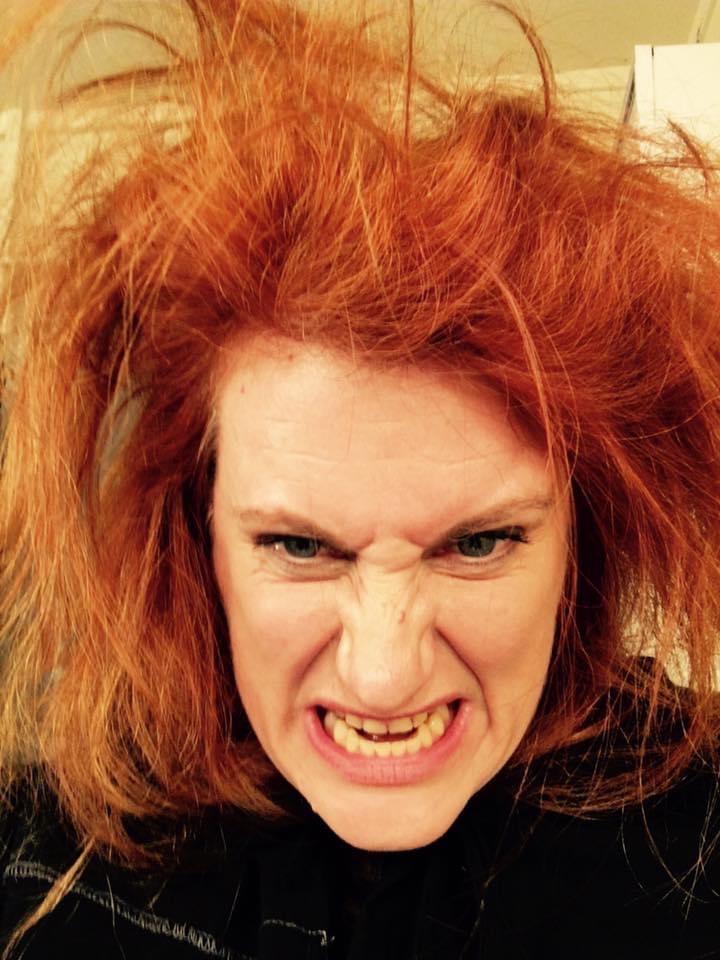
As Hecate in Macbeth (2016)
In keeping with reclaiming mythical and magical female figures from history to embody more empathetic, inclusive and complex interpretations, it is worth noting that since the late 19th century AD, Hekate's relevance has been revived and her spiritual importance has been incorporated into religions such as Wicca and Modern Paganism. 

As a lady in Macbeth (2016)

Friday, 22 October 2021

Friday Five: Halloween Cross-Stitch

It does feel very odd to me that the seasons are back to front here and certain festivals occur at the 'wrong' time of the year. Halloween falls between Harvest Festival and Guy Fawkes Night. It occurs as the nights begin to draw in and there are more shadows and misty corners in which things can lurk and our fears and anxieties can grow if left unattended. To me it is tied to the Gaelic festival of Samhain, which marks the end of the harvest season and the beginning of winter or the 'darker-half' of the year. 

As with many things the ancient pagan, mythical, religious roots have largely been consumed by consumerism and capitalism. I dislike that intensely. I do, however, like the idea of making the connections with the liminal world more comforting and less frightening. To this end, I have enjoyed stitching these designs. 

5 Halloween Cross Stich Designs:

Tuesday, 5 January 2021

My Newest Favourite Thing: The Unicorn Tapestries

1. The Hunters Enter the Woods
Unicorns have been rather co-opted into the (predominantly female) childish world of sparkly pink and rainbows. But they used to be magical creatures of mystery and influence. And they used to symbolise, among other things, chivalry, purity and Christianity.

A famous series of seven tapestries, The Hunt of the Unicorn or La Chasse à la licorne, dates from the late Middle Ages and shows a group of noblemen or hunters in pursuit of a unicorn through an idealised French landscape. The tapestries were woven in wool, metallic threads, and silk - the vibrant colours were produced from dye plants: weld (yellow); madder (red) and woad (blue). They were probably woven between 1495 and 1505 in Brussels, which was an important centre of the tapestry industry in Medieaval Europe. Whereas wool was widely produced in the rural areas around Brussels, and a common primary material in tapestry weaving, the silk was costly and hard to obtain, indicating the wealth and social status of the owner.

First recorded in 1680 in the Paris home of the Rochefoucauld family, the tapestries were looted during the French Revolution, rediscovered in a barn in the 1850s, and now hang in The Cloisters in New York. The tapestries themselves are the subject of intense scholarly debate about the meaning of their iconography, the identity of the artists who designed them, and even the order in which they are meant to be hung. Although various theories have been put forward, there is no definitive answer as to their provenance, and their dramatic but conflicting narratives have inspired multiple readings. 

2. The Unicorn is Found
According to Wikipedia, "One theory is that the tapestries show pagan and Christian symbolism. The pagan themes emphasise the medieaval lore of beguiled lovers, whereas Christian writings interpret the unicorn ad its death as the Passion of Christ. The unicorn has long been identified by Christian writers as a symbol of Christ. conscripting the traditionally pagan symbolism of the unicorn. The original pagan myths about The Hunt of the Unicorn refer to an animal with a single horn that can only be tamed by a virgin; Christian scholars translated this into an allegory for Christ's relationship with the Virgin Mary". 

In Gothic tapestry, the makers considered biblical events as 'historical' and linked the biblical and secular narratives in the tapestry weaving. Medieaval art illustrated moral principles, and the tapestries used narrative allegories to illustrate these morals. The secular unicorn hunt was not simply Christian art, but also an allegorical representation of the Annunciation.

3. The Unicorn is Attacked
There is some speculation that the unicorn tapestries were commissioned to celebrate a marriage - as medieaval poets connected the taming of the unicorn to the devotion and subjugation of love. The taming of the unicorn, therefore, symbolises the secular lover who was enchained by a virgin and trapped in the fence (in the tapestry The Unicorn in Captivity) - this all seems rather brutal and dominating, but apparently the concept of an overlapping God of Heaven and God of love was accepted in the late Middle Ages. 

Different interpretations lead to different titles and different sequences in which it is suggested the tapestries should be hung. The tapestries are different sizes and some suggest that they were designed for use as a bedroom ensemble, with the five large pieces fitting the back area of wall, while the other two pieces serve as the coverlet or overhead canopy. Others contend that the first and last may be independent works or form a different series entirely. 

4. The Unicorn Defends Itself
Whatever the interpretation, the tapestries are glorious and  rich in floral imagery, featuring the 'millefleurs' background style of a variety of small botanic elements. Invented by the weavers of the Gothic age, this style became popular during the late Medieaval era and declined after the early Renaissance. There are more than a hundred plants represented in the tapestries, scattered across the green backgrounds of the panels, most of which (85) have been identified by botanists according to a paper published in 1983. This paper maintains that the particular flowers featured in the tapestries reflect the tapestries' major themes and represent not only a secular, physical, enclosed garden (hortus conclusus), but also a connection with the Annunication.

5. The Mystic Capture of the Unicorn
If these tapestries look familiar, they probably are. Replicas of them can be found in all sorts of places in film and television, ranging from Spiderman: Far from Home to Family Guy and Once Upon a Time. They appear in the 1988 film, Some Girls, the 1993 film, The Secret Garden, and a French advert for cheese. Children's authors, science fiction short story writers, folk musicians and Leonard Cohen have all woven them into their artistic creations. In Harry Potter and the Half Blood Prince, the last tapestry in the series, The Unicorn in Captivity, is seen in the various common rooms (Gryffindor, Slytherin, Ravenclaw and Hufflepuff) with different-coloured backgrounds. 

The Unicorn is Killed and Brought to the Castle
And now there are fantastic recreations adorning the walls of the Queen's Inner Hall at Stirling Castle, after a thirteen-year project to reweave the tapestries. They were never known to have been in the castle, but there is thought to have a been a series like it. Only the very wealthiest of people could afford tapestries, and an inventory shows that James V had a large collection including two sets which showed unicorns. A two-million-pound project saw two teams of three weavers recreating the tapestries and results in visitors to Stirling Castle being able to imagine something of the atmosphere of Scotland's royal court. 

The Unicorn is in Captivity and No Longer Dead
An exhibition at the castle tells the story of the recreation and explains how the tapestries were worked in the Medieval way, using a technique whereby the warp thread comes down, the weft thread is picked out, threaded through the warp, and packed down with the bobbin - I love the terminology as much as the painstaking process (The Unicorn in Captivity alone took two years to weave, working from right to left) and watching a video of the intricate art is truly incredible.
   
A selection of samples
To develop a greater understanding of the thread types, colour palette and weaving techniques used by the original weavers, several hundred samples were made by the weavers of the new Hunt of the Unicorn tapestries. The sample of a single hunter's knee on the bottom row was the first sample to be made and was woven at eight warps per centimetre, which is the warp count of the original 15th Century tapestries. This was done to calculate the commission cost of the full set of seven tapestries. The adjacent sample of two knees was woven at four warps per centimetre (which is what was used for the new tapestries) and saved thirteen years of production time. 
Some of the threads on bobbins
In the sample showing two knees the blending of colours in the left knee uses a traditional technique: separate threads of different colours are combined to create different tones. The blending of colours on the right knee has been made using a contemporary method where different coloured threads are blended together before weaving. The whole thing is quite remarkable and I felt extremely humbled by the dedication and the magnitude of the project. My little cross-stitches are nothing in comparison, but I still love the focus on a small section of canvas which, with individual stitches, brings an image to life. I'm sure that has to be a metaphor for something... Life's rich tapestry, perhaps? 

Blue and green should never be seen...

Friday, 31 October 2008

Happy Halloween

A friend asked me yesterday, 'Halloween - yes or no?', to which I have to say a resounding yes.

When we were kids, one of my very best friends was American (actually, she still is, but we're no longer kids). She introduced me to 'trick or treating', of which I'm not a great fan - it always seemed a bit too like begging. But she also introduced me to 'Halloween candy', dressing up, outrageous decorations, lots of black and orange, playing ridiculous party games and scaring ourselves silly. I loved the Jack o'lanterns. I loved apple bobbing. I loved eating cream buns hanging from the ceiling by a thread with your hands tied behind your back.

As I got older I went through a New Age, pagan sort of phase involving lots of candles, ribbons and bad poetry. I communed with cats and tried to see the good in toads. I learned about masculine and religious oppression and I celebrated the female goddess worshippers; the medieval healers and midwives who were persecuted and hanged or burned at the stake for offending the patriarchal establishment.
One Halloween Him Outdoors took me up Pendle Hill, site of the infamous
Lancashire witches, ten of whom were hanged for witchcraft in 1612. It was dark and quite spooky. People trudged up there to light bonfires and join covens. I have only dabbled and never specifically tried to invoke the dark side. I don't know if I believe in a dark side and certainly wouldn't want to invoke it. I was scared of the people who believed they were conjuring with black magic.

So I no longer really know what to believe. But I enjoy so-called Pagan Festivals - like May Day, Yule, Candlemas, Midsummer, and, naturally Halloween. I worry that it is too easy to get too serious about such things however, and would like to remind you to treat Halloween responsibly and not to leave alcohol around pumpkins.