Showing posts with label Macbeth. Show all posts

Wednesday, 8 March 2023

International Women's Day: Reclaiming Hekate

At the end of last year I went to the National Museum of Australia to see the excellent exhibition, Feared and Revered: Feminine Power through the Ages. The collection of treasures from the British Museum is touring until 27 August 2023, and I would thoroughly recommend attending if you get the chance. A highlight for me was the marble statue of Hekate from Italy (161-200 AD).


In her book, Feminine Power: The Devine to the Demonic, which accompanies the exhibition, Belinda Crerar writes, "The goddess Hekate is one of the most enigmatic deities of the classical world. Her reputation as the infernal 'goddess of witchcraft' has become cemented in modern popular culture and stretched back to classical belief, but it is a narrow characterisation of a complex and multifaceted ancient divinity. To the Greeks and Romans, Hekate was associated with liminal times and places, and, importantly, stood between life and death at the entrance to the underworld; yet her powers encompassed protection and guidance." 


Hekate's famous triform image appears in Greek art from the fifth century BC onwards. The statue in this exhibition shows her with three bodies and three faces, each young, with flowing hair and crowned diadems. In her six hands she holds a roe and the handles of torches and daggers. Her flaming torches, common attributes in both sculpture and painting, situate her in darkness, but associate her with guiding light, and she is often also shown holding keys to illustrate her power to open or bar the way.


As a goddess of transition, Hekate is often represented in statues set up in entranceways to private and sacred spaces or at road junctions, where each of her three faces looks down a different path. 


Last year in Romania at the Brukenthal National Museum in Sibiu, I encountered a very similar statue in the courtyard of the Altemberger House. The attached plaque claims it is a Hekate Triformus Statue from the 2nd-3rd centuries, 'Probably Salinae (Ocna Mureș, Alba Country)'. 


Hekate's earliest and fullest description is found in Hesiod's epic poem, Theogony of the seventh century BC, which contains an extended hymn in praise of Hekate just before the birth of the Olympian gods. In Hesiod's account, she is not an underworld deity but is said to hold dominion over the earth, sea and sky. She appears to stand apart and distinct from the gods who follow, as if she is more ancient and more honoured than they are, and Hesiod is keen to stress that even Zeus, king of the Olympians, pays Hekate special respect above all others.


The reason for this reverence is made clear when Hesiod explains that success or failure is determined by Hekate's will: she can stand protectively in harm's way or step aside as she chooses. A primordial but ambivalent force, Hekate was given the epithet kourootrophos, the 'nurse of the young' by Hesiod, and the contemporary but unknown author of the Hymn to Demeter describes her as 'tender-hearted'. 


In some later Greek, but particularly Roman literature, Hekate's underworld associations become more pronounced, and she is portrayed as a more sinister force. Her approach was said to be heralded by howling dogs and she is no longer honoured by Zeus but now by Circe, Medea and Erichtho, the sorceresses and witches of classical literature who make sacrifices to her and vows before her altar for aid in their magic. 


The shift in the conception of Hekate in literature may have been influenced by actual magical rituals of the Hellenistic and Roman periods. A Greek prayer found in a handbook of incantations and magical formulas from Egypt (dated c. 275-375 AD) describes her in demonic terms as bull-faced, having snakes coiled across her brow, stalking graveyards and consuming the dead. 


As is often the case, female power is subverted by those who fear it and made to seem evil. Some male observers cannot cope with women being multi-faceted, so they cast them as two-faced as though that is a bad thing. To modern audiences, Hekate is largely known through being the 'leader' of the three witches in Shakespeare's Macbeth. She is presented as a sadistic, controlling and merciless commander of the coven, angry to have been excluded from previous plots and determined to control the prophecies and apparitions in order to maximize their manipulative affect and contribute to Macbeth's downfall. Naturally this has particular relevance for me as I played Hecate in a 2016 production of Macbeth by Canberra Repertory Society. 
"I am for the air; this night I'll spend
Unto a dismal and fatal end:
Great business must be wrought ere noon:
Upon the corner of the moon 
There hangs a vaporous drop profound;
I'll catch it ere it come to ground
And that distill'd by magic sleights
Shall raise such artificial sprites
As by the strength of their illusion
Shall draw him on to his confusion; 
He shall spurn fate, scorn death, and bear
He hopes 'bove wisdom, grace and fear:
And you all know, security
Is mortals' chiefest enemy." - Macbeth (Act III, scene v), William Shakespeare

As Hecate in Macbeth (2016)
In keeping with reclaiming mythical and magical female figures from history to embody more empathetic, inclusive and complex interpretations, it is worth noting that since the late 19th century AD, Hekate's relevance has been revived and her spiritual importance has been incorporated into religions such as Wicca and Modern Paganism. 

As a lady in Macbeth (2016)

Friday, 22 January 2021

Friday Five: Kings and Queens (and a Bonus Oddball) of Scotland

When we visited Stirling Castle, we saw an exhibition about the kings and queens of Scotland and their relations with the castle itself. It began with a family tree, which claimed to illustrate the direct blood link between Kenneth MacAlpin and Robert the Bruce. A cautionary note warned that 'the route between was often complicated'. This was written by the master of understatement.

Now, I have no illusions that I am any good at this sort of thing, and this is certainly not any attempt at providing a definitive history. There are, however, a few names that capture the imagination here.


1. Kenneth MacAlpin (842-858) - Kenneth (snort); it just doesn't seem like a very regal name. He was, however, apparently a notable warrior and the first leader to establish power over the Picts and the Scots to unite them in the kingdom of Alba, now known as Scotland. 

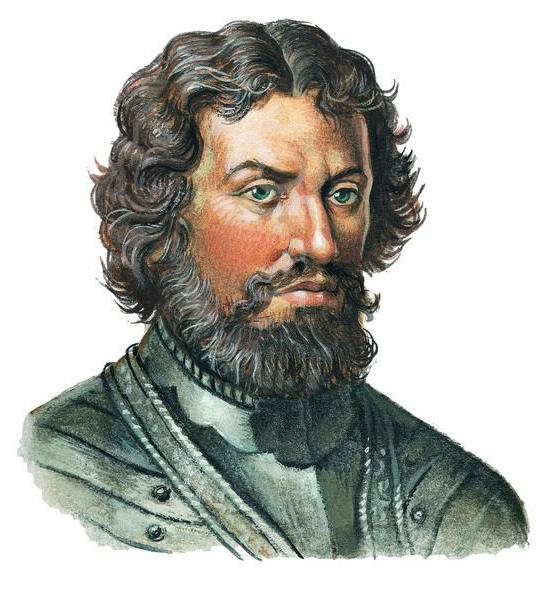
2. Macbeth (1040-1057) - There is a section of the long line (or tenuous ribbon if you prefer) of divine monarchical inheritance which reads, 'Duncan I 1034-1040; Macbeth 1040-1057; Lulach 1057-1058 ; Malcolm III (Canmore)1058-1093'. 

It would seem that Duncan I launched an attack on Moray, Macbeth's lordship, and was killed in action by Macbeth's troops. Macbeth subsequently became King of Alba where he ruled peacefully for 17 years with apparently little opposition. His only major confrontation during his reign was an English invasion in 1054, led by Siward, Earl of Northumbria on behalf of Edward the Confessor. Macbeth was killed at the Battle of Lumphanan in 1057 by forces loyal to the future Malcolm III. He was buried on Iona, the traditional resting place of Scottish kings. Macbeth was briefly succeeded by his stepson, Lulach, who only ruled for a few months before being killed by Malcolm III, whose descendants continued to rule Scotland for another two hundred years.

Wikipedia tells us, "Macbeth is today best known as the main character of William Shakespeare's tragedy Macbeth and the many works it has inspired. However, Shakespeare's Macbeth is based on Holinshed's Chronicles (published in 1577) and is not historically accurate." Wait, Shakespeare fudged the facts? Well, I never...


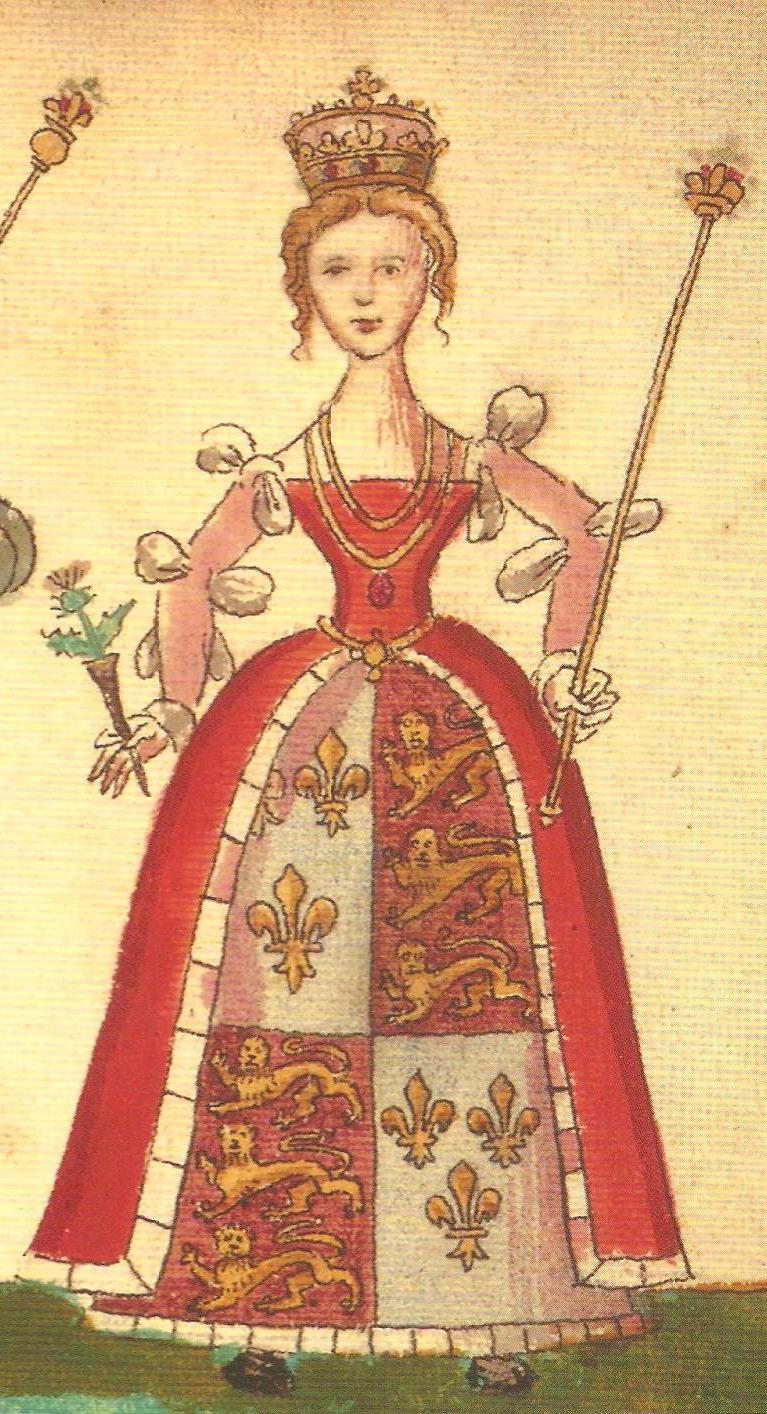
3. Joan Beaufort (1424-1437 & regent 1437- 1439) - She was twenty when she married James I: he made her co-monarch and gave her Stirling Castle as a wedding present, which was nice.  When James I was assassinated in 1437, Queen Joan smuggled their young son, James II, to Stirling Castle for safe-keeping. She then ruled from here as regent, surely making her one of the most powerful women in the land.

4. James IV (1473-1513) - Apparently this James was a passionate supporter of arts and culture (hurrah!). He was clever and well-educated, spoke seven languages and surrounded himself with poets, musicians, writers and philosophers. He was influenced by Classical ideas and the culture of the European Renaissance. He also seemed to rather like building (or at least, having other people build things for him). While at Stirling Caste he commissioned building works on a grand scale including the old Chapel Royal, the Great Hall the Forework and the King's Old Building.

Also, somewhat importantly, in 1502 he signed the rather ambitious-sounding Treaty of Perpetual Peace with England, and the following year married Margaret Tudor, daughter of the English king, Henry VIII. Well, that's all nicely settled then.


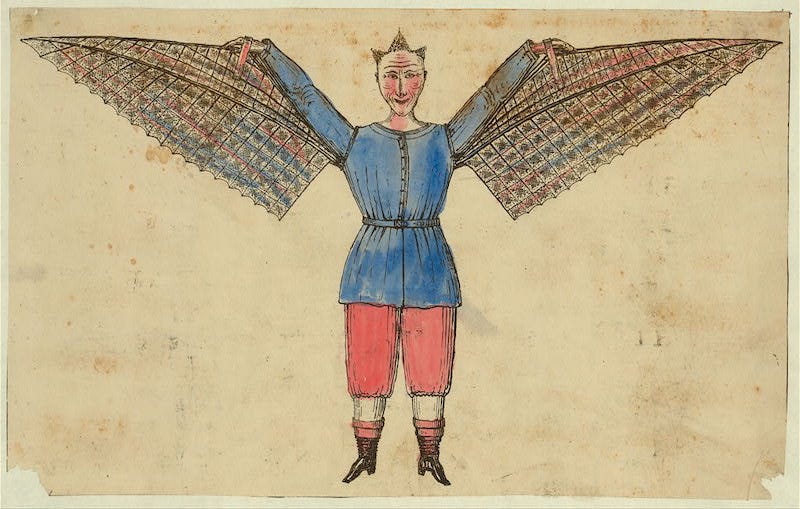
5. John Damian - Not a king, but a fascinating figure nonetheless. He was an Italian alchemist who believed he could transform base metals into gold.  As James IV's court welcomed artists, scientists, and classically-trained poets and thinkers, Damian's claims intrigued the king and he was set up with a laboratory at Stirling Castle. "Despite the generous royal funding, Damian had no success." I wonder why...?

In 1507, in an attempt to retain the king's support, Damian tried a new experiment. He made wings from chicken feathers and announced he would use them to fly to France from the walls of the castle. His doomed flight from the Ladies' Lookout on the west side of the castle ended in a dunghill. Damian blamed "the wrong kind of feather". Is there a play about this? If not; there should be.


6. Mary Queen of Scots (1542-1587) - All joking aside (because she's not exactly known for her sense of humour), Mary is probably the queen that the country knows best. She lived at Stirling Castle until 1548 when she was sent to France "for safe-keeping". She returned to Scotland in 1561. 

As an adult, Mary spent much of her seven years at Stirling Castle. In 1566 the Old Chapel Royal was the setting for the baptism of her son, the future James VI. No expense was spared. Mary borrowed twelve thousand pounds (about two million today) to fund the event. During a great ceremony to impress the foreign emissaries, Mary laid on three days of "feasting, fireworks, music and masquing" in a celebration to rival anything Europe had ever seen.

Friday, 17 May 2013

Friday Five: Theatre Superstitons


Tonight is opening night of Tempo Theatre’s production of Agatha Christie’s The Hollow in which I am performing. I would like to wish all the cast and crew the very best. Yes, good luck and all that.

Now, there are a lot of superstitions in the theatre. People will tell you that thespians are almost as superstitious as sailors. I don’t know any sailors, so I couldn’t possibly comment. I do know a lot of theatre types. Some of them (heaven forfend) are somewhat pretentious – ’tis the nature of the beast – but few of them are superstitious.
 
Some of the more well-known superstitions stem from historical reasons, but they have no relevance today. Like business jargon, they are merely used to form a club, to fake importance and exclude others. If your art is worth doing, it will stand alone without the need for nonsense and special terminology. I hereby declare theatre superstitions as bunkum.
 
5 Nonsensical theatre superstitions:
  1. Good luck – It is considered bad luck to wish someone good luck before performance. Apparently there are evil fairies who listen in and pervert the positive vibes – conspiracy theories, anyone? So people wish each other ill-luck to confuse these easily befuddled fairies. Many English-speaking thespians exhort each other to ‘break a leg’ and Australians announce ‘chookas’. This apparently originates from the fact that actors are poor and chicken is expensive so if the house was full and the actors were paid according to box-office takings, they could afford chicken for dinner. ‘Chooks it is’ was shortened to ‘chookas’ and it’s off to KFC for all. Classy folk, those Aussies.
  2. Macbeth – Some folk claim that if you mention Macbeth (or quote lines from the play) in a theatre or you will have to leave the theatre, turn around three times, spit, and knock on the door to be invited back in. Apparently the play is cursed, and several explanations are offered. One; because it contains a lot of sword-fighting and people are likely to get hurt, two; the witches were cross that their secrets were revealed, three; some idiots believe the Globe was burned down during a performance of Macbeth. (It was actually Henry VIII – live cannons on stage will do that for you). For this reason, theatre folk tend to refer to it as ‘the Scottish play’. To that I say, ‘bollocks’. Or, in the immortal words of the fabulous Stephen Fry, “Macbeth, which we actors call [pause for dramatic effect] Macbeth.’
  3. Whistling – this one does actually have a reasonable origin. It is considered bad form to whistle in a theatre, because riggers used to use a code of whistles to change set, scenery, lighting and other stage effects. Since the invention of communication devices, however, this is hardly relevant.
  4. Bad dress rehearsal – people claim that a bad dress rehearsal means a subsequent sterling opening night. What tosh. A bad dress rehearsal means the cast and crew are under-prepared and it is something directors are forced into saying to boost the spirits of their woeful company.
  5. Ghosts – every theatre worth its salt has a resident ghost. It’s a great scapegoat for things going missing or not being where you swear you set them. Theatres are usually closed for at least one night a week, to allow the ghosts to have their own performance. Never mind that the actors need a rest. Or that the off-night is usually a Monday when paying audiences don’t tend to go out after a hectic and expensive weekend.

Tuesday, 1 May 2012

Quote for Today


"Great acting is being able to say 'Pass the salt, please,' without sounding weird or odd or stupid or portentous. Great acting is being able to say 'Horror! Horror! Horror!' without sounding weird or stupid or portentous." - William Boyd, Waiting for Sunrise

Sunday, 23 August 2009

Power and Persuasion


Power and Persuasion (Alchemy Actors Company)
Philosophy House, August 14-21

Shakespeare’s plays are so often about power – who has it; who wants it; and what they are prepared to do to get it. This theme is extensively explored in a series of extracts from a selection of the playwright’s dramas in Power and Persuasion. John Bach and Mel Dodge enact these vignettes with palpable emotion. The venue of Philosophy House is perfect as the audience walk up a sweeping staircase and into a world of heightened reality where issues are argued from every angle.

Each of the five pieces are performed in the traverse so you watch one then another like a tennis match or a fencing bout as the actors serve and volley; thrust and parry the barbed comments and cunning appeals. Tipping this balance like a see-saw they approach and withdraw or circle one another, sneaking up from behind or breaking away as in a fervent tango.

The actors are dressed in black and change their characters through their movement and expression rather than their dress. Small costume adjustments allow a shawl to represent Queen Katherine or a bright red ribbon tied around the waist to indicate the blood-lust of Lady Macbeth. Bach twists his own back into the deformity of Richard III or toys casually with an apple as the confident suitor Petruchio.

Oberon and Titania begin the evening with the scene from Midsummer Night’s Dream in which they battle over the changeling child. This episode is often cut from full-length productions, although I wonder why if it can be made so alluring as this. Nature itself is perturbed by their duelling, and their whirling, twisting movements are fluid and lithe, verging on hypnotic.

I’ve never read nor seen Shakespeare’s Henry VII so this extract is a real treat. Bach is all calm composure and assumed deference as his Cardinal Wolsey approaches Dodge’s Queen Katherine and bids her to grant King Henry a divorce so that he can marry Anne Boleyn. Knowing how much she stands to lose, Katherine refuses and her inner turmoil writhes passionately beneath her mask-like face. This would be an excellent piece for an audition and I mentally file it for future reference.

Hilary Norris directs a selection of scenes from Macbeth from the moment Lady Macbeth hears of the prophecy of the witches to the murder of Duncan and the onset of madness. Highlighted by an intense and eerie soundscape (James Dunlop), this piece has chilling power and Lady Macbeth uses all the emotional weapons in her arsenal (from seduction to ridicule) to persuade.

The actors wrestle both physically and verbally through Taming of the Shrew. Bach is a commanding and confident Petruchio with just a hint of cruelty while Dodge is truly tempestuous as Kate. The constant ebb and flow movement resembles the erosion of waves upon a shore and, when the couple grapples on the floor, I can’t help but think of the beach scene in From Here to Eternity.

According to the programme notes, Lyndee-Jane Rutherford has never directed Shakespeare before. Judging from this excerpt from Richard III which befits her slightly melodramatic style, this is definitely a direction she should explore. Bach’s mellow tones suit the tyrant king perfectly and Dodge is credibly distraught as the grieving Anne. The intensity of hatred underpinning the formal courtship leaves a lasting impression as the final of the quintuplet. As we descend the stairs back to the rain-washed streets I believe this really is a ‘brave new world that has such people in it.’

Wednesday, 1 July 2009

Shakespeare's Greatest Hits


All the World's a Stage
Circa Two, 29 May - 27 June

Ray Henwood’s presentation of Shakespeare’s greatest hits is a comfort for a cold evening. That there is nothing out of the ordinary is not a criticism – rather it is because, as he explains in one of his many addresses to the audience, that the bard’s conceptions have passed into common parlance.

Dressed in a morning suit against a simple curtain for a backdrop, Henwood illuminates the stage with a range of speeches, soliloquies and sonnets inspired by Sir John Gielgud’s Ages of Man. He begins with the prologue from Henry V in which the chorus begs to ‘on your imaginary forces work’. For the next 90 minutes, Henwood takes us on a veritable round-the-bard-trip as promised.

He recites some beautiful poetry with evident passion in a voice you could listen to all day. Explaining that even the non-beautiful creations get the poetry, he portrays characters as diverse as Caliban (The Tempest), Angelo (Measure for Measure), and Lorenzo (The Merchant of Venice). The Queen Mab speech from Romeo and Juliet is spirited and full of fun.

Each section is introduced with a few words or a brief discourse. In a segment on the nature of sleep, Henwood ranges from Macbeth’s – ‘that knits up the ravel’d sleeve of care’ – to Prospero’s – ‘We are such stuff as dreams are made on; and our little life is rounded with a sleep.’ The simple but effective lighting (Jennifer Lal) generally remains true to the ethics of the limited technical intervention, as actor and director (Peter Hambleton) alike choose to paint pictures with words.

As you would expect, Henwood is particularly captivating as Lear and Henry V. He includes lots of Henry V including the infamous ‘Once more into the breach’ speech and the ‘little touch of Harry in the night’. The best of these snippets is when he plays both Falstaff and Prince Hal imitating Henry IV (Henry IV: Part One).

Attempting to persuade us that there are as many strong female as male characters (which is patently untrue) Henwood gives us Lady Macbeth on receipt of the letter from her husband narrating what greatness he has been promised. He is not entirely convincing in this role, not just for the obvious reasons, nor does he seduce us as Iago (just as an aside – Peter Hambleton’s Iago is actually the best I’ve seen in New Zealand), although he draws attention to his complexity.

Shakespeare was a master at creating complexity of character – ‘what a piece of work is a man’. This always reminds me of the Blackadder episode in the second series in which Edmund has his Aunt and Uncle Whiteadder over for dinner, at the same time as hosting a drinking party. When his aunt takes him to task after someone stumbles in wearing comedy breasts, ‘Edmund! Explain yourself!’ he replies, ‘I can’t. Not just like that. I’m a complicated person, you see, Auntie.’

Shakespeare’s characters are not representative of a certain singular trait and Ray Henwood is excellent at embodying diversity. Nowhere is this more pertinent than in his Shylock, who is more than ‘just a Jew’. He gives an interesting insight into the character – there are other Jews and other money-lenders who weren’t hated as Shylock was. It was more his disposition than his religion that was despised, yet, with our (entirely understandable) fear of Nazism, we worry that this loathing is anti-Semitism.

No one else in the Shakespeare canon is a stereotype, so why do we assume he is? As Henwood points out in one of the more intriguing passages of the evening, surely this says more about the audience, with our modern sensibilities, than it does about the bard.

Other interludes are the sonnets which provide a quality counterpoint to the plays, and the morsels from other works. Having directed the opening scene of Terry Pratchett’s Wyrd Sisters, myself, I found this as recognisable as Shakespeare’s works. Less familiar, although equally enjoyable, to me was the short excerpt from Rinse the Blood off My Toga.

Mainly All the World’s a Stage was like ‘An Evening with William’, channelled towards the fans with little from the more obscure works or the comedies. Like a concert where you only really want to hear the hits and not the worthy stuff from the experimental album, this was clearly a success with the mainly elderly audience. Having said that, this would work really well in schools as an introduction to Big Bill.