Showing posts with label A Midsummer Night's Dream. Show all posts

Friday, 15 March 2024

Friday Five: Ides of March

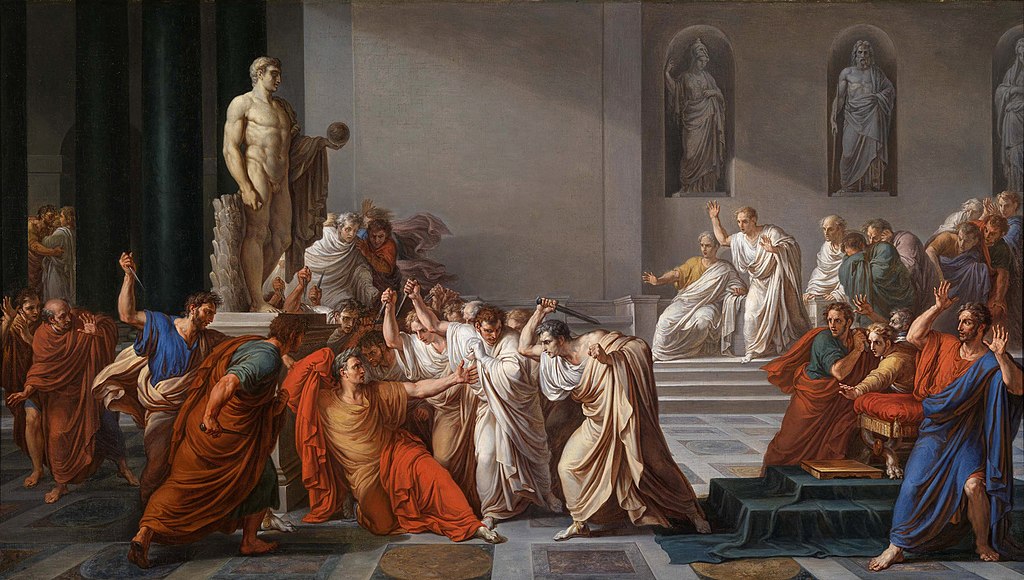
La Morte di Cesare (1805) by Vincenzo Camuccini
Well, today's the day that all self-elected senators should probably avoid temple steps, just in case all their so-called mates gang up on them and stab them in the back. Or so says Shakespeare, anyway. The soothsayer tells Julius Caesar on more than one occasion to beware the ides of March, but does he listen? No, he does not. And the rest, as they say, is history.

As with many people educated through the British school system in the 70s and 80s, I learned much of my history through Shakespeare plays. It was a great grounding for understanding the true definition of fake news, which allowed me to filter out a lot of the nonsense promulgated by white men talking about subjects they didn't really understand, but who had a following because they wrote a good speech, or got ghost writers to do it for them. In keeping with that theme, here are five Shakespeare quotes that relate to calendar dates.
  1. "Beware the Ides of March", The Tragedy of Julius Caesar, Act I, scene ii (15 March)
  2. ''And gentlemen in England now a-bed/ Shall think themselves accursed they were not here,/ And hold their manhoods cheap whiles any speaks/ That fought with us upon Saint Cripin's day."- Henry V, Act IV, scene iii (25 October)
  3. "Good morrow, friends. Saint Valentine is past: Begin these wood-birds but to couple now?" - A Midsummer Night Dream, Act IV, scene ii (14 February)
  4. "On Holy-rood day, the gallant Hotspur there,/ Young Harry Percy and brave Archibald,/ That ever-valiant and approved Scot,/ At Holmedon met,/ Where they did spend a sad and bloody hour." - Henry IV, Part One, Act I, scene i (14 September)
  5. Twelfth Night - Yep, the whole play. (5 January)

Friday, 8 January 2010

The rehearsal must go on


The weather has been, as they say, variable. We have been ploughing ahead with our rehearsals for Shakespeare on Location in the Queenstown Gardens regardless. Admittedly, the weather has been better on some days than others.

Much though I admire Billy Connolly, I have to take issue with his assertion, 'There is no such thing as bad weather; just inappropriate clothing'. Singing about the joys of spring and the delights of nature is a bit difficult when you can't hear over the rain drumming on your umbrella.

Here, Juliet begs the night to hurry up and arrive so she can spend time with her lover, Romeo.

My lovely fairies are busy cavorting in grove and green among the cowslips and the dewdrops.

Jaques is nonplussed by Orlando's lovesick attitude:

Gertrude is shocked by Ophelia's descent into madness, 'divided from herself and her fair judgement':

And although Ophelia does eventually drown, I didn't expect it to be during this scene.

A huge thank you to all the cast for continuing to rehearse in such 'inclement weather' - I think that may be the understatement of the season!

Sunday, 23 August 2009

Power and Persuasion


Power and Persuasion (Alchemy Actors Company)
Philosophy House, August 14-21

Shakespeare’s plays are so often about power – who has it; who wants it; and what they are prepared to do to get it. This theme is extensively explored in a series of extracts from a selection of the playwright’s dramas in Power and Persuasion. John Bach and Mel Dodge enact these vignettes with palpable emotion. The venue of Philosophy House is perfect as the audience walk up a sweeping staircase and into a world of heightened reality where issues are argued from every angle.

Each of the five pieces are performed in the traverse so you watch one then another like a tennis match or a fencing bout as the actors serve and volley; thrust and parry the barbed comments and cunning appeals. Tipping this balance like a see-saw they approach and withdraw or circle one another, sneaking up from behind or breaking away as in a fervent tango.

The actors are dressed in black and change their characters through their movement and expression rather than their dress. Small costume adjustments allow a shawl to represent Queen Katherine or a bright red ribbon tied around the waist to indicate the blood-lust of Lady Macbeth. Bach twists his own back into the deformity of Richard III or toys casually with an apple as the confident suitor Petruchio.

Oberon and Titania begin the evening with the scene from Midsummer Night’s Dream in which they battle over the changeling child. This episode is often cut from full-length productions, although I wonder why if it can be made so alluring as this. Nature itself is perturbed by their duelling, and their whirling, twisting movements are fluid and lithe, verging on hypnotic.

I’ve never read nor seen Shakespeare’s Henry VII so this extract is a real treat. Bach is all calm composure and assumed deference as his Cardinal Wolsey approaches Dodge’s Queen Katherine and bids her to grant King Henry a divorce so that he can marry Anne Boleyn. Knowing how much she stands to lose, Katherine refuses and her inner turmoil writhes passionately beneath her mask-like face. This would be an excellent piece for an audition and I mentally file it for future reference.

Hilary Norris directs a selection of scenes from Macbeth from the moment Lady Macbeth hears of the prophecy of the witches to the murder of Duncan and the onset of madness. Highlighted by an intense and eerie soundscape (James Dunlop), this piece has chilling power and Lady Macbeth uses all the emotional weapons in her arsenal (from seduction to ridicule) to persuade.

The actors wrestle both physically and verbally through Taming of the Shrew. Bach is a commanding and confident Petruchio with just a hint of cruelty while Dodge is truly tempestuous as Kate. The constant ebb and flow movement resembles the erosion of waves upon a shore and, when the couple grapples on the floor, I can’t help but think of the beach scene in From Here to Eternity.

According to the programme notes, Lyndee-Jane Rutherford has never directed Shakespeare before. Judging from this excerpt from Richard III which befits her slightly melodramatic style, this is definitely a direction she should explore. Bach’s mellow tones suit the tyrant king perfectly and Dodge is credibly distraught as the grieving Anne. The intensity of hatred underpinning the formal courtship leaves a lasting impression as the final of the quintuplet. As we descend the stairs back to the rain-washed streets I believe this really is a ‘brave new world that has such people in it.’

Friday, 12 June 2009

Dream On


A Midsummer Night's Dream
Stagecraft, Gryphon Theatre, 24 May - 6 June

In his diary Samuel Pepys called A Midsummer Night’s Dream, “the most insipid ridiculous play that ever I saw in my life”. Director Paul Kay and assistant Joy Heller would take delight in this description of their version of the bard’s silliest comedy.

Set in the '80s with all the fashion and music that engenders, this production eschews any hidden depths (filial duty; loyalty and compromise; sexual politics; gender inequality) to frolic in the shallows.

This approach sits comfortably with the audience who are content to laugh at fluorescent lycra leggings, big hair, shoulder pads and sparkly eye-shadow. A friend once asked me in all seriousness why grown women wear glitter make-up; ‘Just who or what are they hoping to attract, and why?’ He’s got a point.

The set design (Anna Lowe) is intriguing with many levels used to great effect to denote the power struggles and parallel worlds imperative to any production of this play. Fairies eavesdrop on the mezzanine level and leap off it, and it would have had even greater use had Oberon (Stephen Walter) not broken his finger in rehearsal.

The coloured squares on the dance-floor suggest a Michael Jackson video as does the striking lighting design (Don Blackmore). Wreathes of dry ice may get the front row coughing but they add a mystical element to the wood, and the roving spotlights create a nightmare episode from a twisted fairytale into which the lovers stumble.

Helena (Melanie Camp) is the best of the lovers displaying a fine acting range from lover to fighter – one minute pathetic puppy dog; the next fearsome virago. The wedding feast (that is not a plot spoiler – if you don’t know it by now…) is organised by Anna Beccard as Philostrate, the wedding planner – she is my one to watch for the future. Meanwhile Matt Bentley as Theseus comes into his own as he harangues the mechanicals in their performance, channelling his inner Johnny Vegas.

His wife, Hippolyta (Jasmine Embrechts) gets to wear all the best costumes, looking resplendent in bikini, riding jacket and a distinctly un-'80s flapper frock. Most of the costumes, however, are hideous (although excellent; the wardrobe team are to be highly commended and I promise not to ask if any of those items are their own).

The fairies are all renamed as '80s constructs from Goth to Legwarmer and everything in-between. Thankfully we’re not in America or Bumbag would have to be Fannypack. They are more off-putting than ethereal, but Puck (Reuben Brickell) is fluid in his movements and I’m not surprised to learn he is a contortionist. He brings a mix of strutting arrogance and fawning cringe to the role which gives him an uncanny resemblance to Gollum.

The interaction between their king, Oberon, and queen, Titania (Michelle Jordan), is one of the highlights of the play. Oberon looks like Adam Ant and sounds like Keith Richard – the monotonous tone is originally jarring yet he is good enough to carry it off – ‘I am invisible’ – and my companion declares that she finds him quite sexy by the curtain call.

Titania occasionally appears awkward when she delivers her soliloquies and the audience attention wanders during her static stance. This could be because she is uncomfortable in her dominatrix outfit, but when she cracks her whip and stalks the stage we are soon brought back to heel. Their odd duet, Love is a Battlefield, has an edge, and not just because of the hilariously erratic dance (God we took ourselves seriously didn’t we?), proving that ‘the course of true love never did run smooth’.

The rude mechanicals are the other stand-out of the show. The role of the long-suffering foreman, Peter Quince becomes Petra, a giddy aerobics instructor. I was concerned about a female cast in a male role (one of my frequent bugbears with staging Shakespeare) but I needn’t have worried. Rebecca Parker is one of Wellington’s finest amateur actors and she enhances every nuance of the script with a delightful performance.

Despite some over-simplification of the text (trust your audience!) these scenes are excellent and the play-within-a-play at the end, which so often seems like an unnecessary addendum, is a lot of fun. Alan Carabott once again displays his impeccable comic timing in the part of Bottom (who else?); Gillian Boyes is impossibly cute as Snout/Wall; and Helen White also steps up to the gender bending challenge of Frank Flute/Thisbe, finding a new paradox in the lines, ‘Nay, faith; let me not play a woman; I have a beard coming’.

The musical interludes provide distraction and a unifying theme as the cast break out into choreographed movements (like Fame School came to Whitireia Community Polytechnic). There was some great music in the ‘80s (The Cure; The Smiths; Depeche Mode; The Pogues; The Clash; Madness; Fun Boy 3; OMD; Blondie; The Pretenders; New Order; Happy Mondays; The Stone Roses; The Beastie Boys; Echo and the Bunnymen; Adam and the Ants – I could go on, and on) but none of it is used.

There is a hint of Ultravox, The Human League and Frankie Goes to Hollywood but many of the cast, who weren’t alive then, will think that the 80s consists solely (or soullessly) of tasteless disco pop and air guitars. A friend told me she feels slightly insulted that these youngsters look at the 80s as we look at the 60s – something to be scorned and ridiculed or plundered for comic effect and fancy dress parties – but we lived through it and we wore those clothes (and that hair and make-up) without irony.

Paul gleefully admits he has done the decade a great disservice. Apparently he has a level below which he refused to stoop (Air Supply and Def Leppard were mentioned) for which I suppose we must be grateful. For the final number, the cast line up to sing I Want to Know What Love Is underpinning (or is that undermining? Paul rants, ‘you should never have to apologise for a play’) the epilogue. Rumour has it one earnest cast member asked what their motivation was to sing the song. Apparently Paul replied, "Motivation? You’re a f*&%ing fairy!" I can only hope that story isn’t apocryphal (that’s my zeitgeist, Paul!).

My sister, not a big bardolater, loved it – she said it brought Shakespeare alive for her. This show should tour schools. Some of Shakespeare’s plays are for the gentry and others appeal to the groundlings. Paul told me he would never be so irreverent with King Lear for example. Having seen how well he can act angst, I would love to see him direct something weighty and dark. Maybe next time…