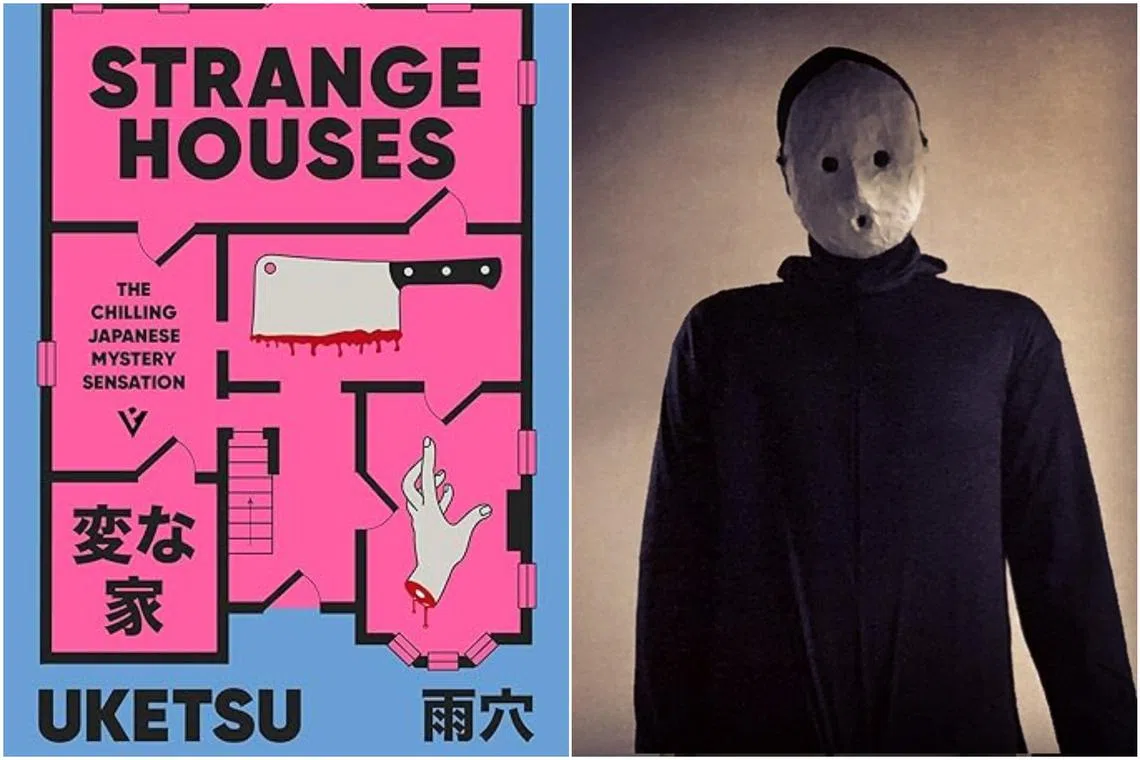
This is the first of three (so
far) short novels by Uketsu, translated to English from the original Japanese
by Jim Rion. According to the publisher’s blurb, the author, Uketsu, is “an
enigmatic YouTuber and author, specializing in horror and mystery, who has
exploded onto the literary scene in Japan, where his books have sold millions
of copies. He only ever appears online, wearing a mask and speaking through a
voice changer. His true identity is unknown.” A sort of viral Banksy if you
will.
The story begins with the
narrator explaining, “I’m a freelance writer, my speciality being stories of
the macabre. Given this line of work, lots of people approach me with their
personal experiences of the eerie and the unpleasant.” He goes on to tell a
story with a blanket level of detail, in which floor plans and family trees
take up half the book – refreshingly, there is no need to flick back to the
beginning pictures to follow along. The floor plans reveal hidden passages and secret
rooms for nefarious business. Most of the text is written as play dialogue,
which contains all the exposition so there is very little description. There is
an element of Edgar Allen Poe’s short stories; thrilling creepy tales that can
be read in a day or two.

In keeping with detective
fiction rules that all clues must be mentioned, there are plenty of apparent irrelevancies,
but also deliberate omissions. Despite exhuming some standard tropes, the Japanese
horror story is certainly different. Sub-headings within chapters are almost like
a child’s first reader: A Message from a Friend; An Unexpected Email; The
Mysterious Space; Daydream; Two Bathrooms; The Article; A Grisly Discovery;
Differences; The Letter; The Hidden Room; The Sign. The tale deals with dismembered
bodies, curses, murderous children, blackmail, and the importance of succession
and illegitimacy. One character fairly remarks, “I can see how it all fits
together, but… isn’t it all a little far-fetched? It’s so convoluted.” Japanese
horror is built on this sort of thing, and there is already a film - released in Japan in 2024.
The murders themselves seem quite
matter of fact. “The Katabuchi family has been murdering people for generations.
I don’t know why, but it has become a tradition.” When a character suspects her
father is involved, the narrator notes, “It was not the kind of truth that most
people could have accepted so calmly, but she seemed surprisingly untroubled.”
He, himself, hardly seems more disturbed, as he ponders where a child was
killed, but not why they were killed at all. He casually discusses horrific customs,
such as, “Mabiki. ‘Thinning the garden’. In Japan, there was once a
tradition of aborting babies or even killing children to keep down the number
of mouths to feed. The practice lasted into the late nineteenth or even early
twentieth century in some communities.” When the ending appears to be
inconclusive, and his colleague “flashed a broad grin”, he allows himself to
feel “a twinge of irritation at his total lack of concern.”
Training children in macabre cults and brainwashing them into murder adds a particularly chilling element. “He had an unhealthy pallor, and his expression was as blank as if it had never known emotion… He never took any action of his own volition and never expressed any of his own feelings or desires.” The whole scenario is highly implausible, but this is the breeding ground for horror. “It sounds wild, but we already know the Katabuchi family is not a normal one.” Investigating murder by looking into floor plans brings a new angle – in many dimensions – to a standard genre. They may be compact crimes, but they are far from cosy.