Showing posts with label horror. Show all posts

Wednesday, 29 April 2026

Horror in Another Dimension: Strange Houses


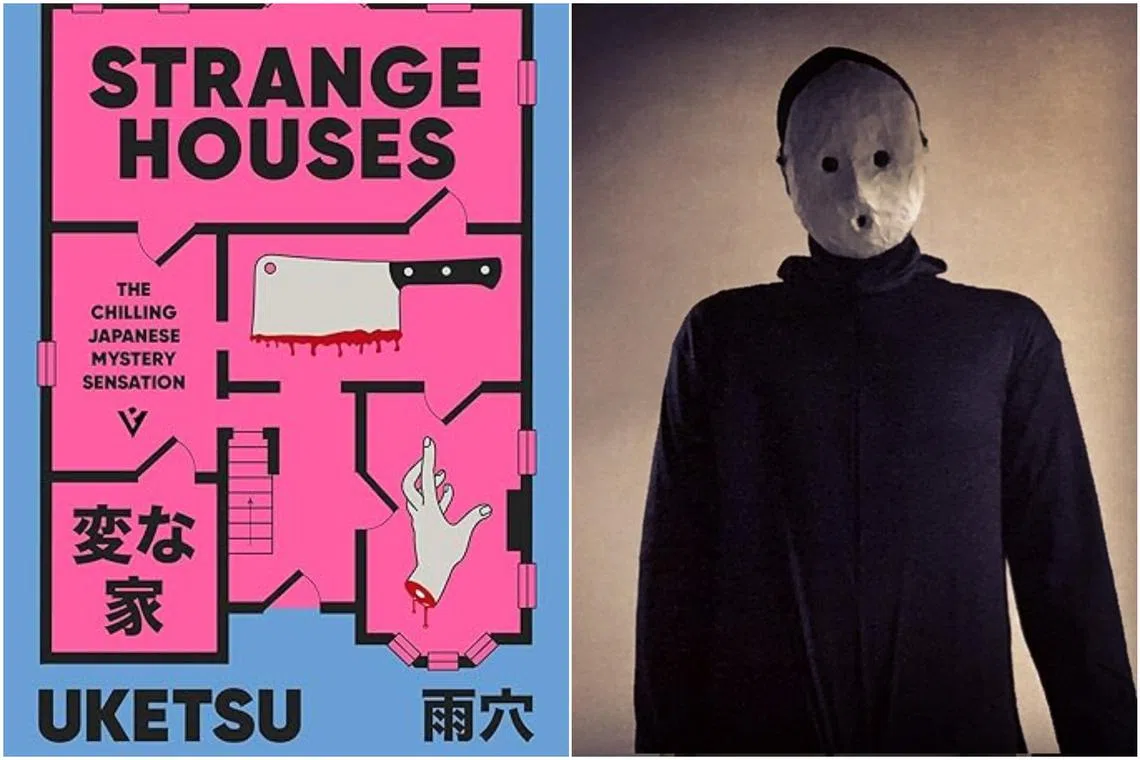
Strange Houses by Uketsu
Pushkin Vertigo
Pp.197
 

This is the first of three (so far) short novels by Uketsu, translated to English from the original Japanese by Jim Rion. According to the publisher’s blurb, the author, Uketsu, is “an enigmatic YouTuber and author, specializing in horror and mystery, who has exploded onto the literary scene in Japan, where his books have sold millions of copies. He only ever appears online, wearing a mask and speaking through a voice changer. His true identity is unknown.” A sort of viral Banksy if you will.


The story begins with the narrator explaining, “I’m a freelance writer, my speciality being stories of the macabre. Given this line of work, lots of people approach me with their personal experiences of the eerie and the unpleasant.” He goes on to tell a story with a blanket level of detail, in which floor plans and family trees take up half the book – refreshingly, there is no need to flick back to the beginning pictures to follow along. The floor plans reveal hidden passages and secret rooms for nefarious business. Most of the text is written as play dialogue, which contains all the exposition so there is very little description. There is an element of Edgar Allen Poe’s short stories; thrilling creepy tales that can be read in a day or two.


In keeping with detective fiction rules that all clues must be mentioned, there are plenty of apparent irrelevancies, but also deliberate omissions. Despite exhuming some standard tropes, the Japanese horror story is certainly different. Sub-headings within chapters are almost like a child’s first reader: A Message from a Friend; An Unexpected Email; The Mysterious Space; Daydream; Two Bathrooms; The Article; A Grisly Discovery; Differences; The Letter; The Hidden Room; The Sign. The tale deals with dismembered bodies, curses, murderous children, blackmail, and the importance of succession and illegitimacy. One character fairly remarks, “I can see how it all fits together, but… isn’t it all a little far-fetched? It’s so convoluted.” Japanese horror is built on this sort of thing, and there is already a film - released in Japan in 2024.


The murders themselves seem quite matter of fact. “The Katabuchi family has been murdering people for generations. I don’t know why, but it has become a tradition.” When a character suspects her father is involved, the narrator notes, “It was not the kind of truth that most people could have accepted so calmly, but she seemed surprisingly untroubled.” He, himself, hardly seems more disturbed, as he ponders where a child was killed, but not why they were killed at all. He casually discusses horrific customs, such as, “Mabiki. ‘Thinning the garden’. In Japan, there was once a tradition of aborting babies or even killing children to keep down the number of mouths to feed. The practice lasted into the late nineteenth or even early twentieth century in some communities.” When the ending appears to be inconclusive, and his colleague “flashed a broad grin”, he allows himself to feel “a twinge of irritation at his total lack of concern.”


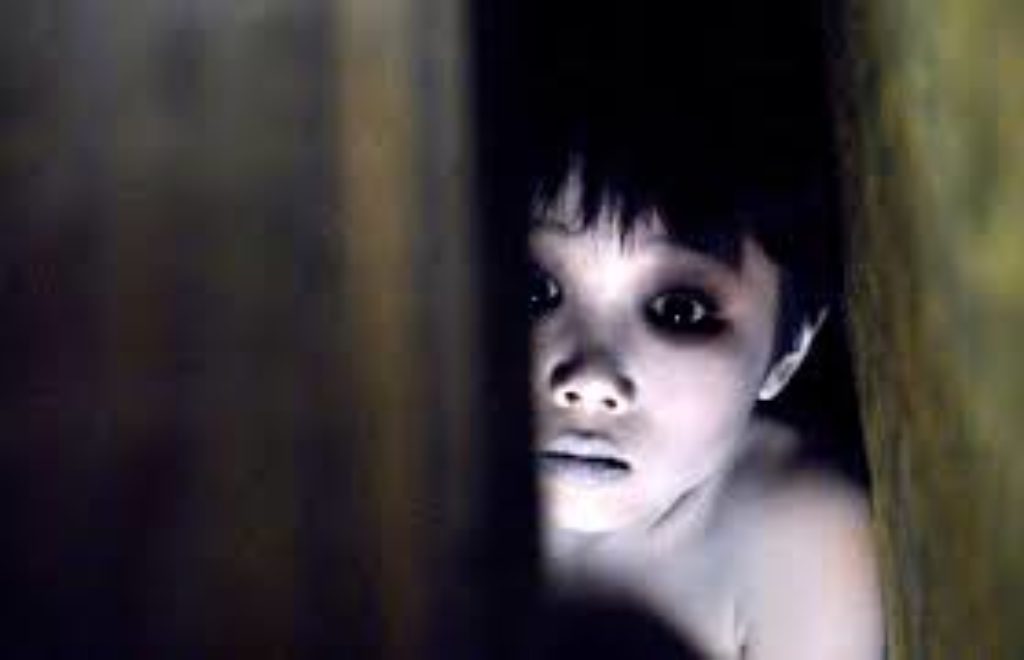
Training children in macabre cults and brainwashing them into murder adds a particularly chilling element. “He had an unhealthy pallor, and his expression was as blank as if it had never known emotion… He never took any action of his own volition and never expressed any of his own feelings or desires.” The whole scenario is highly implausible, but this is the breeding ground for horror. “It sounds wild, but we already know the Katabuchi family is not a normal one.” Investigating murder by looking into floor plans brings a new angle – in many dimensions – to a standard genre. They may be compact crimes, but they are far from cosy.

Friday, 17 April 2026

Friday Five: Books Read in March

  1. Prisoners of Geography by Tim Marshall (Elliott and Thompson Ltd) - To see how nations and cultures behave the way we do, we often look to history. In this fascinating work, Tim Marshall posits that past actions may have more to do with geography; natural rivers and mountains as boundaries (France was a successful nation because it has the most kilometres of navigable rivers of any country in the world, thus facilitating movement of goods and ease of trade), and artificial partitions (the arbitrary division of East and West Pakistan has caused unrest and volatility in the subcontinent for the past eighty years). For example, the USA and Russia had communication and unification issues purely due to their physical magnitude; Egypt didn't become a colonialist power because it had no trees with which to build ships; and China seeks expansion to secure warm water seaports. Control of ports, seas, exclaves, canals and straits are of crucial geopolitical importance. Marshall wrote this book in 2015, and this is a revised version published in 2025. With recent global conflicts, including the war to control the Strait of Hormuz, he has plenty to include in his next update. 
  2. Cunning Women by Elizabeth Lee (Windmill Books) - Of course I was going to read this book set in 1620 Lancashire, at the height of the persecution of women condemned as witches. In a small hamlet abandoned since the plague, the only people who live there are the Haworth family: Sarah, her little sister Annie (who is practically feral), her brother John and their mother, who is losing her wits (increasingly conversing with her familiar, Dew Springer) potentially due to lack of contact with the local community. It's sort of a love story as Daniel falls for Sarah but cannot explain why, so naturally others say it's because she has bewitched him, particularly the pretty May Queen who wants him for herself. It is also an exposé of hypocrisy as the villagers like the family and use their knowledge when it suits them, but blame and condemn them when that is more convenient.
  3. The Dark Side of Camelot by Seymour Hersch (Harper Collins) - There is a romantic view of JFK, enhanced in part by his assassination. If that's the way you'd like to preserve your idealisation, I would recommend steering clear of this book. From his serial womanising (he had people to procure him prostitutes and warn him when Jackie was returning to the White House so he could get them out of the pool), to his evident connections with the Mafia and organised crime, via his complete and callous incompetency over the Bay of Pigs incident and the Cuban Missile Crisis, there was something very rotten in the state of D.C. As part of his personal feud with Fidel Castro, Kennedy authorised to the CIA to lace Castro's cigars with toxins, poison his milkshakes, prepare contaminated diving suits and rig brightly-coloured explosive seashells in the areas where he commonly went skin diving, not to mention bringing the world to the brink of nuclear war. He made deals with Russian politicians, which have only come to light since the declassification of documents and personal correspondence in the late 1990s, escalated the Vietnam War and approved the use of chemical weapons. He was also on multiple drugs (including opioids, anaesthetics, steroids, tranquilizers and stimulants) to manage his back pain - naturally this toxic cocktail would have affected his judgement as much as the corset he wore to straighten his posture prevented him from slouching in the seat on that fatal day in Dallas. The tone of the book is very serious and wordy, so don't expect light relief, but then again, you might consider that the hagiography of an arrogant, misguided misogynist to be no laughing matter.
  4. The Shortest History of Australia by Mark McKenna (Black Inc.) - The 'Shortest History of' series began with Europe in 2012. It has since expanded to include titles on Japan, Greece, Ancient Rome, India, Democracy, The Crown, War, Economics and Innovation. The premise is that they offer 'clear and concise accounts of broad-ranging topics from the world's leading subject matter experts [that] can be read in an afternoon and will transform your perspective for a lifetime.' At over 250 pages and packed with facts and information, I dispute the idea that this could be read in an afternoon, but I do agree that it is fascinating and illuminating. Perhaps the main theory behind this treatise is that the history of Australia is neither linear nor consequential but that many strands can co-exist consecutively. Indigenous Australia, the penal colony, the gold rush, Federation, WWI and the formation of the Anzac legend (Australia being "the only modern nation-state to create an origin myth not located on its own soil"), WWII, the Cold War, and waves of non-British migration are all necessary to the shaping of the country, and all are essential to understand Australia as it is now.  
  5. Strange Houses by Uketsu (Pushkin Vertigo) - In this Japanese horror/ mystery, housing floor plans and family trees take up half the book. Much of the text is written as play dialogue, which contains all the exposition, so there is very little description. The tale deals with dismembered bodies, family curses, murderous children, blackmail, and the importance of succession. Despite being pretty far-fetched and exhuming some standard tropes, the creepy thriller is certainly different in style. There is an element of Edgar Allen Poe's short stories, which can be read in a day or two, but leaves a lasting impression.

Friday, 28 April 2023

Friday Five: Films on a plane

  1. Emily: Still not my favourite Bronte, although Emma Mackey is brilliant and the moors look pretty.
  2. EO: What with Banshees of Inisherin, this may be the Year of the Donkey.
  3. The Fablemans: The making of an auteur. It's clearly very autobiographical and gives away a few secrets (putting pinholes in the film; allowing light through to simulate flashes from gun-shots). The personal and insular focus, with specific parental relationships, is the same kind of film-making therapy as demonstrated in Honeyboy.  Lock-downs clearly led to lot of navel gazing and subsequent oversharing. This is great if you want to know all about your directors/ actors/ film practitioners, but a bit self-indulgent if you don't.
  4. Marcel the Shell with Shoes on: A cute and quirky animation in which a shell tries to find his family. As well as exploring the sense of identity and belonging to a community, the film also addresses the issue of on-line fandom and virtue-signalling activism. It's far more affecting than it has any right to be. 
  5. M3GAN: Science-fiction horror, which is also funny and cine-literate with self-aware references to previous works in the AI-companion-goes-feral genre.

Friday, 26 August 2022

Friday Five: TV Viewing

I've not done a recap of the TV I've been watching for a while, so there's a fair bit of catching up to do. Here are five recent viewing choices.

5 TV Shows I've Watched Recently:

  1. Jekyll (BBC One) - Proving that he would have made a great Dr. Who, James Nesbitt stars in the Steven Moffatt-written 2007 TV series, Jekyll. It has all the hallmarks we have grown to expect from the man who went on to write Sherlock and Dracula also for the BBC. Described by its creators as a sequel to the 1886 novella, Strange Case of Dr. Jekyll and Mr. Hyde, rather than as an adaptation of it, it positions Nesbitt as Tom Jackman, a modern-day descendant of Dr. Jekyll, who has recently begun transforming into a version of Mr. Hyde (also played by Nesbitt, having fun exploring the dark side of a character). Michelle Ryan plays the psychiatric nurse who assists him in his experiments, recording evidence for further interpretation of the deeper workings of the inner mind. It's slick and stylish sci-fi with lashings of horror and a splash of humour, and because it's British it consists of six episodes and then it stops leaving the viewer wanting more rather than dribbling on for several seasons and outstaying its welcome. 

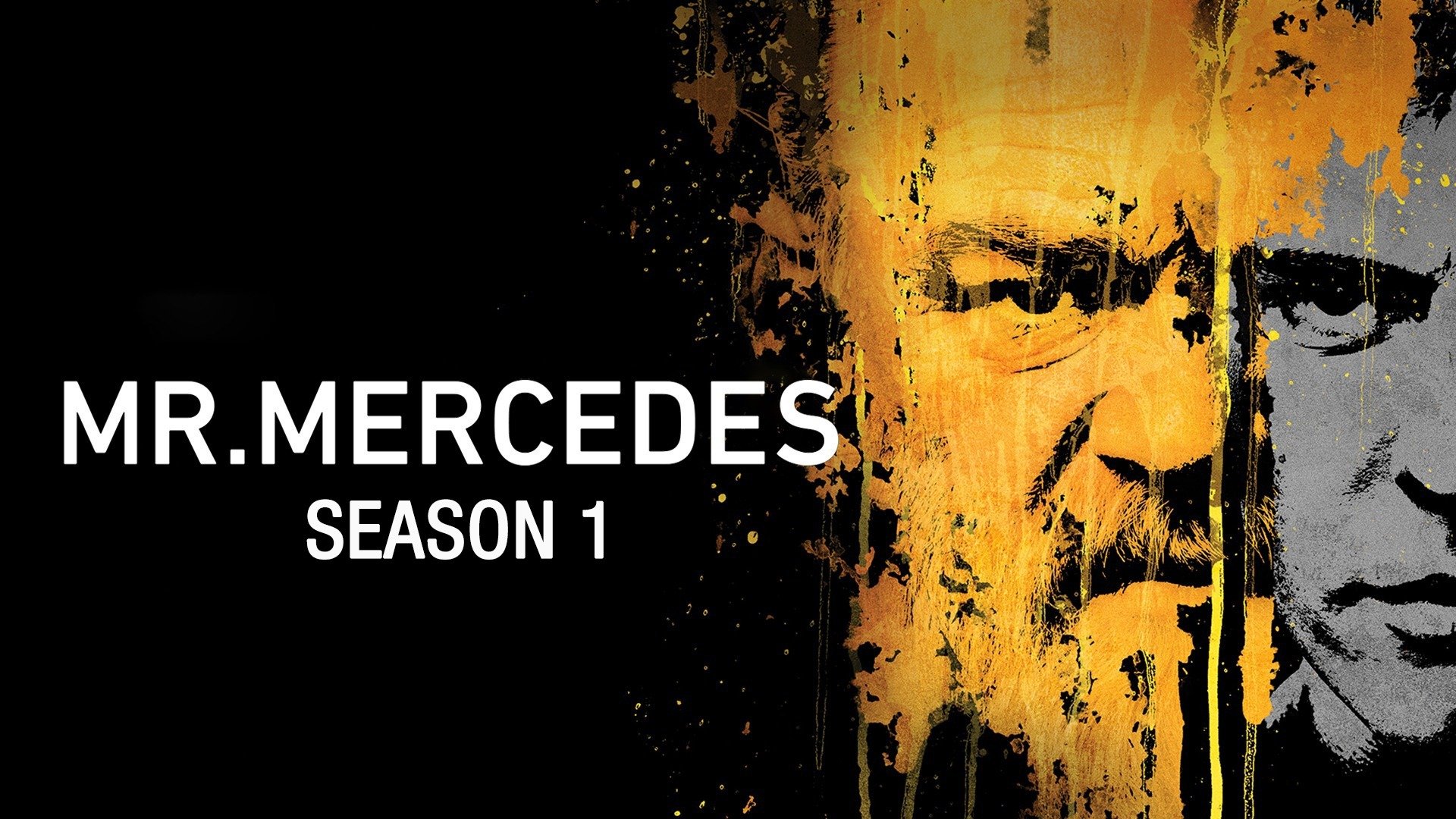
  2. Mr. Mercedes, Season One (SBS On Demand) - Based on the Steven King novel, this TV series is part supernatural horror and part detective fiction. Brendan Gleeson is Bill Hodges, the recently-retired detective who drinks too much, hates everyone and everything except his pet tortoise, and can't seem to let go of an unsolved case from two years previously, when a driver in a clown mask ploughed through a crowd of people waiting outside a job fair. Hodges may not know who the killer was, but the audience does, as Harry Treadway is introduced as Brady, calling himself Mr. Mercedes and taunting the detective with his criminal past. The show begins with a seedy ambience (Brady's family situation is a far-cry from the wholesome American Brady Bunch set up, and his place of work isn't much better) but it is highly polished with snappy dialogue and credible characters - all provided with backstories and sympathetic motivations (created by David E. Kelley). There are another two seasons after this; I'll probably watch them. 
  3. The North Water (BBC First) - A bunch of men go whaling in the mid-nineteenth century. None of them are particularly pleasant, but some even less than others. They drink and fight and kill. Testosterone abounds in the ports and the ship as it travels to the Arctic with a secret agenda and a lot of laudanum. It feels nightmarish and disturbing, as writer/director Andrew Haigh intended: "I always wanted the audience to feel at sea. So they were never quite sure what this was going to become or what it was." The chiaroscuro effects are dazzling - if we are not in the dark belly of the ship we are on the blinding white landscape of ice and snow, splatted with blood and seal carcasses. The acting is excellent (Colin Farrell; Stephen Graham; Jack O'Connell; Sam Spruell; Roland Møller; Tom Courtenay), the motives are shady, the concept is brutal, and the scenery is spectacular. 
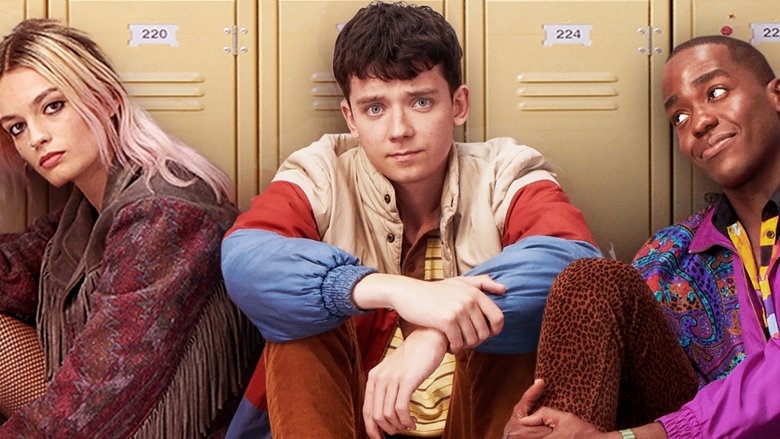
  4. Emma Mackey, Asa Butterfield and Ncuti Gatwa in Sex Education
  5. Sex Education, Season Three (Netflix) - After having binged the first two seasons in a weekend a couple of years back, I admit I watched this mainly after the announcement that Ncuti Gatwa was going to be the new Dr. Who - I didn't want to confuse him with Eric in my  mind, so watched this to get it out of my head(and he is the best thing in it). The first few episodes started slowly but then it picked up momentum, diving deeper into the stories of the talented ensemble than previously. Connor Swindells (Adam), Aimee-Lee Wood (Aimee), Tanya Reynolds (Lily), Chinenye Ezeudu (Viv) are among those who get to flex their acting muscles and create showreels for future auditions. It still tackles tough issues of adolescence and identity, but each one is neatly wrapped up as it begins to feel more American than British. The diversity and inclusion is a bit unicorns and rainbows, the humour is glib and obvious rather than sarcastic and subtle, and I keep expecting the cast to break into harmonised song and choreographed dance.
  6.  
  7. Vigil (BBC First) - Imagine you're in a confined space with a group of people you don't really like. There's a murder and you have to solve it. Did I mention the confined space is a submarine? Did I mention you're claustrophobic and need to take medication to remain calm, but that medication is prohibited on the vessel? And that the submarine is a nuclear stealth submarine? And that it's just been hit? By a suspected ally? And you can't communicate with the outside world because it would give your position away? And no one knows you're there? Right- that's the premise, created by Jed Mercurrio and the team that brought us Line of Duty and Bodyguard. Suranne Jones is both tough and vulnerable as DCI Amy Silva in this preposterous position, and her partner above the waves, DS Kirsten Longacre is Rose Leslie in a performance that is almost good enough to atone for her irritating turn in The Good Fight. Martin Compston (Steve Arnott in Line of Duty), Gary Lewis (My Name is Joe, Billy Elliot), Shaun Evans (Morse in Endeavour), Connor Swindells (Adam in Sex Education), Paterson Joseph (Benjamin in Jekyll and Lyndon in Teachers amongst other things), Adam James (John Bellasis in Belgravia and multiple stage appearances), all give committed and credible performances, and the tension is palpable, although the plot is a bit leaky and the conclusion is all too neat - with an eye on the US market perhaps?

Friday, 27 August 2021

Friday Five: Classic Films I 'Should' Have Watched

You know those films that you always feel you should  have watched, but you just haven't got round to it yet? Well, over the last week (we're in lockdown), I've been trying to catch up with some.

5 Classic Films I 'Should' Have Already Seen:

  1. The Exorcist (1973 Horror/ Supernatural) - Lots of male doctors lecturing a woman about how to run her life and deal with her daughter; the keepers of the knowledge deciding females they can't understand must be hysterical... It might be almost 50 years old, but some aspects still resonate. I believe good horror stories are never 'just' about horror; they connect with our deepest fears, ignorance and insecurities to explore something psychological. I feel this films does that, and Ellen Burstyn is spectacular. In conclusion: worth watching as a classic of the genre (I know all the best lines anyway), but probably not scary to a modern audience.
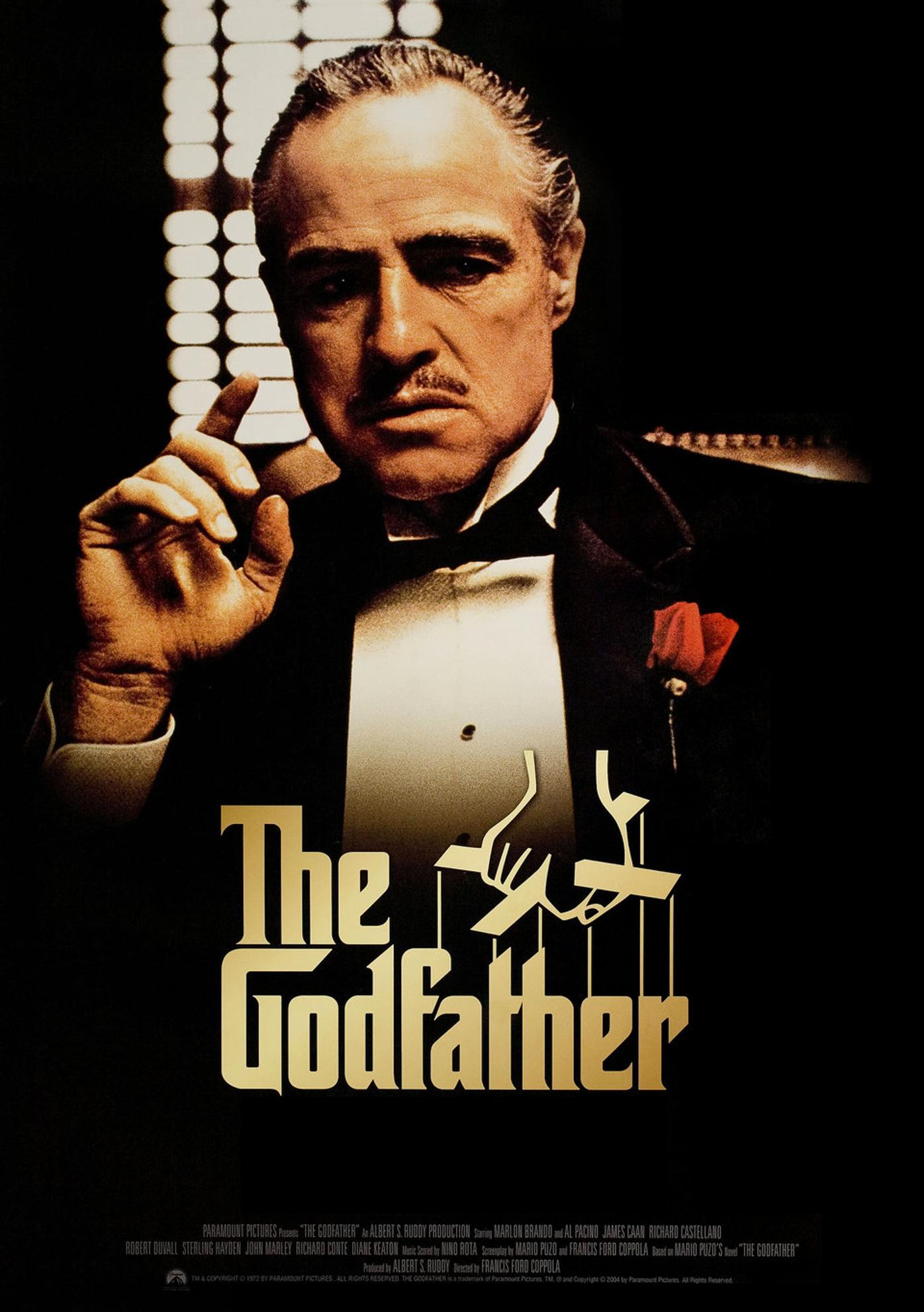
  2. The Godfather (1972 Crime/ Drama) - Men use their violence and strength to secure nepotistic deals and gain yet more wealth and power. How quaint. Again, all the best lines are familiar - offers you can't refuse; sleeping with the fishes etc. - the score is sumptuous, and Marlon Brando, Al Pacino and James Caan give brilliant performances. I understand that this film re-calibrated the notion of seeing gangsters as a response to a corrupt society and made them into good guys, but it really is all about the guys, isn't it - and the toxic masculinity and lack of female representation may have set the women's movement back as far as it advanced the film genre.
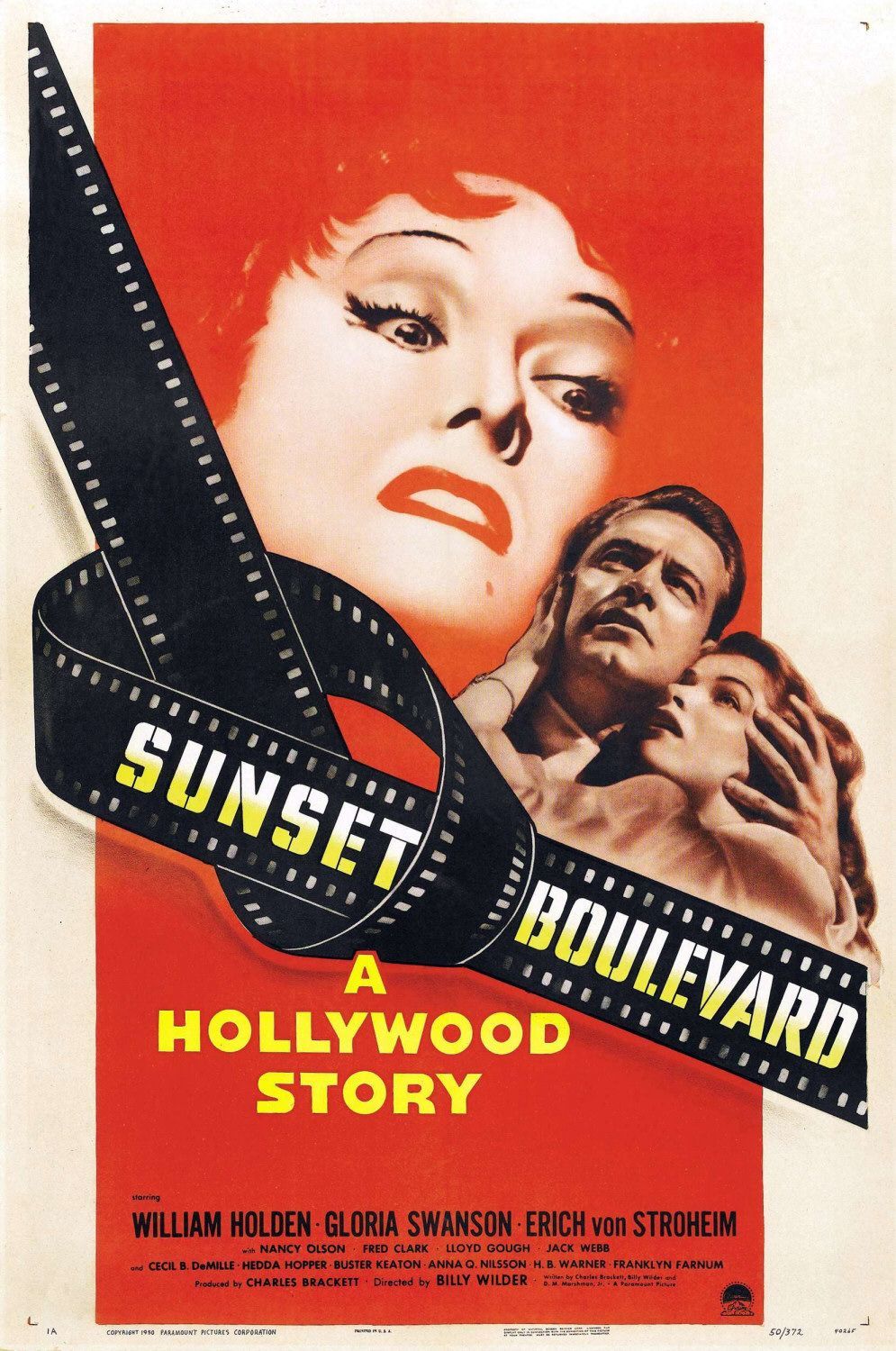
  3. Sunset Boulevard (1950 Noir/ Drama) - Mavellous fun; full of dramatic tension, stunning design and black comedy, with a seminal central performance from Gloria Swanson as a previous silent screen star in a world of talking pictures. "There's nothing tragic about being 50. Not unless you're trying to be 25."
  4. Battleship Potemkin (1926 Drama/ Silent) - I love me a good bit of revolutionary propaganda and I have particular views on borscht, so I thought I was ready for this. I wan't - it is outstanding! Those montages sequences and individual close-ups in the middle of mayhem are utterly groundbreaking, and the stirring score is thrilling. I appreciate the excellent moustache detail and I now understand the The Untouchables reference. 
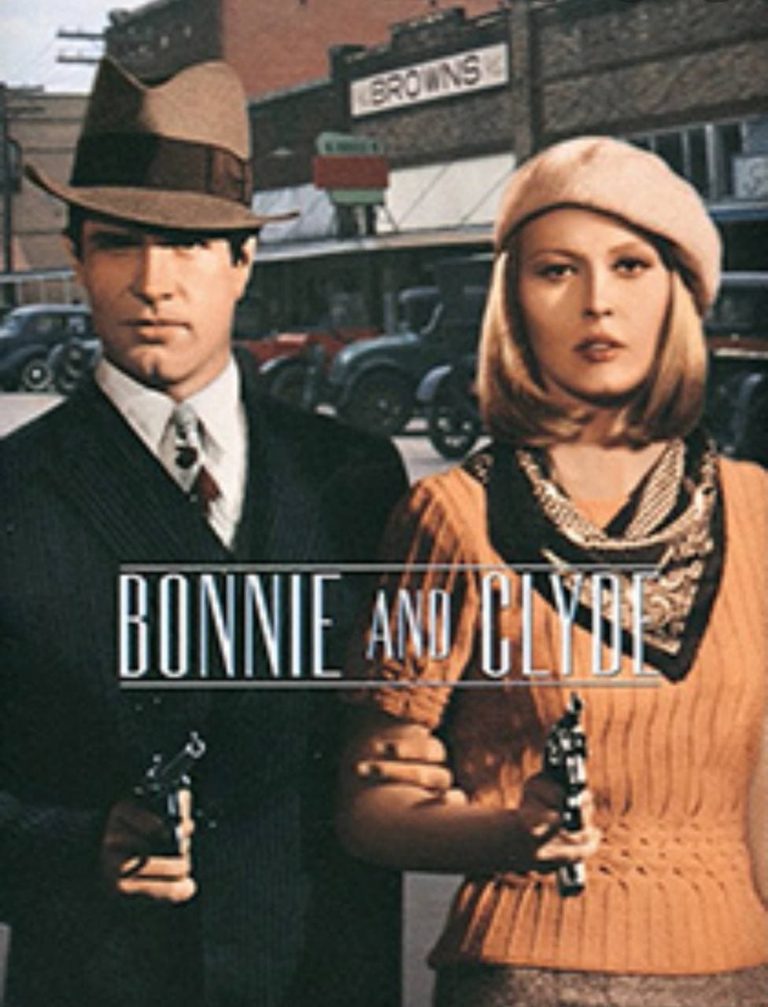
  5. Bonnie & Clyde (1967 Drama/ Crime) - Obviously the inspiration for The Dukes of Hazzard with a comedy-crime-committing duo who claim 'we rob banks' although there is nothing to rob because the people are so poor they've got nothing to save. I understand that life may be dull, but killing people is not the answer (although I agree with Ivan Moss's verdict on tattoos). Faye Dunaway has some fabulous outfits, Gene Wilder's screen debut is a highlight, and whatever charm and charisma Warren Beatty has (and with his reported womanising he must have some) it can only be off-screen rather than on. 

Tuesday, 18 May 2021

Putting the Cult into Culture: The Vesuvius Club


The Vesuvius Club by Mark Gatiss
Pocket Books
Pp.240

Mark Gatiss is well-known as an actor, screen-writer, and author, with multiple plaudits for (amongst other things) Dr Who, Sherlock, Dracula, The League of Gentlemen, The Madness of George III, and Coriolanus (for which he was nominated for an Olivier award for best actor in a supporting role). With The Vesuvius Club, his first non-Dr Who novel, he received a nomination in the category of Best Newcomer in the 2006 British Book Awards, thus assuring his position as a cult figure in the world of contemporary culture.

The Vesuvius Club is a Lucifer Box novel (the first of three), the subtitle of which is, “A Bit of Fluff”. This indicates that it is not to be taken too seriously, but also hints at a derogatory remark about a sexual partner. Indeed, there is lots of barely-concealed double entendre on account of the fact that, in the Edwardian era in which the novel is set, “London was in a bit of a panic with the recent exigencies of Mr O.F.O’F.W. Wilde so fresh in the memory.” A comment on the jacket describes the novel as “Oscar Wilde crossed with H.P. Lovecraft” and, with the addition of John Buchan, that pretty much captures the genre mashup. The tone is one of humour and horror with a dash of wit and the world of espionage; there are archaic views of beauty propounded by the aesthetes (namely youth and slimness), racist stereotypes, and action-packed set scenes.

Lucifer Box is a flamboyant portrait artist, who lives at Number Nine, Downing Street. “I know, ostentatious, isn’t it? But somebody has to live there.” He uses his position to get close to the rich and influential and to provide cover for his clandestine activities as a secret agent. The Royal Academy acts as secret headquarters, where the toilet partition wall slides up to reveal the spymaster (obviously this also has other seedier connotations). He enjoys his work and thinking up novel ways to eliminate enemies: “artistic licence to kill, you might say.”

His mission is to investigate the disappearance of the Cambridge Four; a group of scientists, all now missing, presumed dead. This madcap adventure incorporates a whirlwind of stock thriller scenes: a horse-drawn cab chase with pistols; a rendezvous in the mist at a mausoleum; wrestling in a steamy Turkish bath; underground S&M clubs; glittering parties; an attack by a venomous centipede; a hunt through the sewers; explosions; eruptions; and volcanoes.

From the opening sentence it is clear that Gatiss is parodying Wilde’s linguistic style. “I have always been the most appalling judge of character. It is my most beguiling virtue.” The novel is full of similar sayings, causing the reader to wonder whether it is a witty aside or an empty aphorism. The illustrations by Ian Bass echo those of Aubrey Beardsley, and the louche, world-weary attitude is also familiar, as he fulfils his role with equal relish and ennui. “It was midway between the fish course and the pudding, as Supple opened his mouth to begin another interminable tale, that I did the decent thing and shot him.”

The novel is a spirited homage to spy novels and the work of Oscar Wilde, with a dash of cultish horror blended into the thriller. It’s fun and frivolous and a perfect divertissement.

Tuesday, 6 October 2020

Playing the Gothic Game: The Turn of the Screw


The Turn of the Screw by Henry James
Silver Burdett Company
Pp. 118

Originally published in 1898, The Turn of the Screw still delights and terrifies readers over 120 years later. The enduring appeal of the novella is due to James’ mastery with form and style as he uses Gothic tropes to exploit deep-seated fears and phobias. An unnamed governess narrates the story of how she takes her first position at Bly, a remote country house, and begins to fear that it is haunted by the previous employees, the valet, Quint, and the governess, Miss Jessel. She fears the spirits intend to harm her young charges and she is determined to keep them safe, with disastrous consequences.

The Gothic conceits are all present in a way that would be familiar to contemporary readers, and suggest that James is playing with them. The possible presence of ghosts in an isolated mansion (Mrs Grose, the kindly but dim-witted servant, is the only other living occupant) with dark corridors and darker secrets is a ruse recognisable to readers of popular fiction from The Castle of Otranto and The Mysteries of Udolpho (mentioned specifically in this novel) to Jane Eyre and Dracula (published the previous year). It also employs the device of a framed narrative, such as in Wuthering Heights, Frankenstein, and The Legend of Sleepy Hollow, in which we are told of a story told to someone else in the words of a manuscript a governess had left behind. This third-hand tale is introduced with chilling and thrilling glee as a typical ghost story; “The story had held us, round the fire, sufficiently breathless, but except the obvious remark that it was gruesome, as, on Christmas Eve in an old house, a strange tale should essentially be, I remember no comment uttered.”

Angelic children have become a mainstay of modern horror, and eight-year-old Flora and ten-year-old Miles are clearly prototypes as, “Both the children had a gentleness that kept them – how I shall I express it – almost impersonal and certainly quite unpunishable.” They are almost impossibly delightful with “their more than earthly beauty, their absolutely unnatural goodness”, although this may simply be an inexperienced governess’ interpretation of childhood.

The tension is increased throughout the tale, like the titular turning of the screw, as there are hints of paranoia and madness. For all the elaborate language, nothing is definite and everything remains in shadows. The metaphor is made explicit as the governess suffers from insomnia, stalking the halls with a candle in the middle of the night.

A Freudian interpretation would suggest hysteria and sexual repression: Quint and Miss Jessel were discharged for conducting an illicit affair, from the knowledge of which the children must naturally be protected. There is certainly a suspicion of surveillance, and the governess feels she is being observed, and judged, by the spirits on her performance. The central issue of the story is whether the ghosts are real, and the governess’ efforts in protecting the children are justified, or whether she is going mad, in which case they are at risk from her, and her consideration that they are linked to unspeakable evil is a reflection of her tormented psyche.

At the end of the nineteenth century readers were far more likely to believe in ghosts than they are now, although we are perhaps more understanding of psychoses.  Because James refuses to choose a definitive solution to his mystery, the tale of terror is compelling either way. It continues to be popular because we like a good scare, and this one is a ripper.