Showing posts with label nostalgia. Show all posts

Tuesday, 8 November 2022

You Spin Me Right Round, Baby: The Music Shop


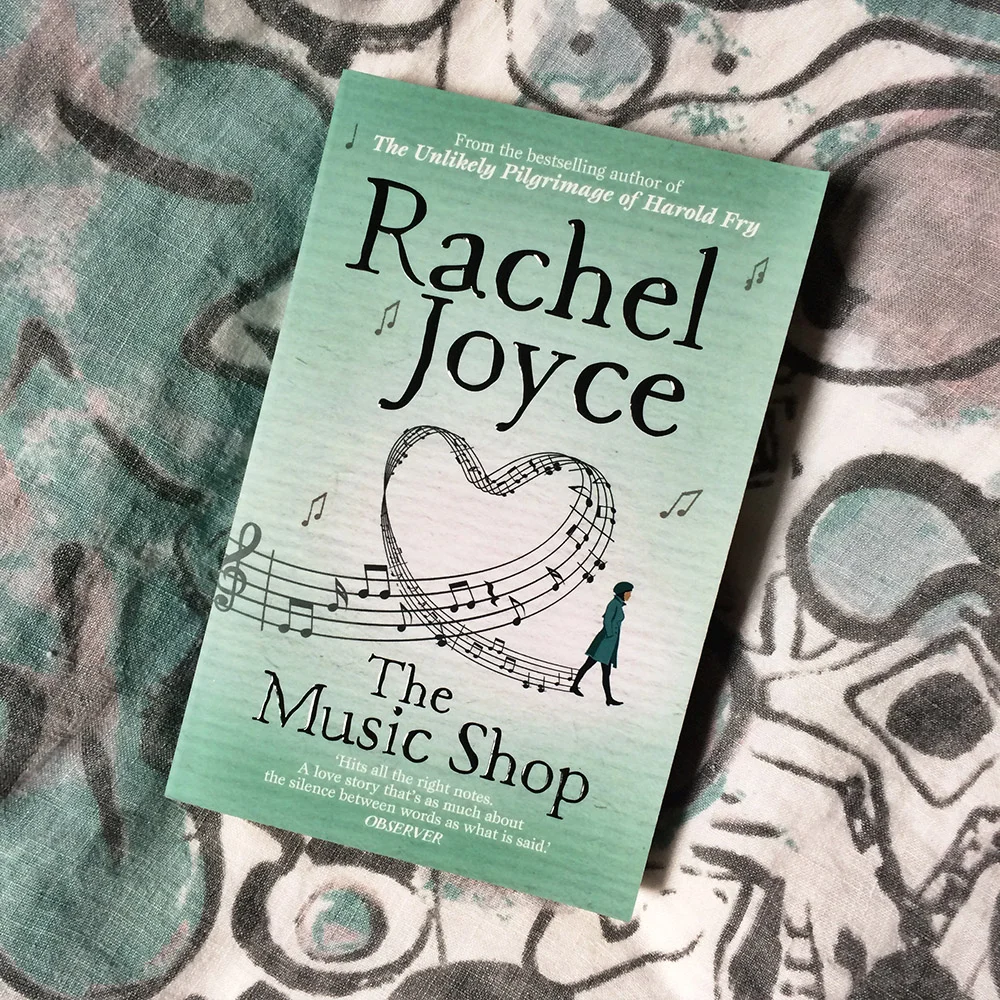
The Music Shop by Rachel Joyce
(Black Swan)
Pp.354

Frank owns a music shop which only sells vinyl, and he has the gift of being able to find the right music to soothe a person’s soul or mend their marriage. One day a beautiful woman, Ilse Brauchmann (manic pixie dream girl in a pea-green coat), faints outside his shop and they have a relationship. She says she doesn’t listen to music so he teaches her how to hear it. It turns out she was a highly proficient violinist but now has arthritis and can no longer play. And she is engaged to someone else. Of course she cares for him, but the author introduces deliberate (and illogical) stumbling blocks to draw out the story. Frank is not actually all that nice but he’s got lots of friends who encourage him in his romance (Richard Curtis style) including Maud, the tattooist, a woman who has always been inexplicably in love with him, and Kit, an incapable but passionate assistant. It’s very light and fluffy and employs every trope known to rom com, and yet the added appeal comes from the music and nostalgia.

Frank’s finest characteristic is his sense of community with the other shopkeepers. “Here they were, living together on Unity Street, trying to make a difference in the world, knowing they couldn’t, but still doing it anyway.” Ilse is supposedly cute, but immensely irritating. They meet for the lessons about music, in a café called The Singing Teapot, and the waitress becomes involved in their story too, which is charming, delightful, twee and completely unrealistic. Meanwhile, the author tells us everything so there is no room for mystery or suspense.

Music has magical properties, and listening to it can release oxytocin – books are written like this about cookery all the time; all the chapters are named after songs and there is an accompanying soundtrack. The novel contains frequent time shifts as we are cast back to Frank’s relationship with his mother, Peg, who taught him how to really appreciate music. This rapport is more interesting than that with the girl.

Music, especially vinyl, is part of the nostalgic focus of the novel, and it should be enjoyed as an experience. He uses the difference between CDs and records as a metaphor for life (God only knows what he’d make of music-streaming services), refusing to accept that he and his music shop are out of date although several reps and customers stop calling. He maintains that vinyl is messy and fragile, and therefore, more human.

The novel is Notting Hill meets Black Books; it is obviously written with one eye on the film rights, but it will doubtless be taken over by an American company who will change the setting and ruin it (see High Fidelity). Music is closely aligned with memory because it stimulates emotions, and that is what matters. Ilse remembers Frank because, “You didn’t talk about the technique of music. You told me how it felt when you listened.” Love may tear us apart, but music is best experienced together.

Tuesday, 9 June 2020

Idyllic Island Life: My Family and Other Animals


My Family and Other Animals by Gerald Durrell
Penguin Books
Pp.308

A generation of readers was introduced to this marvellous family and the island of Corfu through the school curriculum. It is ingrained in the childhood of many and to return to it as an adult is refreshing and fascinating. The recent TV series starring Keeley Hawes as Mother has fuelled a new interest and it is actually quite hard to separate the books from their screen interpretations, as they have been done so sensitively and affectionately. The opening sentence sets forth to manage our expectations;

“This is the story of a five-year sojourn that I and my family made on the Greek island of Corfu. It was originally intended to be a mildly nostalgic account of the natural history of the island, but I made a grave mistake by introducing my family into the book in the first few pages. Having got themselves on paper, they then proceeded to establish themselves and invite various friends to share the chapters. It was only with the greatest difficulty, and considerable cunning, that I managed to retain a few pages here and there which I could devote exclusively to animals.”
The memoir is narrated by Gerry, the youngest of four children. The other members of the family are Larry, the eldest, and also known as famous published author, Lawrence Durrell, Leslie, who seems to like shooting things, and Margo, who wants nothing more than to get a tan. They are guided, after a fashion, by Mother, to whom the book is dedicated. It was either a bold or a foolhardy move to decamp to a Greek island in the 1930s (the TV series suggest alcoholism and impecuniousness were involved), but with hindsight, Gerry’s affection for his mother and her management of the menagerie is clear.

The family are loud and boisterous, with confidence that would be arrogance if it weren’t so kindly transcribed. Mother is aware that Gerry desperately needs an education; he explains that as a child his English and maths are woeful and the only words he can spell correctly are biological ones. He captures his dealings with his family with a child’s interest, providing light humour and insight. The direct style mixes the monumental with the banal. The family move house a few times (including the first great shift) and each time Larry suggests it; mother rejects it: “We are not moving to another villa, I’ve made up my mind about that”. The next chapter then begins with the move: “The new villa was enormous”. 

They have parties where the animals terrorise the guests (there are scorpions in matchboxes and snakes in the bath) and The Durrells think nothing is untoward. The family seem to get ‘caught up’ in the island rituals rather more by accident than design, while Gerry visits the islanders, who all think the English are odd, but refer to him (apparently affectionately) as “the little lord”. There is a lot of stereotypical sexist peasant behaviour that is considered acceptable, and his views are vaguely racist.

Gerry is interested in little other than animals, and there are lots in the book, as suggested by the title, but not as many as I had remembered. There are far more insects, and plenty of anthropomorphising. He gets a little carried away with describing the seasons in a manner that is not strictly scientific, adding to the overall whimsy. He can be forgiven, however, for the book itself has a wonderfully soporific effect. When he writes of languid afternoon swims, sunny siestas on the veranda and afternoon teas that leave the guests pleasantly replete, it is with precision and nostalgia. Who wouldn’t want to be there? 

The author evokes a wonderful feeling of a time and place, which could never be replicated. Because this is the memory of a child, it may never even have existed, but, whether returning to this book or encountering it for the first time, the reader feels the comfort of coming home.

Thursday, 26 March 2020

Walking in Circles: London Overground


London Overground by Iain Sinclair
Hamish Hamilton
Pp. 258

In 2012 Iain Sinclair and his walking companion, Andre Kötting (British artist, writer and film-maker b.1959) spent a day tramping around the London Overground circuit, and Sinclair recounts the journey by weaving in references to others who have come before. Processions and pilgrimages are evoked from Chaucer’s Canterbury Tales to Bunyan’s Pilgrims Progress, as the duo walk just for the sake of walking. He is at his best when describing the physical mechanics of motion. “Refuelling was a requirement, but sitting down would carry the risk of our not being able to rise again. Pints were delivered, swilled back, replenished, before a bowl of steaming fish pie made it from microwave to table.”

He likes to walk. He has walked around Hackney, the M25, and areas that have been cleared for the Olympics before, and written books about all of them.  Understanding the needs for a hook with which to draw in the reader, he chooses routes that are frequently travelled, but by different forms of transportation. Above all, he fears bland homogenisation and he despises shopping centres, such as Clapham Junction, in a sentiment familiar from Ghost Milk.

Sinclair writes with a sense of nostalgia, and is proud of his grumpy old man status: “This old-man sourness is addictive. Period pains from the inability to accommodate change. When nature pricks and the heart engages, people go on long pilgrimages”. Resistance to progress tends towards snobbish bigotry. He dislikes popular culture; he dislikes cyclists, mothers with pushchairs, and people on mobile phones; anyone, in fact, who enters ‘his’ space.

His references are deliberately esoteric but they are overwhelmingly white, middle-class, and decidedly male. The number of name drops becomes exhausting – there are 387 in 258 pages (I counted and catalogued them all, with their Wikipedia entries as interpretation). Of these 387 authors, artists, poets, politicians, film-makers, architects, actors, explorers, scientists and activists who people this particular landscape, only 43 are female: that’s fewer than 12%. Women may be mentioned as eye witnesses to events, nameless passers-by to whom he talks, or memories of previous lovers (again nameless), but they make no significant impression on this history of London.

Sinclair writes in truncated sentences, which can be punchy but soon grow tiresome: “He put his money where his mouth was. And his tongue was blistered with diamonds.” It can be difficult to tell whether the prose is clever or just obtuse: are these profound analogies or empty aphorisms?

One of Sinclair’s bugbears is the commercialisation of the environment. He notes the areas of desirable real estate: “Even a minor physical elevation comes with entitlement to upward social mobility.” He admits, “We would all live on the river if we could, waiting for the rains of Schadenfreude to wash us away. Climate is another word for conscience.” He shuns the wealthy and the nouveau riche. “Fundamentalism of every stamp, including the fundamental decencies of the old Surrey stockbroker belt (now given over to Russian oligarchs and Premier League footballers), is suspect. Bourgeois marriage is a lie. Property is debt.”

While mourning the past, he invokes the present in poetic language, “The Thames riverbank would, in a few years, become a circus with a Ferris wheel, chair-lift rides, millennial (discon)tent on the East Greenwich swamps, and a shockheaded mayor as a public clown, swinging from wires or falling off a trick bicycle.” His associations with the city are intense, and he refutes any that don’t align with his emotions. “Maybe that’s it: the memory-place should remain fixed. The attitude to the great sprawl of the metropolis is verging on Oedipal.” London changes constantly, and while everyone is defensive of their own version, they should probably be more tolerant of the fact that there is room for many more.

Friday, 24 May 2013

Friday Five: Looking Back

The most-hyped film of 2013 is due for Australian release next weekend. In the lead-up to Baz Luhrmann’s bombastic take on The Great Gatsby, there has been a general scramble to show appreciation of the jazz age. This includes many folk opining how much they would have liked to have lived in the 1920s, when glamour was de rigueur and showgirls were awash with champagne.

I’ve never really got this ‘born into the wrong era’ thing. For one thing, if you were lucky enough to be a Bright Young Thing in the 1920s, you had a great depression, another World War and the chilling spectre of fascism looming on the horizon. As for fashion, those dresses (not to mention those dances) aren’t at all becoming for larger-chested women. And women (aged 21 and above) did not achieve the right to vote until 1928 in the UK. (The Representation of the People Act of 1918 only enfranchised women over 30 who met minimum property requirements).

Herein lies much of the problem. When people look back longingly at bygone eras and imagine themselves in such times, they are thinking of the rich, the male and the white. Admittedly there is still a long way to go (and many of today’s young women are actually retarding the cause by assuming it is no longer an issue) but there has never been a better time to be a woman than right now in the Western democratic world.

I have the right to vote; to work; to be educated; to be healthy; to live how I want and love whom I want. So when people ask in what decade you would most like to live, I have to say now. Many people seem to like to wallow in nostalgia, and I have recently come across many examples of this, but I will not play that past is better game.

5 Examples of Moribund Nostalgia:
  1. The Hollow by Agatha Christie – I recently performed in this play which includes many lines about memory and going back to our roots. “The past is sometimes a very good place to live.”
  2. Midnight in Paris – fellow cast members had a discussion about this film, which illustrates in a surprisingly gentle way how even those who live in the so-called halcyon days don’t see them as such as yearn for something else.
  3. The Past and Other Lies by Maggie Joel – a book I was reading at the time of the run, which follows three sets of sisters in London from WWI until ‘now’ and includes this quote:
    “You were meant to get nostalgic for the past once you reached a certain age, but it hadn’t happened. And why would it? The past wasn’t somewhere any right-thinking person would wish to dwell. It contained far too much that you were sad had gone forever, and so much more that was just plain unpleasant. And it got no less unpleasant just because the years had passed. You just felt the pain of it less, that was all.”
  4. An article I read in The Word magazine by Rob Fitzpatrick about our attitude to young people’s music, in which he writes,
    “Don’t waste your life trying to steal back the past. But just as importantly, don’t try and trash the future either – because it’s not ours to trash. The people it belongs to don’t care what we think anyway.”
  5. “The past is a foreign country – they do things differently there” – the opening line from L.P Hartley’s The Go-Between, and a great quote.