Showing posts with label Gerald Durrell. Show all posts

Tuesday, 23 March 2021

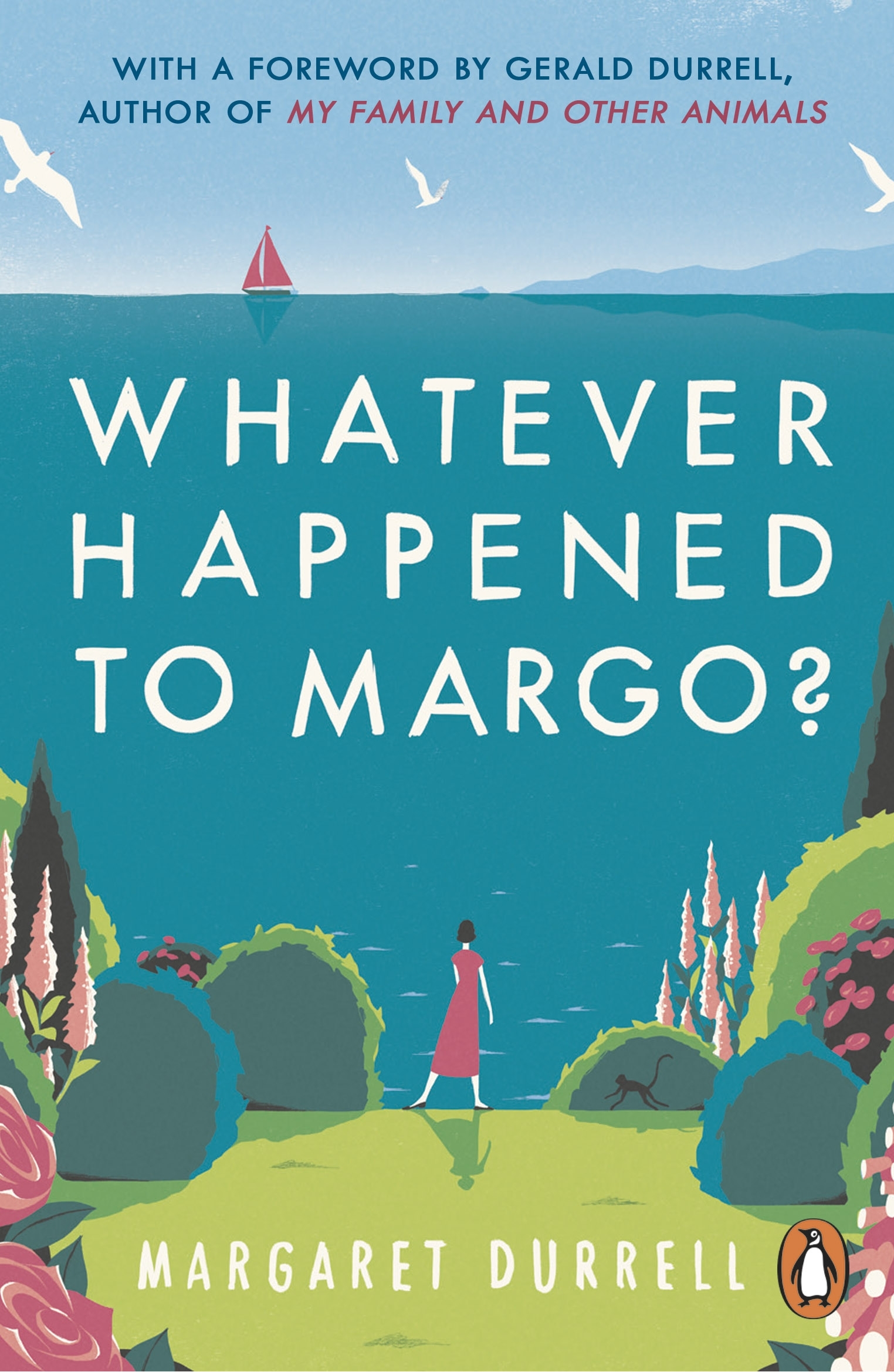
Bigotry in Bournemoth: Whatever Happened to Margo?


Whatever Happened to Margo? by Margaret Durrell 
Penguin
Pp. 259

Those who read Gerald Durrell’s Corfu Trilogy about the escapades of the Durrell family on the Greek island in the 1930s, will be familiar with the character of Margo, and may indeed be interested in discovering what became of her. Fortunately for them, she has written a book about her subsequent life as a landlady in a Bournemouth boarding house. Unfortunately, she is not as entertaining a writer as her brother, and, whereas his anthropological remarks on animals were amusing and informative, hers on people are snobbish and dated.

After prompting from an aunt, Margo decides to buy a property across the street from her mother’s house, with money which was “a legacy from my father – dwindled somewhat”. She is ‘respectable’ and ‘middle-class’ with a divorce and two male children to her name, but there is no evidence of actual work. Her plan to take in a series of lodgers is a decent one especially since (one suspects) she has no employable talents.

It is 1947 and attitudes were different then, but the language and assumptions about her lodgers are quite ugly when related to modern readers. Edward Feather is a flamboyant red-bearded painter, leading to words like ‘nonce’ and ‘pansy’ being bandied about and smirks about men who wear tight trousers. Harriet is an eccentric old lady who accuses others of stealing her belongings while removing all the lightbulbs in the public spaces; when the residents gather over psychology books to decide what is wrong with her, at first they think she is “on the change”, a theory they quickly discount as “she’s too old for such capers”. Nelson is an obnoxious Billy Bunter type schoolboy (whom we are supposed to like for some inexplicable reason) and his harassed mother, who have fallen on hard times as their father/husband is in prison serving time for assault of her mother; he broke a plate over her head and she had to have twenty stitches.

Other residents include a man who abuses his wife – no one does anything until they dislike the noise – There is also Jane, a spinster, who is mercilessly ridiculed for being unattractive; a man who comes into money, which makes him a catch; a pair of musicians, one of whom Margo falls in love with; two glamorous nurses; and a bloke trying to get a job and a partner with equally limited success – he has a relationship with an Eastern European woman whom Margo, when she discovers she is transgender, reports to the police and a psychiatrist. All the women are in competition for men’s attentions, and the men are all expected to drool over attractive young females, while making fools of older ones. “It was surprising what a compliment from another man could do, lifting the drabbest of married women almost to prettiness.”

In a nod to her brother’s writings on animals, there are some in the house, including a dog (a present from her brother, Leslie) that cocks a leg over anything it chooses, including the baby’s pram. Gerald himself brings a python and a troop of monkeys for her to look after, and of course they escape with hilarious consequences. Meanwhile, the insufferable Nelson breeds mice to sell, causing Margo to display one of her many peculiar views as she remarks that there are “white mice breeding in the back lavatory like Communist China”.
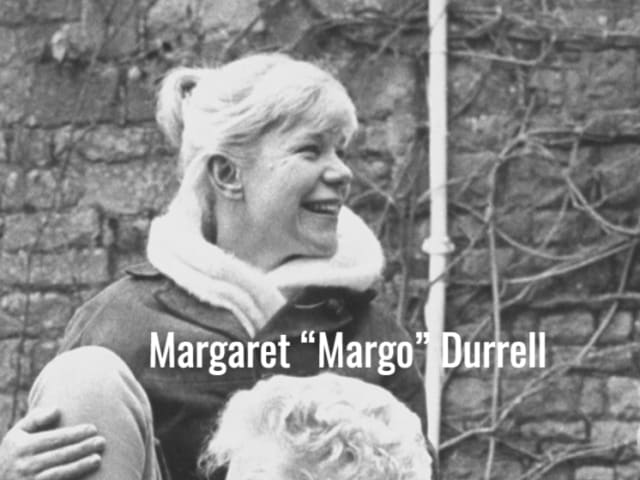
The descriptions of her mother as an uptight suburbanite are a long way from the courageous woman who took her children to a Mediterranean island in search of a better life, and mingled with a cast of colourful characters in Gerald’s books. Here she is judgmental and small-minded, referring to a lovelorn woman as “walking barefoot like some male aborigine with twigs in her hair”. Margo packs her own children off to their father and takes Nelson on a trip to the seaside. She seems more interested in him than in her own offspring, and one wonders whether they will in time write their own account of these days in a never-ending family spiral. If they do, let’s hope it is in the style of their uncle rather than their mother.

Wednesday, 16 September 2020

Goodbye to the Greek Island: The Garden of the Gods


The Garden of the Gods by Gerald Durrell
Penguin Books
Pp. 198

This is the third and final instalment in Gerald Durrell’s stories about his years in Corfu with the family, begun in My Family and Other Animals and continued in Birds, Beasts and Relatives. The tone has been set by the previous two, and this continues with more idyllic scene-setting and animal anecdotes.

These are halcyon days as the children have outstanding freedom in their unaccompanied travels: Gerry potters about in his boat; Margo swans off to the mainland; Leslie wanders the countryside with guns; Larry invites complete strangers to come and stay at their villa.

Gerald Durrell has a highly evocative way of writing that makes the countryside sound divine, and there are Homeric epithets in his descriptions of the sea. When he writes of the approaching seasons, his naturalist’s eye combines with his rustic poeticism and, as always, his main preoccupation is zoological. “For me, spring was one of the best times, for all the animal life of the island was astir and the air full of hope.”

He is keen to amass more creatures for his ever-growing menagerie, but he knows that certain members the family (particularly Larry), do not like his animal collection so he tries to get Mother and Margo on side, and they often feel sorry for abandoned animals. One of the peasants, wanting to get rid of unwanted puppies, buries them alive, by which fact Mother is understandably outraged. She exclaims, “These peasants! I can’t understand how they can be so cruel.”

The Greeks are examined almost as another species, which can be uncomfortably racist to a modern reader. Margo has many affairs of the heart, but always with Greeks rather than English boys (friends of Larry’s), saying of the local peasant boys, “They’re so handsome and so sweet. They all sing so well. They have such nice manners. They play the guitar. Give me one of them instead of an Englishman any day.” On the subject of changing attitudes with time, the family are remarkably accepting of potential paedophilia, commenting of a guest, Colonel Velvit, “Since his retirement his one interest in life was the local Scout troop and, while there were those unkind enough to say that his interest in Scouts was not entirely altruistic, he worked hard and had certainly never yet been caught.”

Mother accepts all the guests and offers outstanding hospitality, even to horrible or boring people, warning Margo, “We’ve never done anything nasty to anyone that’s stayed with us – I mean, except as a joke or by accident – and we’re not going to start.” One visitor friend of Larry’s believes he can levitate and keeps trying, invariably falling through the trellis

Gerry embellishes stories for comic effect, and sees them through a boy’s eyes, but some of the details are harrowing, such as when a Turk visits them (at Margo’s invitation) with three wives, aiming to make Margo his fourth.

They live in a weird limbo land without news of the outside world because, “we did not have the dubious benefits of a wireless and so, for the most part, lived in a state of blissful ignorance.” Part of this lack of ‘outside interference’ means they have to rely upon themselves for entertainment, and they do so with spectacular results. Gerry’s descriptions of the food, drink and company at these events are exquisite, and his depictions of a bygone era are sumptuous and appealing. He paints pictures with words that inspired a generation to travel and take an interest in nature. Some of the attitudes are outdated, but if he instils a sense of conservationism, they can be excused as the results of age. It’s tough to farewell these tales of childhood on an island paradise.

Tuesday, 11 August 2020

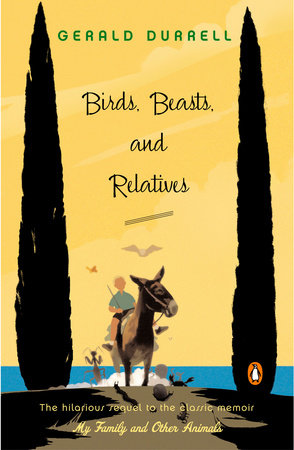
Childhood entitlement: Birds, Beasts and Relatives


Birds, Beasts, and Relatives by Gerald Durrell
Penguin
Pp. 245

This is the second instalment of Gerald Durrell’s Corfu Trilogy in which he continues with stories from the first book because the family say he has missed out all the best bits. As it is the same time period as the previous work, we don’t really need re-introductions, although it is interesting to see what the family members thought of their portrayal.

Gerry introduces several extra characters to us, mentioning Larry’s many friends who come to visit, including Max and Donald, and Sven who plays the accordion. We are also introduced to Countess Mavrodaki, “the recluse par excellence”., and we learn about his tutors, such as George, and his final (for this book) tutor, Kralefsky, a keen aviculturist (a person who keeps and rears birds) and a storytelling fantasist. He also provides greater depth to characters we have already met, and he describes his meeting with Theodore Stephanides, to whom the book is dedicated ‘in gratitude for laughter and learning”.

Gerry still collects animals for his menagerie: an owl called Ulysses; three dogs; and “there were rows and rows of jam jars, some containing specimens in methylated spirits, others containing microscopic life. And then there were six aquariums that housed a variety of newts, frogs, snakes and toads. Piles of glass-topped boxes contained my collections of butterflies, beetles and dragon-flies.” I remember things that I learned from reading these books as a child, such as the fact that snails are hermaphrodites.

Gerry has a child’s viewpoint and assumes that people and things exist for his entertainment. He experiences bucolic activities such as harvesting olives, but also is witness to live birth, and his reaction is less palatable. The description is anatomical but also unpleasantly dispassionate, perhaps because the human is foreign. “I was so used to the shrill indignation of peasants over the most trivial circumstances that I did not really, consciously, associate Katerina’s falsetto screams with pain. It was obvious that she was in some pain. Her face was white, crumpled, and old-looking, but I automatically subtracted ninety percent of the screaming as exaggeration.”

Furthermore, his description of the gypsies is somewhat uncomfortable in a modern setting. “I had always wanted to get on intimate terms with the gypsies, but they were a shy and hostile people… and although they would allow me to visit their camps, they were never forthcoming, in the way that the peasants were in telling me about their private lives and their aspirations.”

When Mother receives unwanted attention, and even a proposal of marriage, from a ‘disgusting old brute’, Captain Creech, she is naturally horrified and a little bit afraid. The children all laugh and ridicule, and she counters, “When there’s a real crisis, you children are of absolutely no use whatsoever.” Yes, this is an amusing anecdote, but she is a single woman in a foreign country in the 1930s with no respectable family to protect her.

Gerry writes of people as though they were specimens to be studied as his animals, birds and insects; because they are foreign (or female), they are other and this dispassionate approach is a little off-putting. These are still great stories of their time, but a deeper look reveals some more unsavoury aspects, which can be excused from a child’s account, but not really as an adult reader.

Tuesday, 9 June 2020

Idyllic Island Life: My Family and Other Animals


My Family and Other Animals by Gerald Durrell
Penguin Books
Pp.308

A generation of readers was introduced to this marvellous family and the island of Corfu through the school curriculum. It is ingrained in the childhood of many and to return to it as an adult is refreshing and fascinating. The recent TV series starring Keeley Hawes as Mother has fuelled a new interest and it is actually quite hard to separate the books from their screen interpretations, as they have been done so sensitively and affectionately. The opening sentence sets forth to manage our expectations;

“This is the story of a five-year sojourn that I and my family made on the Greek island of Corfu. It was originally intended to be a mildly nostalgic account of the natural history of the island, but I made a grave mistake by introducing my family into the book in the first few pages. Having got themselves on paper, they then proceeded to establish themselves and invite various friends to share the chapters. It was only with the greatest difficulty, and considerable cunning, that I managed to retain a few pages here and there which I could devote exclusively to animals.”
The memoir is narrated by Gerry, the youngest of four children. The other members of the family are Larry, the eldest, and also known as famous published author, Lawrence Durrell, Leslie, who seems to like shooting things, and Margo, who wants nothing more than to get a tan. They are guided, after a fashion, by Mother, to whom the book is dedicated. It was either a bold or a foolhardy move to decamp to a Greek island in the 1930s (the TV series suggest alcoholism and impecuniousness were involved), but with hindsight, Gerry’s affection for his mother and her management of the menagerie is clear.

The family are loud and boisterous, with confidence that would be arrogance if it weren’t so kindly transcribed. Mother is aware that Gerry desperately needs an education; he explains that as a child his English and maths are woeful and the only words he can spell correctly are biological ones. He captures his dealings with his family with a child’s interest, providing light humour and insight. The direct style mixes the monumental with the banal. The family move house a few times (including the first great shift) and each time Larry suggests it; mother rejects it: “We are not moving to another villa, I’ve made up my mind about that”. The next chapter then begins with the move: “The new villa was enormous”. 

They have parties where the animals terrorise the guests (there are scorpions in matchboxes and snakes in the bath) and The Durrells think nothing is untoward. The family seem to get ‘caught up’ in the island rituals rather more by accident than design, while Gerry visits the islanders, who all think the English are odd, but refer to him (apparently affectionately) as “the little lord”. There is a lot of stereotypical sexist peasant behaviour that is considered acceptable, and his views are vaguely racist.

Gerry is interested in little other than animals, and there are lots in the book, as suggested by the title, but not as many as I had remembered. There are far more insects, and plenty of anthropomorphising. He gets a little carried away with describing the seasons in a manner that is not strictly scientific, adding to the overall whimsy. He can be forgiven, however, for the book itself has a wonderfully soporific effect. When he writes of languid afternoon swims, sunny siestas on the veranda and afternoon teas that leave the guests pleasantly replete, it is with precision and nostalgia. Who wouldn’t want to be there? 

The author evokes a wonderful feeling of a time and place, which could never be replicated. Because this is the memory of a child, it may never even have existed, but, whether returning to this book or encountering it for the first time, the reader feels the comfort of coming home.