Showing posts with label philosophy. Show all posts

Wednesday, 25 September 2024

Believe: Small Gods


Small Gods by Terry Pratchett
Corgi
Pp. 381

Many people list Small Gods as the best of the Discworld novels. It is, however, probably my least favourite of the thirteen I have read so far. This is mainly due to the fact that the satire seems more obvious than in Pratchett’s other works, but also because organised religion, squabbling philosophers and the nature of belief are such easy targets for mockery.

The story opens in the city of Omnia, whose chief god, Om, has been reduced to a pitiful existence in the form of a turtle because no one really believes in him anymore. Gods need belief to live and thrive, and they fear becoming small gods, barely existing out in the desert wastelands with no believers at all. Om’s religion exists to perpetuate itself, with its rituals and vicious punishments and wars presided over by the psychotic Deacon Vorbis, like a sort of Inquisitor. 


One simple lad, Brutha, does believe in Om, and hears him telepathically when tending to his melon patch. Brutha’s belief is just enough to sustain Om, although the god has a lot of explaining to do. Brutha tells Om that according to The Book of Ossory as dictated to Ossory by Om, Om is omnipotent, but Om counters that not only did he not dictate these words, but “Don’t even remember anyone called Ossory.” He denies he chose anyone to tell his story. “They chose themselves”.


Furthermore, Om admits that he may have not strictly told the truth when he said there was no other god than him. “I exaggerated a bit. But they’re not that good. There’s one of ’em that sits around playing a flute most of the time and chasing milkmaids. I don’t call that very divine. Call that very divine? I don’t.”


The novel was written in 1992, but its discourse on certainty in religion and politics feels particularly pertinent in our post-truth world thirty years on. “Fear is strange soil. Mainly it grows obedience like corn, which grows in rows and makes weeding easy. But sometimes it grows the potatoes of defiance, which flourish underground.” Philosophers gather in town squares and brawl in bars over esoteric topics. Discussion can quickly escalate to argument followed by war, which is often binary and almost always arbitrary. While uncertainty can be troubling, it can also bring comfort with the knowledge that there are no absolutes. One character opines, “You don’t know. That’s what stops everyone going mad, the uncertainty of it, the feeling that it might work out all right after all.” Another counters, “Last night there seemed to be a chance. Anything was possible last night. That was the trouble with last nights. They were always followed by this mornings.”


Mere mortals struggle to make sense of life – hence the plethora of philosophers – but the gods are literally above it all. As the novel draws to a close, it returns to its beginnings, as Om surveys the world from his vantage point above the Hub. In a reference to the famous fable, he considers, “It seemed simpler when you were up here. It was all a game. You forgot that it wasn’t a game down there. People died. Bits got chopped off. We’re like eagles up here, he thought. Sometimes we show a tortoise how to fly. Then we let go.” Pratchett suggests that if there were gods, they have a vicious sense of humour and a total lack of decency.

Tuesday, 27 October 2020

An Age Old Question: The Devil and Miss Prym


The Devil and Miss Prym by Paulo Coelho
Thorsons
Pp. 201

Leo Tolstoy is said to have said, “All great literature is one of two stories; a man goes on a journey or a stranger comes to town.” This is the latter of those two options, and its claim to great literature is subjective, but the author has sold over 175 million of his books worldwide. One day a stranger comes to the town of Viscos (spoiler alert: he is the devil of the title) with a backpack containing twelve bars of gold. He offers one of them to Chantal (the Miss Prym of the title) on the condition that she communicates to the villagers that they will receive the other eleven if they commit a murder.

In essence it is a very simple morality tale; are people intrinsically good or evil? The basic prose may be a matter of translation from the original Portuguese (Coelho is Brazilian) but it suits the elements of fable, incorporating many parables. As it is a philosophical conceit, the narrator is omniscient, the characters are ciphers, and the events are unrealistic. It is cerebral rather than emotional; designed to make the reader think rather than feel.

The village of Viscos is remote and irrelevant, chosen deliberately by the stranger for his experiment. He wants to pit the villagers against each other, knowing that they are all in desperate financial straits and would welcome a windfall. It does not matter to the stranger whom the villagers choose to murder, only that they commit the act, and therefore, this is also an exploration of the conflict between the individual and society. “The story of one man is the story of all men. I need to know if we are good or evil.” Most cultures and religions have tales of the eternal struggle between good and evil. A Native American myth posits that we all contain two wolves; a kind and gentle one and a fierce and vicious one. The one that survives is the one we feed. This is incorporated into the metaphor of the rogue wolf which stalks the forest and terrorises the villagers, keeping them afraid. Many religions also have “a place of punishment, where the immortal soul goes after committing certain crimes against society (everything seemed to be in terms of society, rather than of the individual).”

The fundamental question is whether we are intrinsically good or bad, and what makes us this way. Coelho suggests that we are only good due to the fear of consequences. The stranger says, “I am a man who walks the earth with a devil at his side; in order to drive him away or accept him for once and for all, I need to know the answers to certain questions.” He chose Chantal because she is orphaned and searching for a way to escape her dull life in the village, but she wants someone to rescue her rather than acting for herself. She has several meetings with the stranger – as a single woman these may cause consternation but she has no one to protect her morality and can do as she please. She realises, however, that she too is bound by the fear of the future.

The metaphysical problem is described as game theory – gambling on the actions of others in order to protect yourself. It’s an old conundrum and one that doesn’t really have an answer. Chance exists and bad things happen to good people (the story of Job from the Old Testament is included along with many other myths and legends); perhaps we need the hope to carry on, like the widowed Berta, who sits outside her house every day watching the villagers and commenting on their action with her dead husband. The problem with the severely pedagogic tone is that it leaves little for the reader to do. Just as Chantal is trapped in the village, we are trapped in this narrative and will only be released when Coelho has finished with his lecture.

Monday, 27 March 2017

A portrait of an author ahead of her time


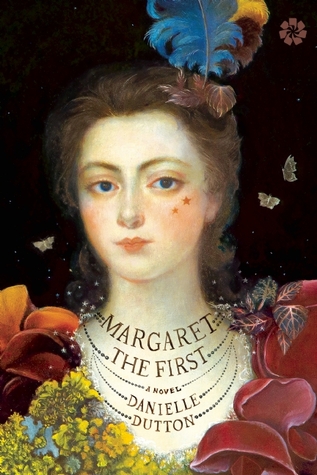
Margaret the First by Danielle Dutton
(Scribe)
Pp. 160

Margaret Cavendish was a poet, philosopher and visionary. As a child she created imaginary worlds (populated with thinking-rocks, humming-shoes, her favourite sister and Shakespeare, Ovid and Caesar) and stitched little books together with yarn. “Eventually she achieved fame, but it was not necessarily that which she sought, as children chased after her carriage calling out to ‘Mad Madge’ and she became a cautionary tale for young girls who dreamed of becoming too intelligent.

With the civil war raging, she joined the court of Queen Henrietta Maria and followed her into exile in France, where she met and married the much older William Cavendish, Duke of Newcastle. William was generally very supportive of her work and encouraged her to speak up and express her thoughts. Through him, Margaret came into contact with many of Europe’s leading thinkers; but she was bashful and awkward in society. When she was invited to speak at The Royal Society (the first woman to be so invited, and the last for 200 years) she could only stammer appreciation and rush away; causing Samuel Pepys to write, “A mad, conceited, ridiculous woman. I do not like her at all.”

As a woman who published books of her thoughts, she was considered doubly shocking. First that she had them, which was scandalous enough, but to voice them was even more so. Furthermore, she was childless, attempted cures for which included syringing herbs into her womb and “a drench that would poison a horse.”

Many of her thoughts centred on the physical world. As well as poetry and philosophy she wrote and published works of extraordinary utopian science fiction and fantasy. In her book, Philosophical and Physical Opinions, 1655, against the prevailing ideas of the time, “I argued all matter can think: a woman, a river, a bird. There is no creature or part of nature without innate sense and reason, I wrote, for observe the way a crystal spreads, or how a flower makes way for its seed.”  

In contrast with much current weighty (in size) historical fiction, this short novel (160 pages) covers historical events in brief detail; The English Civil War is dealt with very succinctly:
“The King of England was convicted of treason. Then the King of England was dead. It was Tuesday. It was 1649. Parliament hacked off Charles I’s head outside the Banqueting House at Whitehall.” Halfway through the novel, Danielle Dutton changes from first-person to third-person narration. This ambitious move reflects the fame Margaret sought as people began to talk about her after the coronation of Charles II, and the Cavendishes’ return to London.

While Danielle Dutton doesn’t claim Margaret specifically as a proto-feminist, she does dwell on her issues with equality, or the lack thereof. Indeed, the title comes from her own self-honorific. “Though I cannot be Henry the Fifth, or Charles the Second, yet I endeavour to be Margaret the First”. She was far from saintly, however, and, jealous of William’s success, she upstaged him at the opening of his play by attending the theatre with her breasts bared and her nipples painted.

Margaret Cavendish was a remarkable woman. She has been championed by Virginia Woolf and deserves wider renown. Unfortunately, with society’s attitude towards women, she will be better remembered for her outfits and her manners than her literary and artistic achievements.