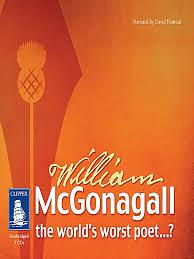
William McGonagall is often lampooned as the world's worst poet. That is a pretty bold claim and I have been insterested as to why he is so called. His poems are bad - they feature endless repetition, deridable rhymes, irrelevant details, poor scansion and weak metre. The mockery existed during his lifetime (1825-1902) and continues today with his work being celebrated with an Ig Nobel award in 2011. (He was also J.K. Rowling's inspiration for the name of her beloved character Minerva McGonagall.) He had no idea of this ridicule and fancied himself as having a calling to write, announcing himself as The Queen's Poet. Despite Queen Victoria refusing him patronage, he walked almost 100 kilmoetres from Dundee over mountainous terrain and through a violent thunderstorm to present himself at Bamoral where he was refused entry and had to return home. He made some money reciting his poems in pubs (the anti-drinking ones were particularly ill-advised), theatres, and the streets. As his reputation grew, his performances were attende by raucous crowds who drowned out his recitations and occasionally forcefully carried him out of venues. He found lucrative work performing his poetry at a local circus where he was pelted with eggs, flour, herrings, potatoes and stale bread. His story has many parallels with that of Florence Foster Jenkins, and one could perhaps feel great discomfort at his treatment (he was very probably on the autism-Apserger's spectrum), were it not for the fact that his self-aggrandising writings are incredibly pompous and dismissive of others. His poems, biography and other works are read by Scottish actor David Rintoul in brilliant fashion. He allows the unintentional humour to shine forth and reveals the terrible poetry in all its magnificent awfulness. It is a thing of unimaginable joy.
Friday, 11 October 2024
Friday Five: BorrowBox
William McGonagall is often lampooned as the world's worst poet. That is a pretty bold claim and I have been insterested as to why he is so called. His poems are bad - they feature endless repetition, deridable rhymes, irrelevant details, poor scansion and weak metre. The mockery existed during his lifetime (1825-1902) and continues today with his work being celebrated with an Ig Nobel award in 2011. (He was also J.K. Rowling's inspiration for the name of her beloved character Minerva McGonagall.) He had no idea of this ridicule and fancied himself as having a calling to write, announcing himself as The Queen's Poet. Despite Queen Victoria refusing him patronage, he walked almost 100 kilmoetres from Dundee over mountainous terrain and through a violent thunderstorm to present himself at Bamoral where he was refused entry and had to return home. He made some money reciting his poems in pubs (the anti-drinking ones were particularly ill-advised), theatres, and the streets. As his reputation grew, his performances were attende by raucous crowds who drowned out his recitations and occasionally forcefully carried him out of venues. He found lucrative work performing his poetry at a local circus where he was pelted with eggs, flour, herrings, potatoes and stale bread. His story has many parallels with that of Florence Foster Jenkins, and one could perhaps feel great discomfort at his treatment (he was very probably on the autism-Apserger's spectrum), were it not for the fact that his self-aggrandising writings are incredibly pompous and dismissive of others. His poems, biography and other works are read by Scottish actor David Rintoul in brilliant fashion. He allows the unintentional humour to shine forth and reveals the terrible poetry in all its magnificent awfulness. It is a thing of unimaginable joy.
Tuesday, 13 February 2024
A Refusal to Die of White History: Modewarre
Modewarre is the indigenous word
for musk duck, a creature at home on land, water and air. Through her poetry, Patricia
Sykes explores various histories and the boundaries between them which blur and
blend. She splits the poems into three sections: House of the Bird, House of
Water, and House of Detention, examining words and their connotations, dwelling
on reflections, refractions and altered perceptions.
Naming things robs them of their
magic and power, as we use “language, so impossibly cumbersome/ for discovering
the true weight of things/ the grandmother would have known”. The literary
fragments are almost Sapphic with physical and sensual meaning: “as always the
modewarre/ places faith in its eggs/ yolk and the sun/ breed each other”. The
strong bonds of belonging and connection to land go beyond words, until the
frustration is clear in a poem such as eponymous,
“to the interrogator who keeps asking/ ‘so are you still suckling on myths of
place?’/ I say try the enigma address/ the bird who keeps vanishing in water –”
The
poems recall the land and the life before the colonists came, and also the
sheer incomprehension of the invaders dealing with the loss. In eupathy (right feeling of the soul) she
sees the land from above as though flying with the eagle. “to talk now/ of
whether this is still so/ or if the eagles in free flight/ are an option/ to
speak of/ options, land, again/ once more/ not as that which was taken/ is
un-ownable/ contracting and crowded/ but as lava shift/ the heat of a river/
always underfoot/ in a molten indifference/ to politics”. There are layers of
knowledge contained in a word, such as the poem, ‘brid’, eight darkness in which
‘brid’ is the name given by Nyangangu, a Yolgnu artist of Northeast Arnhem
Land, to her bird carving. “there, where you are,/ bred of earth, breeding sky/
working the uplift, wingbeat/ as if sculpting a refusal/ to die of white
history”.
The world is a palimpsest and so
is the brain – our thoughts and memories are malleable. Birds connect people
and places, and are often totems for Aboriginal and Torres Strait Islander
people, helping to define kinship with people, their Country and nature,
connecting to the roles and responsibilities of a mob, offering protection and
foreshadowing danger and momentous events. This connection extends throughout
the world as the birds migrate along their own songlines.
Means of expression are
insufficient, with even mechanics of speech and typing unable to capture the
richness of the language. “this keyboard’s/ tireless tap-tap mouth/ which
cannot voice/ the interior ‘n’ in Nyangangu/ the one with the tail/ the sound
of ‘ng’ in singer”. And yet the words can be damaging and belittling. “how the
eyes like linguists are never satisfied/ how they’ll poke and pry into any
lexicon”, wanting to preserve and capture, destroying the natural.
The poems in House of Water are
concerned with childhood, disease, death, invasion, cattle, birds, and bunyips.
Roads are built over traditional lands, only to crumble and fray at the edges
demonstrating their impermanence in the liminal space. “what never was field/
become paddock become/ fences become livestock/ the cattle the sheep/ foraging
for the hoofprints/ they lost the last time/ they departed a shore”.
In the House of Detention, the
poems move on to highlight migrants trapped in refugee camps, prisoners in
cells, wives in marriages, women in motherhood, caterpillars who will one day
be butterflies, political constraints, and people wanting to be “at home in
every world/ where exile does not exist”. In great-aunt narrative among the excised lands, Sykes leans upon the
double meaning of refuse (verb and noun) as it relates to denial and pollution:
“oh my Canberra…/ high city of
presumptive cleanliness/ among the dirty waters exuding from the workplaces/
the smell of your refusal laws”. She uses a rare capital letter in this poem,
which must surely be ironic as her punctuation is clean and almost entirely
absent.
Modewarre is a great collection of powerful fragments, connecting words to the echoes of previous language both spoken and unspoken. It is a reminder that we are merely one of millions of moving parts that comprise our environment, expressing a concern for what will happen to the delicate balance once we form a pyramid and place ourselves at the apex.
Friday, 2 September 2022
Friday Five: Books Read in August
- Chatter: The Voice in Our Head and How to Harness It by Ethan Kross (Vermilion) - We all have voices in our head; some supportive and encouraging; others belittling and disruptive. Kross provides pop-scientific reasons for why and which ones count. Talking to ourselves and others can be beneficial to help us distance ourselves from traumatic experience, but it can also lead us into a vicious cycle of repetition, particularly in the echo chambers of social media. This book presents ways to normalise and contextualise confronting events and suggests methods that enable us to take back 'control'. Easy to read and with a practical 'toolkit' of strategies, this is recommended for anyone struggling with daily overwhelm.
- Cow by Susan Hawthorne (Spinifex) - A sublime book of poetry inspired by the humble (or scared in some societies) bovine beast. From ancient aurochs to nursery rhyme moon jumpers; cattle chattel of Lakshmi, the Hindu goddess of wealth and good fortune to the shape-shifting Io of Greek myth who became a white heifer due to Zeus' lust and Hera's rage, there are cows, "at the edges of every known world/ like it or not we are everywhere."
- The Club: Johnson, Boswell and the Friends Who Shaped an Age by Leo Damrosch (Yale University Press) - Named one of the ten best books of 2019 by the New York Times Book Review, this is the story of the phenomenal London club, established in 1764, and the men (and it was only men) who comprised it. It was established in a tavern and was the meeting place of writers, thinkers, economists, philosophers, artists, actors, playwrights, politicians, historians, lawyers, doctors, musicologists, poets, clergymen, botanists, chemists, scholars and statesmen - a who's who of the mid-late eighteenth century. Told mainly through the eyes of James Boswell (he wrote a lot), it captures the characters and the events of the times, such as the cultural climate and political happenings, but, "Above all the Club existed for conversation: not just small talk, but wide-ranging discussion on topics of all kinds."
- Fled by Meg Keneally (Echo Publishing) - This novel tells the story of Mary (Dabby) Bryant, who was transported to the fledgling colony of New South Wales for highway robbery. Once there, she manipulated the system as much as possible until she escaped to make her way back to England, where she thought she had a better chance of survival for herself and her children. She is renamed Jenny Trelawney for the purposes of fiction, and while the 'real' Mary Bryant was illiterate and never wrote down any thoughts or feelings, many of the facts are true and make for an incredible historical adventure. In the Mobius strip-like way that art can unfold, Meg Keneally's father, Thomas wrote a book, The Playmaker, based on the story of the first play ever performed in Australia, with Dabby Bryant being one of the actors - this book was the basis for a play by Timberlake Wertenbaker, Our Country's Good, in which I am currently performing (as Dabby Bryant) at Canberra Repertory.
- The Secrets of Strangers by Charity Norman (Allen & Unwin) - When a bloke marches into a café in London and shoots the proprietor, several of the patrons get caught up in the cross-fire and the ensuing hostage situation. We learn about them all individually in a highly stylised manner that makes the novel seem more like a stage play or a series of TV episodes. Among those captive in the café are a grandmother looking after her grandson, a lawyer who is meant to be defending her client in court, a former teacher who is now homeless due in part to a gambling addiction, and a waitress who is hiding in the cleaning cupboard, her presence unknown to the gunman. Their stories all wrap up neatly - everyone has to have a backstory to provide context for their actions, many of which are glossed over or shoehorned into the story as the cause du jour (coercive control; refugee experience; infertility obsession) - and the reader has very few gaps to fill, removing any tension necessary for a thriller. We also hear from Eliza, the police negotiator who is talking to the gunman and trying to secure the release of the hostages - hers is the most interesting and realistic voice in the novel. While the pace is fast enough that one does want to keep turning the pages, there are no surprises and the need to keep everything tidy and completed is distancing and unsatisfying to the point of triteness.
Friday, 24 September 2021
COVID-19 Friday Five: More Podcasts
We're allowed two hours of exercise now. I walk. I listen. Sometimes I listen to the birds and sometimes I listen to podcasts. Here are some of the podcasts to which I listen.
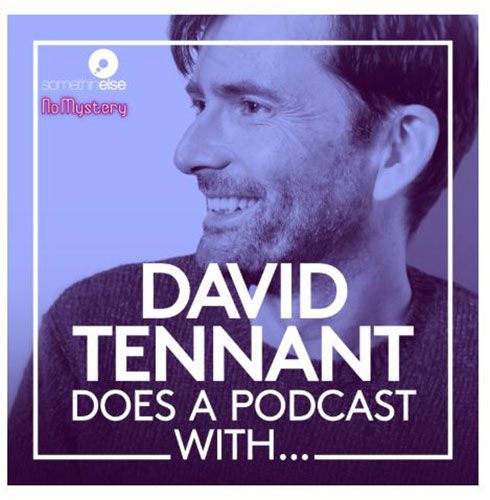
- David Tennant Does a Podcast With... (Somethin' Else and No Mystery) - The former Doctor Who star chats with his showbiz friends. It's very star-studded and a bit lovely-dahling, but it makes one realise how many great actors he has worked with, from Judi Dench, Olivia Colman, Elisabeth Moss, Billie Piper and Cush Jumbo to Ian McKellan, Neil Gaiman, Michal Sheen, John Hamm and Brian Cox. At this stage there is no Season 3 planned, but there are still 21 episodes to get to grips with at this stage.
- Eyes on Gilead (SBS) - As a companion podcast to The Handmaid's Tale, a group of intelligent and interested viewers (Fiona Williams; Haidee Ireland; Sanar Qadar; Natalie Hambly) discuss and dissect each episode after it has finished. More than just examining the plot, they suggest possibilities and refer to design and direction elements that highlight the intricacies of the show. There are also bonus interviews with actors (special love for Yvonne Strahovski - well, it is Australian), composers, make-up artists, costume designers, directors and the series creator. It's one for the fans.
- Natalie Haynes Stands up for the Classics (BBC Radio 4) - a friend introduced me to this podcast after I read Natalie Haynes' A Thousand Ships, which re-tells the story of The Illiad from the perspective of the women involved (it's excellent - more on that later). In a sort-of spin-off from the original series, Natalie Haynes does a series within the podcast in which she 'sits down' for the myths. In a move that will surprise absolutley no one, the first one I listened to was on Penelope. There are also episodes on The Odyssey, Clytemnestra, Helen of Troy, Penthesilea and Medusa. Plus, there are the original episodes on Cicero, Plato, Sophocles, Virgil, Ovid, Aristotle, etc. It's told in a light, informative and entertaining manner. I remember most of it, and can happily go back a few weeks later to remind myself of the bits I missed first time around.
- The Poet Laureate Has Gone to His Shed (BBC Radio 4) - I've got a bit of a thing for Simon Armitage. No, not like that (although I do love his voice). I've met him (twice) and I'm in his book, Gig (although not by name). He taught at the polytechnic where I studied (although not at the same time) and we know some of the same people, and have a shared interest in myth (The Odyssey; The Green Knight; King Arthur). He is busy writing haiku in his shed at the bottom of his garden (or so he would have us believe) and he interviews some iconic figures from my growing-up days. So far I have listened to the episodes featuring Jo Whiley, JK Rowling and Johnny Marr. I look forward to listening to the back catalogue including interviews with Maxine Peake, Antony Gormley and HRH Prince Charles.
- The Skewer (BBC Radio 4) - Described as the news retwisted as a comedy treat, it is a biting satire on politics and current events using the very effective sampling techniques that put words into other people's mouths. It's irreverent and devastating in 15-min chunks with dazzling wit and British pop-culture references that might stump some living outside the UK.
Friday, 28 August 2020
Friday Five: More Podcasts
Back in May I wrote a blog post about the podcasts to which I was listening in COVID-19 times. Well, it's still going on, and I'm still listening. I just keep adding them to the list, and they roll around and keep me entertained alongside my regular favourites. Here are five more recently-listened-to podcasts.
5 Recent Podcasts:
- The Guilty Feminist (Patreon) - Deborah Frances-White hosts this podcast which ranges from stand-up comedy to interviews about hard-hitting topics such as domestic abuse and genital mutilation; recent episodes have covered Justice, Satire, Rebellion, Shame, Education and Credibility. Every episode kicks off with a round of 'I'm a Feminist, but...' as hosts and guests confess to 'shameful' double standards which we can all recognise. While mixing up the tone, the message remains firmly to fight for gender equality, and this is also the podcast that introduced me to the wonderful protest folk music of Grace Petrie.
- The Anfield Wrap (TAW Player) - Yes, it's all about Liverpool F.C. and yes, it has over 28 million downloads worldwide. Neil Atkinson hosts a group of blokes (and it is nearly always blokes, unfortunately) who sit around discussing the highs (of which there are many lately) and lows of the club. There are a number of levels to which one can subscribe, but the free content is sufficient for me, covering transfers, signings, matches (both before and after), player interviews and a plethora of awards. Bonus 'cup of tea' episodes address current issues and how they affect the club from supporting foodbanks to LGBTQI rights and kicking racism out of football.
- No Filter (Mamamia) - If interviews with interesting folk are your thing, then this Australian podcast hosted by Mia Freedman might be for you. With a fresh approach and a candid attitude she chats to well-known celebrities (Julia Gillard and Osher Gunsberg) and 'ordinary people' with incredible stories, such as a mother of a trans child or the bloke whose wedding sparked a COVID outbreak.
- Have You Heard George's Podcast (BBC Sounds) - George Mpanga (aka George the Poet) delivers a highly individual take on societal issues through a mixture of music, poetry and storytelling. The first series, which came out in 2018, won four gold awards at the British Podcast Awards, plus two silvers and the podcast of the year. His subjects included blaxploitation films, Reaganomics and why drug dealing and murder can seem the only options for black youth, whether in the 1970s and 80s US or contemporary UK.
- Newscast (BBC News) - I started listening to this when it was Brexitcast, then it became Newscast, then Coronaviruscast, and now I think we're back to Newscast. It might be tricky to keep up with the title but the premise is the same - intelligent, topical political and social issues introduced by Adam Fleming, and discussed 'with the BBC's best journalists and other people who know what they're talking about'. It's basically how I check in with what's going on back in Blighty; it's interesting informative and measured with lots of heft and a touch of levity.
![]() |
| The lads of The Anfield Wrap with the manager of the Anfield team |
Monday, 27 March 2017
A portrait of an author ahead of her time
Thursday, 17 November 2011
Walking Dreams
Not a useful talent,
But a good party trick:
It entertains, and people smile.
I launch forward through my arms;
Lurching from side to side:
Chest pushed out; neck stretched;
Legs bent over like a question mark
Asking when will I fall,
And if it’s before I wake,
Will I die in my sleep?
Is that entertainment?
Thursday, 2 September 2010
Street Poetry
I read out the words with awe. Him Outdoors has seen different words advertising breakfast – unaware of the latent lyricism he says, ‘Coffee and tea – 49p. I’m not right into poetry, me.’
Friday, 30 July 2010
National Poetry Day
I don't think I'm boasting when I say that my poem is the one that is still remembered by the group several years later. In fact, of everything I've ever written, this is the only thing that anyone ever quotes at me. I'm not sure what sticks most in the memory: the deceptively simple but subtly complex structure; the mesmerisingly eloquent rhythm or the deeply insightful persipience. I'll allow to you make up your own mind.
Saturday, 13 February 2010
Supermarket creep
Friday, 29 May 2009
Oh, to be in England!
Oh, to be in England
Now that April's there,
And whoever wakes in England
Sees, some morning, unaware,
That the lowest boughs and the brushwood sheaf
Round the elm-tree bole are in tiny leaf,
While the chaffinch sings on the orchard bough
In England - now!And after April, when May follows,
And the whitethroat builds, and all the swallows
Hark! where my blossomed pear-tree in the hedge
Leans to the field and scatters on the clover
Blossoms and dewdrops - at the bent spray's edge
That's the wise thrush; he sings each song twice over,
Lest you should think he never could recapture
The first fine careless rapture!And though the fields look rough with hoary dew,
All will be gay when noontide wakes anew
The buttercups, the little children's dower, -
Far brighter than this gaudy melon-flower!Robert Browning (1812-1889)
I was never really a fan of Robert Browning in my youth. I thought him weary and trite and too fond of the Romantic poets for his own good. Now, as I approach my own 'season of mists and mellow fruitfulness', I find I'm starting to rather like him. Is this a natural consequence of ageing, I wonder?
Also, I know that he was from down south and so probably writing about the Home Counties' countryside, but I can't help connecting his words with the Lake District. I get my fix of this beautiful place through Tony Richards' Lakeland Cam website. Every day the erstwhile postman takes photos of the region on his daily walks and posts them to his site. 
Thursday, 7 May 2009
'Tell me a story'; 'I don't want to give you nightmares'
A Most Outrageous Humbug, Three Spoon TheatreDownstage Theatre, 29 April – 7 May
The opening gambit of A Most Outrageous Humbug sets the scene for the entire play. Artfully designed piles of books and sombre mood lighting (Marcus McShane) form the backdrop to Edgar Allan Poe’s parents’, Elizabeth (Jean Sergent) and David (Adam Donald) ferocious and theatrical argument which ends in tears and blood.
Top hats, velvet waistcoats, silk cravats hoop skirts, and fortified corsets (gorgeously designed by Dawa Devereux) hint at the constriction of fierce passions. Meanwhile the scenario is underpinned by Tane Upjohn Beatson at the piano with its exposed hammers and strings playing dramatic, morose music. This promises to be an American Gothic Romance with dark undercurrents of violence and passion, and boy, does it deliver.
Told through a mix of Poe’s essays, poems and stories woven with imagined events, the play purports to be a biography of the man. As a lesson to anyone who ever wants to know how much of an author’s work is biographical – it’s simply impossible to know. Three Spoon Theatre under the direction of Charlotte Bradley have created a work which shows a man spiralling into madness and sabotaging his entire literary career, loosing himself in stories and wine. You might just as well worry about their state of mind.Edgar Allan Poe became an orphan at two, the inference being he had no early stabilising factors in his life. Driven by thronging passion – ‘his ardour was matched only by his ambition’ – he hoped academia might rein in his wild excesses. We are told this by Thomas McGrath narrating as Poe from the sidelines, becoming increasingly involved in the action as the play progresses. The play both shows and tells with Ralph McCubbin Howell acting as Poe throughout.
Poe writes every moment available between his studies to the detriment of them both, and becomes romantically involved with Frances Osgood (Adrianne Roberts). His rival in love and literature is the ‘sweaty and creepy but persistent and rich’ Rufus Griswold (Ed Watson). Poe may be ‘talented and passionate’ but he also has a wild disregard for propriety reflected in his appearance. Howell plays him as explosive, which leaves him with nowhere to go as his tempo is feverish from the beginning.The journey into madness is marked by a number of well-scripted scenes. There is a poetry reading between Poe and Griswold at which Griswold suggests ‘The ladies will enjoy our academic duelling’. There is Poe’s peculiarly abstract proposal to his 13-year-old cousin Virginia ‘Sissy’ Eliza Celmm (played with wide-eyed gaucheness by Alex Lodge) using his macabre stories as a form of courtship – ‘I liked your poetry better’. Sissy’s amusing wittering suits the young girl’s naivety, but her chilly defence is a little modern – ‘I may not be an adult, but at least I’m not a prat.’
There is the costume party book launch at which Elmira Shelton (Jean Sergent) dresses as the author – is it a sincere form of flattery or grist to his burgeoning paranoia? Meanwhile a mysterious hooded figure, seen only by Sissy, stalks the party, which cannot bode well. In orchestrated breaks from the party, guests partner up into formal dance and corpses return to life.As Poe reads his stories we are frequently deceived into questioning what is reality and given unheralded glimpses into his manic mind. ‘What a gift to tap into the psyche of a blood-thirsty psycho so effortlessly’. He applies for an editing position only to be interviewed by characters from his short story Doctor Tarr (Adam Donald) and Professor Fether (Jean Sergent) in a show-stealing scene.
This is a brilliantly written script and hangs so tightly together that it is hard to believe it was devised collaboratively. The colours of red (the consumptive blood that claims so many characters) black (the raven feather; the relentless gloom) and white (the purity and innocence of Sissy; the bleached bones of his tales) are woven into the tapestry of the narrative. Death unifies all from his mother’s untimely demise to his own wrestling with himself (literally) in the final scene. It’s not exactly joyful, but it is triumphant, and a worthy inclusion in the Pick of the Fringe.
Monday, 22 September 2008
Simple to Sumptuous: Clasp
A couple of months ago I went to an exhibition at the National Library gallery called Simple to Sumptuous, which was a collection of book bindings from the Alexander Turnbull Library, ranging from 1400 to the present.
To secure knowledge, many books were kept in chained libraries with a chain passing through the clasp; there is an example of one of these clasps harbouring a miniature in a book covered in brown goatskin, edged in brass with gilt text edges.
Clasp
But a little is dangerous
So it must be rationed.
There are checks and balances;
Keys and locks
Surround her face
In a miniature oval,
Clasping the spine tightly.
Her smile is serene as she
Guards her secrets.
Beneath layers of glass
Protected and displayed
Her image is eternal;
Impossible to analyse as a
Thought in words.


.jpg)