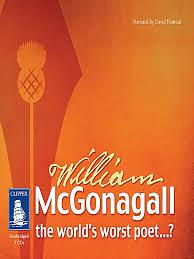
William McGonagall is often lampooned as the world's worst poet. That is a pretty bold claim and I have been insterested as to why he is so called. His poems are bad - they feature endless repetition, deridable rhymes, irrelevant details, poor scansion and weak metre. The mockery existed during his lifetime (1825-1902) and continues today with his work being celebrated with an Ig Nobel award in 2011. (He was also J.K. Rowling's inspiration for the name of her beloved character Minerva McGonagall.) He had no idea of this ridicule and fancied himself as having a calling to write, announcing himself as The Queen's Poet. Despite Queen Victoria refusing him patronage, he walked almost 100 kilmoetres from Dundee over mountainous terrain and through a violent thunderstorm to present himself at Bamoral where he was refused entry and had to return home. He made some money reciting his poems in pubs (the anti-drinking ones were particularly ill-advised), theatres, and the streets. As his reputation grew, his performances were attende by raucous crowds who drowned out his recitations and occasionally forcefully carried him out of venues. He found lucrative work performing his poetry at a local circus where he was pelted with eggs, flour, herrings, potatoes and stale bread. His story has many parallels with that of Florence Foster Jenkins, and one could perhaps feel great discomfort at his treatment (he was very probably on the autism-Apserger's spectrum), were it not for the fact that his self-aggrandising writings are incredibly pompous and dismissive of others. His poems, biography and other works are read by Scottish actor David Rintoul in brilliant fashion. He allows the unintentional humour to shine forth and reveals the terrible poetry in all its magnificent awfulness. It is a thing of unimaginable joy.
Friday, 11 October 2024
Friday Five: BorrowBox
William McGonagall is often lampooned as the world's worst poet. That is a pretty bold claim and I have been insterested as to why he is so called. His poems are bad - they feature endless repetition, deridable rhymes, irrelevant details, poor scansion and weak metre. The mockery existed during his lifetime (1825-1902) and continues today with his work being celebrated with an Ig Nobel award in 2011. (He was also J.K. Rowling's inspiration for the name of her beloved character Minerva McGonagall.) He had no idea of this ridicule and fancied himself as having a calling to write, announcing himself as The Queen's Poet. Despite Queen Victoria refusing him patronage, he walked almost 100 kilmoetres from Dundee over mountainous terrain and through a violent thunderstorm to present himself at Bamoral where he was refused entry and had to return home. He made some money reciting his poems in pubs (the anti-drinking ones were particularly ill-advised), theatres, and the streets. As his reputation grew, his performances were attende by raucous crowds who drowned out his recitations and occasionally forcefully carried him out of venues. He found lucrative work performing his poetry at a local circus where he was pelted with eggs, flour, herrings, potatoes and stale bread. His story has many parallels with that of Florence Foster Jenkins, and one could perhaps feel great discomfort at his treatment (he was very probably on the autism-Apserger's spectrum), were it not for the fact that his self-aggrandising writings are incredibly pompous and dismissive of others. His poems, biography and other works are read by Scottish actor David Rintoul in brilliant fashion. He allows the unintentional humour to shine forth and reveals the terrible poetry in all its magnificent awfulness. It is a thing of unimaginable joy.
Wednesday, 17 February 2021
New York Nostalgia: City of Girls
Vivian grows up in a typical
conservative WASP family in upstate New York, where there is an assumption that
she will go to college, find a husband and settle down into the life of a wife
and mother. Due to reasons of lethargy and lack of engagement, her parents pack
her off to New York to stay with her Aunt Peg, who happens to run a rather
dilapidated playhouse. Vivian has always been told that she hasn’t got a lot of
talent, but she can sew, and she is soon making costumes for all the
productions and winning friends with her skill with a needle and a tight
budget.
When Vivian reaches New York and
meets the showgirls, she is wildly distracted by their gossip and their glamour,
and entranced by their lifestyle, which is different from anything she has ever
known. The leader of this troop is the outrageously entitled personification of
a whirlwind, Celia Ray. Her behaviour is infuriating and inconsiderate, but Vivian
is happy to tolerate it because it makes her feel included into another world
of conviction, enthusiasm and, above all, youth.
The novel is a love story to a
time and a place. The time was the 1940s; the place was New York City, more
specifically, the Lily Playhouse. Sure, there was a war approaching, but with
the callow and shallow nature of self-obsessed youth, Vivian managed to disregard
it, even though her brother had just joined the navy. New York is a city of
dreams, possibilities and action, and in Vivian’s eyes and breathless
descriptions, the Lily Playhouse is where these dramas take shape. It would be
a fabulous, chaotic place to work, but the business model is unsustainable, and
it is the sort of atmosphere that can be regarded fondly with hindsight, but
not last forever or be recreated. Elizabeth Gilbert, through Vivian’s
reminisces, is expert at blending the brilliance with the base, and tempering
the glow of nostalgia with the grit of reality.
A theatre is the perfect metaphor
for presenting a bright surface to conceal a shabby behind, and the shows that
were staged at the Lily are the essence of this. “To my mind there was never
anything better than those simple, enthusiastic revues. They made me happy.
They were designed to make people happy without making the audience work too
hard to understand what was going on.”
Vivian spends a lot of her youth
being told who she is, and what she should be, by men. She discovers another
talent – that of making men desire her – and she works that angle for all it is
worth, and far beyond, damaging her own and others’ relationships in the
process. There is a freedom of sex which she interprets as power; it is not as
if she enjoys the act itself, but she does relish the game. She is callous and
flippant and frivolous, and she loves every second of it, until she becomes entangled
in a scandal and is judged, again unfairly, for her part in the affair – men get
away with indiscretions; women are discreetly got away. In typical Moll
Flanders style, the later bits of her life, when she comes to realisations and
profundities are not as interesting as the titillating sections of her wild
youth.
Friday, 28 August 2015
Friday Five: Bad Publicity
Bad Publicity: popular wisdom has it that there's no such thing. Many actors and directors say they never read their reviews. I don't believe either of those things. The thespians I know read every word they can get their hands on, and they read them at least three times.
The first time they scan it quickly, looking for references to themselves; the second time they read the whole thing, being particularly alert to any perceived slight; the third time they agonise over the tiniest critical comment, which will be burnt into their consciousness for the rest of their life.
I am just as guilty. Even though I am a reviewer myself, and I know that a review is only one person's opinion, and that as a performer one should have faith in the art as directed, a hastily written quip (often hurtful remarks are the result of an inexperienced reviewer trying to be clever) can still drive me to distraction, where no one else can see the problem.
Recently I played the role of Bella in Patrick Hamilton's Gaslight for Canberra Repertory Theatre. To even out the balance, here are snippets from reviews of the play, both good and bad:
5 Reviews of Gaslight:
- Bouquet: "Director barb barnett and her cast resist the temptation to lapse into melodrama, choosing to probe for the truth beyond the psychological abuse and strange occurrences." Brickbat: "a thriller in search of greater tension and suspense"
- Bouquet: "Entertaining and spooky, with witty jokes and intense drama"
Brickbat: "The script calls for more paranoia and ambiguity to keep the audience guessing."
Full Review: City News
- Bouquet: "Kate Blackhurst plays the part of Bella Manningham very well."
Brickbat: "The play is rather wordy and is repetitive in parts."
Full Review: Stage Whispers
- Bouquet: "The audience is drawn into a complex and devious plot that maintains interest right up until the very satisfying climax."
Brickbat: "A straight forward production"
Full Review: Canberra Critics Circle
- Bouquet: "The members of the Canberra Repertory Theatre showed their wonderful talent"
Brickbat: "The highlight of the show has to be the curtain"
Full Review: Woroni
Full Review: Canberra Times
Friday, 14 December 2012
Friday Five: Non-competitive pursuits
I think it's fair to say that I don't like reality TV. I have mentioned this before. One of my least favourite sub-genres is the competition variety. You know the type of thing, where people are pitted against each other to paint a room or build a wall and then someone wins and everyone at home thinks they could have done the same and the real decorators and stonemasons go out of business while general standards plummet.
Although I like the celebrity dancing ones (especially the ice-dancing one), I know I am no expert. This is not true of the people who routinely watch the singing shows and then feel free to critique performances about which they know nothing. It also means that we are left with chanteurs who think that to belt and warble is the epitome of 'singing' and we are left without subtlety, nuance or character. Bob Dylan or Florence Welch wouldn't make it through the first round.
With performance and artistic pursuits, a lot is left to personal preference - A might like sci-fi or farce; B might prefer romance or Jacobean drama; C might swoon at ballet and metaphysical poetry and so on. It doesn't mean any one is 'better' than the other - it just means they shouldn't be judged against each other. In 'pure' sport if you run fastest, jump highest or throw something furthest, you win. You are the best at that particular thing. Don't get me wrong, some things lend themselves to competition and this is a good thing (not keeping the score during football games because 'it's all about participation' is ridiculous!) but when subjectivity creeps in, nothing is so clear.
Acting, comedy and writing awards are often suspect. Yes, they are worth something when awarded by your peers, but often they are voted for by a partisan panel - the more friends you have in the audience; the more likely you are to win. These tributes might provide a feel-good factor, but they are relatively worthless. Entertainment is not a science; nor should it be a competition.
5 Things that should never be a competition:
- Cooking - as far as I am concerned you either cook because it is your job and you are paid, or because it is a way of expressing love and friendship to those around you. Eat with me and know you are welcome. Do not judge the temperature of the soup or the slicing of the vegetables. I have prepared this gift for you in my own way.
- Surgery - there will come a day when cameras go into operating theatres and viewers vote on who best wields the scalpel. I'm surprised it hasn't happened already. Health is personal, although you wouldn't know it from those shows which 'expose' physical deformities and laugh at fat people. Some things should be conducted behind the curtained cubicle - pull yourself together.
- Sex - it's personal and not up for discussion apart from between the relevant parties. According to late-night phone-ins (you hear a lot driving home from rehearsals) many people seem to be concerned about whether or not their sex-life is 'normal'. As long as you and your partner are happy with it, whatever you're doing, or not doing, is fine.
- Raising children - I hate the use of nouns as verbs, so have resisted the urge to call it parenting. I'm sure it's pretty difficult to raise a child to be a reasonable and responsible human being. Just do your job and stop comparing yourself and your child to others. In some respects they're all the same; in others they're all different - don't bother worrying or boasting, and if you must do either, do it to yourself as no one else cares. Really.
- Friendship/love - when I was little I used to refer to 'best friends'. Now I know that best is a superlative meaning 'of the most excellent or outstanding or desirable kind' there can only be one, by definition. I would now say I have many good or close friends - all of them special to me in individual ways and I love and admire them for their specific qualities. I would never try to rank one above the other. That's not how this love thing works.
Sunday, 11 November 2012
Quote for Today: Reheasal Space
Dominic Dromgoole has some sage words about rehearsal rooms, although clearly he has never worked in Queenstown.
“For some, it’s a seminar room (the deadliest); for some a party (the most fun, with the most variable results); for some it’s a therapy session (avoid like the bubonic plague); and for many it’s a knocking shop (be selective). But for the best it is often a temple. Something special and magical takes place in there, and the air around it has to be carefully looked after to ensure anything is possible. This doesn’t mean everyone prays or takes off their shoes and pads around with Peter Brookish Obi-Wan faux religiosity. It means you treat it with respect and humility. And you don’t allow kids in.” - Will and Me: How Shakespeare Took Over My Life by Dominic Dromgoole, artistic director of the Globe Theatre.
Monday, 11 June 2012
My Week With Marilyn: Wiggle It
In this entertaining and engaging film, Colin Clark, an employee of Sir Laurence Olivier’s, documents the tense interaction between Olivier and Marilyn Monroe during production of The Prince and the Showgirl. It really does concern the events of one week (although they seem to be typical and exemplary of a much greater timespan), allowing director Simon Curtis to maintain a tight focus and avoid the rambling pitfalls of many a biopic.
| Eddie Redmayne is charming and fresh as the besotted Colin Clark |
She particularly shines among the ‘common people’ – at Eton or the local pub, where she tells the landlord, “Nice place you’ve got here”. It is enough to warm his soul and he would dine out on such a chance remark for years. She knows it, but she can afford to be generous with her winsome smile.
| "Shall I be Her?" |
Marilyn grew up in other people’s homes with her own mother in an asylum. She doesn’t know who her father is and seeks approval from the establishment who are smitten with her sex appeal although they don’t much care for her personality. Her current husband, Arthur Miller (played with assured nonchalance by Dougray Scott) complains, “I can’t work; I can’t think; she’s devouring me” and he leaves her to return to America, which threatens to tip her into suicidal despair. Green explains, “You don’t leave Marilyn alone. She thinks everyone’s abandoned her”, and she questions through a drug-induced haze, “Why do the people I love always leave me?”
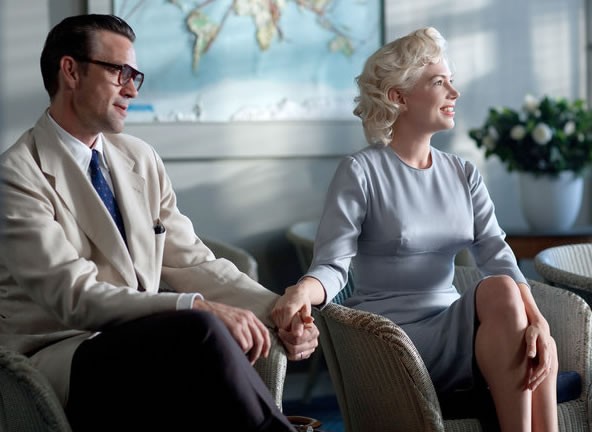
| Dougray Scott as Arthur Miller and Michelle Williams as Marilyn Monroe |
| "Did she break your heart? Just a little bit? Good, it needed breaking." - Emma Watson as Lucy considers her 'rival' |
| Kenneth does Larry |
Marilyn persists with acting coaching from the brilliantly bristling Paula Strasberg (Zoë Wanamaker) although Olivier fumes, “Trying to teach Marilyn to act is like trying to teach Urdu to a badger.” Larry doesn’t like method acting; it’s new and it frightens him. Marilyn is the future, which makes him feel threatened. When he removes his make-up before the mirror, he reveals the man beneath the actor, admitting that he wanted to feel young again by working with her, but “when I look at that magnificent face, all I see is my own inadequacy.”
Vivian Leigh (Julia Ormonde), Olivier’s wife and remarkable actress in her own right, is 40, which is too old to play on screen what she can on stage. She sweeps into rehearsals to dispense benedictions but also to check on her competition. Marilyn is 30. Hollywood demands young women, although hypocritically dominated by older men.
There is much warmth and generosity of spirit (and acting) in the film, but none more so than from the simply spectacular Dame Judi Dench. Who could possibly want a greater mentor than her or her character, Dame Sybil Thorndike? She makes excuses for the forgetful and stumbling Marilyn, always has a gentle word to ease her into the situation, and commiserates with Colin's infatuation pains. She also becomes embroiled in a stand-off between union members (over whose job it is to move a chair), which she calms by reminding us, “If the unions fall out, only the management benefits”. She is clearly on the side of us; the workers.
| The ever-fabulous Dame Judi Dench as Dame Sybil Thorndike |
Thursday, 22 September 2011
When communication counts
One of the things I enjoy about theatre and performing or directing is the way all the elements come together. Sometimes these blend almost seamlessly, and at other times they are more awkward.
We are currently in 'black week' for the Alexandra Musical Society's production of The Full Monty. This is the term given to the week before the performance where the actors, having been the focus for the past three months of rehearsal, are no longer centre-stage. Instead the director turns his or her attention to aspects of sound, lighting, cotumes, hair and make-up, the band and traffic.
This show uses 'trucks' or set pieces on wheels which must be rolled into position and then removed from stage for various scenes. We have to negotiate urinals, pianos, police sergeant's desks, sofas and coffins: the stage-crew are busy. There are very quick changes: the costume department are very busy. Microphones have to be attached and removed in a rapid time-frame; meanwhile lighting and sound cues are crucial to the actors and the band.
It's all coming together and it will be a wonderful show. Many people are learning a lot and learning it fast. Our director, Bryan Aitken, is a good teacher - he spells things out clearly and concisely. The most important lesson he teaches is, "It's not just about you. Make sure you communicate". The stage manager calls the show - he or she makes sure that the actors are ready; the sound and lighting technicians know when their cues are; the band are tuned up and focussed in the pit.
No one component can start without the other. It is a giant dramatic jigsaw puzzle and each piece fits in exactly the right place - if it doesn't, then the picture will be subtly (or radically) altered. Clear forms of communication are necessary between departments, which may mean that not everybody has to pipe up at the same time and create a chaotic cacophony.
Meanwhile the rest of the nation is embroiled in the throes of the Rugby World Cup. The media here is still harping on about the mess of the 'party central' when lots more inebriated rugby fans, and other folk, turned up to the Auckland waterfront than were expected so all public transport was thrown into turmoil, even though this was routinely advertised as 'the place to be'.
Asked for advice, Jonny Wilkinson (OBE) said the most important aspect of any team sport was to communicate clearly with your team so everyone was aware of what the others were doing all the time. It's all very well to be the Flash Harry, but for the sake of cohesive teamwork and ensemble performance, it's better to be Johnny-on-the-spot.
Wednesday, 24 August 2011
Playing Dress-Ups
I am currently rehearsing for Secret Bridesmaids' Business (which is due to open on Thursday 1st September at the Athenaeum Hall in Arrowtown), in which I get to play a character completely unlike myself. Lucy Dean is 'earthy, impetuous, direct.' She is 'tall, striking', and one hell of a trouble-maker. She never censors herself, is impossible to embarrass, and is 'not scared to say things that people don't want to hear'.
I am a Libran who is almost incapable of making a decision. I hate conflict and am terrified of hurting people's feelings. Can you imagine how liberating it is to portray the exact opposite? There are many reasons that actors act. This is one of them. You can slip into different characters and try them on for size just like a new outfit. It's a lot of fun, and can be a thrilling experience. I think you just have to make sure you don't take it too far, however, which is why I am not a fan of method acting.
When the lights go down and the audience leaves, you have to remember who you are underneath the temporary wardrobe. Acting (in the words of the great Sir Ian McKellen) is pretending. Imagination is powerful, and children instinctively know that. Maybe I have just never really grown up, but I still love playing dress ups and hope I always will.
Tuesday, 2 November 2010
Big Foot Strikes Again!
Recently the New Zealand media has been awash with hysteria over The Hobbit. Because some actors who were part of the union dared to ask for comparable wages with their American counterparts for doing the same job in the same conditions on the same film, the executives at Warner Brothers threatened to take the film off-shore. Suggestions were Poland or Czechoslovakia, because it’s cheaper. There was outcry.
This did lead to some interesting asides as an article in The Guardian speculated where certain scenes might be located if set in Britain (let’s not forget; where the book was originally written). The Shire is described thus; ‘Tranquil and pastoral, the Shire is home to the Hobbits, a bizarre race of tiny, shoeless, greedy, pipe-smoking, badly dressed little men and matronly wives.’ The suggested location was therefore Luton town centre. The forum was opened up to the public to propose where they would shoot The Hobbit – the first answer was, ‘I would shoot the hobbit in the face’. My, how I laughed.
According to some sections of the population The Hobbit can be set nowhere but New Zealand, never mind the fact that JRR Tolkien never even visited here. For a nation that has been proudly churning out ‘New Zealand-made’ garments from sweat-shops in China for years because it’s cheaper, the righteous indignation feels a little hollow. These are probably the same people who illegally download films and music, thereby killing the performance industry to save themselves a few dollars.
Many extras and people who don’t actually make a living through acting are claiming, ‘I’d do it free’. How helpful is that really? For some reason many sections of society seem to think that because actors love their job, they should be paid a starvation existence, if at all. I’m not sure I follow this argument – are we saying that lawyers and surgeons hate their work? After all, no one expects them to work for free.
It seems that the nation has finally woke up to the fact that people don’t adore them the way they think – they just use them because their labour is often cheaper than in other (generally unionised – i.e. fairly paid) countries. So I woke up one morning last week to find that John ‘I made fifty million pounds out of screwing people like you’ Key has changed the labour laws overnight, and denied one of the workers’ primary rights – that of collective bargaining. Yes, you read that right: 300 years of workers’ rights sold to Warner Brothers. It may not be Mickey Mouse, but it’s certainly goofy.
Corporate greed triumphs once again, as you would expect from the despicable I’m Alright Jack politics that epitomised the Thatcher era (during which this particular Jack made his millions), but the fact that a Prime Minister can directly intervene in a commercial venture and bribe a company to come to his country (Warner Brothers will receive $25 million in tax breaks) so it receives worldwide exposure is disgraceful. New Zealand scenery will once again be on the big screen and it will do wonders for the tourism industry (the same Guardian article points out that, ‘prior to those films it was just bungee jumping and binge drinking, but now the spectacular scenery is its own selling point’), but the actors will leave. He has made sure of that.
When all that is left are right-wing propaganda mainstream X-box American remakes in ten years time, people who voted for this slippery snake will have only themselves to blame. I will be boycotting the film of The Hobbit when it finally comes out, even if it does star Richard Armitage. Admittedly, I am only one person and will not make much of an impact on the American/oops, I mean New Zealand (there appears to be little difference) dollar, but like the actors who fought for their rights I am prepared to stand by my beliefs. (Plus The Hobbit is one of only two books I have ever started and not finished out of sheer boredom.)
Meanwhile in France, such things would not pass without a ripple. President Sarkozy’s attempt to raise the retirement age from 60 to 62 drew mass protests and strike action from the workers. It was said to cost the national economy €400 million a day and yet 70% of people supported the unions who called for these strikes. Jean-Luc Hacquart, a representative of the CGT union in Paris (Confédération générale du travail) – the strongest union in France – said (albeit doubtless in French),
Monday, 20 September 2010
Two Plays in Spanish in Edinburgh
The Man Who Fed Butterflies (Teatro Cinema)
Kings Theatre, Edinburgh
29 August – 4 September 2010
The play blends film and live action in an intriguing manner in which the actors work with each other as well as shadows and projections of themselves. Changing positions and perspectives confuse more than they clarify and the hallucinogenic sound-track enhances the hypnotic ambience. The special effects are probably crude in comparison with cinematic tricks but they form the basis of the show and Teatro Cinema are acclaimed for their innovation.
The Butterfly Effect is often mentioned in relation to Chaos Theory in which it is propounded that small actions such as the beat of a butterfly’s wing may have profound effects such as causing a tidal wave. This may all be a bit much so it’s probably best just to enjoy the illusions and let them wash over you without examining them too closely.
The Man Who Fed Butterflies asks questions about the true potential of the human mind, the nature of acting (one of the actors of the film within a play says, ‘I prefer theatre’ – I think I do too) and the importance of fantasy as an antidote to the harsh realities of life and loneliness. It is easy to admire but not to identify and, as all the characters wear masks their stories are representative rather than real. It makes me think; but it doesn’t make me feel.
Diciembre (Teatro en el Blanco)
Royal Lyceum, Edinburgh
2-4 September 2010
2014 is the new 1984 in Guilllermo Calderon’s play, Diciembre. It’s the predicted dystopia in the near future when the tensions in South America have exploded and Chile is at war with Peru and the Bolivias (which are no longer one country). In December, the season of ‘sad celebrations’, the young soldier Jorge (Jorge Becker) returns on leave to find his older twin sisters both pregnant and both with their ideas for his future.
Paula (Mariana Muñoz) hates with a passion and she rants against the imperialist enemies, desperate for Jorge to return to battle and kill them all. Trini (Trinidad González) is a pacifist who would rather hide and protect her brother; she merely wants love and affection, even if she gets it through sticking her finger into the eye socket of the eyeless army deserters. Jorge plays his sisters off against each other while wanting to know who are the fathers of their unborn babies.
Despite the strong social element the play has both a human and an absurdist feel as the sibling rivalries and political passions break free around the Christmas dinner table like an elaborate tango. Each of the actors plays another character (the drunken auntie; Father Christmas; the rejected lover) which is a heightened version of their more ‘natural’ self.
In many ways, this is a typical Christmas dinner with all the accompanying arguments, drunken relations and revelations, and enhanced festive sentiment. Due to power cuts, the tangle of coloured bulbs that illuminate the spare set of an off-centre table flicker on and off in different configurations like the end of a party that has got out of control.
Teatro en el Blanco have produced a highly charged and dramatic work of black humour. Whether engaging with the domestic dynamics or reflecting on the nature of war (Machu Picchu has been destroyed and ‘civil blood makes civil hands unclean’ indeed), this is a powerful drama even to someone who knows very little about South American politics. The fast-paced dialogue, gradual reveals, quick changes of character and rapid-fire South American Spanish all combine to heighten the challenging. I am left reeling and with feeling of sensuous exhaustion that makes me so glad that it is not Christmas every day.
Monday, 17 May 2010
Oliver! It's a fine show
Director Stephen Robertson is a stickler for detail, which is evident in the overall look of the show. Costumes, set and lighting combine to create the effect of a Bruegel painting in which splashes of colour illuminate a highly-styled background. Colourful silk handkerchiefs are judiciously used for everything from set-dressing, dancing props and the pickpocket scene.
The music (under the direction of Cheryl Collie) is befittingly bold as brass. It is a delight to hear the bassoon, although the French horn occasionally drowns the singers and there are a few technical issues with the balance of sound. Choreography is handled expertly (also by Stephen Robertson) with strong moves that engage the children and fill the stage. Both the workhouse 'boys' and Fagin's gang are charmingly proficient.
The adult company assist in the slick scene changes that allow few pauses for breath, and their ensemble numbers are vibrant highlights. Who Will Buy can be a difficult and messy number but this is a huge success – the soloists add a piquant edge to the forthright professionalism of the morning’s traders. Often standing at convergent angles and with sweeping side-to-side movements familiar from the Ascot Gavotte, the company bring the bright shiny morning bustlingly to life.
The Artful Dodger (Caleb Dawson-Swale) is full of nervous energy and rapid gestures like an out-of-control tic-tac bookie – I would definitely want to be in his gang. Energy bursts off the stage as he leads the company in the remarkable Consider Yourself, enhancing the Wurlitzer fairground attraction atmosphere. The dance itself is three parts Lambeth Walk to two parts Macarena and has everyone in the audience tapping their feet. The reprise also makes a fantastic ending, my only quibble being that this should come after the bows, leaving an overwhelming impression of music and company rather than figures shuffling off the stage in the half-light.
Most satisfying of all in this production are the solid outbreaks of acting, seldom seen in amateur musicals. Fagin (Marty McLay) praises Nancy’s acting but he is obviously the consummate performer here, always trying to ‘win friends and influence people’ by whatever means possible. Desperate to please or persuade, he acts many roles with rolling eyes and waggling fingers but never crosses the line into pantomime.
McLay eschews the stereotypes to make his Fagin uniquely human. He uses the street urchins for private gain, unconcerned with their welfare, and his attitude to Nancy is despicable. He is pleasant when he can afford to be but ultimately selfish and greedy, caring for no one but himself; John Key would be so proud.
Nancy (Fiona Stephenson) is also excellent. She brings extra vigour and authenticity, a natural compassion for the children, and a sense of fun. Earthy and gruff, she sings guttural songs which suit her gutter origins and has natural interjections, although some are a little modern (‘Listen up?’).
The compact stage works in the show’s favour making the action up close and personal. Empathy with the characters is encouraged so there is an intimacy often absent from musical theatre. When Nancy briefly regrets her errant lifestyle ‘Not for me the happy home, happy husband, happy wife’ it is profoundly touching.
There is no honour among these thieves; they may play games and be jovial but they won’t stand up for each other. A nice subplot hints at Dodger’s affection for Nancy, but he won’t take on Bill Sikes (a brutish and menacing David Oakley). They are all afraid of being alone and friendless – Fagin keeps a caged bird for company, and Dodger admits with a touch of sadness, that he “ain’t got no ‘hintimate’ friends.”
Oliver (Angus Reid) avoids the mawkish sentiment that mars many orphan Olivers, as he is presented with a succession of patently unsuitable parent substitutes. At the workhouse he suffers the wonderfully manipulative Widow Corney (Kathleen Brentwood) and the suitably pompous and disturbingly lecherous Mr Bumble (Mark Ferguson).
After causing a disturbance (committing the heinous crime of asking for more gruel) he is sold to the Sowerberrys (Nick Hughes and Amy Taylor) with their sneering disdain and unfoundedly high opinion of themselves. Their duet, That’s Your Funeral, cuts and thrusts with barbed comments, making Mr Bumble’s well delivered, ‘I don’t think this song is funny’ all the more entertaining.
Oliver fits most suitably with Mr Brownlow (David John) and Mrs Bedwin (Jane Robertson whose calm understanding contrasts delightfully with Nancy’s fiercer instincts). The cameo roles are all generally strong, although a couple of the males are teetering on the cusp of caricature – if they plunge over that precipice as the season persists it will be to the detriment of the show.
The ending is always problematic in this musical as all the loose ends are hastily tied up and the implausible explanations offered, but the cheeky Cockney character (and yes, it does help if you have the accent) shines through. Whereas some productions are epic and grandiose, this one is cheerfully engaging – consider yourself well in, indeed.
Thursday, 29 April 2010
Ring out the bells
This film had a very low budget (the American scenes are clearly not overseas, and the flight there is obviously a model aeroplane) but the production values are still very high and the cinematography is excellent. The changes in depth of focus and sharp close-ups are a welcome relief from the shaky blurred vision that plagues most documentaries. And green and pleasant lands and the Compasses Inn in Wiltshire, where most of the filming was done, make a fine backdrop to the action.
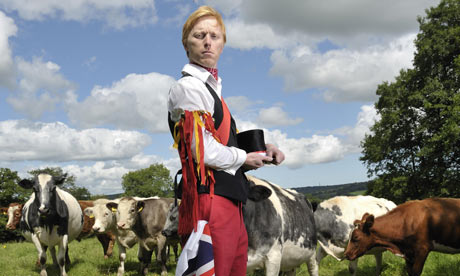
The story follows Derecq Maximillian Twist and his troupe of Morris men, the Millsham Morris. At 32, Derecq is at the peak of his dancing life. He may seem like a mild-mannered tractor mechanic from West Dorset but he is consumed by his passion for ‘the Morris’. Apparently, the term ‘Morris’ covers a multitude of sins and there are a variety of styles, including Borders, Rapper and Clog Dancing, but the Cotswold style is “the distillation of masculinity – it epitomises and embodies the essence and magic that is the essence of Morris.” So says Professor Compton Chamberlayne (Harriet Walter), Emeritus Professor of International Folk Dance at Cambridge. She exudes academic authenticity and is so convincing that you are left doubting what is real and what is absolutely made up?
Derecq introduces his team to the documentary maker, Jeremy (Aidan Mcardle) in a line-up like a proud sergeant showing off his troops to the Queen. They number Will Frosser (Jasper Britton), the foreman; Muff Barcock (Clive Mantel), Point Man 1, who has been “dancing for 40 years and still dances like a gazelle”; Plush Gurney (Richard Lumsden), Point Man 2, who came from ballroom dancing and struggles with his fitness; Boothby Pagnell (Adam Ewan), Point Man 3, who “came from ballet dancing but we won’t hold that against him – everyone has to dabble in the dark side” – besides, he has the top-five hanky work in the country; and Lydiard Spurling (Andy Black), Point Man 4, who is on a cultural transfer from Newcastle and no one understands a word he says.
You have to be asked to join, by showing sufficient calibre and letting your interest be known. Jean Baptiste (Dominique Pinon), substitute Point Man, “dances like a demon, especially after a couple of pints of cider” (i.e. Onan’s Revenge or Wookie’s Hole). A fabulous reconstruction reveals the tempest in which he was caught when he was a fisherman – he washed up on Dorset shore and decided to stay, and married the landlady of The Travellers’ Inn. With its well-drained, level ground, this is the perfect place to dance.
Between them Derecq Twist and Professor Chamberlayne explain that “Morris asks many questions of a man – mentally and physically.” It is apparently a dangerous, contact sport, not just about keeping fit; you need to have “nerves of steel and reactions like lightning’ and a dubious taste in jumpers. The Millsham Morris troupe has a nutritionist and is aware of potential injuries, such as splinters, chipped teeth and cracked knuckles. It is essential to warm up properly and get the blood flowing – they share a hilarious joint training session with the local basketball team – and they take it very seriously indeed; “It takes the three ‘p’s – ‘Passion, practice and a desire to be the best’.”
Derecq is also interested in the world of dance outside Morris and attempts to combine other elements (such as Brazilian Maurizio). “Much is within; much without – it will take from anywhere.” He finds inspiration for his free form ‘New Morris’ from other cultures, people and cider, which is very important to interpretation. “The use of any drug is dangerous; organic cider particularly so.” There is a hint of Gareth from The Office as he introduces innovative styles and balletic jumps into his new code. “Someone will end up in hospital – guaranteed.”
With his pursuance of originality, however, he has “ruffled a few highly-placed feathers in the Morris world” and finds himself monitored for deviation. Quentin Neely (a delightfully pompous Derek Jacobi), in his city office overlooking the gherkin on the Thames, maintains that Derecq is bringing Morris into disrepute. Neely denies that Morris should be allowed to change and develop like any other dance; change is only a good thing if it is managed properly. His main objection is that the foreign influence is unwelcome. “Morris is, to its core, English, English, English!”
And so Derecq is rusticated – removed from Her Majesty’s Morris Circle – and forbidden to dance. The laws are reluctantly enforced by Endeavour Hungerfjord Welsh (Ian Hart) the squire of The Moss Side Morris. In DMs and braces they look as though they have stepped out of A Clockwork Orange but they show great sensitivity as they withdraw the staves and confiscate the hankies and ruggles. Seeing Derecq so dispirited is too much for Jeremy who breaks the cardinal rule of documentary making – “I intervened”.
Jeremy arranges for Derecq to fly to California and work with the outrageously camp Orange County Morris (OCM). Of course, he never actually leaves the studio and the backdrop is studiously fake as Derecq deadpans, “Beverly Hills is a bit like Torquay with traffic and palm trees – but a bit sunnier.” He finds the climate a bit of a shock – “I’m used to dancing in all weathers in Dorset, except sunshine.” Unfettered by tradition and with a rich benefactor, Miloslav Villandry (Greg Wise in a remarkable velour pants-suit), the OCM flout convention with their screamingly funny outfits and light-weight carbon-fibre staves.
With the help of their publicist, Sonja (Naomie Harris) with whom Derecq begins a relationship, they decide to incorporate Derecq’s skills into their act and perform to wild acclaim at the Sonomoa County Folk Festival. The practice scenes are like Dirty Dancing meets The Full Monty and the dancers explain that the UK and USA are ‘Two cultures divided by language but united through dance.’ Their routine is full of blinding lights, pelvic thrusts and gyrating rhythms calling upon Boyzone and Michael Flatley. Commercialised with trainers rather than clogs, the union flag intertwines with the stars and stripes, and the punters have never seen anything like it.
Spurred onto greater successes, the OCM turn professional, but Sonja accepts a job as a political press secretary and moves to Iowa. Derecq follows her there and the film drags in this section – at least one scene in a bowling alley could have been cut. There is no appetite for Morris in the mid-West and though he may teach it at weekends, he has sacrificed it to love. Jeremy wonders if his interference was a bad thing as it is terrible to see a formerly mighty Morris man reduced to the devil’s dance – line-dancing in Iowa. Derecq is just a West Country boy at heart – “I love to do a dance with the boys, and have a pint of cider and a game of cribbage afterwards.”
So does Dorset hold more sway over him than his new love? For some inexplicable reason, I actually found that I really cared! It’s not just the romanticised music (original score by Richard Lumsden), reminding me of Brassed Off, which is superb, right down to the rap version of a Morris tune over the final credits. It’s not just the sheer quality of the acting, the sublime scenery or the intelligent direction, although all of the above are outstanding.
Above all, the film weaves an excellent story around a much-maligned art-form. Celebrating the earth, the harvest and general fertility, Morris dancers who performed outside pubs in England were guaranteed a free beer – and who can argue with that? It is heartening to see many closet Morris fans shaking their bells in celebration, and it leads me to question why the public ridicule the Morris and revere the haka? Despite the popular perception, I’d rather take a fun fertility ritual than a threatening war dance any day.
Tuesday, 9 March 2010
Everybody else does it; why can't I?
These film people have put a lot into their art and this is their big night - fair enough. But the gushing cling-ons are hard to take as they bounce and squeal excitedly over each pleat and ruffle. One asked a bloke 'Who's tux are you wearing?' which I thought was rather rude. Were they suggesting that he couldn't afford to buy his own and had to borrow someone elses? Apparently not. That's fashion-speak for 'Who designed your outfit?' (And in the case of Sarah Jessica Parker, 'Was it for a bet?')
The 'stars' smile and politely pirouette for the masses. They all want the acknowledgment - that's why actors act, right? - they will get from their peers inside the building. But to get there, they are prepared to face this gauntlet first where they know the people simpering at them now will be ripping them to shreds in the magazines and websites later.
No, I'm not above it. And just to prove it, I took notes on whose gowns I'd like to own, and which were total frock horrors.
Cameron Diaz's look was described as 'old school glamour'. We dressed in navy blue polyester at my old school. I like this gold strapless gown, but it would have been somewhat impractical on the lacrosse pitch.
This is sort of similar, but what it makes up for in the practicality stakes with shoulders, it looses out with a fish tail. Sandra Bullock is beautiful and she has clearly chosen to match her outfit to the cute accessory she will take away later, but it might help if she could move. She can't even break into her trademark smile for fear of breathing.
Demi Moore's Versace frock is described as 'blush' which is slightly amusing as she is now so plastic, I doubt she is capable of doing that herself. However, she looks good for a doll and is able to wear all those ruffles without looking like a toilet roll cover.
Speaking of ruffles - why does this work? Diane Kruger risks looking like a Christmas tree, but this dress is so frou-frou and chic it can only be Chanel. There is a gorgeous ribbon effect that hangs down the middle of her back, and adds extra interest, like a gift you can't wait to unwrap...
...whereas Jennifer Lopez (why is she at the Oscars at all?) in bubble-wrap looks like something you desperately want to cram back into the box.
Speaking of boxes, Vera Farmiga appears to have crashed through the first layer of chocolate and ended up in that annoyingly noisy crinkly stuff like an anaemic strawberry cream.
Helen Mirren retains her Queen of the Catwalk crown with this sparkly metallic number with the subtle sleeve detail that 'ladies of a certain age' wear so well. She is simply stunning.
My beloved Kate, however, looks like she is auditioning for the Tin Man in this suit of armour. Metallics don't always work the way you intended.
Carey Mulligan looks great in this Prada outfit sewn with tiny scissors which earned the word 'quirky' on the night by everyone who mentioned it. Who says black has to be boring? And she gets extra points for proving that yes, film stars really do have feet (I was beginning to think they were all on wheels).
At last, some colour! If you're not size six, you're going to stand out at the Oscars anyway. Mo'Nique does it for all the right reasons (as well as winning the best supporting actress award, obviously) in electric blue.
Oops, I spoke too soon about the colour. In all the excitement, Maggie Gyllehall forgot to get dressed and just wrapped herself in a bath sheet. It seems she remembered earrings though.
This is one outfit that certainly doesn't need jewellery, and Zoe Saldana rocks it. Colour; check, sparkles; check, metallics; check, ruffles; check, fish tail; check. Perhaps she stole some of Maggie's materials?
I actually like this dress on Penelope Cruz, although I did hear it described as 'provincial bridesmaid'. Let's just say that if you were the bride at this wedding, you would be well and truely outshone. So, colour; there is the good...
...the bad (Sigourney Weaver is so angular that an asymmetric look just doesn't work for her, unless the exposed shoulder is to stop her blending into the carpet)...
...and the ugly. Sarah Jessica Parker gushed, 'Mr Lagerfeld made it just for tonight', to which I wanted to ask, 'What, this morning? In ten minutes? With his eyes closed?'