Showing posts with label friendship. Show all posts

Wednesday, 21 July 2021

Wrap up Warm: The Quilter's Apprentice


The Quilter's Apprentice by Jennifer Chiaverini
Simon and Schuster
Pp. 271

For a novel with quilting at its centre, this is as homey and heart-warming as you would expect. It features friendships, family, forgiveness, sisters and sisterhood, supported by a wealth of detail about making quilts that those who do will doubtless find fascinating. Taking disparate scraps and piecing them together into a whole is an obvious metaphor for storytelling: in quilting the stitches that bind the fabric together are best if they are nearly invisible. Unfortunately the working is quite clear in this novel as some of the dialogue is clunky, and the scenarios are often unrealistic.

Sarah and Matt move to a new town for his job as a landscape architect. Matt works for an irascible client, Mrs Compson, at Elm Creek Manor restoring the grounds to their former glory while Sarah reluctantly takes up a position indoors, helping with the cleaning and taking lessons from Mrs Compson (an awarded quilter) in return. Sarah is a trained accountant but she is bored with the work. The characters are privileged, middle-class and comfortable, and Sarah’s complaints certainly seem petty.

Mrs Compson plans to sell Elm Creek Manor, but when Sarah and Matt discover that the intended buyer wants to tear it down and build student accommodation, they are appalled and try to think of a way to save it. The focus is on conserving and preserving rather than progressing and assisting potential students with their future living arrangements.
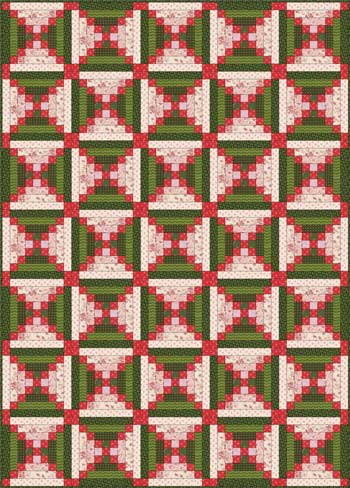
Chimney and cornerstone quilt design

Looking to make friends, Sarah joins a quilting circle, befriending the other women, although they clearly have reservations about Mrs Compson. They welcome Sarah into their group and help her practice, supporting the individual tutoring she has with Mrs Compson, expanding upon the techniques of the craft. They discuss different stitching methods; there are arguments over the preference between hand and machine stitching; and the skills required to undertake different tasks, with a level of detail that might be skimmed by those not interested in the minutiae. 

The history of quilting is mentioned, as are individual patterns with their specific meanings. Mrs Compton explains to Sarah the relevance of the Log Cabin quilt pattern to Elm Creek Manor, which was a stop on the Underground Railroad during the Civil War. “If an escaped slave saw a log cabin quilt with black centre squares hanging on the washline, he knew it was safe to knock on the door.” When Sarah asks wouldn’t bounty hunters see the quilt too, Mrs Compson replies, “Why, who pays attention to women’s work? Laundry, hanging on the line? Sorry, can’t be bothered. We’re out doing important man things.” There is a highly unrealistic conversation about craft being viewed unfavourably compared with art as it is considered women’s work, which raises some valid points, although the dialogue is stilted and deeply unlikely.

Sarah appreciates her newfound female friendships, and learns about Mrs Compson’s past through the older woman’s reminisces and reflections of life. She looks to Mrs Compson as a substitute mother-figure, while acknowledging her complicated relationship with her own mother. This dynamic is left unresolved – perhaps for the next novel; this is clearly positioned as the first in a series.

The theme returns to the purpose of making quilts, whether as a practical hobby and a leisure activity or an art form to be rewarded. Chiaverini argues that the value of a quilt is more holistic. Craft as empowerment is not a new theme, but it is one that this novel embraces warmly bringing gentle comfort.
Log Cabin quilt

Wednesday, 29 January 2020

Just right: A Universe of Sufficient Size


A Universe of Sufficient Size by Miriam Sved
Picador
Pp. 311

Spanning continents and three generations, this rich novel of mathematics, politics, friendship, family, sexuality and love, features numerous time and narrative shifts. Illy discovers a diary written by her mother, who has left it deliberately where she can find it, and reading it changes Illy’s perception of history and her self. It takes her back to 1930s Hungary, when Jews are barred from attending university, so a group of five friends and mathematicians (two couples – Ildiko and Levi; Eszter and Tibor; and Pail) meet beneath the statue of Anonymous in Budapest to expound upon their theories.

This desire for anonymity is unusual as nationalities fight to be the one to make mathematical breakthroughs that can be given military applications. Ildiko considers how one can know what future use will be made of the science, maths and physics they think they are discovering in isolation.

The friends cannot know that the Holocaust is coming, but they are aware that the future will be dangerous and that their group will dissolve. They can’t imagine marriage or children, because they live in such uncertain times. They all, particularly Eszter, want to protect Pail from the real world and shield his genius, worrying that he is not equipped to deal with the coming war and its consequences. While Pali remains entrenched in his theoretical problems, not all of the friends agree he needs extra attention. Ildiko tells Eszter, “Someone will always look after Pali, because he is brilliant and hopeless at the same time. I have noticed that people can’t resist the combination of brilliance and hopelessness in men.”

This world is echoed in the present when Josh, Illy’s son, attempts to find applications for his version of theoretical mathematics. He is aware of the work of Pali Kamar, but thinks the internet provides practical applications, which he explains to his grandmother, Nagymama, not knowing she was a friend of Kali’s. Josh is excited by finding order in chaos; to understand the universe; to feel less insignificant, which he (and Pali before him) demonstrates through Euclidean planes. Josh searches for order and predictability, trying to shape the situation to fit.

Everyone in the novel tries to find their own pattern and shape their own narrative, while accepting difference and factoring it into individual and societal equations. When Nagymama moves to America, “It still surprises her how everything in this ridiculous country seems brighter, bursting with its own youth; even the vegetables have a juvenile optimism.” Infinite possibilities provide exciting concepts, but is it necessary to try and define them when there are constant breakthroughs and alternate opinions which subvert preconceived notions about everything from sexuality and religion to mathematics and astrophysics?

Friday, 14 December 2012

Friday Five: Non-competitive pursuits


I think it's fair to say that I don't like reality TV. I have mentioned this before. One of my least favourite sub-genres is the competition variety. You know the type of thing, where people are pitted against each other to paint a room or build a wall and then someone wins and everyone at home thinks they could have done the same and the real decorators and stonemasons go out of business while general standards plummet.

Although I like the celebrity dancing ones (especially the ice-dancing one), I know I am no expert. This is not true of the people who routinely watch the singing shows and then feel free to critique performances about which they know nothing. It also means that we are left with chanteurs who think that to belt and warble is the epitome of 'singing' and we are left without subtlety, nuance or character. Bob Dylan or Florence Welch wouldn't make it through the first round.

With performance and artistic pursuits, a lot is left to personal preference - A might like sci-fi or farce; B might prefer romance or Jacobean drama; C might swoon at ballet and metaphysical poetry and so on. It doesn't mean any one is 'better' than the other - it just means they shouldn't be judged against each other. In 'pure' sport if you run fastest, jump highest or throw something furthest, you win. You are the best at that particular thing. Don't get me wrong, some things lend themselves to competition and this is a good thing (not keeping the score during football games because 'it's all about participation' is ridiculous!) but when subjectivity creeps in, nothing is so clear.

Acting, comedy and writing awards are often suspect. Yes, they are worth something when awarded by your peers, but often they are voted for by a partisan panel - the more friends you have in the audience; the more likely you are to win. These tributes might provide a feel-good factor, but they are relatively worthless. Entertainment is not a science; nor should it be a competition.

5 Things that should never be a competition:
  1. Cooking - as far as I am concerned you either cook because it is your job and you are paid, or because it is a way of expressing love and friendship to those around you. Eat with me and know you are welcome. Do not judge the temperature of the soup or the slicing of the vegetables. I have prepared this gift for you in my own way.
  2. Surgery - there will come a day when cameras go into operating theatres and viewers vote on who best wields the scalpel. I'm surprised it hasn't happened already. Health is personal, although you wouldn't know it from those shows which 'expose' physical deformities and laugh at fat people. Some things should be conducted behind the curtained cubicle - pull yourself together.
  3. Sex - it's personal and not up for discussion apart from between the relevant parties. According to late-night phone-ins (you hear a lot driving home from rehearsals) many people seem to be concerned about whether or not their sex-life is 'normal'. As long as you and your partner are happy with it, whatever you're doing, or not doing, is fine.
  4. Raising children - I hate the use of nouns as verbs, so have resisted the urge to call it parenting. I'm sure it's pretty difficult to raise a child to be a reasonable and responsible human being. Just do your job and stop comparing yourself and your child to others. In some respects they're all the same; in others they're all different - don't bother worrying or boasting, and if you must do either, do it to yourself as no one else cares. Really.
  5. Friendship/love - when I was little I used to refer to 'best friends'. Now I know that best is a superlative meaning 'of the most excellent or outstanding or desirable kind' there can only be one, by definition. I would now say I have many good or close friends - all of them special to me in individual ways and I love and admire them for their specific qualities. I would never try to rank one above the other. That's not how this love thing works.

Friday, 9 December 2011

Friday Five: Scooter


It is with infinite sadness that I write about the death of one of my dearest friends, Glenn 'Scooter' Reid. Him Outdoors and I have known Sooter for a dozen years and he has enriched them in a way I cannot express. He has the biggest heart of anyone I know, but sadly his little body wasn't strong enough to deal with the pancreatic cancer with which he was diagnosed almost a year ago to this day. I will love him and miss him forever, but I am also incredibly lucky to have had such an amazing and close friend. So I want to acknowledge the affection, warmth and humour that he brought into our lives. This one's for you, Scoot:

5 Things I Love About Scooter:
  1. His ability to be all things to all people: Whether with rugby, work, or theatre productions, he has a way of making you think that you are the most important thing in the world, and at that moment you are. With so many diverse interests he knows a lot of folk and there are always numerous claims on his attention. To love Scooter is to share him; whenever we went out for a meal or to the cinema or whatever, we would have to leave at least half an hour early to give everyone who wanted to, the chance to stop and say hello.
  2. His problem-solving ability: There are few problems Scooter couldn’t fix (usually with a Maglite and a roll of gaffer tape) and he loved being able to do so. As a director I often asked if it was possible to produce a certain effect and he would say ‘of course’ and then work out how. I generally left all that technical stuff to him, as if you gave him a clear idea of your vision, he would bring it to reality. He hated problems he couldn’t fix (such as emotional issues) and on more than one occasion he wished he had a time machine so he could go back and change things.
  3. His enthusiasm: There aren’t many Southern Men interested in both sport and theatre, and I’ve loved our travels nationally and internationally to see both (I’ve taken him to football; he’s taken me to rugby; we both respectfully disagree about the greatest game ever), but his interests don’t stop there. He knows stuff (he’s been an invaluable member of our quiz team), and what he doesn’t know he is generally happy to learn. Don’t get me wrong, he has an acerbic tongue at times and won’t take shit from anyone, but he can talk to most people about most things – a wonderful companion and great drinking buddy.
  4. His thoughtfulness: He provides you with things you didn’t even know you needed but then can't do without, and is always available for friendship and support. We were on holiday in Vanuatu and Tasmania when we were made homeless by the Queenstown floods and landslips of 1999; we returned to find that Scooter and some other wonderful friends had gathered up our essential belongings (photos; diaries; records; books; cats) and stored them in their spare rooms/ basements/ garages out of further harm. We moved five times in six months and he helped us with every single shift. We rented a caravan for a week over Christmastime, which was tough with two cats and no space. He brought us a box of beer and a barbeque and came to visit every day to help with whatever he could, especially the cooking and drinking! Being an immigrant (albeit of fifteen years), Christmas is one of the hardest times for me as I miss my family desperately. Scooter knows this and is always particularly welcoming at this time of year, inviting us to share his family and his time.
  5. His affection: he is fiercely protective of his family and his friends. When Scooter loves you; you know you are loved. And he is one of the best huggers it has ever been my pleasure to know.

Saturday, 21 March 2009

Friendship is...

If love is never having to say you're sorry (which I actually don't believe), then perhaps friendship is not having to say anything at all. I think of this because one of my favourite ways to spend time with friends and loved ones is in companionable silence.

The day we left America, Our Gracious Hostess and I sat at her dining room table drinking herbal tea, she looking up scrapbooking websites and me writing my diary. We hadn't seen each other for a long time and didn't know when we would see each other next - it could be years - but there was no need to babble on.

It reminded me of those times during our childhood when we sat quietly for hours flipping through magazines, painting our nails, drawing pictures, reading books... Occasionally we would look up and share a snippet of information, but most of the time we just worked quietly together.

There is a type of person who you know so well that there is no need for words. A look, a smile, a sigh or a gesture says it all. When I was a child I would often take a book into my brother or sisters' room and just sit on the floor or propped on the bed reading while they did their homework or listened to their records. It wasn't that I wanted to say anything, but I did want company. My cat is really good at this. He comes and sits near me, flicking an ear every now and then to let me know he's aware of my presence, but he doesn't say a lot. I like it.

Often we fill this silence with empty chatter - almost overcome by a need to say something, to prove our wit or our existence. We are almost afraid of silence as though it is somehow impolitie to be with someone and not talk to them. But when you have grown up with someone or shared so many experiences, there is no need for phatic communication.

I'm not good at small talk and I hate 'networking' or going to parties where I don't know anyone (this picture is not typical of what happens to me at such events) and I have to pretend I'm interested in what they've got to say. Sometimes I am, but often (especially it involves their children - which it invariably does with women over the age of 30 - or their salary to mortgage ratio) I'm not, and I can't bear the whole 'smile, nod, interject' routine.

This becomes even harder as I get older, and I fear I don't make new friends as well as I might. I miss being around my old friends and family - people who know where I went to school and what's my favourite colour and the terrible relationship mistakes I made. They know all that and accept it, so we don't have to go over it all again.

We can talk about things we really want to talk about, have pointless conversations, such as the definition of a sit-com; why religion and politics mix in America but not Britain; how easy is it to live without seasons; or we can simply say nothing at all.

Sunday, 1 March 2009

Happy Birthday Neighbour

Today is a good friend’s birthday, so Happy Birthday to her. When we lived in Queenstown, she lived ‘over the fence’. She put carriage steps against the fence so that we could pop over to each other’s house for a cup of tea (or, more usually a bottle of wine) and a chinwag.

We shared jigsaw puzzles and personal problems in equal measure, and many laughs were had at parties or just lonely evenings that weren’t lonely anymore. Noise police were frequently called and I think we managed to get rid of all the other neighbours in our radius several times over.

They had a spa pool where we used to while away long winter hours under the stars. We had a huge gum tree that I loved but it blocked their sun. I agreed to have it cut down, although I cried (I know; sentimental tree-hugger) and they made it into a garden seat so I could sit and read in the shade.

I missed them very much when they moved to Auckland. I missed the sound of the dice rattling in the Yahtzee cup. I missed the ‘pointless’ food we used to eat with our gin and bourbon. Her husband makes the most amazing platters of nibbles (those are far from pointless) and loves to barbecue things he has shot or fished himself – the day I found the dead deer hanging in the shower is not one I’ll forget in a hurry.

I began to think about neighbours and the ones I’ve had over the years. When I was a kid, my neighbour was a barmaid in my local pub – which was a nightmare until I actually turned 18. My best friend (Our Gracious Hostess from the American trip) lived over the road and we used to ride around on our bikes ‘cackling and terrorizing the neighbourhood’ – I have this on good authority from another great friend who lived just up the road.

When we lived in Poughkeepsie, NY, our neighbour was a retired policeman. He was a lovely gentleman and yet, as a teenager, I was slightly afraid of him. He was always inviting us round to play in his pool, but he was a cop – and a New York cop at that! He must have dealt with guns and villains every day of his working life and I knew he would see right through my adolescent sassiness.

In Manchester in the early 90s I lived on an estate in Hulme. It could be rough and you wouldn't go out alone after dark. Him Outdoors and I were courting then, and when he came to call there would be young ruffians swinging on the gate. They grew to recognise him and his car – they nicked the badge off the bonnet but told him when he had left his windows open and it started to rain.

One day after he had knocked at the door with no answer, he was going to leave when they told him that no, I was in, and just to knock louder. They were right; I was in the bath with the stereo on. It was a weird feeling to know they watched the door and knew the comings and goings of me and my flatmates. I also knew that nothing bad would happen to me on their patch – I was their neighbour after all.

Now I live next door to a hairdressing salon. The hairdressers are often sitting on the back steps having a cigarette and I stop to chat about the weather, how busy they are, and my cat – who wanders up and down the counters in front of the mirrors like he’s on a catwalk. Once an apprentice stroked his beautiful little head but she had hair dye on her hands and Chester sported a funky pink rinse for a while until it grew out. She was made to apologise to me and she felt dreadful, but Chester didn’t seem to mind, so I didn’t either.

Our neighbours do make a difference to the way we feel about a place. I have made great friends with some of mine and have fortunately never had any of those ones from hell that feature on reality TV programmes. Relationships with those who live next-door or over the fence make up a community. There’s lots of stuff in the bible about being a good neighbour – everybody needs them apparently. Australians even make soap operas about them. So do we, but we call them Coronation Street, Eastenders, or even Brookside, although they buried each other under the patio.

Him Outdoors told me that at Leeds University lectures were rescheduled around Neighbours because so many people were opting for the intrigues of Ramsay Street rather than electrical circuit theory. We loved Neighbours in the 1980s. We couldn’t get enough of Charlene, Scott and Plain Jane the Super Brain. When Harold got swept out to sea and Madge did whatever she did, they came to England to tour the pantomime circuit.

Our love affair didn’t quite stretch to Home and Away. Although it looked more alluring at first glance (it had a surf club, which we thought was terribly exotic) the appeal was superficial and soon wore off – it was the Dannii to Kylie’s Minogue. We just didn’t really see her as the desirable girl next door.

Neighbours aren’t meant to be glamorous but they are meant to ‘be there for one another’, sharing fortunes both good and bad as well as cups of sugar. Actually, I’ve never borrowed a cup of sugar from a neighbour, but I have borrowed eggs and jump-leads, although not at the same time. And if you’re lucky, ‘good neighbours become good friends.’


Tuesday, 1 July 2008

Thought miles

Yesterday was a good friend's birthday. I thought of her and I wrote a card. She lives in England so it isn't going to get there for at least a week. It has to fly there in a plane because I sent it airmail. I am contributing to the destruction of the planet by sending greetings around the world.

The phone doesn't really work because we are annoyingly half a day apart. When I am sitting down to relax with a glass of pinot and Coronation Street, she is heading out of the door to work, after preparing the kids' breakfasts and taking them to school. Much though she would love to sit down and chat, I'm sure it's the last thing she has time for in her hectic maternal schedule.

And a letter is so much better than an email or a text. When I was a child my aunt travelled to exotic locales and I used to love receiving envelopes or crinkly airmail letters covered with her distinctive handwriting and clourful stamps often with arabic language I couldn't understand printed across them. Without meaning to be naff, I pictured them bringing sunshine into my life in so many ways. I've kept them all in shoeboxes and the memories spring out when I release the lid.

And so I know that it is not cost effective, economically sound or environmentally conscious to tell my friends back in England that I miss them and I love them and that they are in my thoughts. But I will continue to do so because yes, we may only have one planet, but without true friendship in our lives, it wouldn't be a world worth living in.

Thought Miles

My morning is your night before.
When I’m out drinking
You’re starting work,
And I seldom call or write,
But I often think of you:

When I have a carpet picnic
Sitting cross-legged on the floor
With crisps and taramasalata,
Hiding from the rain and the world;

When we’re driving in the car
Singing along to The Primitives,
Hair blowing everywhere
And passing the time with ‘which is better…?’

When it takes hours to choose
A film to watch that night
Drama or action thriller,
That we’ll talk through anyway;

When I tell stories
About my history and background
Friends and influences
That made me who I am.

If you could read my mind
You’d know you’re always there,
But if I forget to tell you
I hope that you read this instead.
And know I think of you.