Showing posts with label singing. Show all posts

Wednesday, 15 April 2020

COVID-19: We Aren't Gathered Here Together


Last weekend it was Easter. I am a 'wishy-washy Anglican' (not actually my words, but I have been called thus) and only really attend Church at the major religious festivals - Christmas, Easter and Whitsun being the big dates in my calendar. Of course, this year I could not go to Church - no one can - and I missed it. I missed singing the songs and saying the prayers; I missed turning to my fellow members of the congregation and wishing them peace and good will. And I missed them doing the same for me. I missed that communal feeling.

For the same reason, I love watching sports and theatre; I enjoy a shared experience. Knowing that you feel the same thing as others is a wonderful thing. When I breathe in the hallowed turf of Anfield, it is a spiritual moment; all the home players and supporters know what I mean - we stand and sing together and no one cares how out of tune we are; we are in time. Our time. Any true fan will tell you the same (although they will worship at a different shrine). 
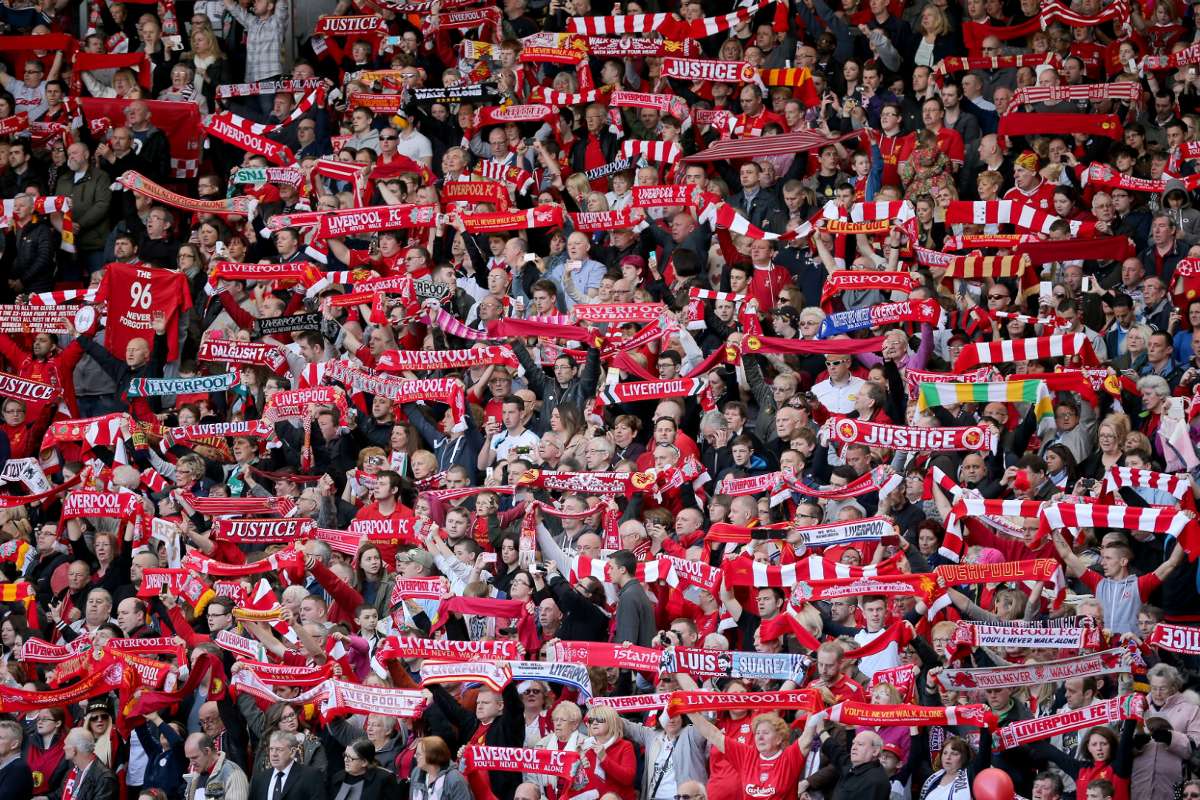


When the curtain raises on the stage and everyone takes a collective breath, we are all waiting to see what unfolds together. This moment will never be repeated - every performance is different - and we know we are privileged to witness it. And when the curtain falls and people applaud, they do it together. I have been part of a cast that received a standing ovation. It was magical and unforgettable. We did it for the audience and the audience appreciated us; and we were one. It was incredible.

I like listening to a band, but I prefer going to a gig or a festival. I don't need to then hear this gig again; I'm not a fan of live albums because generally the sound quality isn't as good, and the whole point is the being there. I am pleased the National Theatre, The Globe and the RSC are screening some of their performances so we can all enjoy things that we couldn't otherwise see - but we are still watching them alone. The roar of the greasepaint and the smell of the crowd is missing. (Yes, that was deliberate.)
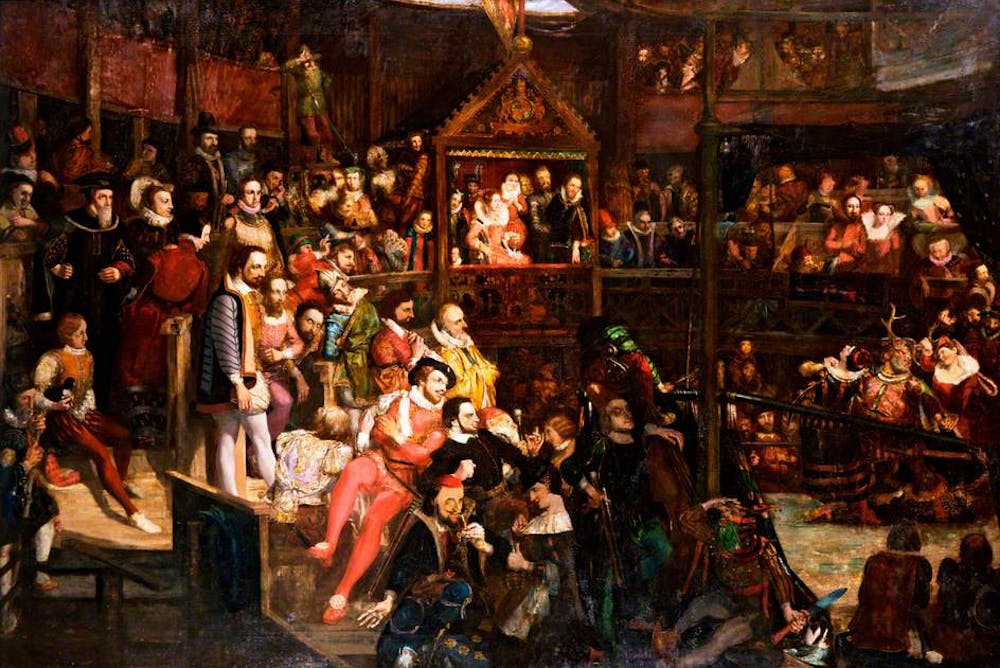
'Queen Elizabeth viewing the performance of The Merry Wives of Windsor, at the Globe in Merrie England' by David Scott
I like a drink as much as the next person. But there's a reason I go to pubs and clubs, even if the beer is often ridiculously overpriced. I like the atmosphere of sharing things with like-minded folk. Restaurants and cafes are better when they're busy (not cramped and heaving full, but with a low-level hum of noise). Silence is good when it is shared. Have you had a moment's silence in public? Then you know what I mean: there is nothing more moving than a collective memorial. 

Over the last few weeks I have held many on-line conversations and 'attended' conferences and meetings; I have done group trivia quizzes and play readings; I have watched re-runs of football matches and 'live' theatre. But I have missed the physicality. I will stay at home, and I will practice the physical distancing, because it saves lives and that's what matters. But when all this is over, I will find my flock and I will join them again, and we will sing our songs. 

Because it may be elitist; it may be exclusive; but being there is everything.

Friday, 14 December 2012

Friday Five: Non-competitive pursuits


I think it's fair to say that I don't like reality TV. I have mentioned this before. One of my least favourite sub-genres is the competition variety. You know the type of thing, where people are pitted against each other to paint a room or build a wall and then someone wins and everyone at home thinks they could have done the same and the real decorators and stonemasons go out of business while general standards plummet.

Although I like the celebrity dancing ones (especially the ice-dancing one), I know I am no expert. This is not true of the people who routinely watch the singing shows and then feel free to critique performances about which they know nothing. It also means that we are left with chanteurs who think that to belt and warble is the epitome of 'singing' and we are left without subtlety, nuance or character. Bob Dylan or Florence Welch wouldn't make it through the first round.

With performance and artistic pursuits, a lot is left to personal preference - A might like sci-fi or farce; B might prefer romance or Jacobean drama; C might swoon at ballet and metaphysical poetry and so on. It doesn't mean any one is 'better' than the other - it just means they shouldn't be judged against each other. In 'pure' sport if you run fastest, jump highest or throw something furthest, you win. You are the best at that particular thing. Don't get me wrong, some things lend themselves to competition and this is a good thing (not keeping the score during football games because 'it's all about participation' is ridiculous!) but when subjectivity creeps in, nothing is so clear.

Acting, comedy and writing awards are often suspect. Yes, they are worth something when awarded by your peers, but often they are voted for by a partisan panel - the more friends you have in the audience; the more likely you are to win. These tributes might provide a feel-good factor, but they are relatively worthless. Entertainment is not a science; nor should it be a competition.

5 Things that should never be a competition:
  1. Cooking - as far as I am concerned you either cook because it is your job and you are paid, or because it is a way of expressing love and friendship to those around you. Eat with me and know you are welcome. Do not judge the temperature of the soup or the slicing of the vegetables. I have prepared this gift for you in my own way.
  2. Surgery - there will come a day when cameras go into operating theatres and viewers vote on who best wields the scalpel. I'm surprised it hasn't happened already. Health is personal, although you wouldn't know it from those shows which 'expose' physical deformities and laugh at fat people. Some things should be conducted behind the curtained cubicle - pull yourself together.
  3. Sex - it's personal and not up for discussion apart from between the relevant parties. According to late-night phone-ins (you hear a lot driving home from rehearsals) many people seem to be concerned about whether or not their sex-life is 'normal'. As long as you and your partner are happy with it, whatever you're doing, or not doing, is fine.
  4. Raising children - I hate the use of nouns as verbs, so have resisted the urge to call it parenting. I'm sure it's pretty difficult to raise a child to be a reasonable and responsible human being. Just do your job and stop comparing yourself and your child to others. In some respects they're all the same; in others they're all different - don't bother worrying or boasting, and if you must do either, do it to yourself as no one else cares. Really.
  5. Friendship/love - when I was little I used to refer to 'best friends'. Now I know that best is a superlative meaning 'of the most excellent or outstanding or desirable kind' there can only be one, by definition. I would now say I have many good or close friends - all of them special to me in individual ways and I love and admire them for their specific qualities. I would never try to rank one above the other. That's not how this love thing works.

Monday, 25 June 2012

Literally Lying

Apparently a new season of X-Factor is due in Australia. I know this because a season of The Voice has just finished. Now, rather than programmes being ruined by endless previews of 'singers' popping up to stand and scream on stage, while people twitter on about them being awesome and giving them goosebumps (it would appear this is a very pimply nation) we have to endure promotions in which presenters blather on about how great it felt in the last series of X-Factor when they made their latest discovery, which they proceeded to inflict on the general public in a frenzy of unmerited hype and hoopla.

The most recent offender is some bimbette (Natalie Bassingthwaighte apparently, who used to be in Neighbours) who prattles that when she saw someone or other perform, it was so good that her jaw literally hit the floor. At last; something that would have been worth seeing!


Unfortunately, I suspect she is merely another in a long line of 'celebrities' who think that mangled grammar and excessive use of hyperbole make them sound intelligent, or even interesting. I know that language is fluid and that words assume new meanings and connotations, but 'literally' has a pretty fixed meaning, surely. I suggest you learn what it is, or try to keep the aforementioned jaw firmly shut.

Saturday, 28 January 2012

Why do I sing?

Eamonn McNicholas, a fellow performer recently asked the question, 'Why do I sing?' He is doing a project on the answers and would like as many as possible, so please go to his blog and leave your comments.

I thought about this question and realised that I always have - I used to sing at school and in the church choir. I always just liked the release it seemed to give me, and I was told I had a decent voice. I sang for myself, all the time, around the house and while out walking or playing in the back garden. We had a 'no singing at the table' rule in our house, which I can only assume was because I used to do it to an annoying extent.

I copied and mimicked, and I invented my own tuneless little ditties. As I grew up a bit, I discovered harmonies, and I loved to play around with those. And then I discovered that I could entertain others by singing (people will listen to a song in a way that they won't listen to a poem or a Shakespeare soliloquy). Children love it, whether you are soothing recalcitrant babies or making up little routines with nieces and nephews, they appreciate the music. And this was a gift. My siblings didn't sing. I guess it was my point of difference. I assumed the role of family entertainer.

When I started doing musical theatre and singing in more discerning circles I soon realised that although I may be considered good, I would never be accounted great. This didn't particularly bother me (I had discovered that I prefered 'straight' acting and plays anyway) as I sang purely for fun and not for acclaim. It was social - once again, people are more likely to join in a song with than they are a recitation of one of Arthur Miller's more poignant speeches.

And it releases emotion and endorphines. I usually use sport for this - running, cycling, swimming, yoga, or even a brisk walk can make me feel better both mentally and physically. Until I was injured and on crutches, unable to exercise. I missed the buzz and the outlet. I went for a sing with some friends. I expelled air and opened up my lungs, controlling my breathing and tuning in to those around me. I felt those endorphines again - it was a natural high and I just really enjoyed it.

So, in short, I suppose that's my answer - I sing because I enjoy it. What about you?

Saturday, 6 March 2010

My Song


After dinner we sat as you sang
With your guitar and capo
In your black bean bag and orange shirt and socks,
Strumming songs about family and friends.
Some sang along
With those they knew,
While others absorbed
The personal and political.
"I'm in love with the free world,
But the free world's in love with itself."

Sister and father
Reflect anguish in a chord change.
"Do you remember when you hated the world?"
Slow down.
Song is closer to smell than memory;
Nostalgia brings tears to my nose.
"You're so fucking special."
I wish I was special.
One day I want someone to write a song for me.
But I'm scared of what they might say.

Monday, 15 February 2010

Nine: Screen Test

To begin, let me say I quite liked Nine, although my friend the Bad Fairy didn’t. She is a fan of musicals, both theatrical and cinematic, and this has been from screen to stage and back again.

What I didn’t know at the time, but do now, was that the original 1982 Broadway production of Nine was nominated for 12 Tony Awards and won five, including Best Musical. The writer (Maury Yeston) sought the permission of his inspiration – Frederico Fellini – to interpret (the original Fellini film based on the number of films Guido had directed to date) for stage – and has now given director Rob Marshall his blessing to make this film.

Knowing all that, I began to wonder whether if you already know the story/have read the book, you are less likely to enjoy the film. Incidentally, I saw Disgrace this weekend and although it faithfully followed the book, I wondered why anyone had bothered to make the film, unless it is just another chance to prove that John Malkovich is indeed, odd. Him Outdoors says it simply brings the story/concept/dilemma to a new audience through a different media. I do so hate it when he’s rational. (And right.)

But back to Nine. It is a male fantasy about the terminally self-obsessed writer/director Guido Contini, surrounded by glamorous women. The women have names, but these don’t matter as they are merely constructs to massage Guido’s ego and only exist in their relation to him. He is trying to write and direct the film Italia, which proves to be too big a job. Perhaps it is impossible to condense the spirit of a country into one film. A nice touch sees the lead actress, played by Nicole Kidman, adorning a billboard to promote the forthcoming film which never eventuates – in a less-than-subtle reference to the teeth-achingly dreadful Australia. I’m not surprised he has writer’s block with a plastic Madonna for a mother and a simpering ninny for a muse.

There are many elements of the film version of Chicago (which Rob Marshall also directed) such as mixing up black and white with colour shots, and interspersing a full set with a theatrical construct. Him Outdoors liked the cars and the intimation of La Dolce Vita.

I was disappointed by the lack of Italian scenery (although a few backdrops of the Coliseum and the Amalfi Coast were thrown in) and felt the script was weak considering it was penned by Michael Tolkin (who wrote the screenplay for The Player – one of my favourite films) and the late, great Anthony Minghella.

A lot of the numbers sounded as though they could have come from any other musical and only a couple stood out. This might be the fault of the ‘singers’ rather than the songs. Bad Fairy questions why they don’t get someone who can actually sing and use their voice instead; it’s not as though it’s ‘live’ so it is actually dubbed anyway. They did it to a cute kid in Berlin, while the ugly kid sang off-stage; that’s show business, folks! She reckons it lets down the integrity of the film when all the other production values are so slick. Fair point, albeit quite controversial.

And so to the cast...

The director: Daniel Day-Lewis – approaching fifty with a mid-life crisis looming (although I doubt he’ll live to 100 with his lifestyle), he assumes a role in which I would have expected to see Rupert Everett as a wonderfully burnt-out genius; he could have come straight from an Oscar Wilde play. His singing is Rex Harrison-esque and the interview scene where he fronts up to reporters with nothing yet ‘in the can’ is transplanted straight from Chicago.

The wife: Marion Cotillard – one of two people in the film who can sing. The song where she makes a dignified exit from the restaurant, insulted that the mistress has turned up (My Husband Makes Movies) is an understated delight. The one where she parodies a striptease, giving all the material trappings to the man who has already taken her soul (Take It All) was re-written for the film (originally it was a trio for her, the muse and the mistress) to showcase her wide acting and vocal range.

The mistress: Penelope Cruz – sexy but vulnerable; a good role for her, although the supposedly erotic scene (A Call From the Vatican) is like something out of one of the less ‘tasteful’ porno mags. She is used and discarded, although our sympathy is tempered when we see her husband whom she is betraying. Her brief is to be childlike and kittenish (all pouts and fluttering eyelashes) and attempt an overdose in melodramatic fashion.

The mother: Sophia Loren – she used to be beautiful when she could move her face. Now she looks like a blow-up doll and it’s hard to act when you can’t form an expression. Their scene of Italian son’s obsession with his mama and the lullaby Guarda La Luna is mawkish in the extreme. Apparently it is her spirit to whom he is appealing as she is actually dead, which would explain the death mask and the wooden acting.

The muse: Nicole Kidman – ditto. When she removes the wig and says, ‘This is me’ I wanted her to put it back on immediately. She looks like something from Mars Attacks! and with similarly out-of-this-world acting, as in completely alien. Rumour has it that Catherine Zeta-Jones was originally cast in the role but pulled out when Rob Marshall refused to expand the role for the film. She made a wise decision, although he did not. If this character were more motivational (not to mention the fact that she could actually sing and dance) it would have been easier to understand her allure over Guido and his need for her. As it is the song, Unusual Way, is weak and insipid; more tepid than Trevi.

The mentor: Judi Dench – a perennial favourite. I saw her in Merry Wives; the Musical and she has a beautiful catch in her throat which, although she is far from a ‘great singer’ makes everything she sings sound emotional. Her song, Folies Bergères (Razzle Dazzle by any other name) wasn’t great, although it was an excuse to swan around with a feather boa and who wouldn’t want that? Her relationship to Guido is similar to M’s affectionate tolerance for Bond’s roguish ways, but the costumes are better. She has a wonderful speech about the role of a director and how little they actually do in pulling together a film.

The prostitute: Fergie – the other one who can sing. Her song, Be Italian, is the one song I remember and can still hum weeks after seeing the film. I loved the staging of it, with handfuls of sand being raked through fingers and flung across the set to create powerful visual effects. I spent the rest of the film wondering how I could incorporate that into a play and who would do all the sweeping up afterwards.

The fashion journalist: Kate Hudson – still the bubbly beautiful girl reprising her role in Almost Famous. Her song (Cinema Italiano) was written specifically for the movie (and it is unashamedly a movie, rather than a film) and sounds exactly like Buenos Aires from Evita – this could have been another opportunity to showcase the glamour of Italy and yet it is set on a catwalk and in a bar.

Saturday, 19 December 2009

Christmas carols

I love Christmas carols – proper ones like Hark, the Herald Angels Sing, and While Shepherds Watched, and Little Town of Bethlehem. I love going to church or standing on a village green singing my heart out with people who were strangers only minutes ago but with whom I now share a bond. There’s something warming about communal singing, whether at carol services or on football terraces. I have sung carols at schools, churches and old people’s homes, on streets and in parks, and, on one memorable occasion, Digbeth Coach Station.

I was coming home from Manchester for Christmas; it was Christmas Eve; snow had fallen steadily and the M1 was closed. I spent hours huddled in a freezing coach station in Birmingham that smelt of wee with the bus driver and several other passengers as we waited for news that the road had been cleared and we could carry on our journey. I just started singing Silent Night – I thought I was singing to myself until other people joined in. It was a magical moment.

In the Bleak Mid-winter was the first solo I ever sang. I went to a C of E primary school and we were taught the carols for school assemblies. I loved the words and the sentiments – there were often sheep and donkeys and little baby Jesus lying in a manger. It was all jolly lovely I thought.

Once my siblings and I made a tape for our cousin, who lived overseas, onto which we recorded ourselves reading stories, singing songs and playing instruments. My brother sang Once in Royal David’s City and he could hardly get the words out through his explosive nervous laughter. Every time I hear about the lowly cattle shed I think of him.

Recently I was having a discussion about how I hated ‘modern’ Christmas music, such as Rocking Around the Christmas Tree, I Saw Mommy Kissing Santa Clause, Santa Claus is Coming to Town and the like. I was horrified to find that someone whom I previously liked and even respected had a secret penchant for Mariah Carey’s All I Want for Christmas. I’ll never look at her the same way again. Fairytale of New York is about the only decent non-carol Christmas song I can tolerate. I was at this concert.


At the local English language school where they teach English to foreign language students, the ‘festive season’ has dispensed with carols altogether – many of them celebrate a denominational religious holiday which is not accepted in current culturally sensitive circles, but also the language is too archaic and difficult to understand.

It always was. My father, who hates blind faith, insisted that if I was going to sing those ‘infernal tunes’ around the house, I should at least know what they meant. When I was about eight, he sat me down and we went painstakingly through the lyrics of Good King Wenceslas until I fully understood the socialist principles of the 10th Century Bohemian king, who believed in helping the poor.

I loved the part where the page and monarch went forth together ‘through the rude wind’s wild lament and the bitter weather.’ I have often thought of this carol when trudging through snow on seemingly endless walks or skiing trips when I have trailed behind Him Outdoors, following in his footsteps. The merry tune and the positive thoughts it inspires does indeed help to ‘freeze my blood less coldly.’ Father dear wasn’t so keen on the good king’s politics or the inherent Christian message, but I think he may find more cheer in the fact that the regal Wenceslas is also the patron saint of beer.

Monday, 4 May 2009

A Multicultural Melting Pot

Poly-zygotic (Pick of the Fringe), F.I.T. Productions
Downstage Theatre, 29 April – 7 May

The other day some friends and I were pondering what we did to entertain ourselves before the techno-You Tube generation. We all admitted we made up skits which we forced our parents and elderly neighbours to come and see, as we performed song and dance routines, ‘gymnastics’ (at best a handstand and a forward roll) puppet shows, or, at a push, poetry.

It seems that is also what happens in Poly-Zygotic as Samoan triplets Aso (Taofi Mose-Tuiloma), Tausaga (Asalem Tofete) and Masin (Tupe Lualua) work out what to perform for Lotu a Tamaiti or Children’s Day. The programme notes explain (to those, such as I, who need the explanation) that on this day the church is filled with people dressed in white, and children perform for their parents and relatives by reciting tauloto (bible verses), singing, or performing creative dances and dramas.

The show comprises the three arguing what they will present to their audience, while worrying that other groups will be better than theirs. As the eldest by an all important 21 seconds, Tusaga thinks he should make all the decisions, despite the ridicule of his sisters. Tofete beautifully captures the shyness behind the bravado when he unveils a routine he has been working on for two years (‘It better not be a trilogy!’). The sisters dismiss it as less like Black Grace and more of a disgrace, but in truth the three move with fluid charm and poise.

Similarly to Neil Ieremia, they decry the stereotypes, refusing to do anything about gangs or violence or ‘the pathetic angel who rescues them and sets them on the right path.’ They have already done all the best bible tales, so what will they do? Has every story been told already? And where will they find their own voice? As each of the siblings struggles for supremacy, this is clearly a question that has troubled them since birth. Masina explains their relationship when she points out that one of these things is not like the other things, and quotes her father who used to say, ‘You are nothing alike but just as ugly as each other.’ Without parents, they are co-dependent and the genuine affection is only barely masked by the simmering rivalry.


A zgote is a basic cell, containing all the genetic information necessary for a new organism. The fact that they are many (poly) leads us to expect a multitude of influences, and that is exactly what we get in this play. There are myriad cultural references, from the American hip-hop and reality TV to the multi-faceted ‘Fever’ sequence. Mose-Tuiloma’s sensual singing in a spot-light evokes the Hindu God and Lord of the Dance while Lualua enacts Bollywood dance-moves in silhouette behind a very Samoan tapa cloth.


There is a touch of stereotype as the three actors play the exquisite ‘aunties’, who observe and comment on themselves as the triplets. Either standing outside the church bitching and smoking, or sitting inside (with dextrous handling of deckchairs) fanning themselves and wearing hats, they talk in realistic rhythms of family histories and community scandals.

This is a rich production full of music, movement and laughter. The actors seem to enjoy themselves as much as the audience – which is always a good sign. Poly-zygotic represents the melting pot of multiculturalism while retaining the individuality of nationhood. It’s a delight.

Monday, 17 November 2008

Young@Heart

This documentary really is all those descriptive words like beautiful, moving, touching and humorous.

A group of old folk (average age 80) get together in Northampton, Massachusetts to sing in a choir. Not only is it great to see them singing and having fun; their choice of song is original and unexpected, unless you’ve seen the trailer. Their versions of songs such as Golden Years, Forever Young, I Feel Good and Stayin’ Alive bring a new meaning to old songs. I Wanna Be Sedated by The Ramones is a classic; by this choir it is hysterical.


The documentary style is so good and unobtrusive that you feel like you’re at the performance and it is instantly engaging. And how refreshing to see the director (Steven Walker) and the director of the choir (Bob Cilman) treat the singers as real people and not patronisingly.

When Bob Cilman introduces a new song to the group and they struggle with it, he is not afraid to bark at one member, ‘You’re holding everyone back’, or ‘I don’t need you to make fun of the song’ at another. One responds with a smile and a shrug, ‘Sure, he’s tough, but so am I’.

The friendships and banter among the group is gentle and genuine – you can still be flirtatious at 92 apparently. The director gives them a CD to sing along to and practice their songs, and one of them turns it over with bemusement – ‘Which side do you play?’

Their sensitivity when someone needs help is very moving. A couple of the group die during the making of the documentary but it isn’t mawkish – old people die. Others have health issues; problems with their heart or eyesight. A trio car-pool to rehearsals, joking that they would all like to drive, but only one of them can see.

Many of the ‘singers’ are fairly tuneless and they warble and waver in that way that old folk can. When Eileen Hall performs Should I Stay or Should I Go?, she speaks the words in realistic enquiry. However, Fred Knittle has a beautiful baritone and when he sings Cold Play’s Fix You as an homage to his late duet partner, there isn’t a dry eye in the cinema. Incidentally all of the bands whose songs they sing give their permission for them to use them on this documentary with one exception; no prizes for guessing that was U2.


They rehearse three times a week in the lead-up to their concert, promoted as Alive and Well. They produce videos with a twist from a fairground, a bowling alley, at a crossroads, and in a rest home. Their performance in a prison was one of the most touching scenes as they shook hands and shared hugs with the inmates. One said it was the best show he had ever seen and while I don’t doubt his sincerity – there were tears in his eyes – I wonder how many performances he has actually seen.

This choir shows the benefits of perseverance, humility, teamwork, and aging with dignity. It’s fabulous to see people doing something because they love it and each other’s company. These guys are enthusiastic without wanting to be famous or compete in one of those ghastly talent contests.

If you stumbled across this documentary by accident, you would have felt you had uncovered a gem. With all the hype that has been built up around it, it is still one of the most inspiring pieces of cinema I’ve seen for a long time. A middle-aged woman comes out of one of the performances and says, ‘I will never complain about being old again.’ I think that sums it up quite nicely.