Showing posts with label cooking. Show all posts

Wednesday, 7 September 2022

Paddock to Plate: Orange Regional Museum

On a trip to Orange, when Him Outdoors was busy competing in a cycling race, I went to the regional art gallery and museum. Their exhibition was Paddock to Plate: a history of food and wine in Orange and the district.


While it did pretty much what you would expect - using historic objects and photographs to illustrate how growing, processing, distribution and consumption of food has changed over time - it was curated in an interesting and interactive fashion, encouraging visitors to learn more about the stories of the people of the region. The exhibition starts with the mountain, an ancient volcano, which created the soils and climate that attracted indigenous people, then others from across the world. 

Stories about producing, processing and forces of change run around the perimeter walls, giving space for large farming objects and showcases containing smaller artefacts. A range of farming tools is mounted on simple white backing boards, so the timelessly beautiful shapes of these objects can be clearly seen. 


Curator Sandra McEwan and the museum team assembled an impressive trove of over 200 historic from around the Orange region with enormous variety of size and scale. Ploughs, refrigerators and a rare wheat flail join whisks, butter pats and dainty mementos of dining in a bygone era. 


Central to the exhibition was the concept of food in the home, and this was represented through a stylised 'kitchen' displaying utensils in a pigeonhole format that echoes kitchen cupboards. Some of these cupboards are see-through, and others have solid doors. Each door has a single word printed on the face giving a clue to the use of the object inside, such as grind, whip, cut, beat, squeeze, shape, lift, protect and hold, which sounds either like cookery, cosmetic surgery or a particularly violent poker game.  


A dining table is covered in a series of projections showing changing styles and tastes of home eating from the 1800s to today. One table features a display of seeds and legumes as in a curiosity cabinet, including wheat, wattle, apple, pumpkin, hazelnut, cucumber, kurrajong and kangaroo grass. 


Paddock to Plate tells the story of food and wine production in this beautiful district through the stories of people, place and a passion for produce. Lists of words always inspire poetry in me, so naturally I took myself to the café where I had coffee and cake and thought of my domestic culinary memories.
Pitter patter of kitchen helper;
patty cake with butter pat,
licking clean the whisk and spoon
with mother in the warmest room:
better batter on baking day.

Friday, 20 January 2017

Friday Five: The Ham-over

Omelette for breakfast
For Christmas, Him Outdoors gets a ham from work. It's a really nice gesture, and I like ham a lot, but it's a little big for two of us. I tend to slice it into portions and freeze them. We buy a load of mustard, cheese, tomatoes, cucumber and pickle, and have variations on the traditional ham sandwich for our lunches. We take ham salads to every meal to which we get invited. We also try to get creative with breakfasts and dinners, and slowly we get through the ham, by about July.


Salad for lunch
5 Meals with Left-Over Ham:
  1. Ham, cheese, tomato and red pepper omelette
  2. Snowpea and ham risotto
  3. Ham, leek and egg pie
  4. Mediterranean lemon, ham and feta pasta salad
  5. German-style potato and ham salad
Pie for dinner

Monday, 23 December 2013

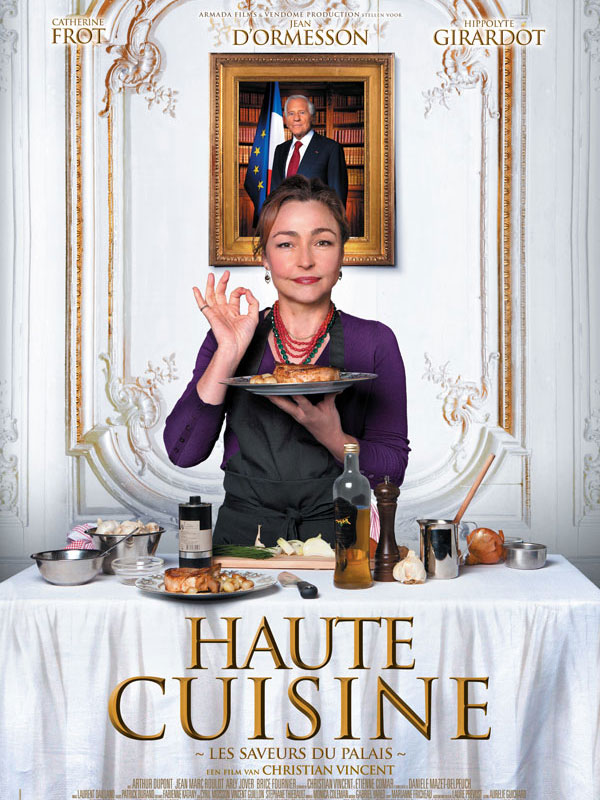
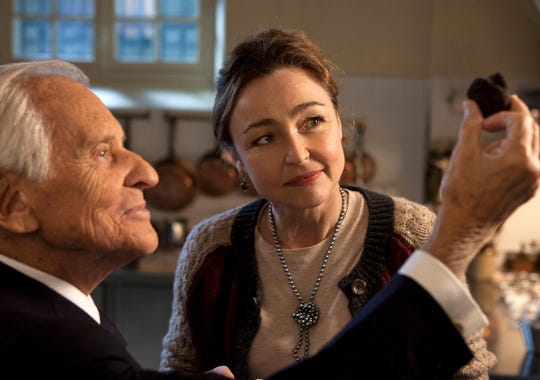
Haute Cuisine (Les Saveurs du Palais) - Supremely Satisfying


Director Christian Vincent offers a delightful film which is as light and fluffy; insubstantial and impressive, as a perfectly executed soufflé. Hortense Labourie (Catherine Frot) is content to be a chef in Périgord with a farm, a menagerie and an elderly uncle to look after, until she is summoned to Paris as the private chef to the President of France (Jean D’Ormesson). The ministers are so arrogant it would serve them right if she simply refused, but then we would have no film, so she accepts and enters this beautiful, formal world, and the gourmet extravaganza begins.

She is given a tour of the Palais de l'Élysée, including the spotless kitchens with all the latest equipment. She moves among gleaming copper pans, printed menus and steamed tablecloths, and is given masses of directions and tips on protocol, but no mention of food. The men in the staff kitchen are no help to her as they resent her position in the private kitchen – they are macho and rude and call her Du Barry (after the mistress of Louis XV) – so if she wants to learn what the president likes, she has to deduce it by trial and error. She studies what is left over on his plate to try and understand his preferences.


Initially Hortense cooks decadent meals such as Savoy cabbage, Scottish salmon, Loire carrots – “I like things to come from somewhere” – but when she is finally awarded an audience with the president he says he likes classic, rustic food and begs her to “cook like my grandmother did; give me the best of France.” He asks for simple and authentic dishes without decorations – “I want to taste things” – and she gives him clams, cream of asparagus soup, fruit and pistachio tart, and Beef Wellington (which is called boeuf en croûte in France).

She has a sous-chef, Nicolas Bauvois (Arthur Dupont) with whom she develops a cute relationship – she insists that he call her by her name, rather than ‘chef’. Catherine Frot’s Hortense is a beautiful middle-aged woman with a ready smile and a twinkling sense of humour, rather than a Hollywood bimbette who would get the role if this were an American film. Although the chemistry in the kitchen is charming and appealing, it is refreshingly free from sexuality. Nicolas shares her love for food and its creation and gives her a sounding board to express her culinary methods and opinions – “I talk through a recipe – I can’t help it.”


The narrative is based on the true story of Daniele Mazet-Delpeuch who became the first female chef to a French president, Francoise Mitterand. In this film it is suggested that the president can talk for hours about food, and maybe it would have been better for him to do so instead of heading into politics. He and Hortense discuss old recipe books and the passion that went into writing them; they bemoan that no one writes like that anymore. Hortense believes that food should reveal individual character and is disappointed by a dish that is well-made but lacking in personality: “anyone could have made it.”

Insistent that she can source better food than that used in the main kitchens, she sets out to buy her own provisions and we are treated to scenes of specialist produce shops selling exclusively cheese, poultry or fish. She and Nicolas experiment and have fun in the kitchen with food and menus, exploring recipes and combinations. Hortense teases him that a pastry chef must measure precise quantities while cooks use instinctive dashes. We may not be able to taste it but the colours, textures and detail of the dishes are gloriously filmed supplying a generous portion of gastro-porn.


Her downfall comes partly at the hands of the main kitchen chef who is upset when he thinks she has muscled in on his territory. She is in charge of appetizers, mains and cheese; he takes care of dessert, and he questions the categorization of cream cheese which he insists she removes from the dishes served at a family dinner. For a country whose revolution is proverbially based on the distinction between bread and pastry – “Let them eat cake” – this seems apt. When she is called to account for the fact that her meals are three times as expensive as those from the main kitchen she counters, “I work with people who share a passion for excellence – it comes at a cost” and she has justification in her claim, “A cook is not an accountant; a cook is an artist”. 

As well as the financial aspects and personal rivalries, Hortense must face the fact that as he ages, the President is forbidden rich food by his health advisors. There will be no more cheese, sauces, or rich or fat foods, and she sulks to Nicolas, “I hope you like working with fruit”. She must now run everything past his guards, which image is turned on its head when she has them running across the courtyard to ensure that dishes are delivered at the correct temperature. Her argument when she is told that she can still cook anything for President’s guests, but just not for the President himself, is that she wasn’t brought in to cook for ambassadors. Ultimately she cannot overlook her passion for the food for the sake of her position.


The film is framed by her experience on a French Antarctic base as a cook for the scientists and surveyors there. She runs by the beach and over the bleak countryside in an environment that couldn’t be further from the opulence of Parisian palaces. On her last day she tells the team that she has bought a truffle farm in New Zealand, combining her loves of the miracle and perfection of truffles with the beauty of virgin territory. Whether in decadent chateaux or primitive extremities, food is more than just physical sustenance. True fans of gastronomy will find much in this film to nourish the soul.

Monday, 16 September 2013

Cooking the Books

The Short Life and Long Times of Mrs Beeton by Kathryn Hughes
(Harper Perennial)
Pp. 428

We all know Mrs Beeton, right? She was a Victorian matron who presided over bland food in bizarre combinations (calf’s foot blancmange, anyone) and fussy serviette folding. She wrote a book about cookery, servant management and other household hints that became a byword for bourgeois and has been much-derided ever since it was written.

Well, wrong, according to Kathryn Hughes’ scholarly biography, which also includes a plethora of information on the changing times, consumerism and attitudes towards women and home-making. Mrs Beeton, née Isabella Mary Mayson, was 21 when she began working on the first Beeton's Book of Household Management which was published in 1859 in serial form in her husband, Sam Beeton’s, Englishwoman's Domestic Magazine. Much of it was copied or stolen from other (often unattributed) sources. She died aged 28, although it benefitted her publishers to pretend that she was still alive as they brought out myriad editions of her books in different packages and formats.

As a young wife, Isabella had no idea how to run a household and probably wished there was a manual, but as there didn’t seem to be one, she began to write it herself. She offered help to women floundering in domesticity, and “emphasised the moral duty of the middle-class mistress in keeping her expenditure in check by brushing up on her arithmetic rather than her conversational Italian.”
This was not to say that Mr and Mrs Beeton were against educating women or thought they should be chained to the kitchen sink, and in fact they were adamant that “those women who needed to should have access to properly paid and respectable jobs.” The key phrase here is ‘women who needed to’, as they assumed, as did all publications of the time, that “a woman’s first and proper desire was always to marry, have children, and run a happy home.”

In an interesting aside, Hughes notes that this situation is so reversed that homemaking is now generally only appealing to those who don’t ‘need to’. Neither condemning nor condoning Mrs Beeton, this attitude also politicises the supposedly simple choice of being a housewife.

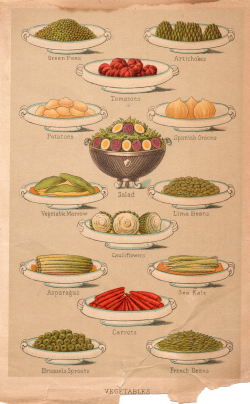
Perhaps Mrs Beeton is best known for her recipes, although most of them are not original. She was possibly the first person to include a comprehensive index at the front and to cross-reference the entries. The inclusion of cooking times and listed ingredients first, before the method, was also innovative albeit derided by ‘proper’ cooks who maintained one should always read through the recipe in full anyway. Beeton's Book of Household Management was the first British cookery book to use colour plates (in 1861) to show readers exactly how the food should look when it came to table.

Another 100 pages of the biography remain after Isabella’s death, reinforcing the idea that she and Sam were Mrs Beeton between them, and that the reputation which was built up around her had very little to do with the woman herself. It made sense for the publishing company to “pretend that Mrs Beeton was alive, well, and looking forward to supplying the nation with yet more words of wisdom from her immaculately-run home.” 

Friday, 14 December 2012

Friday Five: Non-competitive pursuits


I think it's fair to say that I don't like reality TV. I have mentioned this before. One of my least favourite sub-genres is the competition variety. You know the type of thing, where people are pitted against each other to paint a room or build a wall and then someone wins and everyone at home thinks they could have done the same and the real decorators and stonemasons go out of business while general standards plummet.

Although I like the celebrity dancing ones (especially the ice-dancing one), I know I am no expert. This is not true of the people who routinely watch the singing shows and then feel free to critique performances about which they know nothing. It also means that we are left with chanteurs who think that to belt and warble is the epitome of 'singing' and we are left without subtlety, nuance or character. Bob Dylan or Florence Welch wouldn't make it through the first round.

With performance and artistic pursuits, a lot is left to personal preference - A might like sci-fi or farce; B might prefer romance or Jacobean drama; C might swoon at ballet and metaphysical poetry and so on. It doesn't mean any one is 'better' than the other - it just means they shouldn't be judged against each other. In 'pure' sport if you run fastest, jump highest or throw something furthest, you win. You are the best at that particular thing. Don't get me wrong, some things lend themselves to competition and this is a good thing (not keeping the score during football games because 'it's all about participation' is ridiculous!) but when subjectivity creeps in, nothing is so clear.

Acting, comedy and writing awards are often suspect. Yes, they are worth something when awarded by your peers, but often they are voted for by a partisan panel - the more friends you have in the audience; the more likely you are to win. These tributes might provide a feel-good factor, but they are relatively worthless. Entertainment is not a science; nor should it be a competition.

5 Things that should never be a competition:
  1. Cooking - as far as I am concerned you either cook because it is your job and you are paid, or because it is a way of expressing love and friendship to those around you. Eat with me and know you are welcome. Do not judge the temperature of the soup or the slicing of the vegetables. I have prepared this gift for you in my own way.
  2. Surgery - there will come a day when cameras go into operating theatres and viewers vote on who best wields the scalpel. I'm surprised it hasn't happened already. Health is personal, although you wouldn't know it from those shows which 'expose' physical deformities and laugh at fat people. Some things should be conducted behind the curtained cubicle - pull yourself together.
  3. Sex - it's personal and not up for discussion apart from between the relevant parties. According to late-night phone-ins (you hear a lot driving home from rehearsals) many people seem to be concerned about whether or not their sex-life is 'normal'. As long as you and your partner are happy with it, whatever you're doing, or not doing, is fine.
  4. Raising children - I hate the use of nouns as verbs, so have resisted the urge to call it parenting. I'm sure it's pretty difficult to raise a child to be a reasonable and responsible human being. Just do your job and stop comparing yourself and your child to others. In some respects they're all the same; in others they're all different - don't bother worrying or boasting, and if you must do either, do it to yourself as no one else cares. Really.
  5. Friendship/love - when I was little I used to refer to 'best friends'. Now I know that best is a superlative meaning 'of the most excellent or outstanding or desirable kind' there can only be one, by definition. I would now say I have many good or close friends - all of them special to me in individual ways and I love and admire them for their specific qualities. I would never try to rank one above the other. That's not how this love thing works.

Friday, 5 October 2012

Friday Five: Beetroot Brilliance

I read today that Australians eat more beetroot per capita than any other nation. I have a friend who describes it as the devil’s vegetable (I disagree- that is surely turnip) and another who uses it to make her chocolate cakes moist – no, I don’t know how. I have also heard tell that you can slice it finely and sautee it as a crisp. Personally, I would rather just buy crisps.

And I’ve never been a huge fan of the pickled variety. I do like pickled things – eggs; onions; gherkins; herrings; 40-something year olds in the pub on their birthday – but I think it’s a shame to do that to a vegetable with such inherent vibrant personality.

Aussies (and Kiwis) put it in their hamburgers to make them quintessentially antipodean apparently (and they also often add an egg, which is irrelevant to this post). This seems slightly odd as beetroot is originally a southern European vegetable and is now most commonly found in North America, Central America and Britain.

It has several health-giving properties and is a rich source of anti-oxidants, nutrients and vitamins. Obviously the colour is an issue – it will stain everything you wear or touch it with. Disposable gloves are a good idea, but opening the door wearing red-stained surgical gloves is not, unless you want to get rid of cold-callers of course. I find it also pays to remember you’ve eaten it either you will give yourself one hell of a health scare when you next go to the toilet.

5 Top Ways to Serve Beetroot:
  1. Roast it with other winter vegetables with a touch of olive oil and rock salt
  2. Turn it into borscht – I prefer it hot with crusty buttered rolls
  3. Shredded in a salad, with carrot, fennel, walnuts and feta; colourful and tasty
  4. Hummus – add it to the chick peas, olive oil, garlic, lemon, cumin and tahini for a spectacular dip or accompaniment
  5. Add it horseradish and ginger for a perfect pink addition to baked salmon

Monday, 9 April 2012

Easter Treats


I'm not known for my baking, or if I am, it's not in a good way. But Easter often finds me faffing in the kitchen. This Easter I eschewed the oven and made 'surprise chocolate eggs'. I guess the surprise is that they don't look anything like eggs. They are Maltesers covered in a milk chocolate and sour cream mixture, dipped in melted white chocolate and then drizzled with melted dark chocolate. They may look a bit odd, but they taste lovely - and ridiculously rich (as you can imagine with all that chocolate!) Some of them worked quite well; others were mutants.

I am better with savoury stuff - for dnner we had slow-cooked lamb with skordalia (potatoes mashed with garlic and olive oil), green beans with feta, roast tomatoes, and chickpea and risoni salad (I didn't take a picture of that). I know, as Him Outdoors said, as if I didn't have enough to do... But I love cooking, especially at Easter for some reason. 

The gorgeous flowers in the photo are from my mum - thank you mum. She figured I might need a hug, so she sent a floral one long distance. As she often is, she was right and it cheered me up, so I put them in the picture with the Easter chocolatey goodness. I hope you all had a good Easter too with gatherings of the people you love.