Showing posts with label Edinburgh. Show all posts

Wednesday, 27 July 2022

A Doctor Calls: Intensive Care


Intensive Care: A GP, a Community & COVID-19 by Gavin Francis
Profile Books
Pp. 198

Gavin Francis’ memoir about the outbreak of the coronavirus pandemic provides a fascinating first-hand account of how the medical profession dealt with the infection in the face of changing priorities and conflicting information. As a GP in Edinburgh, he also writes proudly of the city’s history, particularly in terms of medical science, and how that relates to current procedures. Published in 2021, this takes a contemporary view of the situation, and certain cautionary tales have proved true in upsetting ways, such as the prioritising of physical health to the detriment of mental health, and the long-term effects of this approach.

We have become inured to the word ‘unprecedented’ – indeed a popular internet meme reads ‘I could really go for some precedented times’ – but the pace of the spread of the virus was extraordinary. Francis writes, “In the space of days, what had seemed like a surreal joke became reality.” Originally doctors were ‘assured’ there was no evidence of human to human transmission, but within weeks the guidelines changed. Doctors dealt with uncertainty, lack of clear messaging and trying to allay fears as well as treat illness.

Of course things are more obvious with hindsight (although this book is written only halfway through the pandemic), and Francis is cautious with his criticism of the politics involved, but he is clearly frustrated about the lack of guidance. He believes that social distancing measures should have been introduced as soon as it became clear that the virus could spread through contact, but understands the hesitancy. While health is his priority – he is a doctor after all – he understands that not everyone will react in the same way. While noting enforced quarantines overseas, he is aware this would be problematic at home. He further appreciates the dichotomy between the suffering of the global economy compared with the recovery of the environment.

There are one or two positives to be drawn from the response to the pandemic, as Francis clutches at straws of hope, such as the speed of the response to the homeless crisis, and the recalibration of which jobs are important, “as if all the old hierarchies were being pushed aside and new possibilities were emerging.”

Some people found that after years of agoraphobia and anxiety, they now felt better as they were not pressured into going out and doing things: introverts were more accepted and acceptable. On the other hand, however, strides taken in the advance of understanding of mental health were now being pushed back. As a GP, his job is to attend to all aspects of his patients’ health, and he finds the crisis causing phenomenal mental health consequences. “Some days every call I took was about loneliness, self-harm, anxiety, panic attacks.” The lockdown may have slowed the pace of transmission, but it provoked “a silent epidemic of despair: panic and anxiety are the virus’s dark refrains, a second pandemic leaching into everyone’s lives.”

Francis writes of the history of epidemics and how public health awareness is the greatest weapon against disease. “More lives have been saved though better housing, sanitation and vaccination than were ever saved by a surgeon’s knife or a physician’s drugs.” He also writes of the development of vaccines and the public attitude to them, both contemporary and historic: it turns out the anti-vax movement is nothing new.

Francis offers some glimpses of hope and humanity, with examples of what we can achieve when we care for each other. But he also presents us with a world that has changed and will never again be the same. How we handle this crisis or challenge depends on our viewpoint and whether we believe in the overwhelming good or bad of society – and yes, there is such a thing.

Tuesday, 7 December 2021

Rookie Errors: Knots and Crosses


Knots and Crosses by Ian Rankin
Orion
Pp. 226

In a new introduction, Ian Rankin explains that he didn’t know Detective Sergeant John Rebus was to become such a huge fictional figure going on to star in more than a dozen novels. He notes his rookie errors in giving Rebus a complex back story and knowledge about things he might not have known (art and literature), combined with lack of understanding of things that he should, such as police procedure.

There is more than an element of Colin Dexter’s Inspector Morse about Rebus as Rankin is keen to show off his education with mixed metaphors and a classical background. “The skies were as dark as a Wagnerian opera, dark as a murderer’s thoughts.” He has faith, but does not hold with organised religion and he reads his Bible for comfort. “Ah, but it was not a nice world this, not a nice world at all. It was an Old Testament land that he found himself in, a land of barbarity and retribution.”

Rebus is patronising towards ideological students; needing to disassociate himself from others’ language; to prove himself better than that (he reads Dostoevsky’s Crime and Punishment, don’t you know), he positions himself above the students who come into ‘his’ city. “Edinburgh was all appearances, which made the crime less easy to spot, but no less evident. Edinburgh was a schizophrenic city, the place of Jekyll & Hyde sure enough, the city of Deacon Brodie, of fur coat and no knickers (as they said in the west).”

Much is made of the city’s underside, hidden from the tourists and the students, but known to the likes of him. Rankin has created this world and he is proud of its darkness. As it becomes clear there is a criminal delighting in killing girls and taunting Rebus, many are shaken that this occurs in the Scottish capital. “But here, in Edinburgh! It’s unthinkable. Mass murderers belonged to the smoky back streets of the South and the Midlands, not to Scotland’s picture-postcard city.”

Rebus has a secret past – of course he does; he was a Para and trained for the SAS with a special Crack Assignments group.  He has buried his SAS experience in his subconscious, but it is clearly important to the case he finds himself investigating. Indeed, there are so many references and near flash-backs that the reader knows this trauma has something to do with the crime, even if he doesn’t. When he decides to delve into his subconscious, it is no surprise that the mind is a deep and curious place, with many layers, just like Edinburgh itself.

As well as being firmly fixed in place, Rankin sets his novel in a particular time, where pubs served different measures, and computers and digitisation are new. Rebus’s colleague tells him that the time is coming when all files will be on computers and work-horses like him will be obsolete. “It’s progress, John. Where would be without it? We’d still be out there with our pipes and our guess-work and our magnifying glasses.”

Unfortunately, another thing that anchors this novel in its time is the casual sexism and portrayal of women. Gill Templar is suspected of being a “ball-crusher” because she has opinions and stands up for herself, although she has appallingly unnatural dialogue. When she inevitably has sex with Rebus she is described less as a woman than as a doll. “She smelt good, like a baby on a fireside towel. He admired the shapes of her twisted body as they awoke to the thin, watery sunlight. She had a good body all right. No real stretch-marks. Her legs unscarred. Her hair just tousled enough to be inviting.” At least she fares better than another woman he picks up, who is written more like a cow in a herd than a human individual with thoughts and feelings.

And then there is his (unsurprisingly) ex-wife, whose body he describes as “pressed, pushed and prodded into a shape attainable only with the aid of some super-strong girdle. She was not, he was relieved to find, wearing as well as their occasional phone conversations would have had him believe.” Currently there are 23 John Rebus novels. Apparently Ian Rankin is now writing the character as a real policeman rather than a graduate’s ideal. We can only hope he has sorted out that adolescent misogynistic streak as well.

Tuesday, 12 October 2010

All the King's Men

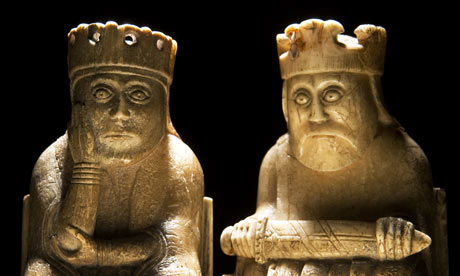
Continuing my punishing schedule of cultural experiences in Edinburgh, I head to the National Museum of Scotland to see the Lewis Chessmen. These charismatic little pieces are advertised all over the city and have piqued my interest. Created in the late twelfth or early thirteenth century from elaborately worked walrus ivory and whales’ teeth, they were discovered in 1831 on the Isle of Lewis and came to public notice through an article in The Scotsman.

I like their expressive faces – the bulging eyes and Dwayne Dibley teeth. They are very intricate, even down to the strands of hair and ornamental carvings in the chairs on which they sat. They seem to follow slightly different patterns which could possibly be due to different craftsmen making them from the same workshop, and some are clearly replacement pieces made later on – there are about 70 pieces all together.

The history of the pieces is shrouded in tales of murder, deception, folklore and legend. A local man, Malcolm MacLeod, said his cattle were grazing on Uig Bay sand dunes (which suggests they must be grassy sand dunes) when he discovered the chessmen. The minister of Lewis preached against idols (the island was strictly Protestant) so Malcolm was afraid of what he had found and took them to the minister in great trepidation. The story before that (or how they came to be in the sand dunes) is that a young boy washed up on shore with them in a bag (the exhibition includes a carved buckle which may have come from this bag) and met a man who promised he would lead him to safety, but instead hit him on the head with a rock and stole them.

Archeological problems are posed by these pieces because nothing else like them has been discovered. Walrus ivory is a popular material for work in Trondheim and Dublin, which makes sense because they were part of the Viking trading route: Greenland; Iceland; Trondheim; Shetland/ Orkney/ Lewis Islands; Isle of Man; Dublin. In the 790s the Vikings raided the Western Isles with a series of brutal attacks on coastal communities and monasteries. Tradition says there was a monastery at Mealasta but there is no evidence of this. Lewis was a Scandinavian island and didn’t revert to Scottish rule until 1266.

The characters are in the likeness of warders, kings, queens, pawns, knights and bishops. They were probably used at chess, tables (a predecessor of backgammon), and a game called hnefatafl. There is nothing like this from similar times in the otherwise progressive Islamic artistic tradition where craftsmen were reluctant to portray humans for religious reasons.

The kings each hold a sword in two hands as though in the act of drawing it – classic mythology says kings did this while listening to the words of Odin. The queens, resting their cheek on their hand, all look vaguely fed up. The bishops were a new feature on chessboards when these were made – this may reflect the importance and patronage of archbishops based in Trondheim (Trondheim was the seat of archbishops).

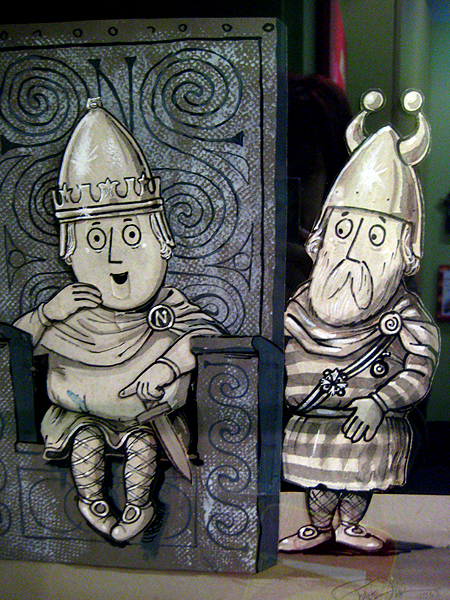
In true Wikipedia fashion, the exhibition provides information as to how and where these figures have been used in popular culture: they are the inspiration for J.K. Rowling’s wizard chess; the template for Rosemary Sutcliffe’s Chess-Dream in a Garden; and the motivation for Oliver Postgate’s Noggin the Nog. He writes that he noticed, “far from being warlike, it was clear that these were essentially kindly, non-belligerent characters, who were thoroughly dismayed by the prospect of contest.”


Friday, 8 October 2010

Britannia Rules the Waves

‘A yacht is a necessity and not a luxury for the Head of our British Commonwealth, between whose countries the sea is no barrier but the natural and indestructible highway.’
HRH Queen Elizabeth II

And yet the Royal Yacht Britannia was taken off the Queen for reasons unknown, but which probably have a lot to do with mealy-mouthed envy. But you can still look around it and admire the royal floating life, from the docks at Leith, so we did.

The admiral’s rooms (and when the Queen is on board she is piloted – or whatever you do with boats – by an admiral) aren’t so smart and are actually a wee bit shabby. The whole ship retains its 1950s chintzy décor – the Queen apparently wanted country-house comfort rather than formal grandeur and she rejected the original plans as too elaborate.
 
It is spotless, however and a junior yachtsman had to scrub the deck every day before 8am. Tasks were all carried out in silence so as not to disturb the royal family, and the crew tried to stay out of sight so that the royal family wouldn’t have to constantly acknowledge their salutes.


In some ways the yacht is actually impractical and the master of modification. ‘Modesty balconies’ prevent skirts blowing up in the wind when the royal family were posing for photographs; high-positioned windows avoid any accidental glimpses into royal apartments; the Rolls Royce or Landrover was housed in a garage – as it was difficult to manoeuvre the vehicle into this space, replacements were ordered for the destination and the erstwhile garage was used for beer storage.

The Queen’s favourite room was apparently the sun lounge with its picture windows, drinks cabinet and rum tub, where she took morning and afternoon tea (not actually in the rum tub). The Queen and the Duke had separate bedrooms (other rooms could be used by other members of the royal family, but these were reserved specifically for them) and all but one room had single beds. Prince Charles had a double bed brought on board for his honeymoon – who says he wasn’t romantic?


There are jolly japes in the wardroom antechamber where the officers met for drinks before dinner. They played tennis with a stuffed toy (meant to be a wombat but looking nothing like one) and took it in turns to hide a wooden monkey around the room. At dinner itself the youngest member had to entertain the others with an amusing anecdote, and the gin pennant indicated who was buying drinks in the officer’s bar.

In the state dining room it took three hours to set the table; there were placings for 56 (guests included Mandela, Ghandi, Churchill, Clinton, Reagan and Thatcher) and menus were given to guests (seated on Hepplewhite chairs) to take away as souvenirs. The walls are lined with gifts from locations visited – The Galapagos, Easter and Pitcairn Islands; Bangkok; Papua New Guinea; Fiji; Australia; New Zealand; Trinidad – and the room could be converted to a cinema or a dance floor.

The Queen did a lot of work on board and she had a sitting room in which to do it. The Duke had a study which is absolutely symmetrical and connected by telephone. Every detail is considered – the centre of the mirror in The Queen’s sitting room is exactly at her eye level.

Chintz sofas and deep armchairs decorate the drawing room used for relaxation and reception, which could accommodate 250 guests, and a piano on which Noel Coward played is bolted to the floor to stop it pitching in high ‘C’s (Ha!). The Queen originally wanted an open coal fire in here but that would have necessitated a sailor to be on permanent stand-by with a fire bucket, so that idea was abandoned in favour of a more prosaic (and practical) electric fire. Flowers were always displayed in this room – they were either given to royals by admirers on their voyages, or they came from the gardens of Windsor Castle and were stored in a cool room – one of the stewards had to double as the royal flower arranger.

Although the chief petty officers were allowed spirits as well as beer, it was an invitation to drink at the petty officer’s mess that was most highly sought-after. Privacy was non-existent and the sleeping quarters were very cramped, but at least it was better than the hammocks (which had been used until 1970).

Some of the men were trained as divers and dived beneath the boat every day, and into every berth before they entered, to check for terrorist devices. The Royal Marines Band played them ashore – they had to know everything from classical to ceilidh and the national anthem of every country they visited, and they played the Beat Retreat after state banquets. The band rehearsed daily (as far from the royal apartments as possible) and had up to 26 different uniforms for band special occasions – all neatly stored in their tiny lockers.

There was exercise and competition to be had – a fiercely-contested Golden Welly was presented to the winning team of six runners who ran four times round the upper deck with the other team in pursuit. A mail office and a shop onboard catered for all incidentals (including sweets which the royal children were allowed to buy, and where fudge is still made and sold).


Britannia could be converted into a hospital ship in 24hours, although she was never used as such, and the sick bay doesn’t look particularly appealing. The laundry, however, was very busy, reaching temperatures of 45°C. Uniforms were changed up to six times a day, and 600 shirts were washed an ironed daily – to preserve decorum the royal family had their laundry done on different days from the crew.

You can take tea in the tearooms, which we did (Britannia lemon drizzle cake and a pot of Darjeeling), then continued our tour with a glimpse of the gleaming engine room. Details include 12,000hp; a team of 80 engineers; a speed of 21 nautical miles and hour; the ability to recycle steam to water and back; and a back-up diesel generator known as chitty chitty bang bang.


The Queen herself chose the blue paint (rather than black) and approved the gold line painted in 24 carat gold leaf paint. She enjoyed visiting the Western Isles and loves sailing generally, as does her husband and children. Prince Philip raced Tui at Cowes, and Charles and Anne learned to sail on the 12 metre class yacht, Bloodhound.


‘Sailing on a sunny day is the nearest thing to heaven anyone will ever get on this earth.’
Princess Anne

Friday, 1 October 2010

Festival Fireworks

As a finale for the festival, fireworks explode over Edinburgh Castle. I try to take photographs, which is very tricky without a tripod to hold the camera steady and not knowing exactly when they will ignite the sky with brilliance - it is pitch black a fraction of a second beforehand. I like the colours and the flashes of light.
 
I also like the way they trail off leaving streaks of flaming cordite against the night sky. We have been drinking whisky as part of our tourist activities, so perhaps I am just seeing stars anyway. Here are some examples of my work. Any tips on how to photograph fireworks would be greatly appreciated.


Tuesday, 28 September 2010

My newest favourite thing: Whisky

Okay, so if we’re honest – and why wouldn’t we be – whisky isn’t exactly a new favourite thing for me. Luckily it wasn’t one of those drinks of which I partook too freely when too young and can now no longer stomach (that would be tequila) so I can still appreciate a fine dram along with the best of them.
 
So we met up with our parents, my cousin and his brother and friend to explore the Scotch Whisky Experience. A little ride in an open barrel takes us through the procedure of making whisky – Dad reckons that with only three ingredients (barley, water and yeast), it should be easy enough to make. As he immediately forgets one of the three (yeast) however, I don’t much fancy his chances. It’s cute and an actor is filmed pretending to be a guiding ghost – there are a lot of those in this city apparently – but you don’t learn anything you didn’t already know (or don’t immediately forget).

We sit in a room with colour-coded sniff pots to detect which flavours we like (smoky for me) from the four main whisky producing regions of Scotland: Lowlands, Highlands, Speyside and Islay. One of them (Speyside) is alternatively described as floral (me) or soap (Cousin Rachael). We also isolate the aromas cloves and vanilla pretty quickly and then we get to sip the nectar. We choose which of the four regions we wish to taste and we get to keep the tasting glass at the end of the tour (we even manage to transport ours all the way back to New Zealand – heartily scrubbed of course).

The Diageo Claive Vidiz Scotch Whisky collection, into which we are ushered, is the largest in the world and housed behind glass. This is the highlight of the tour for many – unable to keep their mouths closed, they may be hoping to catch some of the Angel’s share: the two percent of each bottle that evaporates.

Interestingly there are blends as well as single malts in this collection. Our guide tells us that there is incredible art in blends – the whisky blender has to use exactly the same quantities of each whisky to replicate the taste that the Bells and Teachers fans quaff in their thousands. We grudgingly admit that they are probably very talented, but we would all rather stick to the malts, thank you very much.
 

We have tasting trays of the four main types of whisky brought to us and a map on the wall highlights what we’re drinking. I’ve read review comments that this tour is expensive and a bit cheesy, which it is, but we enjoyed it. For a mixed group with a variety of levels of knowledge about whisky it was fun and a good way to spend an hour or so. I can imagine it would be a good work’s do or an ice-breaker for a hen night or collection of folk who don’t know each other very well (yet).

Various members of our group drift away and a little hard core faction continue our own drinking experience in some Royal Mile pubs. The Scotch Whisky Experience is right up the top by the castle, so it really is all downhill from here!


Thursday, 23 September 2010

In Defens: Edinburgh Castle


Edinburgh Castle emerges from the rock, standing proudly above the city, the flags cracking in the stiff wind. It is imposing, formidable, solid and reassuring – depending on which side you stand – but it is certainly not comfortable.

The great halls are draughty; the stairs are steep; the walls are thick; and the windows narrow. As the weather creeps in through the cracks, the views of Edinburgh are wide and expansive but no number of tapestries and rugs can exclude the chill.


The National War Museum of Scotland explores more than 400 years of Scottish military history. War has given rise to extremes of technology and innovation, and revels in pomp and ceremony. Cabinets contain examples of weaponry; guns, daggers, dirks and bayonets. Rituals involve medals and dress uniforms. Paintings and letters capture coloured versions of history – ‘Butcher Cumberland’ and Culloden are frequently mentioned as is the Battle of Dunbar in 1650 at which the English Parliamentarian forces under Oliver Cromwell defeated a Scottish army and enforced military union with England.

Agreed union came about in 1707 but that was far from the end of the skirmishes including the Jacobite rebellions and Bonnie Prince Charlie. The Victorian era romanticised the Highlands (just like the last 50 years have romanticised the Irish Boglands) and all things Celtic, such as the re-emergence of tartan and the preponderance of kilts, which were worn by the army until 1940. A further exhibition, Land Girls and Lumber Jills, shows how the women were involved in military work while remaining at home – planting and reaping harvests to feed the population and provide timber.

A voice-over recording explains that Scotland’s history is military, and that disbanding their armies has been particularly tough. ‘Famous regiments with famous names have been disbanded regardless of their achievements and long service.’ Although The Black Watch are not specifically mentioned, it is hard not to think of them, especially having seen the phenomenal National Theatre of Scotland play of the same name.
 
Pipe bands play as we roam the parapets – the mournful sound drifting down over the city and reinforcing the elegiac effect of this place on the rock. Modern munitions are represented by the crates of fireworks that will be let off later in the weekend to celebrate the end of the festival. We missed the Edinburgh Tattoo by a day. I can’t say that I’m sad about that, being slightly disturbed by the orgiastic parade of military might (I favour John Hegley’s argument here). There is definitely a pent-up feeling of barely restrained anger without an outlet around these walls.

St Margaret’s Chapel provides a quiet place for contemplation, however. The diminutive building is the oldest in Scotland, built for her by her youngest son, King David around 1130. Even this beautiful but spartan building with its stained glass windows commemorating the saint (Margaret was canonised in 1250 for her pious and charitable acts) has not always been used for worship – from the sixteenth to the eighteenth century it was a gunpowder store.
 
The Scottish National War Memorial is within the castle walls at Crown Square – built in 1927 in a somewhat austere art deco style. It was to commemorate the approximately 150,000 Scottish casualties of the First World War in the Hall of Honour. The names of the dead now extend to over 50,000 in the Second World War and the campaigns since 1945 including the Mayan Emergency, the Korean War, Northern Ireland, the Falklands War and the Gulf War. So many dead soldiers; Scotland remembers.
 
A particularly poignant cemetery is for the soldiers’ dogs, so there are gravestones for Tinker and Scamp, and other officer’s pets and regimental mascots. It has been in use since Queen Victoria’s time and is a perfect example of era’s blend of maudlin sentimentality with dignified respect.

A queue announces the whereabouts of the Scottish Crown Jewels (otherwise known as the Honours) and people shuffle through the exhibit which tells their story, anxious to get a glimpse of the crown, sceptre, orb and the seat of kings (and queens), The Stone of Destiny.

Apparently they still have a ceremonial part to play and the Queen symbolically presented them to the opening of the Scottish parliament but, the way things stand at present, no one will ever again wear the Crown of Scotland. No wonder ‘it’s in good nick’ as Him Outdoors says, ‘it’s not been used much’.

In my defens God me defend is the motto of the Royal Coat of Arms of the Kingdom of Scotland, often simply abbreviated in modern English to 'In Defence'. Nowhere is this more pronounced than the capital's castle where the sense of righteous indignation simmers palpably beneath the surface.