Showing posts with label detective novel. Show all posts

Tuesday, 18 June 2024

Serial Killer: The White Cottage Mystery


The White Cottage Mystery by Margery Allingham
Penguin
Pp.139

The blurb on the back of the book informs us that, “The White Cottage Mystery was Margery Allingham’s first detective story, published initially as a newspaper serial. Her sister Joyce has now skilfully revised the text to reveal a sharply plotted period piece stamped with the genius of a great and familiar hand.” Mostly this revision is apparently removing some of the repetition which would occur in a serialisation to remind readers of the story from last week rather than the previous page.

It is a country house mystery of the type favoured by the Queens of Crime and follows the formula expertly. The blurb also summarises, “Seven people might have murdered Eric Crowther, the mysterious recluse who lived in the gaunt house whose shadow fell across the White Cottage. Seven people had good cause. It was not lack of evidence that sent Detective Chief Inspector Challenor and his son Jerry half across Europe to unravel a chaos of clues.” The clues involve people trying to cover their secrets, such as blackmail, homosexuality, adultery, class pretence, and other sins. Attitudes may have changed, but the well-plotted drama and general motivation to keep things hidden remains.


On one occasion, W.T. Challenor is exasperated with a woman who doesn’t appear to grasp the sliding scale of the importance of secrets. He tries to explain, “An elephant is large compared with a mouse, but it is ridiculously small compared with Mount Etna. That secret may have been immense six months ago, but now we are faced with a larger and much more terrible secret. Don’t you realise what a murder means?” Women frequently exasperate W.T., and he dismisses them as stereotypes. “Grace Christensen was a woman of the pretty, graceful, feminine type that is not too clever.” Other of-the-era outlooks are reserved for foreigners and ‘abroad’, where father and son head later in the novel to track down a suspect. There is an unwritten code of conduct and honour, which is also familiar from early 20th century novels. W.T. states plainly, “I am an Englishman, and we like our facts like our food – without subtlety. If you will honour me with your trust you will find that I shall respect your confidence.” Far more serious is the stance towards childhood trauma and the notion that the best way to approach distressing events is to forget them.


As with all Golden Age detective mystery fiction, however, the crime is treated as something of a game. W.T. muses on the suspects, “They all behave as if they were innocent, and yet each one is hiding something. Each has a motive for killing Crowther, and admits it freely. No sane person would dare to do that unless they felt safe.” It is, of course, baffling to the duo attempting to solve it. The White Cottage Mystery is a gripping, short caper, capable of being consumed in a day, and the fine plotting ensures that everything is neatly tied up with a bow after all. This is highly recommended for fans of the genre.

Tuesday, 30 August 2022

Crime of its Time: Vintage Murder


Vintage Murder by Ngaio Marsh
Fontana
Pp.223

Inspector Roderick Alleyn is on holiday in New Zealand when he gets caught up with a theatre group and a murder, involving a mistimed opening of a jeroboam of champagne. This combines Ngaio Marsh’s interests perfectly, allowing her to give her chapters such titles as Prologue in a Train, Intermezzo, Duologue, and Business with Props. Written in 1937, it is dated in language and attitude, although it was doubtless considered progressive at the time.

Detectives, witnesses and suspects have a lot in common with actors as they rehearse stories, play parts and deliver lines, whereas Alleyn is straightforward and direct with a self-deprecating sense of humour. When he lists the suspects, their possible motives and alibis, he draws up a chart which is included in the chapter Entr’acte to assist the reader as much as himself – naturally, everybody has one.

There is snobbery towards people’s age, size, class and accent, although most prejudice, however, occurs towards the Maori people, as exemplified through the character of Dr Rangi Te Pokiha. A considerably hateful comedian describes Te Pokiha as “the black quack” and “the light-brown medico”, and when Te Pokiha retaliates (he has also been called silly, obviously wrong, and a liar), we are told, “The whites of his eyes seemed to become more noticeable and his heavy brows came together… [His] warm voice thickened. His lips coarsened into a sort of snarl. He showed his teeth like a dog… the odd twenty per cent of pure savage.” One suspect asserts, “There is no colour bar in this country,” but people still use the expression ‘a white man’ to denote a person of good character. Alleyn describes the country and the people with an anthropological aspect that is offensive to modern readers.

The plot is well-crafted, some of the characterisation and theatrical tropes are fun, and the Kiwi setting is original, but the inherent racism, sexism and body-shaming are problematic. Crime novels may remain popular, but fortunately times have changed.

Tuesday, 4 January 2022

Cold as Marble: A Likeness in Stone


A Likeness in Stone by J.Wallis Martin
New English Library
Pp. 361

In the powerful opening scene of the novel, two divers exploring an old flooded house at the bottom of a reservoir find a decomposed body in a wardrobe. We soon discover it is that of Helena Warner, an undergraduate reading English at Somerville College, Oxford, who went missing twenty years ago. At the time, Thames Valley Chief Inspector Bill Driver, was convinced that she had been killed by her lover, Ian Gilmore, but with no body, the case was never solved. Now it is re-opened by the new policeman on the job, Detective Superintendent Rigby, who works with Driver to try to bring Gilmore to justice. It may be set in the same cosy world as Morse and Midsommer Murders (and it was made into a miniseries starring Andrew Lincoln and Ruth Jones) but it is far more grim than that, because, “horror wasn’t choosy. It manifested in the most unlikely of places, and in various guises.”

Of course, this is a mystery, so nothing is as it initially appears, and submerged secrets rise to the surface, as the timeline shifts back and forth. Helena was part of a group of friends who don’t actually like each other very much and still have affiliations and implications many years later. These three university associates are all implicated in a very dark world which includes sadism and psychopaths.

Rigby and Driver must work together to solve the case despite their different methods. Driver looks down upon Rigby whom he dismisses as, “Well-dressed, intelligent-looking; no doubt the product of one of these new-fangled schemes that sends graduates shooting up a ladder Driver had to climb rung by painful rung, year after frustrating year.”

Women are victims; objects to be possessed and preserved in youth before they age and supposedly lose their beauty. Other examples of casual sexism and lazy stereotypes are scattered throughout the novel. Artists are troubled and odd; mental health facilities are a comfortable alternative to a hard life; computers are new (it was published in 1997) and, apparently, the police one is female, “What’s more, this little sweetie was a redhead. One false move and she could go off on one, no trouble.”

This gripping and clinical, fast-paced police procedural has been likened to the work of Ruth Rendell or Minette Walters. It is certainly dark and moody with a chilling aspect. “Real evil, unlike the romanticised fantasy of evil, was merely gloomy, monotonous and boring… The majority of murders were committed not with malice, but with indifference, by people who lived in the type of environment that deadened the soul.” It is eerie, creepy, and a thoroughly captivating thriller.

Tuesday, 7 December 2021

Rookie Errors: Knots and Crosses


Knots and Crosses by Ian Rankin
Orion
Pp. 226

In a new introduction, Ian Rankin explains that he didn’t know Detective Sergeant John Rebus was to become such a huge fictional figure going on to star in more than a dozen novels. He notes his rookie errors in giving Rebus a complex back story and knowledge about things he might not have known (art and literature), combined with lack of understanding of things that he should, such as police procedure.

There is more than an element of Colin Dexter’s Inspector Morse about Rebus as Rankin is keen to show off his education with mixed metaphors and a classical background. “The skies were as dark as a Wagnerian opera, dark as a murderer’s thoughts.” He has faith, but does not hold with organised religion and he reads his Bible for comfort. “Ah, but it was not a nice world this, not a nice world at all. It was an Old Testament land that he found himself in, a land of barbarity and retribution.”

Rebus is patronising towards ideological students; needing to disassociate himself from others’ language; to prove himself better than that (he reads Dostoevsky’s Crime and Punishment, don’t you know), he positions himself above the students who come into ‘his’ city. “Edinburgh was all appearances, which made the crime less easy to spot, but no less evident. Edinburgh was a schizophrenic city, the place of Jekyll & Hyde sure enough, the city of Deacon Brodie, of fur coat and no knickers (as they said in the west).”

Much is made of the city’s underside, hidden from the tourists and the students, but known to the likes of him. Rankin has created this world and he is proud of its darkness. As it becomes clear there is a criminal delighting in killing girls and taunting Rebus, many are shaken that this occurs in the Scottish capital. “But here, in Edinburgh! It’s unthinkable. Mass murderers belonged to the smoky back streets of the South and the Midlands, not to Scotland’s picture-postcard city.”

Rebus has a secret past – of course he does; he was a Para and trained for the SAS with a special Crack Assignments group.  He has buried his SAS experience in his subconscious, but it is clearly important to the case he finds himself investigating. Indeed, there are so many references and near flash-backs that the reader knows this trauma has something to do with the crime, even if he doesn’t. When he decides to delve into his subconscious, it is no surprise that the mind is a deep and curious place, with many layers, just like Edinburgh itself.

As well as being firmly fixed in place, Rankin sets his novel in a particular time, where pubs served different measures, and computers and digitisation are new. Rebus’s colleague tells him that the time is coming when all files will be on computers and work-horses like him will be obsolete. “It’s progress, John. Where would be without it? We’d still be out there with our pipes and our guess-work and our magnifying glasses.”

Unfortunately, another thing that anchors this novel in its time is the casual sexism and portrayal of women. Gill Templar is suspected of being a “ball-crusher” because she has opinions and stands up for herself, although she has appallingly unnatural dialogue. When she inevitably has sex with Rebus she is described less as a woman than as a doll. “She smelt good, like a baby on a fireside towel. He admired the shapes of her twisted body as they awoke to the thin, watery sunlight. She had a good body all right. No real stretch-marks. Her legs unscarred. Her hair just tousled enough to be inviting.” At least she fares better than another woman he picks up, who is written more like a cow in a herd than a human individual with thoughts and feelings.

And then there is his (unsurprisingly) ex-wife, whose body he describes as “pressed, pushed and prodded into a shape attainable only with the aid of some super-strong girdle. She was not, he was relieved to find, wearing as well as their occasional phone conversations would have had him believe.” Currently there are 23 John Rebus novels. Apparently Ian Rankin is now writing the character as a real policeman rather than a graduate’s ideal. We can only hope he has sorted out that adolescent misogynistic streak as well.

Tuesday, 22 December 2020

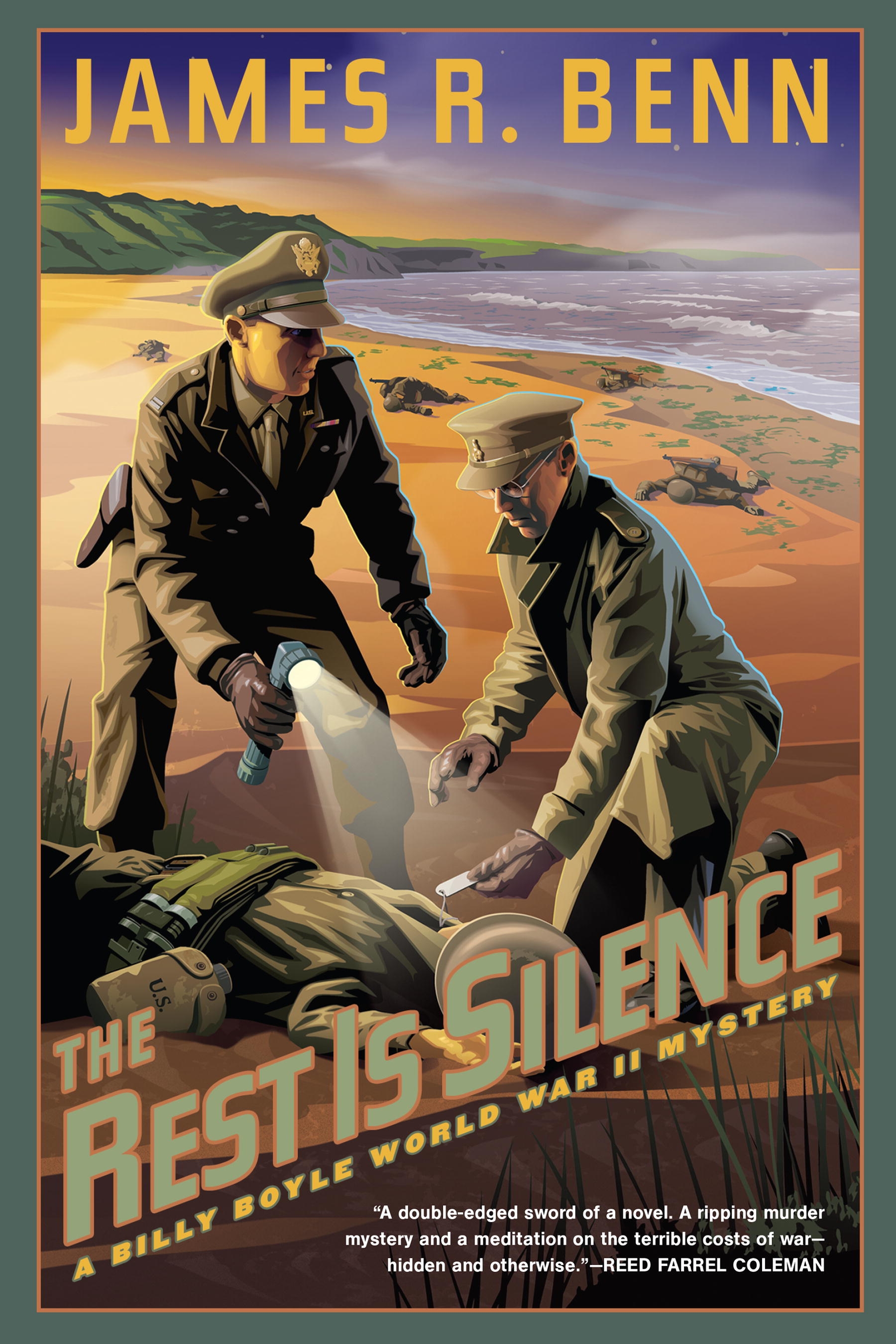
Boys' Own War Adventure: The Rest is Silence


The Rest Is Silence by James R Benn
Soho Crime
Pp. 323

The writing on the jacket claims that this is “a Billy Boyle World War II Mystery”, so it is obviously one of a series in which US Army Captain Billy Boyle and his partner Kaz work for the Office of Special Investigations: “our job was to deal with low crimes in high places that got in the way of the war effort. And to deal with them quietly, although quiet wasn’t always in the cards.” The novel was published in 2014, but the style is that of a previous era with a hard-boiled-detective noir fiction bent.

When a body washes up on Slapton Sands on England’s Southern Coast, Boyle and Kaz are called in to investigate. The Devonshire Beach is the home to Operation Tiger (April 1944), the top-secret rehearsal for the approaching D-Day invasion of Normandy. This was a real event in which hundreds of Allied soldiers lost their lives; there were more American casualties in the exercise than the actual attack.

While the men are investigating the crime, they are billeted in a country house full of rich people, which includes a dead patriarch, old animosities, and a contested will. This provides ample sub-plots about relationship dynamics. One of the family members, Edgar, is writing a book about the interpretation of the end of Hamlet, which is where the title of the novel originates. Boyle seems to be taking a swipe at academia and philosophy, whereas he deals in hard truths and manly facts.

He is a plastic Paddy American who hates the English as part of his shtick, having to restrain himself from voicing his true feelings. Boyle is related to General Dwight Eisenhower, who is everyone’s boss in the US Army: “I call him Uncle Ike”. Lady Pemberton, the matriarch of the house in which he is staying says, “One bristles at the idea of a foreigner, even one of our American cousins, telling the British army what to do. But he seems like a decent fellow.” Boyle is naturally tough and uncompromising and rejects authority figures, or certainly British ones. War is unpleasant, requiring a stern exterior, and Boyle narrates his part in a stoical fashion. He takes no prisoners and favours neither side, trying to remain natural about the situation.

In some cases the language strains to be contemporary to the setting. There are men with physical deformities including Kaz: “[Kaz] grinned, his scarred face looking slightly maniacal. I don’t much mind maniacal when it’s on my side.” And there are men with mental scars as a result of the war, who have suicidal tendencies and difficulty readjusting to civilian life. These issues may be well-known now but were less so at the time, making the recognition anachronistic though the sentiment is sound.

Much of the novel reads like a boys’ own adventure with comrades in arms, smugglers, gun fights, and bureaucratic conversations about military exercises and clandestine operations. Its main interest is in the fact that it is set around a genuine historic incident. There are many others in this series (fifteen at present count), so people are clearly drawn to this style of storytelling with a historical mystery set against a military background with a cynical world-weary hero.

Bootprints of 749 troops were laid out on Slapton Sands, Devon, in April 2019 to mark the 75th anniversary of Exercise Tiger.

Tuesday, 4 June 2019

Picking up the Pieces: The Mao Case


The Mao Case by Qiu Xiaolong
Sceptre
Pp. 289

With this novel set in Shanghai and Beijing, Qui Xiaolong introduces us to cities of growth and contrasts where modern mores sit alongside past rituals. This is a world of art and culture; teahouses and calligraphy; corrupt officials and Triad gangs; opera and poetry; ‘Big Bucks’ and ‘little concubines’; street food and emperor’s places; ballroom dancing and Buddhist scripture. And above or below everything, there is the shadow of Mao and the Cultural Revolution.

There are five previous outings for Chief Inspector Chen, but this reads perfectly well as a stand-alone novel. Chen is relieved of his regular duties to focus on a special case which may or may not involve Chairman Mao. “A case concerning Mao could have unpredictable consequences, possibly serious ones for the cops involved.” Shang Yunguan was a 1950's movie queen who became one of Mao’s many dancing partners before falling from grace and, with her daughter Qian, being denounced in the Cultural Revolution. Now her daughter, Jiao, is causing suspicion through her affluent lifestyle of parties and painting and it is feared she may be in possession of material that could harm the Party. If Chen doesn’t solve the case soon, Internal Security will become involved, and then it really will be game over.

Jiao spends a lot of time in the company of older men, which is not in itself exceptional. The practice of ‘Big Bucks’ keeping young women as concubines is commonplace. They party at an old mansion frequented by ‘Old Dicks’ obsessed with the 1930's and English manners. The treatment of women is problematic – a plot point hinges on a young women being used as bait; she will be harmed but the police will gain information so this is acceptable.

Chen, as a “capable and honest cop” was “a rarity in an age of wide-spread corruption”. He also writes poetry and so is the right person to decipher whether there is anything in the verse Mao wrote which could be personally or politically compromising. The attitude to Mao is an interesting one. The book’s dedication is, ‘For the people that suffered under Mao’. These were indisputably horrific times, and China’s attempt to come to term with this period of its history is one of progress rather than reflection. Chen understands that for the younger generation, who are not personally affected by the horrors and the massacres, Mao is becoming a mythical figure. “The past is now seen as a sort of golden Mao period where there was no gap between the rich and poor, no rampant Party corruption, no organised crime and prostitution, but instead there were free medical insurance, stable pensions, and state-controlled housing.”

Many things are altering in this new world, from attitudes to buildings. There is apparent affluence, but as in the past, it is not equally distributed. “In the fast-changing city, the gap between the rich and the poor was once again expanding. The newspapers and magazines had started talking about a harmonious society, all of a sudden and all at once, like never-tiring cicadas in the trees.” Chen is disconcerted by the modifications to a city he once knew and doubts they are entirely for the better.

The novel picks up pace in the final quarter – there are murders to be solved after all – but for most of its length it meanders through poetry and the past, as Chen reflects on his ex-girlfriend and previous experiences. Although the plot feels a little perfunctory, the setting of the novel is clear and precise, and everything is overshadowed by the spectre of Mao and his legacy.