Showing posts with label World War II. Show all posts

Tuesday, 13 June 2023

Who's Using Who?: The Muse


The Muse by Jessie Burton
Ecco
Pp. 390

The parallel stories in this novel lead the reader to wonder just exactly who is whose muse? It begins in London in 1967 when aspiring Caribbean writer, Odelle Bastien, finds employment at an art gallery, falls under the tutelage of the enigmatic co-director Marjorie Quick, and is seduced by the charms of Lawrie Scott who appears to have a valuable painting to assess. Interwoven chapters focus on the story of Olive Schloss, daughter of Harold and Sarah, who becomes involved with wannabe artist, Isaac Robles, while in Arazuelo in Spain, 1936. Isaac also dreams of being a revolutionary much to the chagrin of his half-sister Teresa who works as a housekeeper for the Schloss family and just wants to avoid trouble.

Of course the names and dates recall the Windrush generation, the Spanish Civil War and the treatment of Jews leading up to WWII. Meanwhile, there are themes of unrequited love, parent-child relationships, and the difficulties of creative women wanting their art to be taken seriously. Lots of people are manipulating each other and hiding secrets in order to score points. It all becomes somewhat messy and incoherent as the author tries to pack too much detail into her story (there is a bibliography at the back to prove she has done her research) and it doesn’t tie together very well. Although the descriptive passages are fantastically evocative, the characters are all one-dimensional and the story itself is unengaging and predictable. In both stories there is a sense of dislocation, privilege and misunderstanding, the notion of shared responsibility and mutual history, and overwhelmingly, the dangerous man trope.

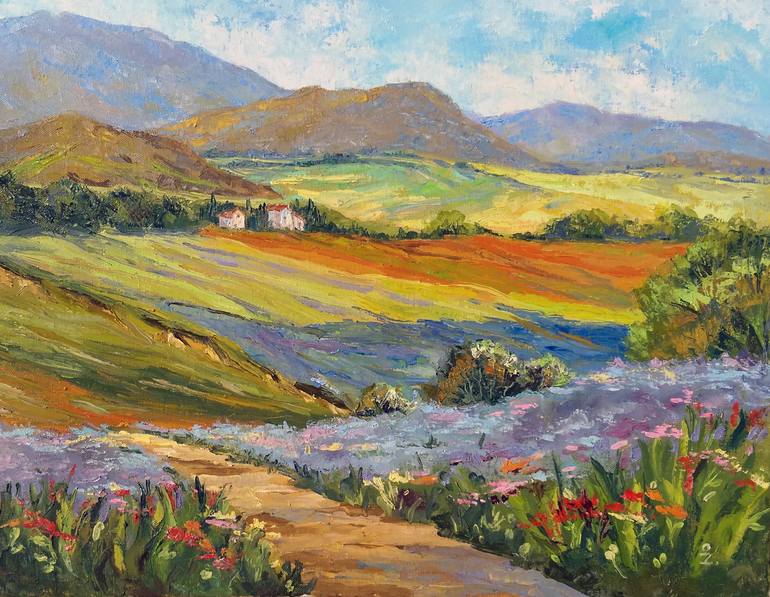
Spanish landscape by Olga Zaitseva

Olive paints pictures and asks Isaac to take the credit for it, aware that her art-dealing father won’t admire it if he knows the true artist. When Isaac protests she should own the paintings, she rejoinders, “Do you know how many artists my father sells? Twenty-six last time I counted. Do you know how many of them are women, Isaac? None. Not one. Women can’t do it, you see. They haven’t got the vision, although last time I checked they had eyes, and hands, and hearts and souls. I’d have lost before I even had a chance.” Of course, this is the provenance of the painting that falls into Lawrie’s hands – there is no mystery to this novel. Olive argues, “They believe it’s Isaac’s painting, and that’s all that matters isn’t it? What people believe. It doesn’t matter what’s the truth; what people believe becomes the truth.”

The attempt at post modernism and attitudes to post-truth are as lazy as the themes of stolen art in Nazi times and the blatant dramatic irony of the impending Kristallnacht. Other descriptive aspects of the prose, however, are a highlight of the novel making the evocative images of Arazuelo in July seem like a painting. “From the hills came the dull music of bells as the goats overtook these smaller sounds descending the scree through the gauze of heat. Bees, drowsing on the fat flower heads, farmers’ voices calling, birdsong arpeggios spritzing from trees. A summer’s day will make so many sounds, when you yourself remain completely silent.” The novel is competent but the craftsmanship is on clear display.

Saturday, 16 October 2021

Friday Five COVID-19: More ISO TV


We're coming out of lockdown today - hurrah! While we will be cautiously allowed out to pubs, cafes and restaurants; theatres and cinemas are not operating at capacity so there will be more TV watched for visual input. Meanwhile, these programs have been on my recent watched list. 

  1. Atlantic Crossing (SBS On Demand) - A Norwegian/ American drama miniseries addresses the issue of trying to get Allied support for Norway against the Nazis, who had invaded their country in WWII. Allied intervention was not assured, as the forces were busy on multiple fronts, so while the King of Norway and the Crown Prince Olav were in England, trying to drum up European support, Crown Princess Martha took her children to the U.S.A., where she becomes the guest of President Franklin D. Roosevelt. because this is a drama, the script implies there may be more than friendship between these characters. Production values are sleek, design and costumes are exquisite, and the acting varies from subtle and inscrutable to histrionic. Soapy romance elements aside, the politics is fascinating to view from a different historical perspective.  
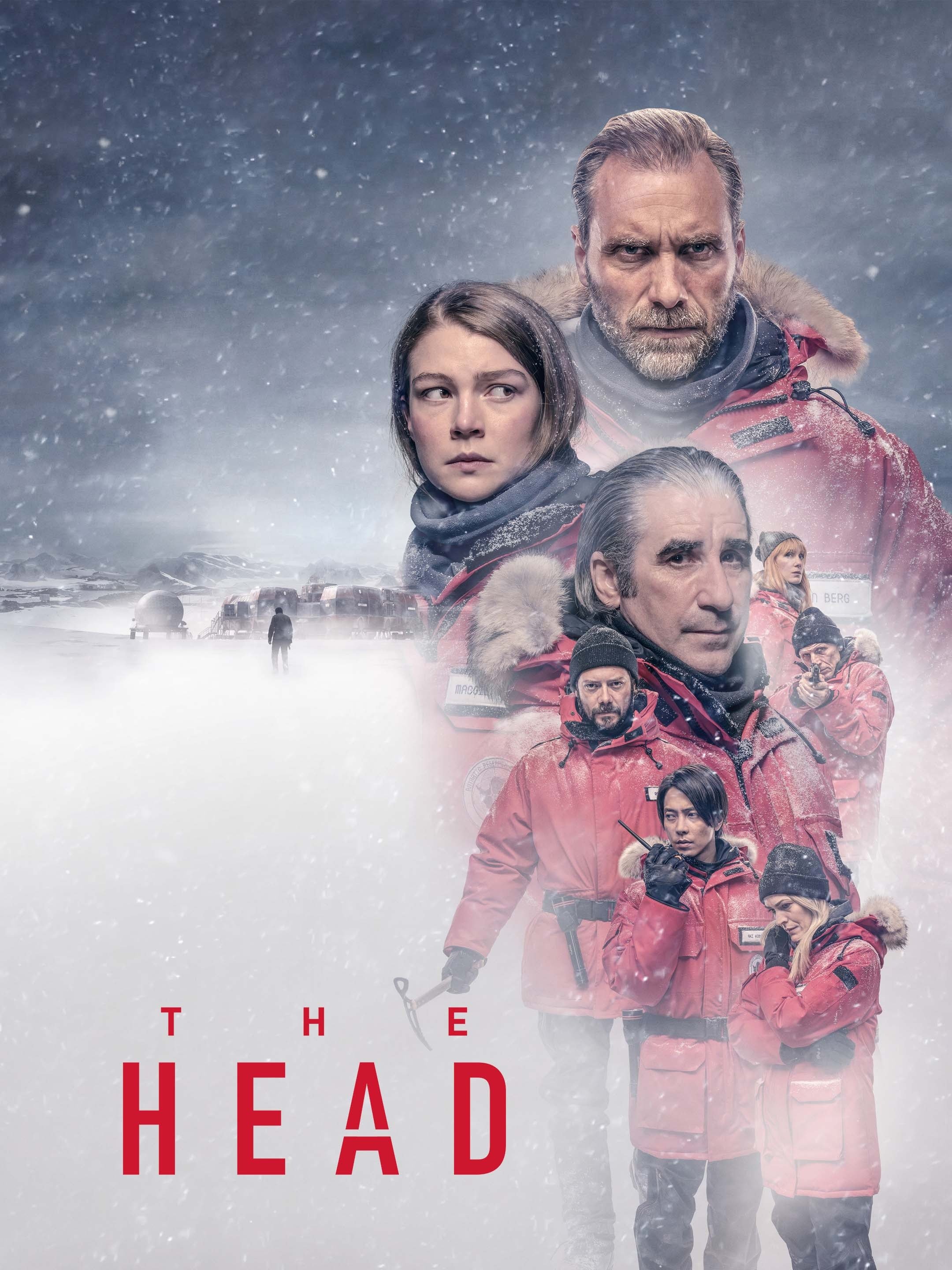
  2. The Head (SBS On Demand) - This Spanish-made, English-language psychological thriller ticks all my boxes; set in a snowy, cold location (The South Pole), a group is left in isolation as the Winterers remain at Polaris VI Antarctic Research Station to continue their research to assist in the fight against climate change. Immediately cracks begin to appear. Fast forward to six months later when the summer team return to find all the Winterers are dead or missing and there is a killer on the loose. Flashbacks indicate that everyone was shifty with a metaphorical axe to grind or a point to prove. It is logical, but I didn't work it out until the very end. It's like Agatha Christie on ice.

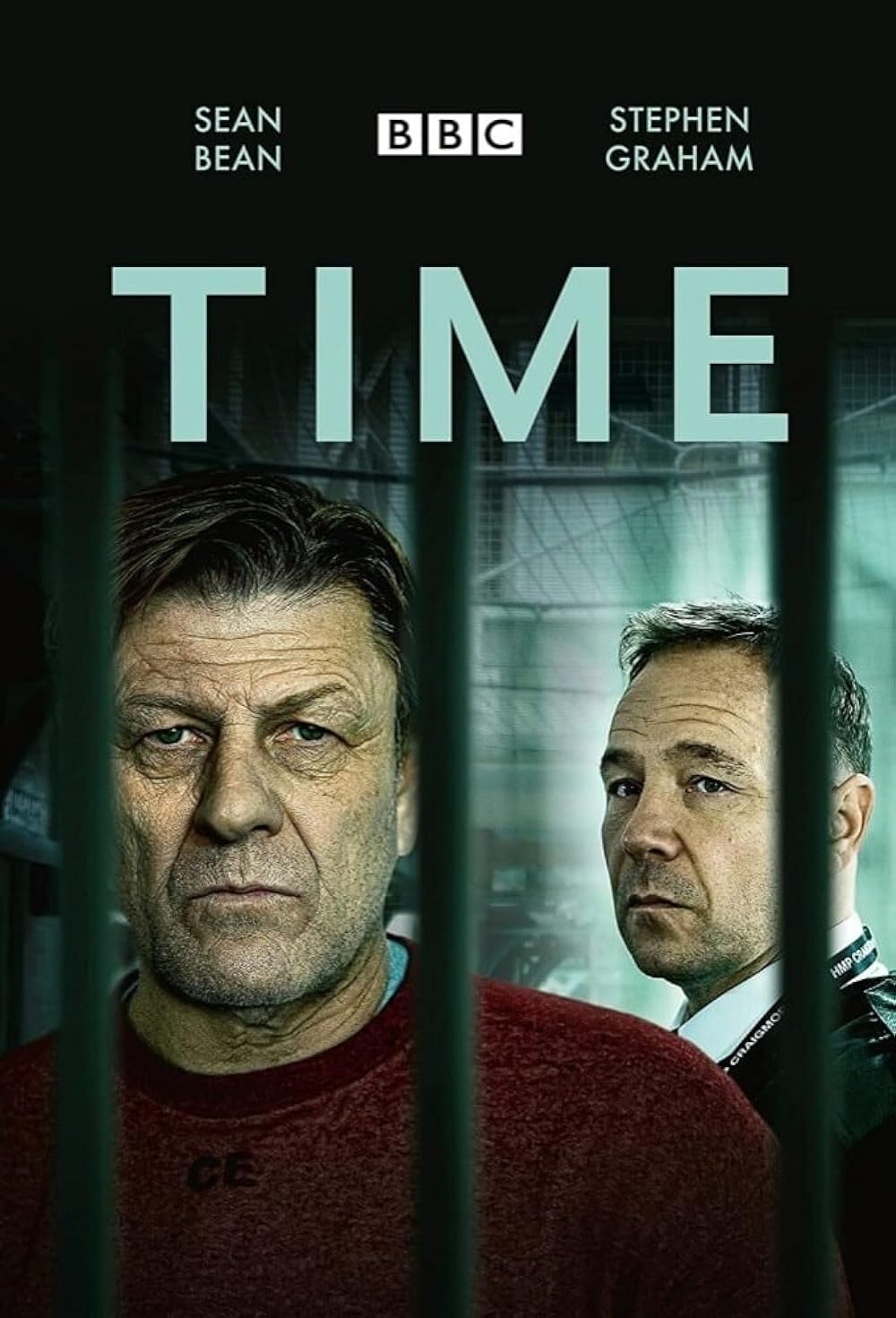
  3. Time (BBC First) - All praise the new three-part drama miniseries by Jimmy McGovern set in a prison, starring Stephen Graham, Sean Bean, Sue Johnston and Siobhan Finnernan. It's exactly as cheery as one would expect, but the acting and the writing is almost criminally good.
  4. Wentworth, Season 5 (ABC iview) - I'm a long way behind with this series - Season  5 finished in 2017, and Season 8 is halfway through (with filming interrupted due to COVID). It chucks in every prison cliché - don't go in the showers; get on gardening detail if you can; beware the butch lesbian; the kitchen deals drugs; most of the screws are bent, but it is one of few mainstream TV dramas that passes the Bechdel Test.

  5. War of the Worlds, Seasons 1 & 2 (SBS On Demand) - There are a lot of versions of this story. According to this one (produced by Fox Networks Group and StudioCanal-backed Urban Myth Films), if you send Nick Cave songs out into the cosmos, you might get invaded by aliens from the future. "I don't believe in an interventionist God" has never seemed so apt. The bleak and deserted landscapes are reminiscent of 28 Days Later or The Day of the Triffids, but Gabriel Byrne lends it a touch of gravitas, and the blend of English and French gives it a certain je ne sais quoi. 

Tuesday, 28 September 2021

'God's Chosen People': Tanamera


Tanamera by Noel Barber
Corgi
Pp. 736

Tanamera (from the Malay meaning ‘red earth’) is the saga of the eponymous house and all who live in her, namely the Dexter family. It is a tale of a dynasty, narrated by John Dexter, and, by extension, a novel of Singapore. Of course it is a white colonialist’s view of Singapore and contains all the inherent classism, racism and sexism one would expect to find in a novel written in 1981. It claims to be both a witness to the change in the country before and after the Second World War, and a love story, but it is so partisan that it can barely be either, especially as the women are very poorly drawn caricatures.

The descriptions of Singapore are as viewed by an ex-pat; there are tennis clubs and gin and tonic on the veranda. And it is hot, and full of insects. The Dexter dynasty, and the house, was established by Grandpa Jack who made his money through rubber (Dunlop), railways, shares in tin mines, and setting up Raffles. The novel condenses the history of rubber and those who control the price and the export of it. The colonialist attitudes are jarring but not unusual: the casual racism and exploitation of the local people is hugely unpalatable but typical of the time. This attitude of superiority extends to gender and sexuality, as the narrator says of his brother, “even though Tim’s sickness manifested itself in his trousers, it was the head that needed attention.” He also refers to Tim, as “that fairy” and “a bugger boy”.


The narrator cannot write a credible female character. Julie, his love interest, is docile, compliant and beautiful, like an ex-pat’s colonial dream of an Asian woman. She is happy for him to take her virginity and does not mind that she is not allowed in his tennis club or at his parties, saying demurely, “I’ll always be yours if you want me.” Her looks and desirability to other men raise her value in his eyes and he admits to a “fierce feeling of possession and intimate knowledge of showing Julie off. Of course Johnnie marries and has children with someone else, while claiming to retain undying love for Julie. He tries to justify his actions as Julie forgives him for sleeping around and marrying someone else because there is licence to cheat during the war, apparently. She is light-hearted and never remonstrates with him but quotes poetry instead in a parody of the accommodating oriental mistress.

It is unlikely that he appreciates a woman’s ability to enjoy herself sexually; he has sex with a friend, Vicki, when they are both married to other people and she tells him, “Every married woman secretly dreams of being raped – by a friend of course.” Later, Julie repeats this nonsense, with the exact same words. This dangerous fantasy of his displays a complete lack of respect and understanding. Dramatic scenes later in the novel linger on the prurience of a gang-rape of his wife and sister, Natasha.

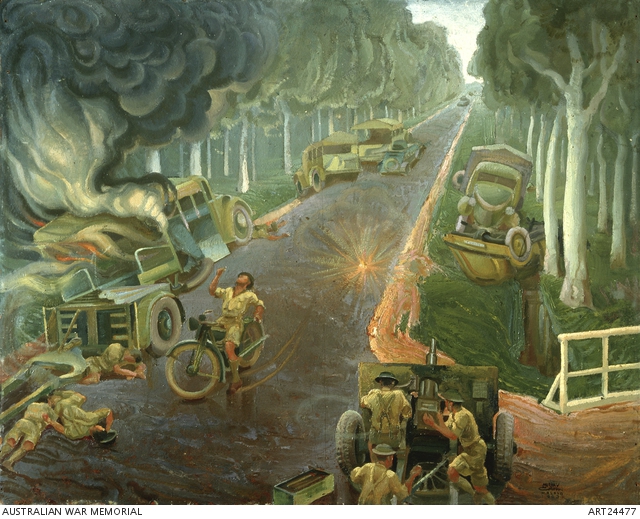
Action at Parit Sulong, January 1942 by Murray Griffin

There is some merit within the book, however, and it is in the description of war and how it affects Singapore (as seen through a colonialist’s eyes). There is a strong ‘end of an era’ atmosphere as can be expressed when viewing it in hindsight. War, when it comes, is initially just another reason for exploitation and profiteering, as it is seen from a distance as capitalists prepare for its approach. Eventually Singapore falls and the war comes directly to the Dexters, as John fights in the jungle, and there are detailed descriptions of making bamboo bombs and the sadistic torture methods and general savagery of the Japanese. As Barber’s reflections become more political and less personal, he includes footnotes to historians’ writing as if to back up his fiction with fact. He is better at understanding the big picture than individual motivations.

As a rambling novel of a family saga with Singapore as a backdrop, this is an ambitious work. One is reminded of James A Michener’s Tales of the South Pacific. He couldn’t write women either and approached the situation from a white male colonialist viewpoint, but it won him a Pulitzer Prize in 1948 when that was the only perspective that mattered. Hopefully times are changing.

Wednesday, 15 September 2021

Hiding Her Light Under a Bustle: Agent Sonya


Agent Sonya: Lover, Mother, Soldier, Spy by Ben MacIntyre
Viking
Pp.328

Spies, especially female spies, capture the imagination. Ursula Kuczynski, codenamed Sonya, was a German Jew, a dedicated communist, a colonel in Russia’s Red Army, and a highly trained spy. From planning an assassination attempt on Hitler in Switzerland to spying on the Japanese in Manchuria and helping the Soviet Union build the atom bomb, Sonya conducted some of the most dangerous espionage operations of the twentieth century. Ursula Kuczynski married several times – she had many names, both real names and codenames. The novel is subtitled ‘Lover, Mother, Soldier, Spy’, and, although she had many lovers, none of her partners ever betrayed her. MacIntyre, meanwhile, is obsessed with her conflicting duties towards the party and her family, which he embodies by talking about making jam and baking cakes.

Ursula had a relatively comfortable and privileged background, and became a communist through ideology. She moved to Shanghai, where she was appalled by the discrepancy in conditions caused by wealth. Bored and sickened by her life in Shanghai, she was anxious to do something more meaningful. She was clearly passionately idealistic, but with sexism bordering on misogyny, MacIntyre is unable to believe that she supported the Communist cause for reasons of ideology alone and frequently espouses the theory that she was attracted to the glamour and the excitement of espionage. “Ursula was committed to communism, but also increasingly addicted to danger, the romance of risk, the addictive drug of secrecy.”
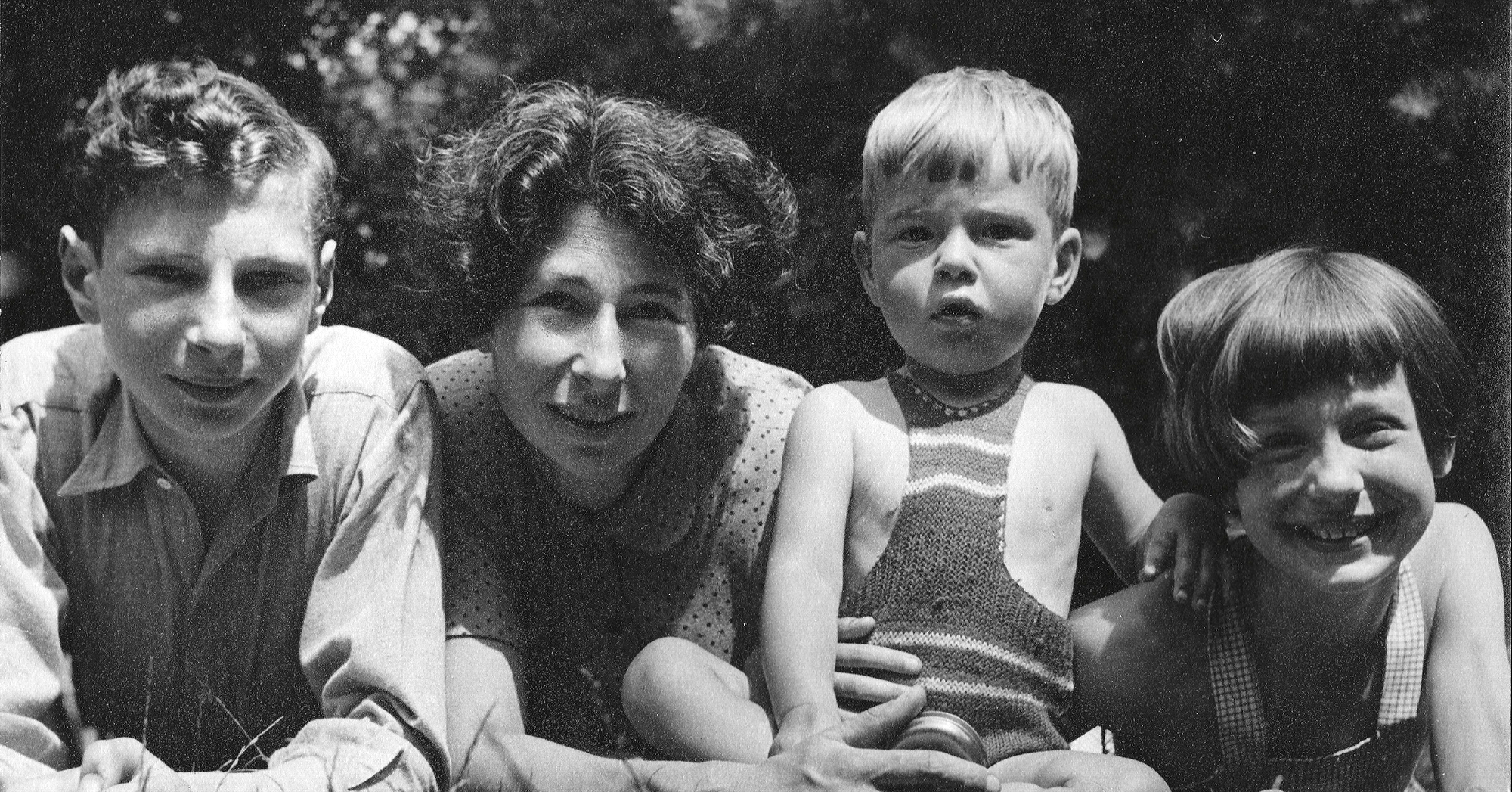
Throughout the book he clearly points us in a certain direction, editorialising in a blunt fashion as if he doesn’t trust the reader to make up their own mind, or perhaps he mistakes condescension for humour. He is also critical of other authors, which is spiteful and unprofessional, merely heightening the sense of smugness. There is a lot of repetition, suggesting the lack of a disciplined editor and, whereas this is a great story and would make a great film or novel, this biography has got both a muddled and didactic approach. He sets the scene very well, even if he does it multiple times, and he clearly enjoys the complicated details of the meetings between handlers and recruits in which two people walk towards each other “holding a green book in one hand and a tennis ball in the other, exactly as Sonya had instructed. At 4pm on the dot, a stocky man appeared, wearing a pair of gloves and holding a second pair in his left hand.”

In 1932 when Japanese forces attacked Shanghai, Ursula was “dispatched” to the war zone to discover if Japanese incursions into China presented a potential threat to the Soviet Union. Later she was sent to Mukden, a city in Manchuria in Inner Mongolia (invaded by the Japanese in 1931) “to liaise with the communist partisans, provide them with material assistance, and transmit military and other intelligence to Moscow by radio.” She built her own radios (which she had to bury in the fields) and assembled aerials on the roof (which she had to dismantle each night). She moved to Switzerland, where she ran a spy network, using the “peaceful land of cowbells and cuckoo clocks” as a base to launch operations into enemy territory. 

Threatened by possible exposure, she left Switzerland and took her family to England where she settled in Oxfordshire. When Ursula moved to Great Rollright, she cycled into the countryside to put messages in a hollow tree and receive drops with her instructions, but there were no communications and she began to worry. Basically, the GRU had got the wrong tree. After the war, Ursula continued to spy for the Communist Party, and in 1949, she went to Berlin where she continued her work in East Germany. She worked with many ‘famous’ spies, including Alexander Foote, a radio operator who spied for Russia and Britain, and Klaus Fuchs, who supplied information from the American, British and Canadian Manhattan Project to the Soviet Union during and shortly after WWII.

It seems incredible that Ursula was not caught. Her brother and father were already under surveillance by MI5 and the whole family were considered suspicious. She had been made a colonel in the Red Army – the only woman to rise so high in Soviet military intelligence. All of her previous husbands, lovers and many of her recruits were interrogated, but none betrayed her. Many men couldn’t comprehend that a woman could be a spy. MacIntyre writes, “Some in MI5 wondered how Ursula could possibly have time to spy since ‘her hands are fairly full with domestic duties.’”

She became dissatisfied with the Communist regime due to instances such as Stalin’s Great Purge, the crushing of the Hungarian revolt against Moscow in 1956, the building of the Berlin Wall in 1961, and the put down of the Prague Spring in 1968, but she still believed she was helping to make the world a safer place by stealing atomic secrets from one side and sharing them with the other. Her own children did not know anything about her life as a spy until she published an autobiography, Sonja’s Rapport in 1977, which would probably be a great read. MacInytre’s attempt to place her experiences into a domestic and female context is clearly done for dramatic effect, but somehow manages to undermine the commitment and consequences of this remarkable woman.

Tuesday, 22 December 2020

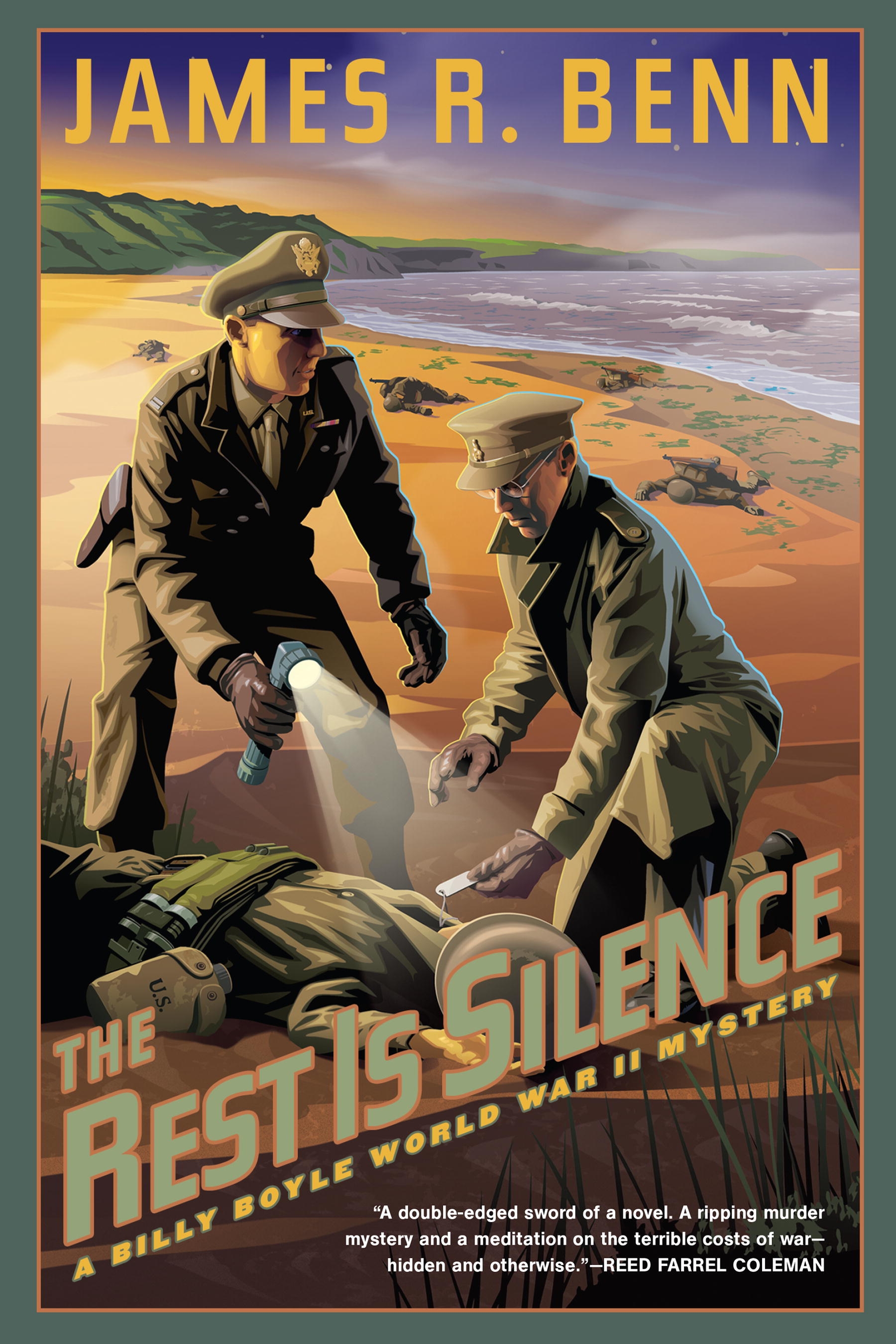
Boys' Own War Adventure: The Rest is Silence


The Rest Is Silence by James R Benn
Soho Crime
Pp. 323

The writing on the jacket claims that this is “a Billy Boyle World War II Mystery”, so it is obviously one of a series in which US Army Captain Billy Boyle and his partner Kaz work for the Office of Special Investigations: “our job was to deal with low crimes in high places that got in the way of the war effort. And to deal with them quietly, although quiet wasn’t always in the cards.” The novel was published in 2014, but the style is that of a previous era with a hard-boiled-detective noir fiction bent.

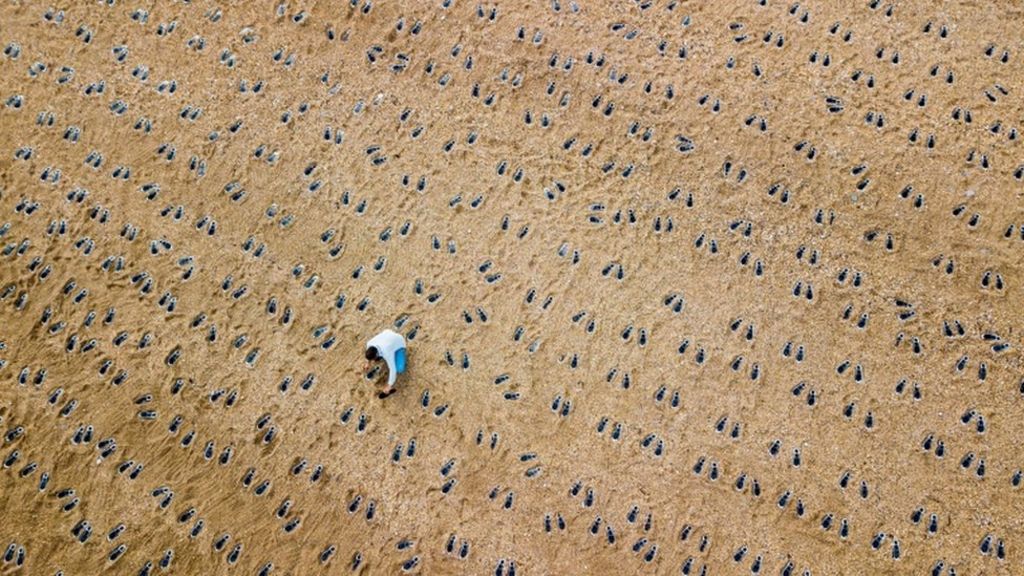
When a body washes up on Slapton Sands on England’s Southern Coast, Boyle and Kaz are called in to investigate. The Devonshire Beach is the home to Operation Tiger (April 1944), the top-secret rehearsal for the approaching D-Day invasion of Normandy. This was a real event in which hundreds of Allied soldiers lost their lives; there were more American casualties in the exercise than the actual attack.

While the men are investigating the crime, they are billeted in a country house full of rich people, which includes a dead patriarch, old animosities, and a contested will. This provides ample sub-plots about relationship dynamics. One of the family members, Edgar, is writing a book about the interpretation of the end of Hamlet, which is where the title of the novel originates. Boyle seems to be taking a swipe at academia and philosophy, whereas he deals in hard truths and manly facts.

He is a plastic Paddy American who hates the English as part of his shtick, having to restrain himself from voicing his true feelings. Boyle is related to General Dwight Eisenhower, who is everyone’s boss in the US Army: “I call him Uncle Ike”. Lady Pemberton, the matriarch of the house in which he is staying says, “One bristles at the idea of a foreigner, even one of our American cousins, telling the British army what to do. But he seems like a decent fellow.” Boyle is naturally tough and uncompromising and rejects authority figures, or certainly British ones. War is unpleasant, requiring a stern exterior, and Boyle narrates his part in a stoical fashion. He takes no prisoners and favours neither side, trying to remain natural about the situation.

In some cases the language strains to be contemporary to the setting. There are men with physical deformities including Kaz: “[Kaz] grinned, his scarred face looking slightly maniacal. I don’t much mind maniacal when it’s on my side.” And there are men with mental scars as a result of the war, who have suicidal tendencies and difficulty readjusting to civilian life. These issues may be well-known now but were less so at the time, making the recognition anachronistic though the sentiment is sound.

Much of the novel reads like a boys’ own adventure with comrades in arms, smugglers, gun fights, and bureaucratic conversations about military exercises and clandestine operations. Its main interest is in the fact that it is set around a genuine historic incident. There are many others in this series (fifteen at present count), so people are clearly drawn to this style of storytelling with a historical mystery set against a military background with a cynical world-weary hero.

Bootprints of 749 troops were laid out on Slapton Sands, Devon, in April 2019 to mark the 75th anniversary of Exercise Tiger.

Thursday, 9 April 2020

Small Town Boy: The Ballad of Barnabas Pierkiel


The Ballad of Barnabas Pierkiel by Magdalena Zyzak 
Henry Holt 
Pp. 269

The narrator of this tale is our guide to the tiny town of Odolechka “located so far from the sea and everything else that nearly no one had known it existed, that is, until everyone knew at once.” In a cross between Borat and Gogol, she mocks the town and all the inhabitants with a gentle satire that points out both their limitations and pomposity. The parishioners and villagers hate each other and are mainly concerned with eating sausages and salted herrings. Our eponymous hero is seventeen and lazy; obsessed with Roosha, the gypsy woman, and his own appearance.

Odolechka does not have much to recommend it. Indeed, when a German spy (with the wonderfully unsubtle name of Boguswav) arrives by parachute and quizzes the mayor and the police chief about their town’s assets, they proudly show him the highlights: an abandoned barracks; haylofts; straw stacks; the windmill; the abandoned string factory; “the scarecrow in the corn field by the wheat field by the edge of town”; “our split oak tree, where Kashak crashed his bicycle” the scorched bootlegging barn; hectares and hectares of cabbage fields; some picket fences; and a well with four bricks missing.

In the true style of a picaresque novel, the town is populated by simultaneously dull and colourful characters, including the police chief who is so fat he can barely squeeze between the church pews, and the mayor who is not much thinner. There is an entrepreneur with a motor vehicle (the only one in the village) a doctor and his phlegmatic wife, and Kumashka, the drunken priest, concerned with minor points of scripture.

Much of the humour comes from the fact that the author claims this is a poor translation, while using specific expressions and complex vocabulary, which has the reader rushing to a dictionary. For example, at one point in church, Barnabas was “leaning on a splintery pilaster in the narthex” and when there is nothing to counter the religious fervour of Kumashka, “The speechlessness of the laity was so entire that borborygmus here and there was heard.” Throughout the narrative, she deliberately deconstructs and draws attention to the artifice of the novel, and frequently loses track of the main narrative, trailing off after other non-entities, only to “return to our hero, whose perspective the negligent author keeps abandoning.”

The quixotic folk tale elements cease abruptly, and a realistic WWII conflict ensues which none predicted. Zyzak’s tale is a blow to complacency. The fictional, bumbling, rural town of Odolechka and inhabitants are mocked, but the town is now destroyed by war. As such it represents a “touchstone for a hundred towns” near the Polish/ German border. We are rocked by sadness for a traditional town we never knew, but also remembrances of real residences that were similarly obliterated. By weaving a tale of froth and humour before ripping it apart with brutal force, Zyzak teaches us a lesson we cannot and should not ignore.

Tuesday, 24 March 2020

COVID-19: Dreaming is Free


Stories are my saviour. Whether told on the page, stage, screen (large or small) or radio, they inspire, enlighten, challenge and comfort me. It may not be the best idea to be watching World on Fire at the moment, but last night we watched the final episode of the first series. The series is set during the Second World War in France, Germany, Poland and the U.K. and it follows several families and characters from 1939-1940. It's tough to watch at times (and there seem to be a few anachronisms in terms of speech and accent), but it is well acted and sufficiently tense and dramatic to keep me involved.

I am tempted to see parallels with our current global situation, and slightly reassured that I 'mustn't grumble: things could be worse'. No one is shooting at me, or trying to bomb me, or threatening to hang me because I am the 'wrong' race, colour, ability, sexuality or political persuasion. Not yet, anyway: I don't live in America - cheap jibe, sorry. But there is a preponderance of panic buying, propaganda, misinformation, uncertainty and an extremely rapid pace of change. Life (and death) goes on in altered circumstances; people still get born; get married; fall in love; fall out... not necessarily in that order. And like World War II, those in the midst of it have no idea of when and how it will finish. Trust me, I've just seen the last episode of World on Fire and there is no satisfying sense of closure - sorry if that's a spoiler.

Our COVID-19 situation also sees leadership, and the lack thereof. Boris has been chewing his way through speeches by Churchill and Plato and now emerges blinking from his shabby chrysalis as a somewhat unlikely statesman; Prince-Hal-like, the foppish fool has sobered up to face the future. Jacinda is calm and firm; just and fair, dealing with a hideous situation with sense and sensibility. Scotty is floundering about like a lumpfish in shallow water but out of its depth. Make some decisions; be bold and resolute; lead!

In Australia we are told that schools are 'pupil-free' but they remain open and no one is turned away. We are told that only essential services should remain open - yet many businesses have not been made to close, so people are still heading to the office, hoping for a gold star from the boss. We are not allowed to gather so theatres, cinemas, gyms, pubs, clubs and restaurants have been closed. Art galleries and museums are choosing to close. There is no statewide ban on beaches, although people are 'advised not go' - yep, we've all seen how well people are following those guidelines.

Hairdressers and beauty salons are still open - it's important to look good in your coffin, apparently - but no one will be there to see you. Churches and places of worship are closed except to very small gatherings; weddings and funerals are not allowed indoors except in small groups observing the one person per four square metres rule. I am a sporadic church-goer; my places of worship are hills and woods and the great outdoors. I worship a mixture of myth and religion - I would like to believe in a golden thread that we can follow out of this darkness into the light once more.

I do usually go to church at Christmas, Easter, and Whitsun, however: they are the significant touchstones of my faith. This year, I will not be attending live services, but I will be commemorating the occasion in my way. Many people are suggesting ways to occupy their time in isolation (although Australia has not moved to this yet, and people are still congregating in entirely unnecessary groups); one of my pass-times is cross-stitch. I have been stitching little Easter designs of baskets and bunny rabbits, surrounded by eggs and flowers.

All this is probably what informed my dream last night in which I was trying to stitch together a Polish fabric that had been destroyed by Germany. It was my duty to reconnect the border by unpicking the existing stitches and working them back into an unbroken line with a golden thread. I believe our dreams are important - not in a Freudian way, but because they are a coping mechanism in which the brain shuffles events and tries to impart some meaning. My bible is the bard, and I find words to fit every event in his plays and poetry. And so it is with dreams, which come to us in sleep:
"Sleep that knits up the ravell'd sleave of care,
The death of each day's life, sore labour's bath,
Balm of hurt minds, great nature's second course,
Chief nourisher in life's feast."
I know I have employed that quote before (it's one of my favourite, from one of my favourite plays), so here's something else that's been on my mind.


Sunday, 14 October 2012

Great Walls and Fire! Museum of London (Part One)

The Museum of London had been recommended to me by my super-in-law, so I took a tube there one day while in the city.

As the Olympics have been held in London three times, and everyone has caught the fever, there was an exhibition in the foyer on the subject. This one hopes to be the most sustainable games to date – for example, the top ring of the Olympic stadium is made from surplus gas pipes.

I skipped through exhibitions about London before London and Roman London (not literally skipped, you understand, that would be weird). The city was burned in AD60 by Boudicca and was then rebuilt and expanded. By AD100 it replaced Colchester as the capital of Britannia. Glass cases contained bones and pottery, models of amphitheatres, stone sculpture tools, coins and horseshoes, but I was being selective, and pressed on.

I was intrigued by the remaining part of the London Wall, however. The first fort was built in AD120 for the soldiers in Londinium. There were remaining mosaics from AD 200 when these walls were strengthened and incorporated into a city wall to protect London. In AD410 the Romans abandoned London; the city declined as it was empty for nearly 400 years and the wall began to collapse.


The Saxons moved in (in AD886), repaired the walls, and added towers for extra protection against Viking attack. They built houses right up against the wall, but they were destroyed in the Great Fire of London (1666). In the nineteenth century, warehouses and shops again abutted the wall. World War II bombing caused extensive damage to both the wall and the buildings, and when archaeologists dug up the ruins, they found sections of the original wall, one of which is displayed here, looking secretive in the summer sunshine. I love how the stones are steeped in history.

Real children were playing in a reconstructed house in the Medieval Britain section. Here the displays feature weapons, keys, chain mail, pottery, preserved doors and altarpieces, rings, paintings, books, manuscripts (bibles and primers from the 1400s) and illustrated letters. There’s a collection of London Delftware pottery, and the Cheapside Hoard, a treasure of Elizabethan and Jacobean jewels discovered in 1912 under the cellar floor of a seventeenth century house in Cheapside.

Again, I raced through this bit, but was morbidly interested by the display on the Plague, Black Death and Pestilence caused by the stink and filth of the city. The ‘War Plague and Fire’ section also interested me as it has a model of the Rose Theatre from 1587 and the three copper plates of the 1559 Copper Plate Map – fifteen plates made up a map of London, and only these three survive, although there is no contemporary printed map.


Oliver Cromwell’s death mask is also on display here. He is claimed to have said, in a 1656 interview, “I am as much for a government by consent as any man; but where shall we find that consent?”

London was teeming – furniture, models of 1660s timber houses, and pictures of the Great Fire illustrate this state. Donald Lupton wrote in London and the Countrey (1632), “London is the great beehive of Christendom... she swarms with people of all ages, natures, sexes, callings... she seems to be a glutton, for she desires always to be full.”

One-fifth of the population died in 1665 due to the Great Plague. In an effort to ward it off, people wore bunches of herbs; lavender, cloves, and pommo d’ambre (a mixture of whale vomit, animal scents and flowers – thought to be efficacious). And then came the Great Fire.


London booksellers stored all their books and papers in the crypt of St Paul’s Cathedral for safety, but it was covered in wooden scaffolding which caught fire, the lead in the roof melted, the cathedral burned down, and everything was destroyed. Fortunately London Bridge had a gap between shops in it (from a previous fire), which prevented the fire from spreading to Southwark, and causing further loss of life.

The gaolers took pity on the debtors in prison at Newgate, and released them to fend for themselves. People pulled down houses and Charles II himself helped with throwing water on the conflagration which raged for five days, destroying 13,000 homes – the King arranged for bread to be delivered each day to feed the many homeless.