Showing posts with label colonialism. Show all posts

Tuesday, 13 February 2024

A Refusal to Die of White History: Modewarre


Modewarre by Patricia Sykes
Spinifex
Pp. 90

Modewarre is the indigenous word for musk duck, a creature at home on land, water and air. Through her poetry, Patricia Sykes explores various histories and the boundaries between them which blur and blend. She splits the poems into three sections: House of the Bird, House of Water, and House of Detention, examining words and their connotations, dwelling on reflections, refractions and altered perceptions.

Naming things robs them of their magic and power, as we use “language, so impossibly cumbersome/ for discovering the true weight of things/ the grandmother would have known”. The literary fragments are almost Sapphic with physical and sensual meaning: “as always the modewarre/ places faith in its eggs/ yolk and the sun/ breed each other”. The strong bonds of belonging and connection to land go beyond words, until the frustration is clear in a poem such as eponymous, “to the interrogator who keeps asking/ ‘so are you still suckling on myths of place?’/ I say try the enigma address/ the bird who keeps vanishing in water –”

The poems recall the land and the life before the colonists came, and also the sheer incomprehension of the invaders dealing with the loss. In eupathy (right feeling of the soul) she sees the land from above as though flying with the eagle. “to talk now/ of whether this is still so/ or if the eagles in free flight/ are an option/ to speak of/ options, land, again/ once more/ not as that which was taken/ is un-ownable/ contracting and crowded/ but as lava shift/ the heat of a river/ always underfoot/ in a molten indifference/ to politics”. There are layers of knowledge contained in a word, such as the poem, ‘brid’, eight darkness in which ‘brid’ is the name given by Nyangangu, a Yolgnu artist of Northeast Arnhem Land, to her bird carving. “there, where you are,/ bred of earth, breeding sky/ working the uplift, wingbeat/ as if sculpting a refusal/ to die of white history”.

The world is a palimpsest and so is the brain – our thoughts and memories are malleable. Birds connect people and places, and are often totems for Aboriginal and Torres Strait Islander people, helping to define kinship with people, their Country and nature, connecting to the roles and responsibilities of a mob, offering protection and foreshadowing danger and momentous events. This connection extends throughout the world as the birds migrate along their own songlines.

Means of expression are insufficient, with even mechanics of speech and typing unable to capture the richness of the language. “this keyboard’s/ tireless tap-tap mouth/ which cannot voice/ the interior ‘n’ in Nyangangu/ the one with the tail/ the sound of ‘ng’ in singer”. And yet the words can be damaging and belittling. “how the eyes like linguists are never satisfied/ how they’ll poke and pry into any lexicon”, wanting to preserve and capture, destroying the natural.

The poems in House of Water are concerned with childhood, disease, death, invasion, cattle, birds, and bunyips. Roads are built over traditional lands, only to crumble and fray at the edges demonstrating their impermanence in the liminal space. “what never was field/ become paddock become/ fences become livestock/ the cattle the sheep/ foraging for the hoofprints/ they lost the last time/ they departed a shore”.

In the House of Detention, the poems move on to highlight migrants trapped in refugee camps, prisoners in cells, wives in marriages, women in motherhood, caterpillars who will one day be butterflies, political constraints, and people wanting to be “at home in every world/ where exile does not exist”. In great-aunt narrative among the excised lands, Sykes leans upon the double meaning of refuse (verb and noun) as it relates to denial and pollution: “oh my Canberra…/ high city of presumptive cleanliness/ among the dirty waters exuding from the workplaces/ the smell of your refusal laws”. She uses a rare capital letter in this poem, which must surely be ironic as her punctuation is clean and almost entirely absent.

Modewarre is a great collection of powerful fragments, connecting words to the echoes of previous language both spoken and unspoken. It is a reminder that we are merely one of millions of moving parts that comprise our environment, expressing a concern for what will happen to the delicate balance once we form a pyramid and place ourselves at the apex.

Wednesday, 22 February 2023

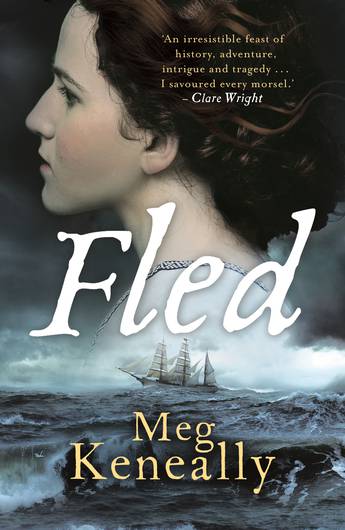
Daring Escape: Fled

Fled is based on the life of Mary (Dabby) Bryant, the woman behind one of history’s most daring escapes. Sentenced to seven years transportation to Australia, she escaped from the colony and sailed over 3,000 miles for 66 days in a stolen open boat with her husband, two children and other companions to West Timor (Coepang as it was then called). Here she was discovered, arrested and returned to Britain to be incarcerated until she was taken up as a cause célèbre by James Boswell who set her up in a house and sent her a stipend after she returned to Cornwall. In an Author’s Note, Meg Keneally stresses that this is a work of fiction, which is why she has changed some elements of the story, including names of the characters – Mary Bryant becomes Jenny Trelawny, later Gwynn after marrying Dan Gwynn.

The first part of the novel concerns Jenny’s route to crime and the highway robbery for which she was transported to the other side of the world. There is a detailed account of that trip on the Charlotte, on which she conceives and after which her daughter is named. She befriends Captain James Corbett, whose character is based on that of Watkin Tench, who tells her, “We don’t need to remake Newgate on the other side of the world. Well, I imagine there will be a guard house, or something like it. I’m sure that not everybody has left their criminal disposition back in England. But the entire place is intended as a prison. We’ll have no need of walls for the most part, it is to be hoped. We’ll have the ocean.”

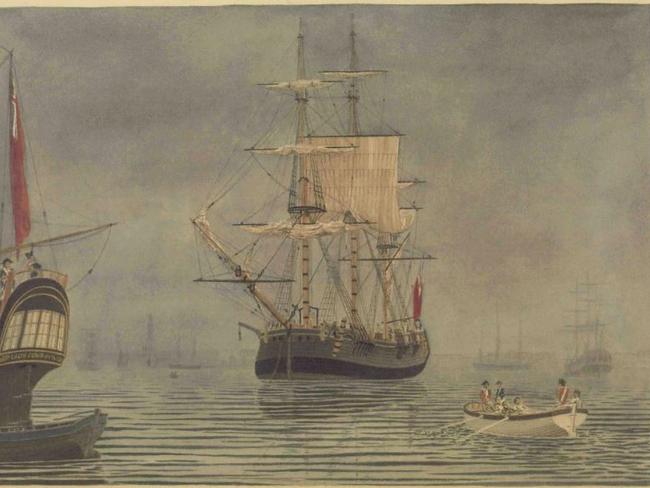
The Charlotte at Portsmouth, May 1787 from Frank Allen's The Ships of the First Fleet

Life in this colony is brutish and cruel, as it is intended to be, in a land that must seem upside-down. The triangle that is used for the floggings is “an ominous symbol, a profane and subverted trinity.” To save herself from rape and degradation by the male convicts and soldiers, she marries Dan and has another child, Emmanuel (these were the real names of Mary Bryant’s children). Married couples are given separate quarters but others, jealous of what they perceive to be her advantages, strive to bring her low. When their actions result in Jenny being expelled to the women’s camp, she reflects, “While space was the only blessing this colony provided in abundance, it was one of the many denied to the hut convicts. Jenny now lived in a place of wails and screams and sobs and fights, of stench upon stench, of dangers buried in innocent conversation.”

From the moment she lands in Botany Bay, Jenny knows she wants to leave, and it soon becomes apparent that their best chance of survival is escape. Food is scarce, supply ships are absent, farming is in its infancy, and provisions are rapidly dwindling; making theft of food a hanging offence and starving to death a distinct possibility. Perhaps if the settlers had collaborated with the local people they might have had better chances of survival, but there is limited interaction between the white settlers and the Indigenous tribes. Jenny encounters an Aboriginal woman who shows her what leaves to chew or to brew to avoid scurvy. Although these are plentiful, Jenny guards this knowledge as currency, as she does when the Indigenous people take her fishing and share their methods with her.

Questions have been asked as to why Mary Bryant would risk a journey for herself and her children on the ocean and potential drowning. As well as starvation, the new colony is rife with disease (particularly smallpox) and the dangers to the women convicts are manifold. “Emmanuel’s death at sea is a possibility. His death here is nigh on certain.”

1930s era illustration of the convict escape
Much of the action of the novel takes place on the water, either in the Charlotte, or the cutter in which Jenny and her companions make their escape. These seafaring experiences are described in some length, which is both terrifying and tedious as indeed it must have been in reality. When they land, Dan’s bragging of his expertise at sailing the boat back to Coepang, leads to them being discovered and their subsequent arrest. The governor who had supported them and admired their skill and courage when he thought they were shipwrecked, turns against them when he learns they are escaped convicts, because he is angry that he has been cheated and make to look a fool; he fears for his reputation and “Laughter, laughter on the seas as the story spreads about the dupe of a governor.” Jenny is frequently at the mercy of men and their egos.

Eventually she returns to her family in Cornwall. She had been afraid of their reaction, but they are thrilled to see her and welcome her back, so the story has come full circle. This is one of the bits that the author has invented, but it makes for a satisfying conclusion. Mary Bryant’s adventure is a fascinating story and, although she has changed the names to compensate for lack of certain facts, Meg Keneally has told it with drama and compassion.

Tuesday, 4 October 2022

My Newest Favourite Thing: Parramatta Pathway

Warning: Aboriginal and Torres Strait Islander readers are advised that this post contains names and depictions of deceased persons.

A few weeks ago I was in Parramatta for work, and as I went for a morning jog along the Parramatta River, I stumbled (quite literally) across this intriguing mural that snaked its way along the path. The artwork was designed, hand-painted and installed by artist Jamie Eastwood, a descendant of the Ngemba people of far northwestern NSW. 

It gives a snapshot of the history of Parramatta from before 1788 to the present day from an Aboriginal perspective. The salt water and fresh water met in the Parramatta area, making the river an important place for food, and a place for meeting and trade between the clan groups of the Darug nation. The paintings tell of early conflicts between settlers and the Darug clanspeople, their resistance to colonial domination, the mistreatment of the Stolen Generations, and recent efforts towards reconciliation. The artist's vision states,
"I hope that the pathway artworks will provide an insight into some aspects of Parramatta's history prior to colonisation, the significance associated with the area and give recognition to the Burramattagal people and neighbouring clans that originally occupied the area. This will create community awareness  from an Indigenous viewpoint. Apart from providing cultural education, I hope that the pathway will provide something beautiful that will flow with the riverine environment."

Another sign explains a little about the Aboriginal art in NSW , which includes richly-decorated cave paintings, engravings on rock shelters, carved designs on living trees, body decorations, and painted and carved designs on wooden weapons and tools. Although cultural traditions and spirituality was associated with most of the artwork, some artwork was made for decorational purposes alone. The design and figures depicted varied across the state, often including human figures, animals, fish and white or red hands of cave-dwelling people. 

It goes on to explain that evidence of the ancient and rich artistic and religious traditions of Australian Aboriginal people still exist in special places and locations across NSW. These significant and ancient sites should be protected for future generations. Aboriginal art continues to flourish in NSW. Contemporary Aboriginal art has responded to the urban environment, blending traditional images of the past with modern colours and design of today. 


Before the arrival of Europeans in 1788, the Sydney area was occupied by three different Aboriginal tribal groups: the Dharug; Kurinngal; and Dharawal. Each group had its own recognised territory which they associated with a particular ancestral dreaming animal or totem. The Burramattagal clan who lived in the Parramatta area were members of the Dharug group, and associated the eel as its totem. The word Parramatta (first used in June 1791) is derived from the name Burramatta. Burramatta is based on the Aboriginal word burra meaning eel. A literal translation of Burramaata is place where the eels lie down. 

Some species of eel migrate from the salt water to fresh water to spawn and the name Burramatta is probably associated with the eel migration up the Parramatta River. Parramatta is located at the meeting point of salt and fresh waters which historically was in the vicinity of Barry Wilde Bridge; the meeting of salt and fresh water is now at Charles Street Weir.


Across Australia, Aboriginal people lived by hunting, fishing and collecting a wide variety of plants. In the inland rivers fishing was aided by spears, hand lines and traps. Spears usually had four prongs made from bone or ironwood. Hand lines were made from hair or bush fibres twined into a string. Traps were built from logs, stones or bush brush set across rivers or creeks, taking advantage of the tides and seasonal migration of certain fish (mainly mullet and bream) and eels. 

With the establishment of a European settlement at Parramatta, the Burramattagal clan was devastated by introduced diseases such as influenza, measles and the 1789 smallpox epidemic. By 1830 there were no known survivors of the Burramattagal clan. 


The circles depicted in this section of the pathway represent the Burramattagal and neighbouring clans who lived in the Parramatta area. The largest circle represents the Burramattagal camp site where the three smaller circles represent the neighbouring clan and their camp sites - the Tugagal clan at Toongabbie, the Watergoro clan at Duck Creek and the Wangal clan at Rose Hill.


For tens of thousands of years Australian Aboriginal people lived in harmony with the land. In 1788, the ships Sirius and Supply, along with six transport vessels and three store ships sailed into Botany Bay. The white people would have looked like ghostly spirits, frightening the Aboriginal people who first saw them.  Their arrival marked the beginning of the invasion of the Aboriginal way of life, land and culture. The Aboriginal culture, one of the oldest on earth, was suddenly changed almost overnight. 

While initial contact between the Aboriginal people and early settlers was friendly, conflict was soon to follow as the Aboriginal people were dislocated from their land and felt the effects of colonial settlement on the environment and their way of life. Many Aboriginal people in showing their disapproval of the new conditions fought to retain their land and culture. 

Baludarri befriended Governor Phillip and lived at Government House, Sydney, from late 1790 to early 1791. Baludarri left Government House to join other Aboriginal people on a seasonal fishing trip in the vicinity of Parramatta. He began to trade fish with residents of Parramatta after Governor Phillip encouraged the local tribes to exchange their surplus catch for food and other goods. 


While Baludarri was trading fish in Parramatta, convicts destroyed his canoe. Baludarri was enraged by the act and sought revenge on the offenders. Governor Phillip intervened and assured Baludarri that the convicts would be punished while in return Baludarri was made to promise that he would not kill white men. Baludarri, according to Aboriginal pay-back tradition, thought that vengeance belonged to him, and speared a convict. When Governor Phillip heard of the spearing, he ordered that Baludarri be outlawed and shot on sight, but he relented on hearing that Baludarri was ill with fever. When Baludarri dies in 1791, he was buried in the Governor's garden in Sydney.

While Sydney was the initial centre for the first wave of settlers, the newcomers rapidly spread to Parramatta. In the area around Sydney, the Erora Tribe fought to maintain their land. The conflict and hostility spread to Parramatta and the outer settlements of Prospect and Toongabbie where a savage war between the Aboriginal people and white settlers was fought between 1771 until 1805.


Although Aboriginal people defended their land ferociously, they were fighting a war against large numbers of armed troops. The Aboriginal people did not have rifles or guns and were also at a disadvantage in numbers and speed of travel. This imbalance ended any resistance to the rapid take-over of their land by the colonialists. 

The Aboriginal warrior Pemulwuy became a central figure in the frontier conflict when he speared and killed Governor Arthur Phillip's gamekeeper, John McIntyre, in revenge for the gamekeeper's involvement in the murder of a number of Aboriginal people. Although Governor Phillip previously had a respectful relationship with Pemulwuy, he responded angrily to the killing of the gamekeeper. Phillip dispatched fifty soldiers with orders to bring back the heads of any six men belonging to Pemulwuy's group. 

Pemulwuy's challenge to colonial authority lasted for twelve years until his death . During this time he led a series of attacks on farms in the Parramatta district, including a challenge to a stand off in the centre of Parramatta township. Pemulwuy was killed in 1802, and his decapitated head was sent to Sir Joseph Banks in England. After Pemulwuy's death Governor King described him as 'an active, daring leader'. 


In 1841 Governor Macquarie established Australia's first school for Aboriginal children at Parramatta known as the Native Institution. William Shelley, a former London missionary, became the first Superintendent. The intention of the Institution was to 'civilise' the Aboriginal people in the Sydney area and to induce Aboriginal people to follow the British way of life, settle down, take up agriculture and to become law-abiding Christians. It was also hoped to teach Aboriginal people arithmetic as well as to read and write. 

A total of thirty-seven pupils were admitted during the eight years that the Institution existed. Of this number, some pupils were captured and forced to attend. Others were attending due to strong pressure placed on their parents from government officials. The Institution had few amenities and separated the children from the outside world with fences. In the four months before the school closed in 1822 four students died and another four were sent home seriously ill. From an Aboriginal viewpoint, the Institution was a failure. 


The Institution, though short lived, set the pattern for future attempts at 'civilising' Aboriginal people. These attempts were based on protection in reserves and eventually the assimilation policy. Between 1930 and 1969 thousands of Aboriginal children were taken from their homes and placed in white institutions. The children are now known as the 'Stolen Generation'. The vast majority of these children never saw their parents or home territory again. Today many of these people are still searching for their lost past. 

This section of the pathway represents a very sad part of Australian history. It represents the Aboriginal children that were stolen from their parents and their homelands. This representation shows the children struggling to stay with their parents while they were being taken away by strangers or officers from the local authorities. 


In 1805 local Indigenous representatives and a local settler, John Kennedy, initiated a Peace conference at Parramatta to end hostility between Aboriginal people of the area and the settlers. It was described as 'a conference with a view of opening the way to Reconciliation'. This was one of the earliest uses of the word 'Reconciliation' in the Australian context and the first attempt at Reconciliation of Indigenous and non-Indigenous people in Australia. 

The Reconciliation process of the 1990s aims to improves the relationship between Aboriginal people and other Australians by creating a greater understanding of the heritage, culture, past dispossession and present disadvantages of Indigenous Australians. Part of that Reconciliation process is to foster a national ongoing commitment to address issues affecting Australian Aboriginal people during national events such as the Centenary of Australia's Federation and the republic debate. 


This section of the pathway represents Reconciliation - coming together to share and learn about Aboriginal culture and heritage. The message stick represents the passing on of knowledge so all Australians can share in a greater understanding of Australia's Indigenous heritage.

Elizabeth Street footbridge over Parramatta River

Tuesday, 28 September 2021

'God's Chosen People': Tanamera


Tanamera by Noel Barber
Corgi
Pp. 736

Tanamera (from the Malay meaning ‘red earth’) is the saga of the eponymous house and all who live in her, namely the Dexter family. It is a tale of a dynasty, narrated by John Dexter, and, by extension, a novel of Singapore. Of course it is a white colonialist’s view of Singapore and contains all the inherent classism, racism and sexism one would expect to find in a novel written in 1981. It claims to be both a witness to the change in the country before and after the Second World War, and a love story, but it is so partisan that it can barely be either, especially as the women are very poorly drawn caricatures.

The descriptions of Singapore are as viewed by an ex-pat; there are tennis clubs and gin and tonic on the veranda. And it is hot, and full of insects. The Dexter dynasty, and the house, was established by Grandpa Jack who made his money through rubber (Dunlop), railways, shares in tin mines, and setting up Raffles. The novel condenses the history of rubber and those who control the price and the export of it. The colonialist attitudes are jarring but not unusual: the casual racism and exploitation of the local people is hugely unpalatable but typical of the time. This attitude of superiority extends to gender and sexuality, as the narrator says of his brother, “even though Tim’s sickness manifested itself in his trousers, it was the head that needed attention.” He also refers to Tim, as “that fairy” and “a bugger boy”.


The narrator cannot write a credible female character. Julie, his love interest, is docile, compliant and beautiful, like an ex-pat’s colonial dream of an Asian woman. She is happy for him to take her virginity and does not mind that she is not allowed in his tennis club or at his parties, saying demurely, “I’ll always be yours if you want me.” Her looks and desirability to other men raise her value in his eyes and he admits to a “fierce feeling of possession and intimate knowledge of showing Julie off. Of course Johnnie marries and has children with someone else, while claiming to retain undying love for Julie. He tries to justify his actions as Julie forgives him for sleeping around and marrying someone else because there is licence to cheat during the war, apparently. She is light-hearted and never remonstrates with him but quotes poetry instead in a parody of the accommodating oriental mistress.

It is unlikely that he appreciates a woman’s ability to enjoy herself sexually; he has sex with a friend, Vicki, when they are both married to other people and she tells him, “Every married woman secretly dreams of being raped – by a friend of course.” Later, Julie repeats this nonsense, with the exact same words. This dangerous fantasy of his displays a complete lack of respect and understanding. Dramatic scenes later in the novel linger on the prurience of a gang-rape of his wife and sister, Natasha.

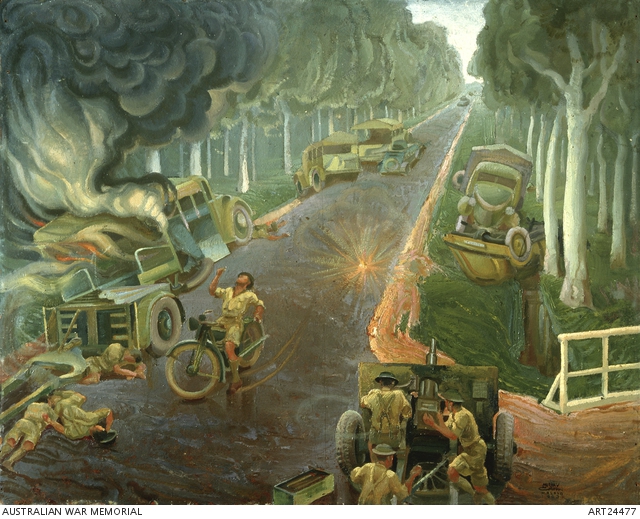
Action at Parit Sulong, January 1942 by Murray Griffin

There is some merit within the book, however, and it is in the description of war and how it affects Singapore (as seen through a colonialist’s eyes). There is a strong ‘end of an era’ atmosphere as can be expressed when viewing it in hindsight. War, when it comes, is initially just another reason for exploitation and profiteering, as it is seen from a distance as capitalists prepare for its approach. Eventually Singapore falls and the war comes directly to the Dexters, as John fights in the jungle, and there are detailed descriptions of making bamboo bombs and the sadistic torture methods and general savagery of the Japanese. As Barber’s reflections become more political and less personal, he includes footnotes to historians’ writing as if to back up his fiction with fact. He is better at understanding the big picture than individual motivations.

As a rambling novel of a family saga with Singapore as a backdrop, this is an ambitious work. One is reminded of James A Michener’s Tales of the South Pacific. He couldn’t write women either and approached the situation from a white male colonialist viewpoint, but it won him a Pulitzer Prize in 1948 when that was the only perspective that mattered. Hopefully times are changing.

Saturday, 12 January 2019

A tour de force of story-telling


Washington Black by Esi Edugyan
(Serpent's Tail)
Pp. 417

This is a picaresque novel full of adventures and multiple locations: from the slave plantation in Barbados to the frozen wastelands of the Canadian Arctic; from the structured canals of Amsterdam to the wild coasts of Nova Scotia; from the scientific calm of the London Aquarium to the wind-swept deserts of Morocco. It is peopled by explorers, adventurers, scientists and exploiters. Everyone is seeking something: discovery; freedom; equality or survival, and it can all be realised as Washington Black says to his mentor who warns him something is impossible, “Nothing is possible, sir, until it is made so.”

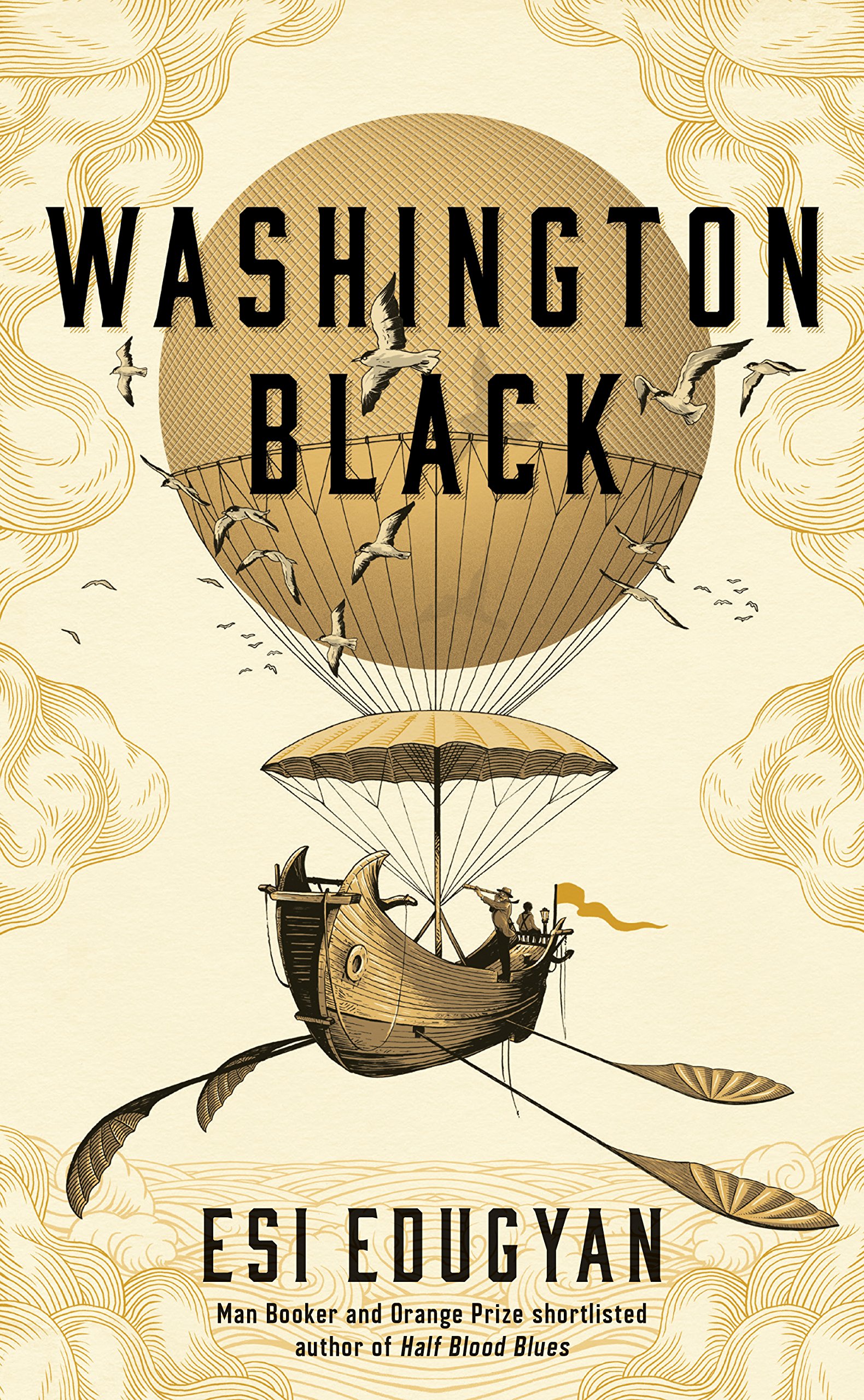
Washington Black is rescued from his brother’s slave plantation by adventurer and inventor Christopher ‘Titch’ Wilde, who says he wants a young boy to help him carry his instruments and take scientific measurements. Titch is trying to sail in a cloud cutter – a craft propelled by both a hot air balloon and more prosaic oars. He encourages Washington’s prodigious gift of drawing and removes him from the daily cruelty of life he has previously experienced. Is he really benevolent, however, or simply using him for his own means?

After an incredibly unfortunate incident, Titch knows that he and Washington must flee and so they affect a wonderfully improbable escape to the Canadian Arctic. Here Washington is introduced to a new world, culture and relationships. When Titch disappears from Washington’s life, he is presumed dead, and Washington must attempt to forge his own way in the world that has hitherto denied him freedom.

Edugyan never flinches from the violence and barbarism of slavery and its consequences, but nor does she dwell upon it. Washington knows his mother was abused and raped, and he writes baldly of the horrors of the slave ships: “The stench of the holds, all of them rolling naked and ill in the dark stomach of the barquentine. The urine and excrement and vomit, men clawing their own throats open with ragged fingernails, bloodied women leaping the deck rails into waters sharp with the fins of sharks. I saw the dozens who had died on the way to Barbados, and I saw those who died once ashore.”

In striving for his freedom, Washington severs his ties with his previous existence and the people he once knew and cared for – it seems that he can only care for himself in order to survive. The novel questions the meaning of belonging. We understand that we do not belong to a person, but can we belong to a place, and how important are family connections? When Washington suspects that Titch may be alive, he begins to search for him, but why? Was he abandoned?

As well as being a sweeping saga of derring-do and outrageous plots, this novel also examines the conundrum of colonialism, survivor’s guilt, and the impossibility of altruism in a pointed and poignant manner. The language is clear and precise as Washington attempts to describe unimagined circumstances, and the fantasy and realism elements blend well in a tour-de-force of storytelling.