Showing posts with label Canada. Show all posts

Wednesday, 8 September 2021

Love's Labour's Knots: Ties That Tether

Ties That Tether by Jane Igharo
Jove
Pp. 306

Azere is a young woman of Nigerian descent, living in Canada, who is obsessed with her cultural identity and screen romance. The novel is written in a light, fluffy style, combining the predictable plots of all her favourite films, while hammering home some ethnic issues. Azere falls for a Canadian man of Spanish descent after a one-night stand but tries to do the right thing by her family, even after he shows up at her work (advertising) as the new marketing director. Her mother has another man in mind for her – one with whom she was in love as a young teen, who took her virginity on a camp and never spoke to her again until now. This has all the makings of a modern sassy rom-com with a younger sister and cultural sensitivity thrown in.

In the opening line Azere tells us, “Culture is important. Preserving it, even more important. It’s the reason I’ve always abided by one simple dating rule.” Due to a promise to her father on his death bed, Azere will only date Nigerian men in an attempt to preserve her culture, even after immigrating to Canada. Her mother and sister are aware of this promise, which rules her life. Let’s start with the culture, because that is what the author keeps banging on about with deafening repetition. She claims, “That’s what my mother has been doing since we moved to Canada – shoving my culture down my throat, so I don’t forget where I come from.” After the eighty-fifth reference, I know the feeling.

She explains the richness of her culture and it is clear, and understandable, that she doesn’t want to relinquish it. Her mother is clearly a powerful influence, although not all her cultural strength is positive, as in when she tells Azere, “If you want to be a feminist, fine. But please be a married feminist with at least three children. In our country, a woman’s honour is her husband and her children. A career means nothing.” Her father, before he died, was a commanding force, and she also has a cultural issue of needing to look after her younger sister. Occasionally in trying to explain how special her culture is, she denigrates that of other people. Her mother sees no difference between a white man and a Hispanic one; there are clearly shades of racism at play here.

Azere is motivated by romances and romantic comedies, and all the references are upbeat and contemporary, from Beyoncé to Sex in the City: it’s pure trash but it makes a change from the tired old Jane Austen template. She is self-aware about the narrative structure, pointing out the mechanics of the story including the lead character’s sidekick – “someone bold, witty, and capable of providing comedic relief and harsh truths the lead isn’t willing to face” – or the grand gesture, “one of the most pivotal scenes in romantic movies”, which is meant to prove one’s love, earn a lover’s forgiveness, or win back a lover’s affection. All of these tropes are deployed. Part of the romantic genre is to place an obstacle in the way of the couple; miscommunication of which threatens their relationship and only love can overcome. In this there is an ‘intrigue’ that goes on far too long about Rafael’s ex-partner, but it provides the definitive hurdle: it is forced, but it fits the romantic mould.

The chapters are told from alternating viewpoints – Azere’s and Rafael’s – although the voice is the same. Everyone cares about their wardrobe, hair and make-up and has “perfectly groomed eyebrows”. Rafael describes Azere’s “spaghetti-strap knee-length dress”; it seems incongruous that the male perspective would notice this detail. Of course the woman is petite and the man big and strong: Rafael epitomises the unsavoury aspects of the masculine hero, and when he tells Azere, “You’re mine now, and there’s no way in hell I’m ever giving you up” we are meant to view it as charmingly romantic rather than disturbingly possessive.

The novel is a simple love story which follows the predictable lines of a modern romance. It has an ethnic and cultural element which gives it slightly more depth, but some of the faux-profound asides are out of step and sound a wrong note. It is shallow entertainment and if it accepted itself as such, it would be a more rewarding novel.

Saturday, 12 January 2019

A tour de force of story-telling


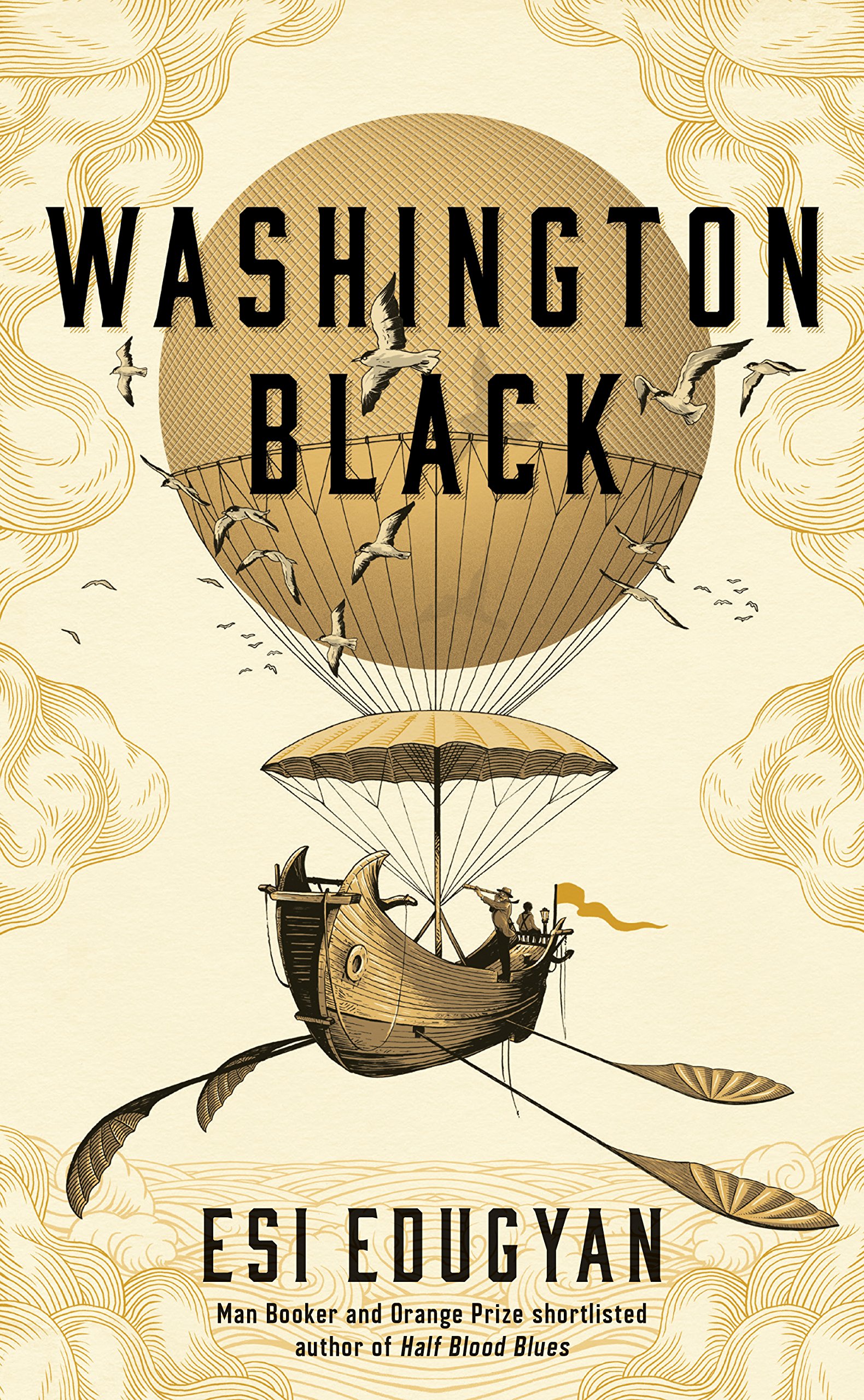
Washington Black by Esi Edugyan
(Serpent's Tail)
Pp. 417

This is a picaresque novel full of adventures and multiple locations: from the slave plantation in Barbados to the frozen wastelands of the Canadian Arctic; from the structured canals of Amsterdam to the wild coasts of Nova Scotia; from the scientific calm of the London Aquarium to the wind-swept deserts of Morocco. It is peopled by explorers, adventurers, scientists and exploiters. Everyone is seeking something: discovery; freedom; equality or survival, and it can all be realised as Washington Black says to his mentor who warns him something is impossible, “Nothing is possible, sir, until it is made so.”

Washington Black is rescued from his brother’s slave plantation by adventurer and inventor Christopher ‘Titch’ Wilde, who says he wants a young boy to help him carry his instruments and take scientific measurements. Titch is trying to sail in a cloud cutter – a craft propelled by both a hot air balloon and more prosaic oars. He encourages Washington’s prodigious gift of drawing and removes him from the daily cruelty of life he has previously experienced. Is he really benevolent, however, or simply using him for his own means?

After an incredibly unfortunate incident, Titch knows that he and Washington must flee and so they affect a wonderfully improbable escape to the Canadian Arctic. Here Washington is introduced to a new world, culture and relationships. When Titch disappears from Washington’s life, he is presumed dead, and Washington must attempt to forge his own way in the world that has hitherto denied him freedom.

Edugyan never flinches from the violence and barbarism of slavery and its consequences, but nor does she dwell upon it. Washington knows his mother was abused and raped, and he writes baldly of the horrors of the slave ships: “The stench of the holds, all of them rolling naked and ill in the dark stomach of the barquentine. The urine and excrement and vomit, men clawing their own throats open with ragged fingernails, bloodied women leaping the deck rails into waters sharp with the fins of sharks. I saw the dozens who had died on the way to Barbados, and I saw those who died once ashore.”

In striving for his freedom, Washington severs his ties with his previous existence and the people he once knew and cared for – it seems that he can only care for himself in order to survive. The novel questions the meaning of belonging. We understand that we do not belong to a person, but can we belong to a place, and how important are family connections? When Washington suspects that Titch may be alive, he begins to search for him, but why? Was he abandoned?

As well as being a sweeping saga of derring-do and outrageous plots, this novel also examines the conundrum of colonialism, survivor’s guilt, and the impossibility of altruism in a pointed and poignant manner. The language is clear and precise as Washington attempts to describe unimagined circumstances, and the fantasy and realism elements blend well in a tour-de-force of storytelling.

Thursday, 28 February 2013

A World Away: Child Migration

On Their Own: Britain's Child Migrants
National Archives of Australia
December 2012 - March 2013

From the 1860s more than 100,000 British children were sent to Canada, 7,000 to Australia, and several hundred to Southern Rhodesia (later Zimbabwe) and New Zealand through child migration schemes. Some were as young as three, but the average age was eight years old, and most of them never returned home.

Their lives changed dramatically and fortunes varied. Some succeeded in creating new futures. Others suffered lonely, brutal childhoods. All experienced disruption and separation from family and homeland. This exhibition, a collaboration between the Australian National Maritime Museum and National Museums Liverpool UK, tells their emotional stories.


In the late nineteenth century, emigration was viewed as a solution to Britain’s economic and social problems. Between 1801 and 1911 the population of Britain increased from 9million to 36million and the rapid rise of industrialism led to overcrowded cities, disease, long hours and poor working conditions. It cost ₤15 to migrate a child and ₤12 a year to look after them on the Poor Law in Britain.

Charities were set up to support emigration including the Child Migration Scheme established by Kingsley Fairbridge in 1909. In 1900 many of the emigrating children came from workhouses, later they came from children’s homes and orphanages. Some parents chose the scheme for their children – orphans were not necessarily without parents – many children were taken into care when their parents couldn’t afford to look after them. They were told they were orphans to ensure they severed all ties with allegedly unworthy relations and made a fresh start.

Children were sent for the prospects of better living conditions and steady employment – a way to improve life away from the perceived evils of city life. It was not all totally altruistic, obviously, as there were growing labour needs in Britain’s dominions. The children were to be the bricks upon which the Empire would continue to be built. Australia in particular ran a ‘Populate or Perish’ campaign. The country was booming and there were demands for more children.


Before leaving Britain, children were given a wooden trunk containing winter and summer clothes (the first time many of them had ever had new clothes), a copy of the Bible and Pilgrim’s Progress. Fairbridge boys were outfitted in smart blazers, shorts, leather shoes and brown and gold striped ties. This fine wardrobe was taken from the children on arrival and replaced with khaki work clothes and bare feet. Barnardos gave children travel bags with new clothes, shoes and personal items (such as toothbrushes and combs) which were taken off them when they arrived in Australia and sent back to Britain to be used again by the next party of migrants.

The voyage was both frightening and exciting. The children they left behind home and family, but also poverty and hardship: they had new clothes and made new friends. Depending on their destination, they saw and experienced many strange sights, boats, islands and harbours – Suez Canal; Arab traders and camels; whales, dolphins and icebergs (off Labrador Coast); Quebec; Montreal; Dar es Salaam; Tanzania; Tenerife; Rock of Gibraltar; Naples; Mt Vesuvius; Port Said; Tropical Colombo; Sri Lanka.


Steamship travel afforded exotic delights and plenty to eat; many children put on weight. They played games of leapfrog and quoits and learned to swim in the pool. One interviewee remembers, “The ship had a swimming pool in the middle and I was terrified to jump in because I thought it would have no bottom and I would end up out in the sea and drown.” I can’t help but be reminded of the Land of Toys in Pinocchio where children are lured with leisure before being turned into beasts of burden. A quote at the exhibition confirms,

“The visual record of child migration is dominated by photographs of cheering children departing the UK and arriving in new lands. These photographs were taken to promote the work of sending organisations and ensure they continued to attract financial support from governments and wealthy patrons. They provide a remarkable contrast to the often damning written and oral testimonies of former child migrants, which form the basis of many case studies in the exhibition.”
Land of Toys by Bakke
Some children were given the choice of emigrating to Canada or Australia and the reasons for their choices are heartbreakingly innocent – they chose Canada because they wanted to be lumberjacks; Australia because they liked cricket or didn’t like the cold. In New Zealand many were fostered; in Canada and Australia they were put to work on the land; in Rhodesia they were educated (at the time they were told that ‘the blacks worked the land’). Some were happy with the skills they learned and later went into the farming trade, wool industry and defence forces.


For some the experience of Canada was that they were stationed in bleak, remote farms, where their accent was ridiculed and they were not allowed to eat with the family. In Australia many were shocked by the heat and the landscape, and sent to remote farm training schools or religious institutions. Pinjarra (80km south of Perth) was the first school of the Kingsley Fairbridge’s Child Emigration Society in 1912. The cottages in which the children were accommodated were called Clive, Raleigh etc – named after British navigators and war heroes to reinforce his imperial vision.

The Fairbridge Society and Barnardos sought ‘good British stock’ to populate, settle and defend the continent, but the boys were destined to be farmers, and the girls domestics and farmers’ wives. One woman recalls, “You finish school at 15 and became a cook in the Fairbridge dining room. Later you meet your future husband, an old Fairbridgian at the Fairbridge holiday camp.” The children were often put to hard labour; tilling soil, churning butter, milking cows, and hauling heavy bricks to build their own dormitories. The correspondent continues, “They asked for the best British stock – children of good health, high IQ and sound moral character – then put them to work as labourers. What a breach of faith that was.”


For some children, things were not so bad. The exhibition collects anecdotal evidence from many who underwent the schemes. One lad earned ₤10 a week and sent ₤1 to Barnardos for banking, for the savings to be released when he was 21. Others, however, tell tales of physical, sexual and verbal abuse, producing scars that remained with them for life. Some societies stole the children’s wages, belongings and letters from ‘home’ and told the children their parents were dead and that they had no siblings; that they were unloved and unwanted. When some of these children found out the truth the betrayal sent them mad. Things improved slightly with the Big Brother Movement (BBM) where Big Brothers helped Little Brothers to settle, but an interpretation panel baldly states,

“For former child migrants the legacy of their experience remains. Many have struggled, not only due to the hardships and abuse they endured, but also because they were torn from their homeland and lost their identities. Others were lucky enough to find fulfilment in their lives.”
In 1914, the First World War put a stop to child migration, although many former child migrants fought in the Canadian army as they still felt strong connections with their British roots. It recommenced after the war, but the interwar years were marked by poverty and austerity in formerly receptive colonies and child migration to Canada was formally ended by 1939. Australia became the main destination after Canada ended the scheme. One third of war evacuees to Australia later emigrated there for good. Indeed, some former child migrants also fought in the Australian army, only to later discover that they had never been granted citizenship.

In 1945 the introduction of the Welfare State reduced the need for child migration schemes, and they were officially ended in 1967. The Australian and British governments apologised for their roles in schemes “that were once considered generous philanthropy, but are now widely condemned as being fundamentally flawed.” The exhibition contains a number of oral histories, which are very moving. Videos and recordings reveal adults who still have a love for Britain even though they have lived in Australia since the age of 12, rationalising that they would have had to endure another war if they had remained in Britain.

Since the 1990s the Child Migrants’ Trust helps to reunite families. The hardest hearted cynic cannot fail to be moved by the collection of tales of reconciliations with parents thought dead and the difficulties of tracing families. Children were often given the wrong birth date and wrong name, and told they were told they had no relations, making it almost impossible to find their missing identity. One interviewee finally found his mother through her name on his birth certificate which had been concealed from him for many years. By the time he found it, she had been dead for two years.

Former child migrants gather in London for the apology from British Prime Minister Gordon Brown in February 2010.
The exhibition is sensitively handled; a well-balanced and thought-provoking treatment of an incredibly emotional issue. We can’t change history, but hopefully we can learn from it. We have done some terrible things in the past with the best of misguided intentions. In the words of the exhibition itself:

“The history of child migration is complex and contested. Issues of redress and compensation remain unresolved. Many former child migrants are still coming to terms with their deportation and dislocation and find it painful to reflect on their past.”