Showing posts with label Nigeria. Show all posts

Wednesday, 8 September 2021

Love's Labour's Knots: Ties That Tether

Ties That Tether by Jane Igharo
Jove
Pp. 306

Azere is a young woman of Nigerian descent, living in Canada, who is obsessed with her cultural identity and screen romance. The novel is written in a light, fluffy style, combining the predictable plots of all her favourite films, while hammering home some ethnic issues. Azere falls for a Canadian man of Spanish descent after a one-night stand but tries to do the right thing by her family, even after he shows up at her work (advertising) as the new marketing director. Her mother has another man in mind for her – one with whom she was in love as a young teen, who took her virginity on a camp and never spoke to her again until now. This has all the makings of a modern sassy rom-com with a younger sister and cultural sensitivity thrown in.

In the opening line Azere tells us, “Culture is important. Preserving it, even more important. It’s the reason I’ve always abided by one simple dating rule.” Due to a promise to her father on his death bed, Azere will only date Nigerian men in an attempt to preserve her culture, even after immigrating to Canada. Her mother and sister are aware of this promise, which rules her life. Let’s start with the culture, because that is what the author keeps banging on about with deafening repetition. She claims, “That’s what my mother has been doing since we moved to Canada – shoving my culture down my throat, so I don’t forget where I come from.” After the eighty-fifth reference, I know the feeling.

She explains the richness of her culture and it is clear, and understandable, that she doesn’t want to relinquish it. Her mother is clearly a powerful influence, although not all her cultural strength is positive, as in when she tells Azere, “If you want to be a feminist, fine. But please be a married feminist with at least three children. In our country, a woman’s honour is her husband and her children. A career means nothing.” Her father, before he died, was a commanding force, and she also has a cultural issue of needing to look after her younger sister. Occasionally in trying to explain how special her culture is, she denigrates that of other people. Her mother sees no difference between a white man and a Hispanic one; there are clearly shades of racism at play here.

Azere is motivated by romances and romantic comedies, and all the references are upbeat and contemporary, from BeyoncĂ© to Sex in the City: it’s pure trash but it makes a change from the tired old Jane Austen template. She is self-aware about the narrative structure, pointing out the mechanics of the story including the lead character’s sidekick – “someone bold, witty, and capable of providing comedic relief and harsh truths the lead isn’t willing to face” – or the grand gesture, “one of the most pivotal scenes in romantic movies”, which is meant to prove one’s love, earn a lover’s forgiveness, or win back a lover’s affection. All of these tropes are deployed. Part of the romantic genre is to place an obstacle in the way of the couple; miscommunication of which threatens their relationship and only love can overcome. In this there is an ‘intrigue’ that goes on far too long about Rafael’s ex-partner, but it provides the definitive hurdle: it is forced, but it fits the romantic mould.

The chapters are told from alternating viewpoints – Azere’s and Rafael’s – although the voice is the same. Everyone cares about their wardrobe, hair and make-up and has “perfectly groomed eyebrows”. Rafael describes Azere’s “spaghetti-strap knee-length dress”; it seems incongruous that the male perspective would notice this detail. Of course the woman is petite and the man big and strong: Rafael epitomises the unsavoury aspects of the masculine hero, and when he tells Azere, “You’re mine now, and there’s no way in hell I’m ever giving you up” we are meant to view it as charmingly romantic rather than disturbingly possessive.

The novel is a simple love story which follows the predictable lines of a modern romance. It has an ethnic and cultural element which gives it slightly more depth, but some of the faux-profound asides are out of step and sound a wrong note. It is shallow entertainment and if it accepted itself as such, it would be a more rewarding novel.

Tuesday, 15 June 2021

Misfortune; Carelessness; and...: My Sister, The Serial Killer


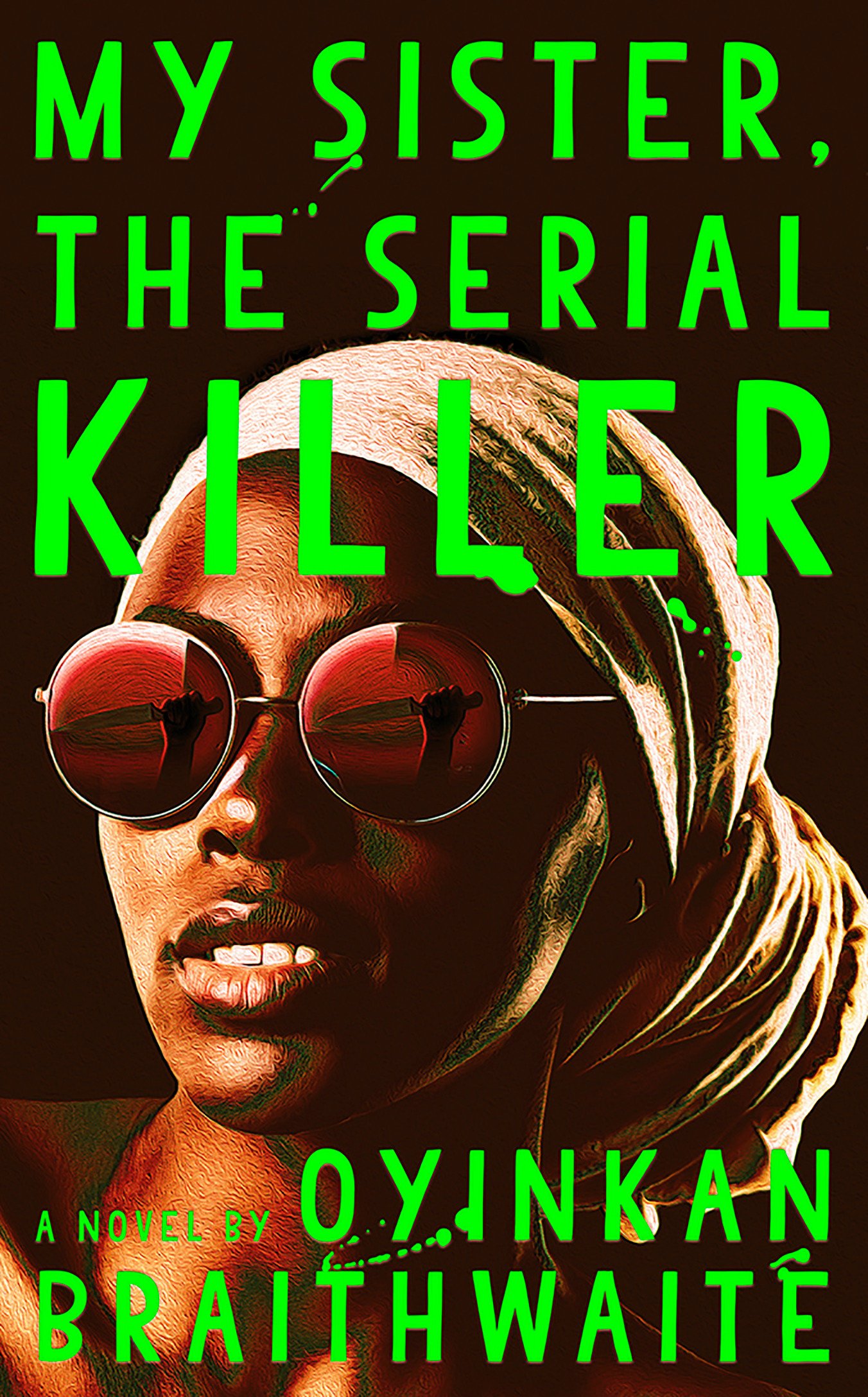
My Sister the Serial Killer by Oyinkan Braithwaite
Atlantic Fiction
Pp. 226

The novella begins, “Ayoola summons me with these words – Korede, I killed him. I had hoped I would never hear those words again.” Immediately we are in familiar but foreign territory. The structure is reminiscent of Charlotte BrontĂ«’s, “Reader, I married him”, from Jane Eyre, but the shocking content is a lot less comforting. Originally published in Nigeria as an e-book entitled Thicker than Water, this tale of two sisters crosses genre lines from thriller to black comedy and socio-political commentary. As Richard Lea writes in their interview with the author (published at the end of the novel), “A novel that puts the relationship between two sisters at its heart, with men as supporting characters who may or may not make it to the final act, has been greeted as a riposte to crime fiction where the plot is so often set in motion by the gruesome death of young women.”

It clearly strikes a chord as it won the 2019 Los Angeles Times Book Prize for Best Mystery/ Thriller, the 2020 British Book Award for Crime & Thriller Book of the Year, and it was longlisted for the 2019 Booker Prize. As well as being critically praised, it is also popular with the public, and won the 2019 Amazon Publishing Reader’s Award for Best Debut Novel. It is certainly easy to read with short chapters (all with a one or two word title) and a fairly universal theme – we may not all have murderous siblings, but many of us understand sibling rivalry and family dynamics.

As the oldest, Korede is obliged to care for her younger sister, Ayoola, and now, she literally cleans up her sister’s messes. It doesn’t help Korede’s mental state to feel that her sister is outstandingly good-looking, and to constantly compare herself unfavourably. “The resemblance is there – we share the same mouth, the same eyes – but Ayoola looks like a Bratz doll and I resemble a voodoo figurine.”

Ayoola carries a knife on dates and she seems to have little compunction in disposing of her suitors, she claims in self-defence. Korede wants to believe her, but there is a touch of the Oscar Wilde loss of parents about her narrative; after all, she has killed three people; “Three, and they label you a serial killer”. Ayoola is seemingly remorseless and is back partying and posting on Instagram and Snapchat straight after she has killed her partner. She apparently believes that she is entirely innocent: “Her actions were the fault of her victims and she had acted as any reasonable gorgeous person would under the circumstances.” The implication is that she is excused because of her looks – it’s different if you’re beautiful.

When Ayoola shows interest in the doctor with whom Korede works, he of course reciprocates it, despite never having noticed Korede’s passionate feelings towards him. This might inform her questioning her sister’s version of events, at which Ayoola accuses her of victim shaming. “Victim? Is it mere coincidence that Ayoola has never had a mark on her, from any of these incidents with these men; not even a bruise?” At a time when we are struggling to believe women, this seems irresponsible, but education is not the duty of the author. Indeed, in her interview, Braithwaite contends, “I like to have fun. The books where I can tell I’m being taught something are a trial in the reading. If there’s a story and you learn something along the way; it’s a bonus.”

It transpires that the girls’ father subjected them to traditional and tribal cruelty, and Korede is concerned that Ayoola may have inherited some of this inherent brutality. “More and more, she reminds me of him. He could do a bad thing and behave like a model citizen right after. As though the bad thing had never happened. Is it in the blood? But his blood is my blood and my blood is hers.”

There are some things which may seem a little far-fetched for a genuine crime thriller – how could they possibly not get caught? One explanation is that the police force is highly corrupt, as are many other institutions in Nigeria, and they can be bribed to look away. Another consideration is that this is not meant to be forensically accurate. The page numbers are in a font that looks as though letters have been cut from newspaper print, or perhaps a graphic novel where all the information is condensed into one frame. It is currently being considered for film, which will be dramatic but not exactly realistic.

Oyinkan Braithwaite has provided us with a fast-paced, high-actioned, black-comedy crime thriller. It covers a lot of genres and is a terrific story. It seems churlish to expect more from her and we should be grateful for this offering and the knowledge that there are authors who can still deliver a gripping novel.