Showing posts with label Morocco. Show all posts

Saturday, 12 January 2019

A tour de force of story-telling


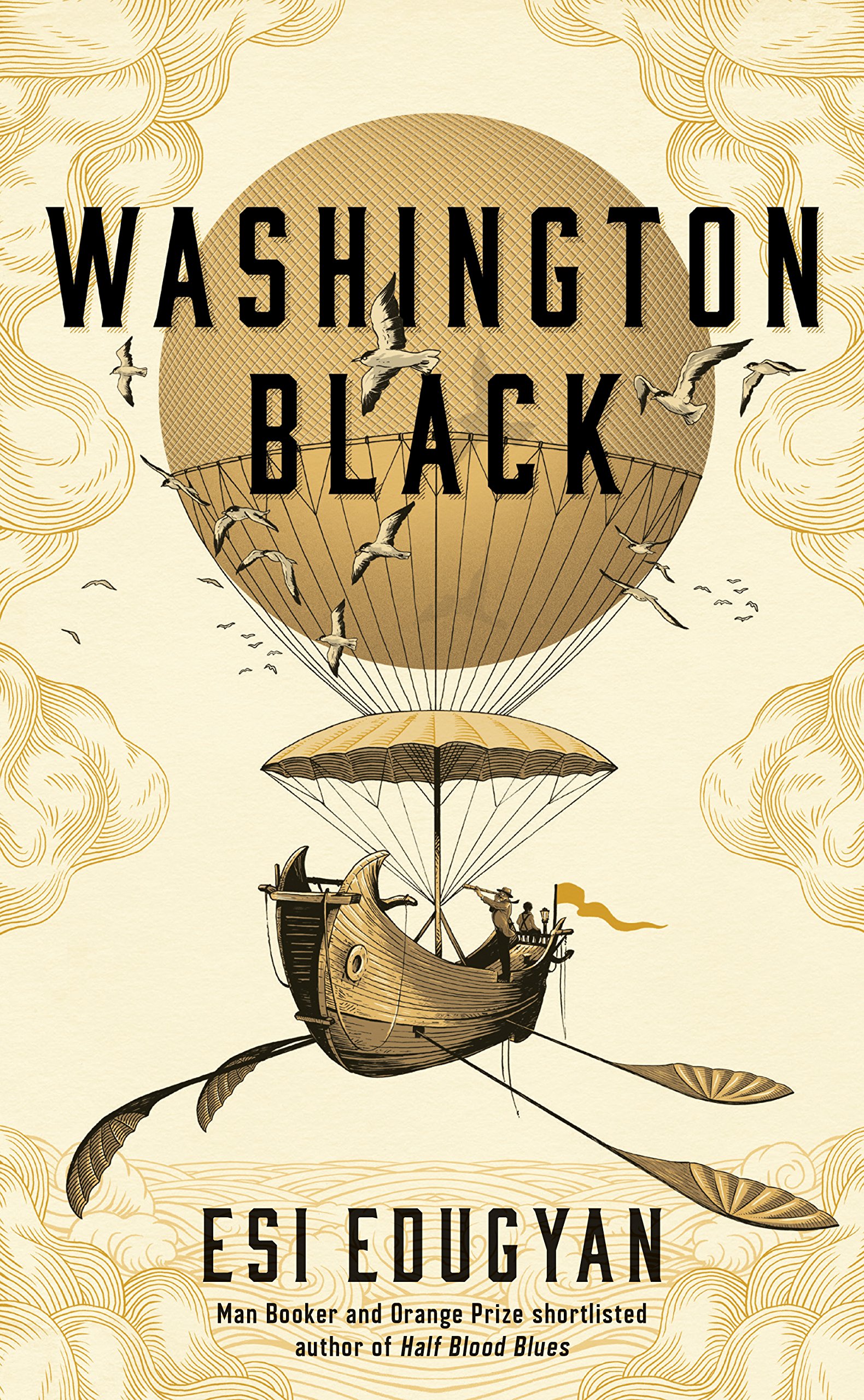
Washington Black by Esi Edugyan
(Serpent's Tail)
Pp. 417

This is a picaresque novel full of adventures and multiple locations: from the slave plantation in Barbados to the frozen wastelands of the Canadian Arctic; from the structured canals of Amsterdam to the wild coasts of Nova Scotia; from the scientific calm of the London Aquarium to the wind-swept deserts of Morocco. It is peopled by explorers, adventurers, scientists and exploiters. Everyone is seeking something: discovery; freedom; equality or survival, and it can all be realised as Washington Black says to his mentor who warns him something is impossible, “Nothing is possible, sir, until it is made so.”

Washington Black is rescued from his brother’s slave plantation by adventurer and inventor Christopher ‘Titch’ Wilde, who says he wants a young boy to help him carry his instruments and take scientific measurements. Titch is trying to sail in a cloud cutter – a craft propelled by both a hot air balloon and more prosaic oars. He encourages Washington’s prodigious gift of drawing and removes him from the daily cruelty of life he has previously experienced. Is he really benevolent, however, or simply using him for his own means?

After an incredibly unfortunate incident, Titch knows that he and Washington must flee and so they affect a wonderfully improbable escape to the Canadian Arctic. Here Washington is introduced to a new world, culture and relationships. When Titch disappears from Washington’s life, he is presumed dead, and Washington must attempt to forge his own way in the world that has hitherto denied him freedom.

Edugyan never flinches from the violence and barbarism of slavery and its consequences, but nor does she dwell upon it. Washington knows his mother was abused and raped, and he writes baldly of the horrors of the slave ships: “The stench of the holds, all of them rolling naked and ill in the dark stomach of the barquentine. The urine and excrement and vomit, men clawing their own throats open with ragged fingernails, bloodied women leaping the deck rails into waters sharp with the fins of sharks. I saw the dozens who had died on the way to Barbados, and I saw those who died once ashore.”

In striving for his freedom, Washington severs his ties with his previous existence and the people he once knew and cared for – it seems that he can only care for himself in order to survive. The novel questions the meaning of belonging. We understand that we do not belong to a person, but can we belong to a place, and how important are family connections? When Washington suspects that Titch may be alive, he begins to search for him, but why? Was he abandoned?

As well as being a sweeping saga of derring-do and outrageous plots, this novel also examines the conundrum of colonialism, survivor’s guilt, and the impossibility of altruism in a pointed and poignant manner. The language is clear and precise as Washington attempts to describe unimagined circumstances, and the fantasy and realism elements blend well in a tour-de-force of storytelling.

Monday, 18 August 2014

Hilda Rix Nicholas: Paris to Monaro

Paris to Monaro: Pleasures from the studio of Hilda Rix Nicholas
National Portrait Gallery (May - August 2013)

Pied Piper (1911)
Hilda Rix Nicholas is known for many things in the world of art, not least her war paintings. These are deliberately excluded from this exhibition which focuses on her standing as a ‘female’ artist. It highlights her imagination linked with a practical mind, resulting in intricate costume designs, images of her son in every possible guise, and a love of colour and clothing.

Born in Ballarat in 1884, Emily Hilda Rix left Australia in 1907 and travelled with her mother and sister to London. She studied at the New Art School and then the Académie Delecluse in Paris. With her sister, Elsie, she spent time in Tangier, Morocco, where she made many striking portraits and sketches, reflecting her love of light and vibrancy. One of these paintings, Grand Marché, Tanger, was bought by the French government after an exhibition.

Marchands du charbons de bois (Charcoal sellers) (1912)

The Well in the Blue, Arab Quarters (1914)
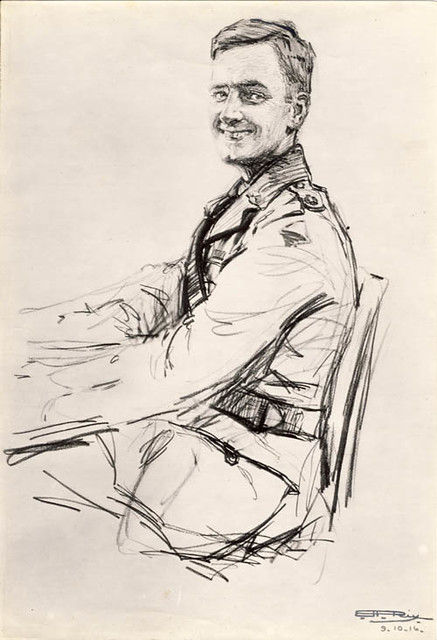
In 1916 she met and married Australian soldier, Major George Matson Nicholas DSO. He died within weeks leading a battalion in France. She drew charcoal and pastel on paper portraits of George and his two brothers, Frank and Athol; the one of her husband is particularly remarkable and the catalogue notes that the brothers evoke the Australian soldier of legend; “raffish, iconoclastic, and proud all at once”.

George Nicholas (1916)


Also during the First World War, she lost her sister and mother to typhoid fever. With amazing positivity, she continued to design and draw costumes for a matinee fundraiser for the Anzac Club and Buffet in 1917 – the exhibition includes her designs for magpie, wool, cheese, gold, gum blossom and warratah.

Hilda Rix Nicholas (as she now signed her paintings) returned to Australia in 1918 and settled in Mosman by Sydney Harbour, where she lived among ‘arty-party-loving people’. She made costumes for parties and illustrations for fairytales – Mary Mary; Simple Simon; Jack and Jill; Little Miss Muffet; Mother Hubbard; Pied Piper etc.

In 1928 she married Edgar Wright, grandson of James Wright – first magistrate of Queanbeyan and pioneer white settler of Lanyon, Cuppacumbalong and Booroomba in the Canberra region. Edgar was severely injured at Passchendaele (buried in the earth by one blast and regurgitated by another explosion). He was repatriated and took over the family farm. The Fleece is a fabulous study of her husband Edgar as he goes about his business.


The Fleece (1944)
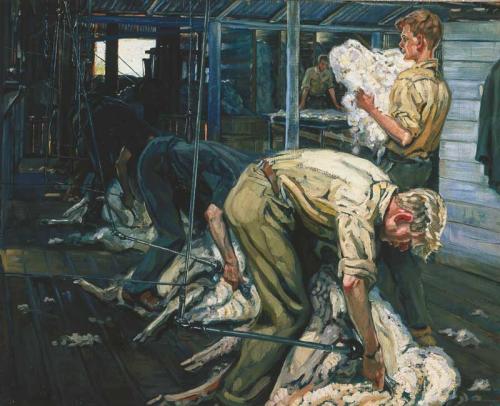
On her travels to Europe, Hilda Rix Nicholas was determined to show viewers the virtues of the bush and pioneer life, following in the tradition of the Heidelberg School and writers such as Henry Lawson and Banjo Patterson. Her portraits of men and women of the land capture an earnest respect for hard work and rugged beauty.

The Shearers (1922-23)
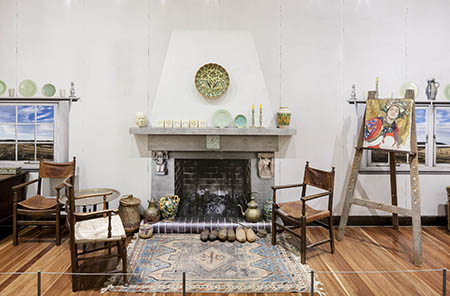
At Knockalong, Hilda Rix Nicholas had a studio built to her specifications, which was completed in 1930. It was French provincial in style with a broad mediaeval-style fireplace, huge windows, soaring ceiling, a loft and a stage. It is recreated in this exhibition and furnished with mementoes from foreign lands: robes, clogs, vests, bags, belts, rugs, slippers, pots and plates, and paintings.  


It is a treat to see these artefacts collected here, along with the pictorial representations of them. Among the clothes which she loved and collected in a trunk, are a Chinese robe and Spanish shawl that she painted with a meticulous eye to the expansive colours and design. 

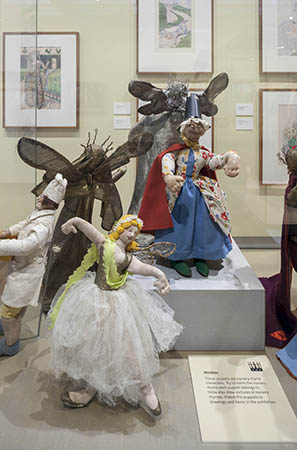
When she was 46, Hilda had a son, Rix, who became the focus of her life. She loved to tell him stories and play games with him, making wire and wadding minikins for their entertainment. She made portraits of Rix in every aspect of life: as a soldier, scout and shepherd among other things.

Some of the minikins Hilda made for her son, Rix
The Shepherd of Knockalong (1933)

She loved her garden and the natural surrounds, painting them with bright blue skies and Pissaro/ Cezanne-like colours. The style may evoke French Impressionism, but the eucalypts are pure Australia.


Spring in my garden, Knockalong (1940)


Country Garden, Knockalong (1945)
Hilda always loved horses and riding, and many of her paintings feature Rix’s governess and jillaroos as models.

Bringing in the Sheep (1936)
The Fair Musterer (1935)
A neighbour described Autumn evening’s golden glow as combining Hilda’s favourite subjects: humans, horses, flower garden and the Monaro landscape brought together on one large, joyously vivid canvas.


Autumn evening's golden glow (1935)