Showing posts with label horses. Show all posts

Monday, 18 August 2014

Hilda Rix Nicholas: Paris to Monaro

Paris to Monaro: Pleasures from the studio of Hilda Rix Nicholas
National Portrait Gallery (May - August 2013)

Pied Piper (1911)
Hilda Rix Nicholas is known for many things in the world of art, not least her war paintings. These are deliberately excluded from this exhibition which focuses on her standing as a ‘female’ artist. It highlights her imagination linked with a practical mind, resulting in intricate costume designs, images of her son in every possible guise, and a love of colour and clothing.

Born in Ballarat in 1884, Emily Hilda Rix left Australia in 1907 and travelled with her mother and sister to London. She studied at the New Art School and then the Académie Delecluse in Paris. With her sister, Elsie, she spent time in Tangier, Morocco, where she made many striking portraits and sketches, reflecting her love of light and vibrancy. One of these paintings, Grand Marché, Tanger, was bought by the French government after an exhibition.

Marchands du charbons de bois (Charcoal sellers) (1912)

The Well in the Blue, Arab Quarters (1914)
In 1916 she met and married Australian soldier, Major George Matson Nicholas DSO. He died within weeks leading a battalion in France. She drew charcoal and pastel on paper portraits of George and his two brothers, Frank and Athol; the one of her husband is particularly remarkable and the catalogue notes that the brothers evoke the Australian soldier of legend; “raffish, iconoclastic, and proud all at once”.
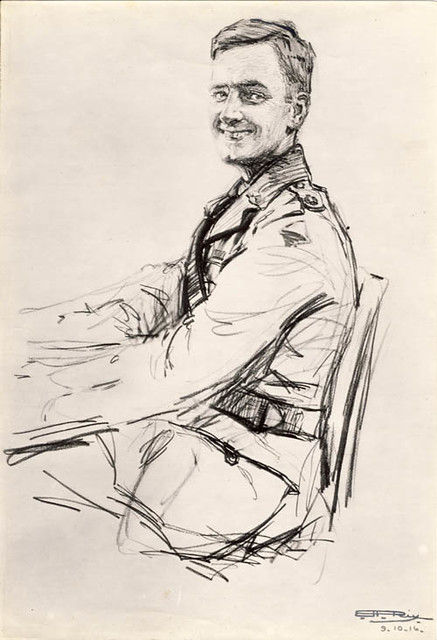
George Nicholas (1916)


Also during the First World War, she lost her sister and mother to typhoid fever. With amazing positivity, she continued to design and draw costumes for a matinee fundraiser for the Anzac Club and Buffet in 1917 – the exhibition includes her designs for magpie, wool, cheese, gold, gum blossom and warratah.

Hilda Rix Nicholas (as she now signed her paintings) returned to Australia in 1918 and settled in Mosman by Sydney Harbour, where she lived among ‘arty-party-loving people’. She made costumes for parties and illustrations for fairytales – Mary Mary; Simple Simon; Jack and Jill; Little Miss Muffet; Mother Hubbard; Pied Piper etc.

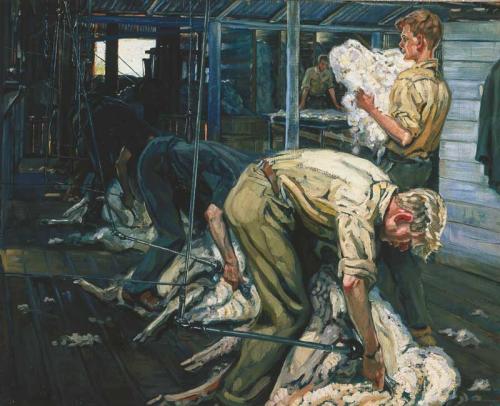
In 1928 she married Edgar Wright, grandson of James Wright – first magistrate of Queanbeyan and pioneer white settler of Lanyon, Cuppacumbalong and Booroomba in the Canberra region. Edgar was severely injured at Passchendaele (buried in the earth by one blast and regurgitated by another explosion). He was repatriated and took over the family farm. The Fleece is a fabulous study of her husband Edgar as he goes about his business.


The Fleece (1944)
On her travels to Europe, Hilda Rix Nicholas was determined to show viewers the virtues of the bush and pioneer life, following in the tradition of the Heidelberg School and writers such as Henry Lawson and Banjo Patterson. Her portraits of men and women of the land capture an earnest respect for hard work and rugged beauty.

The Shearers (1922-23)
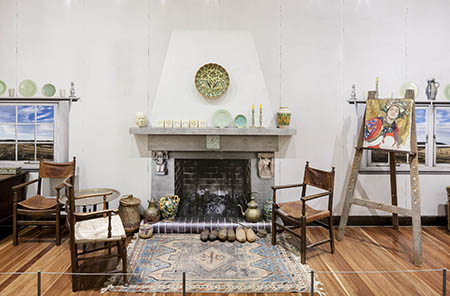
At Knockalong, Hilda Rix Nicholas had a studio built to her specifications, which was completed in 1930. It was French provincial in style with a broad mediaeval-style fireplace, huge windows, soaring ceiling, a loft and a stage. It is recreated in this exhibition and furnished with mementoes from foreign lands: robes, clogs, vests, bags, belts, rugs, slippers, pots and plates, and paintings.  


It is a treat to see these artefacts collected here, along with the pictorial representations of them. Among the clothes which she loved and collected in a trunk, are a Chinese robe and Spanish shawl that she painted with a meticulous eye to the expansive colours and design. 

When she was 46, Hilda had a son, Rix, who became the focus of her life. She loved to tell him stories and play games with him, making wire and wadding minikins for their entertainment. She made portraits of Rix in every aspect of life: as a soldier, scout and shepherd among other things.
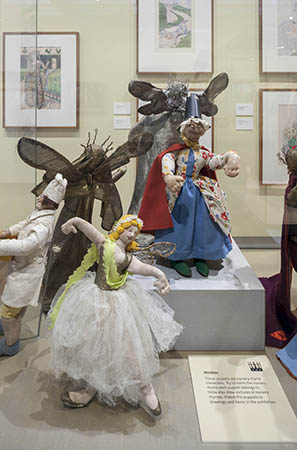
Some of the minikins Hilda made for her son, Rix
The Shepherd of Knockalong (1933)

She loved her garden and the natural surrounds, painting them with bright blue skies and Pissaro/ Cezanne-like colours. The style may evoke French Impressionism, but the eucalypts are pure Australia.


Spring in my garden, Knockalong (1940)


Country Garden, Knockalong (1945)
Hilda always loved horses and riding, and many of her paintings feature Rix’s governess and jillaroos as models.

Bringing in the Sheep (1936)
The Fair Musterer (1935)
A neighbour described Autumn evening’s golden glow as combining Hilda’s favourite subjects: humans, horses, flower garden and the Monaro landscape brought together on one large, joyously vivid canvas.


Autumn evening's golden glow (1935)

Thursday, 16 August 2012

Friday Five: Post-Olympic News

Now the hurly burly’s done and we’re back to the ‘real’ (i.e. non-Olympic) news, the papers make for fairly grim reading. Here is a selection of quotes from today’s press:

5 Trending Topics in Today’s News:
  1. “I think fame became more exciting for me in the late 90s because I could actually use it as a means to an end. I could actually have it help my vocationfulness. I could offer comfort and upliftment and be a leader and take on that responsibility, rather than see it as this daunting thing.” – an interview with Alanis Morisette proves that she is still crazy after all these years (and her grammar hasn’t got any better either. No, it’s not ironic; it’s just unfortunate).
  2. “Whatever views one may have about Julian Assange as a Wikileaks activist, it is clear that in legal and moral terms he cannot properly be described as a refugee.” - Alan Rusbridger (editor of the Guardian) explains his position.
  3. “Despite being the epitome of middle-class (doctor’s daughter, grammar-school girl, boho provincial upbringing), being mistaken as a posho has been a lifetime affliction. Maybe it’s because I went to Oxford, maybe because I refuse to cultivate a mockney accent, maybe because all my friends are called Tarquin de’ath von Bunface-Toffo, I can somehow (inadvertently) pass and I am routinely lambasted for it.” – Hannah Betts offers rare sympathy to Benedict Cumberbatch who has complained that he misses out on a lot of roles because he is too posh for people to take seriously.”
  4. “The world can always be divided into two types of people – those who like board games and those who don’t. Those who thrill to the news that a fancy dress party is in the offing and those who shrink from it like paper from a flame. Those who will listen politely to accounts of other people’s dreams and those who will beat the teller to death with the nearest stick. But none of these divides comes close to that which separates horsey people from the non-horsey.” – Lucy Mangan stands firmly on one side of the fence and refuses to jump it.
  5. “When a new manager comes in it’s always a rebuilding process in certain respects. I’m always honest. I’m always realistic. It’s impossible to say it’s the title this year; people will laugh at me.” – On the eve of their first game of the 2012-13 Premiere League campaign (at West Brom), Stevie G’s pre-season remarks don’t exactly instill confidence. 

Saturday, 12 December 2009

The Cromwell Races - doo-dah!


Having been to the Alexandra Blossom Festival, I thought I should also try out another Otago event – the Cromwell Races. Him Outdoors works for an outfit who were going as their Christmas do, so we trotted along with them. We were picked up by a coach as we stood at the side of the road at Arrow Junction and then the day began.

Let’s talk about the horses first – that is (in theory) what we were there for – although the free food and booze seemed to be an equally big hit. I like horses – they are amazingly powerful beasts and I love to see them run. They paraded around the paddock before they hit the race course and you could see their glossy flanks and noble faces.

Horses are sociable beasts and also highly sensitive – picking up vibes from others around them. There were a couple of smartly dressed blokes on calm steeds who walked around excluding serenity for the racehorses to assimilate. These horses were friendly and liked the attention of being stroked and patted – well, who wouldn’t? – and between the races they stalked along the course by the railings charming the crowd.

I don’t really bet. The last bet I placed was on the final of the 2003 Rugby World Cup. ‘How many points is a drop goal worth?’ I asked, and was reliably informed that it was worth three. I knew that Johnny would kick us to victory in the last minute of the game – I just knew it. So I placed my bet for England to win by three points and as I screamed at the television and my premonition eventuated, I was indescribably smug.

When I went to collect my winnings, however, I was told that I had bet on the outcome of 80 minutes and not 100. They didn’t pay out. I was gutted (although England had won the World Cup after all, which sort of made up for it) and lost all faith in the TAB system, vowing never to bet again.

So, I sent Him Outdoors up to the little ticket window to hand over our five dollars to place (he has all the lingo) while I ‘studied the form’ – this consisted of finding a name of a horse that I liked or colours that the jockey was sporting (pink armbands were a favourite – I thought this might mean they were going swimming as well) and going ‘I’ll have that one’. This began with ‘Sweet About Me’, ‘Ratsandall’ and ‘Tiddley Pom’.

It turned out to be not the best method of picking a winner. I’ve since been told that the way to do it is to watch them come out into the birdcage and pick the one which does the biggest pre-race constitutional as this will make him lighter. It’s all about weight, apparently.

In fact, we soon realised that the best guarantee of success was to choose the horse that Chris Johnson was riding. He may be just a wee jockey (they’re all just tiny but very angry for some reason – they remind me of Rumplestiltskin) but he seems to know his stuff and we soon started betting on him rather than the horse.

In the last race he was down in the programme to ride ‘Illicit’ but he didn’t – someone else did and the horse plodded across the line in eighth place while the one that Chris Johnson did actually ride won the event. We tried to cry foul but the TAB people didn’t care – they really are heartless, that lot. As I said, I don’t trust them enough to bet with them.

The horses were great though and I loved watching and hearing them come thundering past. A vet's vehicle sped after each race, going a fair clip and still being well out-paced, but fortunately it wasn't needed at all and break-neck speed was merely a metaphor.

So there was horse racing and betting, but mainly there was drinking and leching. We were in a marquee where a barbecue service turned up, cooked steaks, sausages and kebabs, accompanied by heaps of bread and salad, and, after we had eaten it, they carted it all away again. There were bottles of wine and crates of beer – it was all kept cool in those chilly bins and everyone seemed to have sufficient.


At one point we went for a walk to see what the poor people did. It seems they went to the general bar (hastily established in an old shed), spread rugs on the grass and held impromptu picnics.

They sheltered from the wind and the sun as best as they could while some bought bag of the season’s first cherries from the back of vans. The army were there trying to recruit – although I wouldn’t have thought sunburned drunken hoodlums are exactly what you want in your armed forces – and in fact, the people we saw were wearing camouflage and eating ice creams.

There were a lot of well-dressed women. They go for the fashion and the occasion to wear jaunty hats or fascinators – what a great word for a few flimsy feathers.

A lot of them had made an effort and were tripping daintily around hanging onto their floaty dresses and sinking into the turf with their stilettos. To be fair, as the day wore on and the sun cream wore off many changed from swanky to skanky, but at least they all seemed to be having a good time – alcohol and inhibitions simply don’t mix.

The men let the side down somewhat. True, a couple had worn their best shirts, but most looked like your average Kiwi bloke – jeans, polar fleece, baseball cap with folded arms a bottle of Speights in one hand. Despite their lack of sartorial (or indeed any) elegance, they appraised the women like they were the horse flesh – standing and grunting as attractive young fillies walked by, while leaning against the railings with their backs to the races. You know what I mean, and if you don’t, this picture should tell the story.