Showing posts with label costumes. Show all posts

Friday, 19 March 2021

Friday Five/ My Newest Favourite Thing: Belly Dancing


This is a cross-over post (of both Friday Five and My Newest Favourite Thing), as for the past six weeks I have been trying something new: namely bellydancing. Let me begin by saying I will never be a bellydancer. I haven't got the grace or the coordination, or the want/ need to shake my bits in front of an audience of strangers (in other words; I've got the belly but not the dancing bit down pat) but I have very much enjoyed my brief introduction to the art.

Our instructor, Brooke Thomas, is amazing. She is talented and professional (and has a proper dance troupe - Quake Bellydance) with warmth and humour to accompany her style. While she teaches serious and capable dancers, she is equally adept at dealing with incompetent, uncoordinated people with two left feet (i.e. me). She gives us moves to develop into a routine and introduces us to fun techniques, with plenty of warm up and cool down stretching, and some technical and historical background for those interested in the art. 

5 Favourite Things about Bellydancing
  1. Camaraderie/ body acceptance - bellydancers come in all shapes and sizes and they are meant to jiggle. The body is an amazing thing and this type of dance celebrates that. Shimmies and hip movements isolate and highlight groups of muscles, and arm placement draws further attention to parts of the body and indicates their vibrancy and versatility. You don't have to be a supermodel to bellydance; you just have to learn to embrace your curves and enjoy the way your body feels when it moves.
  2. Work-out/ flexibility/ stretching - Isolating muscle groups provides a great workout - it can be as high impact as you want to make it, and you really get to move, stretch and tone. The names of the moves are descriptive and evocative: there are hip drops, lifts, flicks, bumps, and rotations, snake arms, ribcage slides and circles, Maya, butterfly catch, envelope, Roman flame. The feeling afterwards is of a contented glow (much like you might experience with yoga or Pilates), and the week after we concentrated on snake arms, I really knew about it!
  3. Music/ Rhythm - I love music and dancing for fun, even if I'll never be any good at it. Brooke makes the choreography fit beautifully to the beats and the ambiance of the music. We listened to some great Turkish songs and compositions, which were uplifting and fulfilling. I will admit to not being a fan of Shakira, although I now have Whenever, Wherever as an uninvited ear worm lodged in my brain.
  4. Costumes - Brooke makes all her own costumes and she looks spectacular (did I mention she is ridiculously talented?). We danced in shorts or leggings and exercise tops. We did, however, get to play with the coin belts and veils. Coin belts are great fun: they jingle as we jiggle and we are literally present with bells on, but they are also tell-tale alarms for when the lower body is meant to be still as the upper body is meant to be directing the action. Veils are just great fun to drape, twirl and float about with. 
  5. Learning new things - it's good for mental as well as physical health. I have a whole new appreciation of the artform. And, most importantly, I had a lot of fun!
Graceful shape framed by a veil

Monday, 18 August 2014

Hilda Rix Nicholas: Paris to Monaro

Paris to Monaro: Pleasures from the studio of Hilda Rix Nicholas
National Portrait Gallery (May - August 2013)

Pied Piper (1911)
Hilda Rix Nicholas is known for many things in the world of art, not least her war paintings. These are deliberately excluded from this exhibition which focuses on her standing as a ‘female’ artist. It highlights her imagination linked with a practical mind, resulting in intricate costume designs, images of her son in every possible guise, and a love of colour and clothing.

Born in Ballarat in 1884, Emily Hilda Rix left Australia in 1907 and travelled with her mother and sister to London. She studied at the New Art School and then the Académie Delecluse in Paris. With her sister, Elsie, she spent time in Tangier, Morocco, where she made many striking portraits and sketches, reflecting her love of light and vibrancy. One of these paintings, Grand Marché, Tanger, was bought by the French government after an exhibition.

Marchands du charbons de bois (Charcoal sellers) (1912)

The Well in the Blue, Arab Quarters (1914)
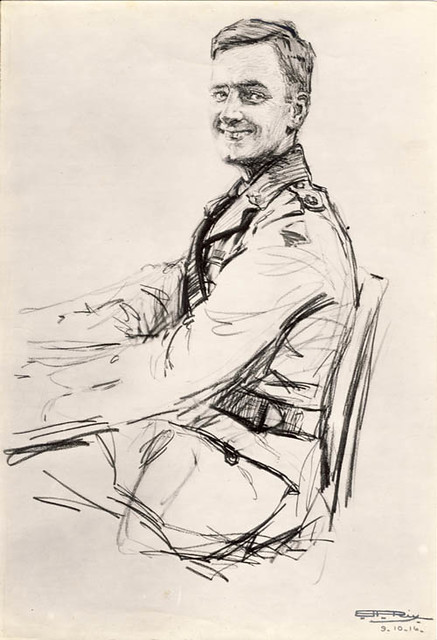
In 1916 she met and married Australian soldier, Major George Matson Nicholas DSO. He died within weeks leading a battalion in France. She drew charcoal and pastel on paper portraits of George and his two brothers, Frank and Athol; the one of her husband is particularly remarkable and the catalogue notes that the brothers evoke the Australian soldier of legend; “raffish, iconoclastic, and proud all at once”.

George Nicholas (1916)


Also during the First World War, she lost her sister and mother to typhoid fever. With amazing positivity, she continued to design and draw costumes for a matinee fundraiser for the Anzac Club and Buffet in 1917 – the exhibition includes her designs for magpie, wool, cheese, gold, gum blossom and warratah.

Hilda Rix Nicholas (as she now signed her paintings) returned to Australia in 1918 and settled in Mosman by Sydney Harbour, where she lived among ‘arty-party-loving people’. She made costumes for parties and illustrations for fairytales – Mary Mary; Simple Simon; Jack and Jill; Little Miss Muffet; Mother Hubbard; Pied Piper etc.

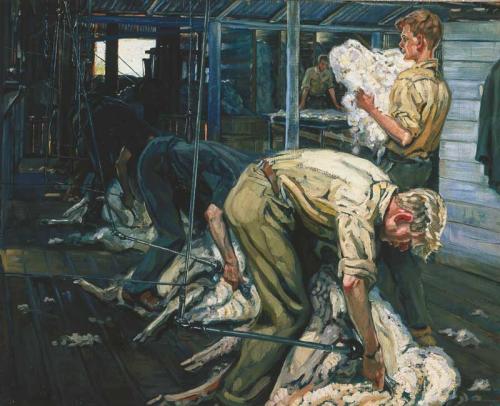
In 1928 she married Edgar Wright, grandson of James Wright – first magistrate of Queanbeyan and pioneer white settler of Lanyon, Cuppacumbalong and Booroomba in the Canberra region. Edgar was severely injured at Passchendaele (buried in the earth by one blast and regurgitated by another explosion). He was repatriated and took over the family farm. The Fleece is a fabulous study of her husband Edgar as he goes about his business.


The Fleece (1944)
On her travels to Europe, Hilda Rix Nicholas was determined to show viewers the virtues of the bush and pioneer life, following in the tradition of the Heidelberg School and writers such as Henry Lawson and Banjo Patterson. Her portraits of men and women of the land capture an earnest respect for hard work and rugged beauty.

The Shearers (1922-23)
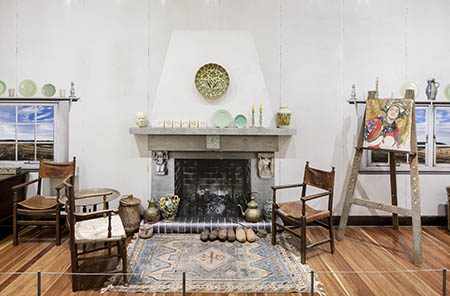
At Knockalong, Hilda Rix Nicholas had a studio built to her specifications, which was completed in 1930. It was French provincial in style with a broad mediaeval-style fireplace, huge windows, soaring ceiling, a loft and a stage. It is recreated in this exhibition and furnished with mementoes from foreign lands: robes, clogs, vests, bags, belts, rugs, slippers, pots and plates, and paintings.  


It is a treat to see these artefacts collected here, along with the pictorial representations of them. Among the clothes which she loved and collected in a trunk, are a Chinese robe and Spanish shawl that she painted with a meticulous eye to the expansive colours and design. 

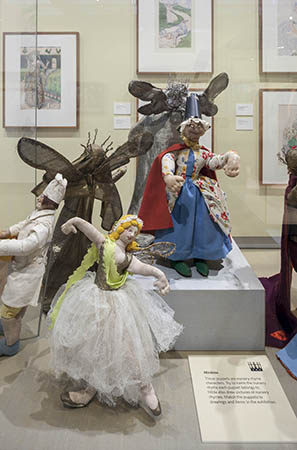
When she was 46, Hilda had a son, Rix, who became the focus of her life. She loved to tell him stories and play games with him, making wire and wadding minikins for their entertainment. She made portraits of Rix in every aspect of life: as a soldier, scout and shepherd among other things.

Some of the minikins Hilda made for her son, Rix
The Shepherd of Knockalong (1933)

She loved her garden and the natural surrounds, painting them with bright blue skies and Pissaro/ Cezanne-like colours. The style may evoke French Impressionism, but the eucalypts are pure Australia.


Spring in my garden, Knockalong (1940)


Country Garden, Knockalong (1945)
Hilda always loved horses and riding, and many of her paintings feature Rix’s governess and jillaroos as models.

Bringing in the Sheep (1936)
The Fair Musterer (1935)
A neighbour described Autumn evening’s golden glow as combining Hilda’s favourite subjects: humans, horses, flower garden and the Monaro landscape brought together on one large, joyously vivid canvas.


Autumn evening's golden glow (1935)

Monday, 23 May 2011

Our Man in London: All's Well That Ends Well

All’s Well That Ends Well at The Globe, London

First trip to The Globe of the year and probably not an obvious choice of play to go and see. All’s Well seems to be viewed as one of Shakespeare’s ‘problem plays’, but I am not sure I see the problem in the same way as I am meant to. The problem is meant to be that the main characters are a flawed bunch. While I agree that they are, another problem is the story. Some bits just don’t add up. Why would Diana give that lengthy performance in front of the King of France at the end and end up with being threatened with being thrown in jail? Is Bertram really so dim that he did not realise that the ring he is given was the one worn by Helena? How come he did not realise that the Italian he was in bed with had suddenly developed a French accent?

Putting aside my pedantry for a moment, this was a great performance. The only bad review I could find of it in the London press was from the Daily Telegraph. To me that means it is worth seeing, although worryingly the Daily Mail gave it a good review. I had no idea who any of the actors were in it, even though I should apparently know of Janie Dee who plays the Countess of Rousillon. I always think you are on safe ground with UK actors if you say you have seen them in The Bill or Casualty and move the conversation quickly on.


To me the star of the show was James Garnon’s Parolles. But with such great lines to deliver and playing the buffoon it’s probably hard to mess it up. Ellie Piercy as Helena was also great despite one reviewer calling her dull and drab. I might be biased though because I think I have a crush on her. I did have a bit of a problem with Sam Crane as Bertram. He looks very young and a bit like the Tory Chancellor George Osborne. Plus he was being very rude about the lovely Helena. I was tempted to ask him outside at one point but decided I would see him afterwards.

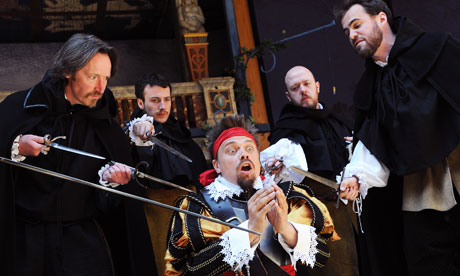
I feel a bit metrosexual about this next point but think I am going to make it anyway. The costumes were stunning. Usually when I watch Shakespeare acted out in Jacobean costumes, they are par for the course and unremarkable, but there really was something stunning about these ones. I could quite happily prance about in the King of France’s togs but doubt I would make it to the end of my street in one piece.

That’s all for now, I have a train to catch and work to pretend to do. Next up is Merchant of Venice at the revamped RSC theatre in Stratford.

Adieu... from Our Man in London

Wednesday, 11 May 2011

My Newest Favourite Thing: Downton Abbey


As the nights draw in and the temperatures plummet, it makes sense to snuggle up to a warm fire and some period drama on television. As I don't watch reality TV or trite American sitcoms, there isn't much for me on terrestrial TV (and now the Premier League has all but concluded, even SKY is looking rather drab), so I anticipated the arrival of Downton Abbey with excitment. Sad, I know, but it was very aggressively marketed with swooning maidens, scheming footmen and a choir singing Every Breath You Take at a thrillingly trippy tempo.

Created, written, and executive-produced by Julian Fellowes, the corset capers have all the typical hallmarks of the genre. Upstairs Downstairs meets Gosford Park (even with some of the same actors), holding hands and skipping merrily through the gamut of impeccable manners, class distinctions, lavish locations, sumptuous costumes, simple housemaids, plotting butlers, and all manner of skulduggery in tails.

The time is April 1912 and the Edwardian era is ending. When the date scrolled onto the screen, Him Outdoors said, 'Titanic's about to go down', and so it did. (I don't want to give the impression that he was instrumental in this maritime disaster, or that he prefixed his pronouncement with 'Lo' - it's fairly standard knowledge, after all), resulting in loss of life and complications of inheritence.

Lord of the manor/ Earl of Grantham (Hugh Bonneville - scrupulously charming) is in a bit of pickle as he only has three daughters and, therefore, no heir, so it looks as though the estate might be farmed out. Shark-finned, sharp-suited suitors arrive instantly until they realise there is another contender; some long-lost relation from (shudder) Manchester.

Naturally the rich American wife/ Countess of Grantham  (Elizabeth McGovern - a breath of fresh air without being a traumatic tornado) wants to keep it in the family, as does the Dowager Countess (Maggie Smith - divine delivery as ever). With nothing in common apart from the desire to prevent Downton from falling into the hands of 'a man who can barely hold his knife properly' these two team up to take on all-comers and also-rans. I'm guessing they'll prove pretty formidable.

Meanwhile alliances and divisions are being brokered and dissolved beneath stairs as well. Added to the drama is the fun of playing spot-the-former-street-actor: Liam Connor (Rob James-Collier) is the roguishly handsome Thomas the footman, while Joanne Froggart's character of Anna the housemaid (these people don't have surnames you see) is much more sympathetic than her conniving counterpart of Zoe Tattersall.

Of course things will never be the same up at the Big House, but the changes will be exquisitely captured on the small screen. From tracking shots down corridors to the intricate details of ironing the newspapers, it will look fantastic. It may feature obvious villains, crude characterisation, semaphored plot and heavy-handed exposition, but it is aimed at the ADD generation, and produced for ITV rather than BBC. Despite that, it is all wrapped up in a cloak of faux-gentility and classic acting, and I love it.

Monday, 28 December 2009

My newest favourite thing: Mascots


There’s something strangely endearing about the sight of a grown man dressed up in a fluffy mascot costume clapping his hands and covering his eyes with oversized hands. It’s a Knockout realised the humorous potential and featured many comedy capers as folk with giant feet raced each other over obstacle courses collecting water in buckets, while Stuart Hall collapsed in hysterics.


When I worked at a bookshop in the children’s department, there were plenty of character costumes to wear. I remember once being crammed into a Mr Happy suit with a hangover – it wasn’t pleasant and the darling little kiddies kept poking me in my giant eyes and pulling my fingers going, ‘There’s a person in there.’

I did, however, fare rather better than our deputy manager who once ventured out into St Anne’s Square in the fat puffin costume without a minder. This probably went down a treat in West Wombletown or some such, but the inner city Manchester kids soon knocked her to the ground, pulled off the head (of the costume that is) and rolled her around the cobbles. Her orange tight-clad legs were wiggling out of the bottom of the costume complete with webbed feet, but she couldn’t stand up as she became an impromptu football. She wasn’t hurt although the costume (and her pride) was dented, but I’m afraid to admit I may have been doing a Stuart Hall impersonation of my own.

And now it’s an intense few days for the English Premier League so I am watching hours of football – most of their teams have mascots, and in fact there is a hotly contested annual mascot race. Liverpool have a Liver Bird, which stands to reason, and lots of teams (Chelsea; Aston Villa; Reading; Bolton; Middlesborough; Blackburn) have lions, which seem appropriately large and fearsome. Manchester City’s Moonchester is oddly cool and West Ham’s Herbie the Hammer is frankly odd.

Burnley have Bertie Bee. Him Outdoors once bought me a cuddly Bertie Bee – he was very proud of himself for giving me this gift. Bertie is really not to be messed with and is actually a former rugby league player, as a streaker in a match against Preston found to his disadvantage.


I actually really like Gunnersaurus – he stands in the tunnel and shakes hands with all the players when they get off the bus. The Arsenal players often give him a hug or a slap on the back too, while the away team look at him with bewilderment. I can understand their bemusement; it seems an odd thing to do to dress up in a hot furry costume and pretend to be one of the lads, but if anyone will, the English will. Long live their peculiarities.

Sunday, 20 July 2008

Material dreams

Last month the Royal New Zealand Ballet auctioned off a load of its costumes to raise moiney for future productions and make some more storage space at its Lower Hutt facilities.

I went on a grim day to the exhibition on the waterfront. As the rain lashed the streets outside, I disappeared into a world of tulle and sequins, where dreams are material and can all come true.

I had to snap this peculiar thing from 1001 Nights - it is a 'blue flying man' according to the programme - but it looks like a cycling outfit him outdoors might wear in one of his more flamboyant moods. I can just picture the sheer white wings flapping out behind him as he pedals round the bays of Wellington.

There were costumes from Swan Lake, Alice, The Nutcracker, Cinderella, 1001 Nights, Jean, Le Papillon, and Coppelia. Apparently these costumes could be used as display in the home or office or for a fancy dress party - but only if you're a size 6.

Apparently more than 100 costumes were sold to the tune of more than $40,000 - so expect a lot of tiny fairies (is there a collective noun for fairies?) coming to a party near you in tutus.

I love seeing these things up close and personal. They look great from a distance and yet are designed for movement and practicality as well as embodying a vision. They combine creativity and practicality in a way which would gladden William Morris' heart .

From pretty maids all in a row, to Chinese men, Neoploitan dancers and Polish peasants, there is a wide range.

Despite the hideous lighting, I did my best to take photos of the sublime and the strange. Mad hats, green goblins and scary ogres nestled beside snow queens and hairdresser's assistants.

One of the problems before the exhibition apparently was the dearth of mannequins in Wellington for display purposes. Who'd have thought that a town full of politicians would be devoid of dummies - sorry, cheap gibe but it proved simply irresistable.

For little (and big) girls everywhere, one of the highlights was the Cinderella tutu. This was a protoype for the famous outfit, and featured hundreds of silk roses sewn on the skirt and tiny diamante sequins on the bodice. It fetched the highest price of the auction ($2,650). Everyone can dream...

Friday, 30 May 2008

Ballet costumes

Last month the very beautiful and very talented Kate Venables (pictured front, rehearsing Banderillero - photo by Maarten Holl) took us on a tour of the Royal New Zealand Ballet (RNZB) headquarters at St James Theatre in Wellington.

When I was a little girl I used to want to be a dancer, despite the fact that I was clearly never going to have the grace, poise and slender strength of these amazing athletes – my father reinforced this by calling me ‘the sugar plum elephant’ each time I not-so-nimbly pirouetted down the stairs.

It’s partly the costumes that attract me. They’re so beautiful and so practical, having to withstand the rigours of vigorous activity while looking simply exquisite. I thought this was a perfect opportunity to get a peek behind the scenes, and I spied upon an entire room for making costumes, where materials, threads, and silent sewing machines wait on stand-by ready to spring into action.

Kate showed us that dress from Cinderella – the white satin tutu designed by Tracy Grant Lord studded with about 60,000 small, sparkling Swarovski crystals in a delicate rose design. It is shown here worn by Katie Hurst-Saxon in a photo by Rob Kitchin.

Kate also showed us a jacket and explained that there are three settings of hooks and eyes so that it will fit whichever principal is dancing the role. Sometimes the part doesn’t necessarily go to the ‘best’ dancer, but the one who fits the costume, although this isn’t too much of an issue as many of the dancers are equally talented, and equally tiny!


The costumes for Romeo and Juliet are being worked on at the moment. The costume budget for a major show is about $70,000, so it pays to be able to reuse things. The RNZB owns the performance rights to certain shows – like Romeo and Juliet, and Swan Lake – that they put on periodically; by the third time they might actually make money on one.

Kate also showed us the shoe cupboard and explained how dancers try all sorts of methods to soften the pointes of their ballet shoes. These are made from layers upon layers of cardboard, and the dancers bend them back and forth, whack them with hammers, soak them in water – anything to mould them to their feet and attempt to make them more comfortable. Dancers have a limited number of shoes, so when they have got them the way they want them; they write their name on the pair they have individually customised.

The shoes hurt and pinch when they dance. Many dancers get foot infections – the fiery red fungus creeps between their toes and can spread up their legs. When they finish a show their shoes can be full of blood and pus, and all the while they smile and look pretty. It is such a tortuous art form!

Despite all the back-stage horrors, the façade that gets presented to the public is magnificent and beautiful. I see that the RNZB are auctioning off some of their costumes from Queen’s Wharf in the last weekend of June. Even if you’re not interested in buying anything, I recommend you get down and have a look, inviting a little make-believe and glamour into your life.