![]() |
| The Guarded Ruin |
![]() |
| Dawn Arrives and Colour Returns |
![]() |
| The Deserted Hearth |
![]() |
| Birdsong and Bullrushes |
![]() |
| The Scorched Earth |
![]() |
| The Guarded Ruin |
![]() |
| Dawn Arrives and Colour Returns |
![]() |
| The Deserted Hearth |
![]() |
| Birdsong and Bullrushes |
![]() |
| The Scorched Earth |
With a wry aside to the power
of fiction on susceptible minds, Kate first learns something may be amiss when
she discovers her husband was skipping work and “reading horror novels by this
mad American – Lovecroft? Something like that.” White examines the consequences
of hiding feelings and burying emotions, suggesting that suppressed memory will
never remain that way, even when counselled, “Put it someplace out of the way,
in a room behind a locked door. Then all you have to do is not go in that
room.” Kate remembers that John told their daughter they had to confront their
fears; after all, “If they didn’t talk about the monsters in this world, then
they wouldn’t be ready for them when they jumped out from under the bed.”
When Abby asks her husband why
he hadn’t previously spoken to her of his fears, and dreams, he replies, “Come
on Abby, I’m not one of your girlfriends. Men aren’t like that.” Later he
relates his reading matter, “I started reading Tolstoy but couldn’t get into
it. Vonnegut and Salinger were both pretty good. Didn’t mind Jane Austen either
– bet you’re surprised to hear that one?” It’s difficult to tell whether this
gender-reductive viewpoint is that of the character or the author, or both.
While appealing to the common
denominator – we all consult Dr Google, right? “Her left foot ached with what
the internet had diagnosed as either gout, a corn, or foot cancer.” – there are
some aspects of the novel which are unoriginal or overexplained. We all know
what TMI is and don’t need it spelled out. Similarly, the story of Orpheus and
Eurydice is used to indicate the consequences of broken trust and looking back.
This must be one of the most overworked myths in recent literature, and the
fact that it needs to be explained suggests a level of disrespect for the
reader.
On the other hand, the author
deals well with the subject of grief. “Since John’s disappearance, such simple
things had become near impossible. Preparing meals, for example, now seemed
like a bizarre foreign custom, needlessly complicated.” Kate cannot easily see
a way forward. “She baulked at people who said things like life’s too short
and time passes in a blur and Jee-zus, is it Christmas already? Life
was long, time moved too slow, and anyway fuck Christmas.” Her friend advises
her how to cope with the aftermath. “You keep moving. You eat, you take a bath,
you shave your legs and you keep looking forward. Guilt, fear, grief, they’re
all like moss. If you slow down long enough, it’ll start to grow and it won’t
stop until you’re covered.” Apart from the bit about shaving your legs –
another male writing about women trope – this is an interesting metaphor.
At other times, the similes
are so original as to almost be jarring. “She was quiet, like a duck slipping
through a pond.” A false person speaks “words like a backdrop in a Hollywood
studio, held together by balsawood and coated in cheap paint.” While waiting
for news, a character smokes with attitude. “He sucked on the cigarette hard
and fast, as if he was hoping to develop lung cancer before dinnertime.” The
colloquial is ever-present as the ferry doors opened and “spat the Lexus out
like a dislodged chunk of meat” or fact is sifted from fiction. “Around here,
rumours are like holey buckets. They don’t hold water.”
The characters and setting are
distinctly Australian. Abby practices taxidermy on roadkill her friends bring
her, and the tools of her trade, pelts and glassy eyes are all fabulously
macabre. It is set on a fictional Victorian (Australian) island out of season where,
“The island represented a cold exclamation mark at the end of a sentence.” The
atmosphere is frigid and grim, or as Abby puts it, “It’s colder than a fairy
penguin’s pocket.”
Overall, this is an intense and compelling thriller which is hugely readable and atmospheric. It is only White’s second novel and already he is being described by The Age as a master of the art of misdirection.
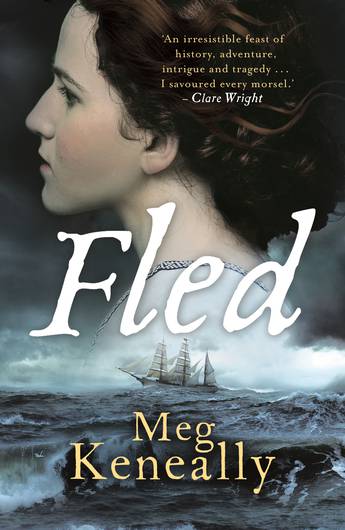
Fled is based on the
life of Mary (Dabby) Bryant, the woman behind one of history’s most daring
escapes. Sentenced to seven years transportation to Australia, she escaped from
the colony and sailed over 3,000 miles for 66 days in a stolen open boat with
her husband, two children and other companions to West Timor (Coepang as it was
then called). Here she was discovered, arrested and returned to Britain to be
incarcerated until she was taken up as a cause célèbre by James Boswell who set
her up in a house and sent her a stipend after she returned to Cornwall. In an
Author’s Note, Meg Keneally stresses that this is a work of fiction, which is
why she has changed some elements of the story, including names of the
characters – Mary Bryant becomes Jenny Trelawny, later Gwynn after marrying Dan
Gwynn.
The first part of the novel
concerns Jenny’s route to crime and the highway robbery for which she was
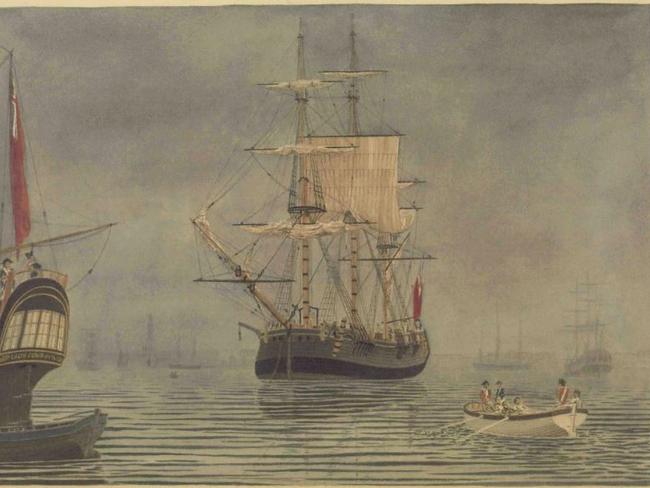
transported to the other side of the world. There is a detailed account of that
trip on the Charlotte, on which she conceives
and after which her daughter is named. She befriends Captain James Corbett,
whose character is based on that of Watkin Tench, who tells her, “We don’t need
to remake Newgate on the other side of the world. Well, I imagine there will be
a guard house, or something like it. I’m sure that not everybody has left their
criminal disposition back in England. But the entire place is intended as a
prison. We’ll have no need of walls for the most part, it is to be hoped. We’ll
have the ocean.”
| The Charlotte at Portsmouth, May 1787 from Frank Allen's The Ships of the First Fleet |
Life in this colony is brutish
and cruel, as it is intended to be, in a land that must seem upside-down. The
triangle that is used for the floggings is “an ominous symbol, a profane and
subverted trinity.” To save herself from rape and degradation by the male convicts
and soldiers, she marries Dan and has another child, Emmanuel (these were the
real names of Mary Bryant’s children). Married couples are given separate
quarters but others, jealous of what they perceive to be her advantages, strive
to bring her low. When their actions result in Jenny being expelled to the
women’s camp, she reflects, “While space was the only blessing this colony
provided in abundance, it was one of the many denied to the hut convicts. Jenny
now lived in a place of wails and screams and sobs and fights, of stench upon
stench, of dangers buried in innocent conversation.”
From the moment she lands in Botany
Bay, Jenny knows she wants to leave, and it soon becomes apparent that their
best chance of survival is escape. Food is scarce, supply ships are absent, farming
is in its infancy, and provisions are rapidly dwindling; making theft of food a
hanging offence and starving to death a distinct possibility. Perhaps if the
settlers had collaborated with the local people they might have had better
chances of survival, but there is limited interaction between the white settlers
and the Indigenous tribes. Jenny encounters an Aboriginal woman who shows her
what leaves to chew or to brew to avoid scurvy. Although these are plentiful,
Jenny guards this knowledge as currency, as she does when the Indigenous people
take her fishing and share their methods with her.
Questions have been asked as to
why Mary Bryant would risk a journey for herself and her children on the ocean
and potential drowning. As well as starvation, the new colony is rife with
disease (particularly smallpox) and the dangers to the women convicts are
manifold. “Emmanuel’s death at sea is a possibility. His death here is nigh on
certain.”
![]() |
| 1930s era illustration of the convict escape |
Eventually she returns to her family in Cornwall. She had been afraid of their reaction, but they are thrilled to see her and welcome her back, so the story has come full circle. This is one of the bits that the author has invented, but it makes for a satisfying conclusion. Mary Bryant’s adventure is a fascinating story and, although she has changed the names to compensate for lack of certain facts, Meg Keneally has told it with drama and compassion.
![]() |
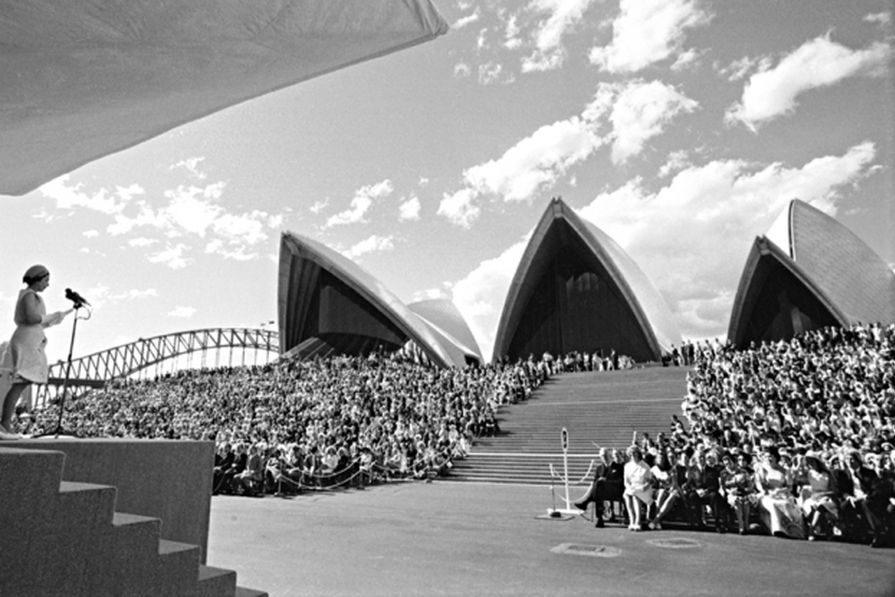
| Queen Elizabeth II officially opening the Opera House on 20th October 1973 |
| Pied Piper (1911) |
| Marchands du charbons de bois (Charcoal sellers) (1912) |
| The Well in the Blue, Arab Quarters (1914) |
![]() |
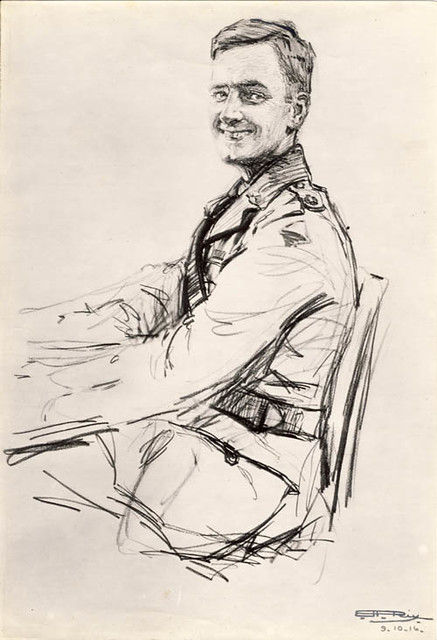
| George Nicholas (1916) |
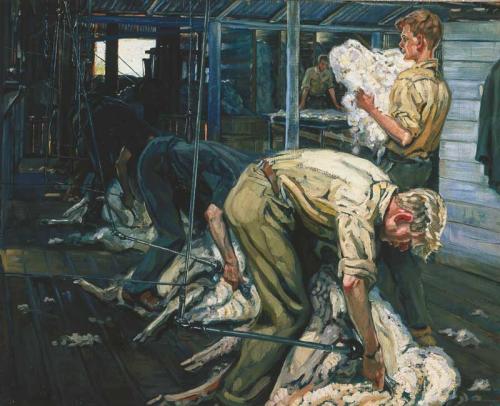
The Fleece (1944)
|
| The Shearers (1922-23) |
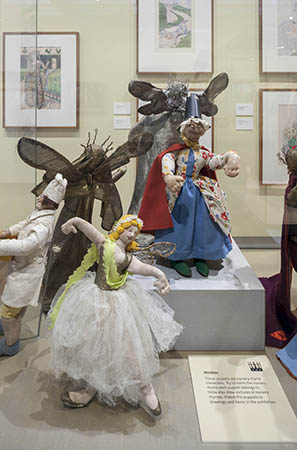
| Some of the minikins Hilda made for her son, Rix |
| Country Garden, Knockalong (1945) |
| Bringing in the Sheep (1936) |
| The Fair Musterer (1935) |
![]() |
| Spider-cam at the W.A.C.A. |
![]() |
| The Melbourne Cricket Ground |
"No Freeman shall be taken or imprisoned, or disseised of his Freehold, or Liberties or free Customs, or be outlawed, or exiled, or any other wise destroyed; nor will We not pass upon him, nor condemnation, but by lawful judgement of his Peers, or by the Law of the Land. We will sell to no man, we will not deny or defer to any man either Justice or Right"“The visual record of child migration is dominated by photographs of cheering children departing the UK and arriving in new lands. These photographs were taken to promote the work of sending organisations and ensure they continued to attract financial support from governments and wealthy patrons. They provide a remarkable contrast to the often damning written and oral testimonies of former child migrants, which form the basis of many case studies in the exhibition.”
| Land of Toys by Bakke |
“For former child migrants the legacy of their experience remains. Many have struggled, not only due to the hardships and abuse they endured, but also because they were torn from their homeland and lost their identities. Others were lucky enough to find fulfilment in their lives.”In 1914, the First World War put a stop to child migration, although many former child migrants fought in the Canadian army as they still felt strong connections with their British roots. It recommenced after the war, but the interwar years were marked by poverty and austerity in formerly receptive colonies and child migration to Canada was formally ended by 1939. Australia became the main destination after Canada ended the scheme. One third of war evacuees to Australia later emigrated there for good. Indeed, some former child migrants also fought in the Australian army, only to later discover that they had never been granted citizenship.
| Former child migrants gather in London for the apology from British Prime Minister Gordon Brown in February 2010. |
“The history of child migration is complex and contested. Issues of redress and compensation remain unresolved. Many former child migrants are still coming to terms with their deportation and dislocation and find it painful to reflect on their past.”