Showing posts with label death. Show all posts

Wednesday, 25 March 2026

How well can you really ever know anyone? The Wife and The Widow


The Wife and the Widow by Christian White
Affirm Press
Pp. 326

In this novel Kate is the widow (husband; John) and Abby is the wife (husband; Ray), and, although this occasionally gets confusing, it is well-written and with enough suspense and intrigue to keep the reader engaged. It has a contemporary feel in that the characters frequently refer to true crime podcasts or “suburban procedural TV shows”, indicating that we have all become familiar with these, and that there is a communal enjoyment. It also explores a common theme of these novels in how secret lives are discovered after the death of a loved one (and sometimes even when they are alive), causing one character to reflect, “We all have things that ought to stay buried, things a person should keep to themselves. Things that, if they were ever dragged into the light, would change the way people saw us. I suppose my point is, how well can you really ever know anyone?”


With a wry aside to the power of fiction on susceptible minds, Kate first learns something may be amiss when she discovers her husband was skipping work and “reading horror novels by this mad American – Lovecroft? Something like that.” White examines the consequences of hiding feelings and burying emotions, suggesting that suppressed memory will never remain that way, even when counselled, “Put it someplace out of the way, in a room behind a locked door. Then all you have to do is not go in that room.” Kate remembers that John told their daughter they had to confront their fears; after all, “If they didn’t talk about the monsters in this world, then they wouldn’t be ready for them when they jumped out from under the bed.”


When Abby asks her husband why he hadn’t previously spoken to her of his fears, and dreams, he replies, “Come on Abby, I’m not one of your girlfriends. Men aren’t like that.” Later he relates his reading matter, “I started reading Tolstoy but couldn’t get into it. Vonnegut and Salinger were both pretty good. Didn’t mind Jane Austen either – bet you’re surprised to hear that one?” It’s difficult to tell whether this gender-reductive viewpoint is that of the character or the author, or both.


While appealing to the common denominator – we all consult Dr Google, right? “Her left foot ached with what the internet had diagnosed as either gout, a corn, or foot cancer.” – there are some aspects of the novel which are unoriginal or overexplained. We all know what TMI is and don’t need it spelled out. Similarly, the story of Orpheus and Eurydice is used to indicate the consequences of broken trust and looking back. This must be one of the most overworked myths in recent literature, and the fact that it needs to be explained suggests a level of disrespect for the reader.


On the other hand, the author deals well with the subject of grief. “Since John’s disappearance, such simple things had become near impossible. Preparing meals, for example, now seemed like a bizarre foreign custom, needlessly complicated.” Kate cannot easily see a way forward. “She baulked at people who said things like life’s too short and time passes in a blur and Jee-zus, is it Christmas already? Life was long, time moved too slow, and anyway fuck Christmas.” Her friend advises her how to cope with the aftermath. “You keep moving. You eat, you take a bath, you shave your legs and you keep looking forward. Guilt, fear, grief, they’re all like moss. If you slow down long enough, it’ll start to grow and it won’t stop until you’re covered.” Apart from the bit about shaving your legs – another male writing about women trope – this is an interesting metaphor.


At other times, the similes are so original as to almost be jarring. “She was quiet, like a duck slipping through a pond.” A false person speaks “words like a backdrop in a Hollywood studio, held together by balsawood and coated in cheap paint.” While waiting for news, a character smokes with attitude. “He sucked on the cigarette hard and fast, as if he was hoping to develop lung cancer before dinnertime.” The colloquial is ever-present as the ferry doors opened and “spat the Lexus out like a dislodged chunk of meat” or fact is sifted from fiction. “Around here, rumours are like holey buckets. They don’t hold water.”


The characters and setting are distinctly Australian. Abby practices taxidermy on roadkill her friends bring her, and the tools of her trade, pelts and glassy eyes are all fabulously macabre. It is set on a fictional Victorian (Australian) island out of season where, “The island represented a cold exclamation mark at the end of a sentence.” The atmosphere is frigid and grim, or as Abby puts it, “It’s colder than a fairy penguin’s pocket.”


Overall, this is an intense and compelling thriller which is hugely readable and atmospheric. It is only White’s second novel and already he is being described by The Age as a master of the art of misdirection.

Wednesday, 20 November 2024

Townsville’s Palmetum

When we learned a good friend had died, we had been expecting it, but were still devastated. We were in Townsville at the time and we went to the Palmetum to reflect. It's a botanic garden displaying one the largest and most diverse public collections of plams in the world. Botanic gardens make me feel calm - there is a reassuring sense of life, growth and continuity. It was what I needed to find peace.


I haven't really got words, so I will just share images. 

In the avenue of Bismarkia nobilis
The Xerophytic Zone is the sort of desert area, which receives irrigation only while plants are being established or during extremely long dry spells. The flowers are bright, but the stalks are spiky and often covered in insects.


I find spirals and circles comforting as they return to their beginnings and intimate infinity. 


Some of them remind me of corals and marine plants and animals - I suppose nature uses similar formations throughout all environments. 


These green ants are found throughout tropical northern Australia from the western Kimberley through northern NT to central eastern Queensland. They are called gulguk by the Larrika people, who harvest them ethically in Arnhem land. They are mainly orange with a bright green abdomen, which is edible, with a powerful taste of citrus and coriander seed. As they are high in protein, Vitamin C and iron, and also contain amino acids, Zinc, Magnesium and B12, they were traditionally used in the Indigenous diet and medicines, to combat coughs and colds. They are now increasingly found as a garnish and a flavouring for everything from cheeses to boutique gin.   


And then we return to a cool spot with a water fountain, because water is life. 

Friday, 28 May 2021

Friday Five: Depictions of the Greek Underworld

I have been exploring the Greek underworld - not literally, obviously - but because The Penelopiad by Margaret Atwood, the play I am directing and co-producing, is partially set there.

The underworld itself - sometimes known as Hades, after its patron god - is described as being either at the outer bounds of the ocean or beneath the depths or ends of the earth. It is considered the dark counterpart to the brightness of Mount Olympus with the kingdom of the dead corresponding to the kingdom of the gods. The Underworld is a realm invisible to the living, made solely for the dead.

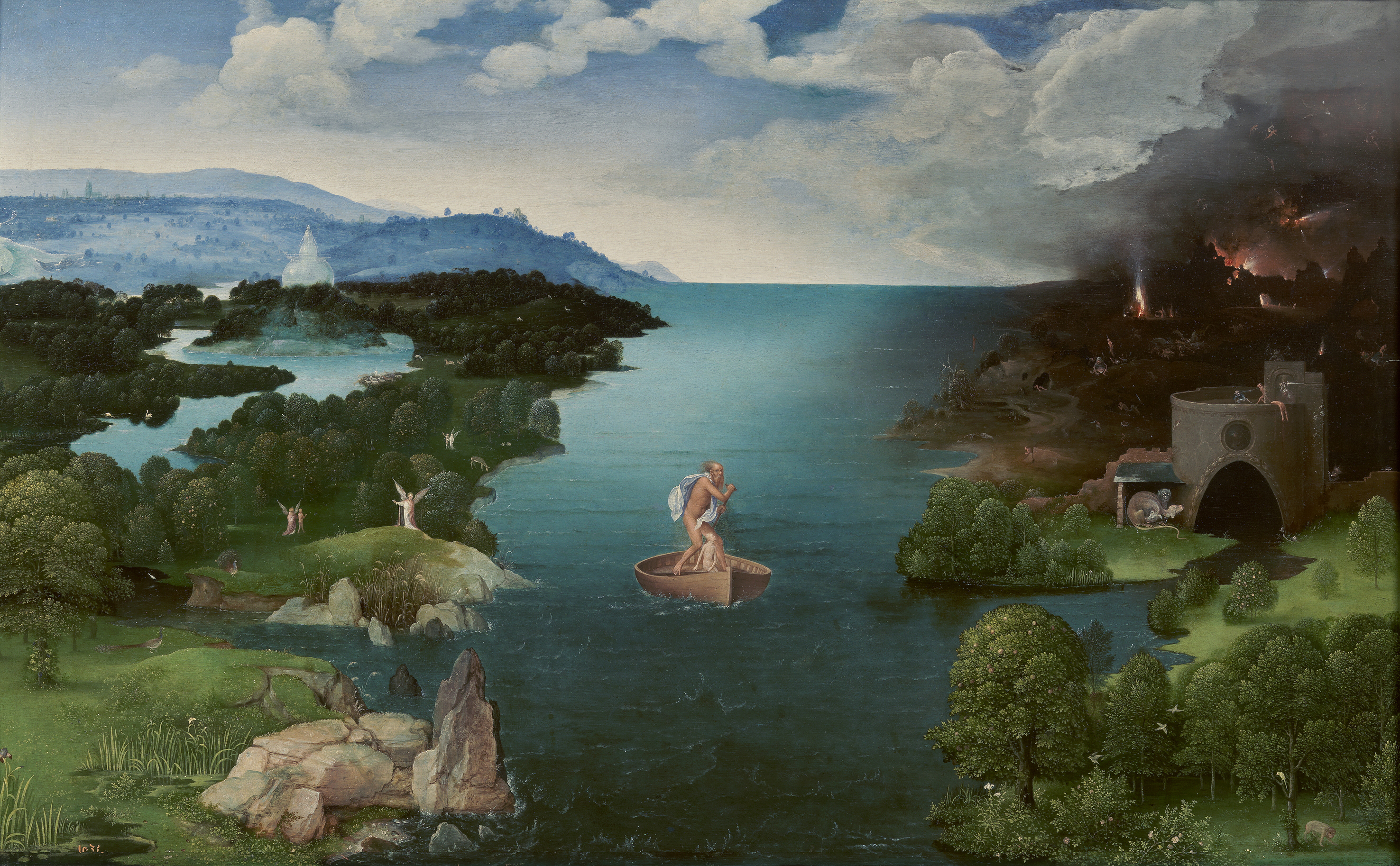
Landscape with Charon crossing the Styx by Joachim Patinir

The Greeks had a definite belief that there was a journey to the afterlife or another world. They believed that death was not a complete end to life or human existence.

In the Greek underworld, the souls of the dead still existed, but they are insubstantial, and flitted around the underworld with no sense of purpose. The Greeks accepted the existence of the soul after death, but saw this afterlife as meaningless. In the underworld, the identity of a dead person still existed, but it had no strength or true influence. The dead within the Homeric underworld lack menos,or strength, and therefore they cannot influence those on earth. They also lack phrenes, or wit, and are heedless of what goes on around them and on the earth above them. Their lives in the underworld were very neutral, so all social statuses and political positions were eliminated and no one was able to use their previous lives to their advantage in the underworld.

Generally speaking, the Greek Underworld can be thought of as being made up of three different regions; Tartarus, the Asphodel Meadows and Elysium.

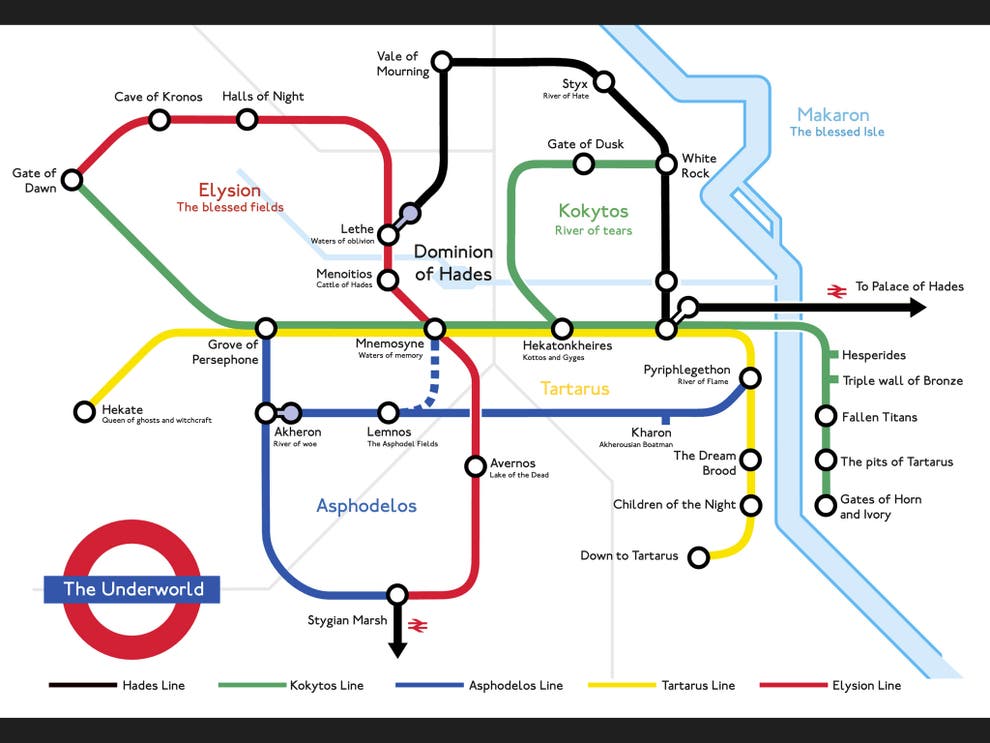
An alternative view of the London Underground tube map by the Iris Project

While Tartarus is not considered to be directly a part of the underworld, it is described as being as far beneath the underworld as the earth is beneath the sky. It was thought to be the deepest region of the Underworld, ad a place where it would take an anvil nine days to reach if allowed to fall from the rest of the Underworld. It is so dark that the “night is poured around it in three rows like a collar round the neck, while above it grows the roots of the earth and of the unharvested sea.” – Robert Garland, The Greek Way of Death

Tartarus is the region of the Underworld normally associated with hell, and was the area where imprisonment and punishment was undertaken; as such it was the normal location of the imprisoned Titans, Tantalus, Ixion and Sisyphus. Zeus cast the Titans along with his father Cronus into Tartarus after defeating them. Homer wrote that Cronus then became the king of Tartarus. While Odysseus does not see the Titans himself, he mentions some of the people within the underworld who are experiencing punishment for their sins.

Aneas and Sibyl in the Underworld by Jan Brueghel the Younger
The Asphodel Meadows was a place for ordinary or indifferent souls who did not commit any significant crimes, but who also did not achieve any greatness or recognition that would warrant them being admitted to the Elysian Fields. It was where mortals who did not belong anywhere else in the underworld were sent. It was where the majority of the deceased would end up, for it was the region of indifference. Having drunk from the River Lethe the deceased located here would forget their previous lives, but would spend eternity in a greyness of mindlessness.

While in the underworld, the dead passed the time through simple pastimes such as playing games, as shown from objects found in tombs such as dice and game-boards. Grave gifts such as clothing, jewellery, and food were left by the living for use in the underworld as well, since many viewed these gifts to carry over into the underworld. There was not a general consensus as to whether the dead were able to consume food or not. Homer depicted the dead as unable to eat or drink unless they had been summoned; however, some reliefs portray the underworld as having many elaborate feasts. While not completely clear, it is implied that the dead could still have sexual intimacy with another, although no children were produced. The Greeks also showed belief in the possibility of marriage in the underworld, which in a sense describes the Greek underworld having no difference than from their current life.

Fields of Asphodel by Brian Doers
Elysium, or the Elysian Fields, was a place for the especially distinguished. It was ruled over by Rhadamanthus, and the souls that dwelled there had an easy afterlife and would spend an eternity of pleasure free from work and strife. Usually, those who had proximity to the gods were granted admission, rather than those who were especially righteous or had ethical merit, however, later on, those who were pure and righteous were considered to reside in Elysium. Most accepted to Elysium were demigods or heroes. Heroes such as Cadmus, Peleus, and Achilles also were transported here after their deaths. Normal people who lived righteous and virtuous lives could also gain entrance such as Socrates who proved his worth sufficiently through philosophy. It is the region of the Underworld where mortals were supposed to aspire to and the most closely associated with paradise.

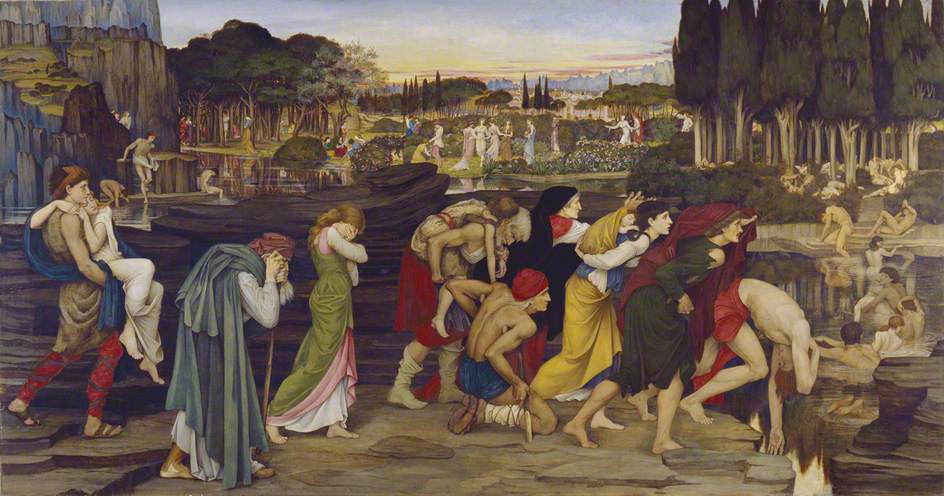
The Waters of Lethe by the Plains of Elysium by John Rodham Spencer-Stanhope

The idea of progress did not exist in the Greek underworld – at the moment of death, the psyche was frozen, in experience and appearance. The souls in the underworld did not age or really change in any sense. They did not lead any sort of active life in the underworld – they were exactly the same as they were in life. Therefore, those who had died in battle were eternally blood-spattered in the underworld and those who had died peacefully were able to remain that way.

Overall, the Greek dead were considered to be irritable and unpleasant, but not dangerous or malevolent. They grew angry if they felt a hostile presence near their graves and drink offerings were given in order to appease them so as not to anger the dead. Mostly, blood offerings were given, because they needed the essence of life to become communicative and conscious again. This is shown in Homer's Odyssey, where Odysseus had to give blood in order for the souls to interact with him.

Hades itself was free from the concept of time. The dead are aware of both the past and the future, and in poems describing Greek heroes, the dead helped move the plot of the story by prophesying and telling truths unknown to the hero. The only way for humans to communicate with the dead was to suspend time and their normal life to reach Hades, the place beyond immediate perception and human time.

It sounds as though social strata was rigidly imposed even back then and even in death.