Showing posts with label The Penelopiad. Show all posts

Friday, 16 July 2021

Friday Five: Reviews of Penelopiad

The Penelopiad by Margaret Atwood produced by Crouching Giraffe Productions in association with papermoon theatre
The Penelopiad  by Margaret Atwood has three more performances to go - two of which are sold out. If you live in Canberra, grab the last tickets to tomorrow's matinee quickly before they're gone. You do not want to miss it. This is what the critics are saying.

5 Reviews of The Penelopiad
  1. That Guy Who Watches Canberra Theatre - "Kate Blackhurst's production brings this thrillingly to life... this is a great night of theatre, thoroughly absorbing and well worth the watch."
  2. The Canberra Critics Circle - Len Power - "Director, Kate Blackhurst, has produced a visually striking, uniquely stylised and thought-provoking production that succeeds on all levels. It's also very entertaining."
  3. The Canberra Critics Circle - Frank McKone - "The production, seemingly simple in the intimate small-scale Studio space, has all the elements of drama working together with purpose and artistic integrity... This Penelopiad is my kind of theatre - strong in its intention; powerful in its effect and its message."
  4. The Canberra Critics Circle - Bill Stephens - "an imaginative version of this epic story, directed with considerable panache by Kate Blackhurst... the central role of Penelope given a compelling performance by Elaine Noon."
  5. The Canberra Critics Circle - Peter Wilkins - "the most significant production that I have seen on a Canberra stage for quite some time... This is theatre that confronts, challenges preconceptions and entertains."

Friday, 9 July 2021

Friday Five: Depictions of Penelope

'Our' Penelope - Elaine Noon in The Penelopiad by Margaret Atwood
The Penelopiad is up and running, and audiences appear to love Margaret Atwood's re-telling of The Odyssey from Penelope's perspective. Elaine Noon is excellent as the titular character. And here are some other artistic depictions of the so-called patient and faithful wife and weaver.

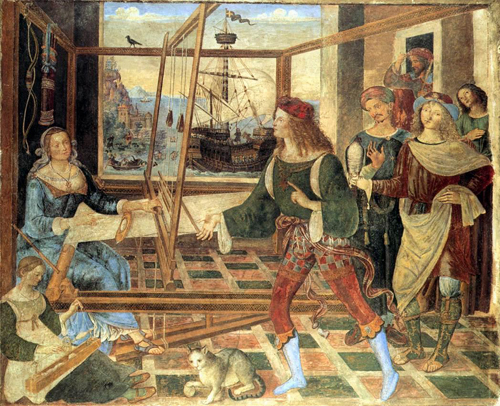
Penelope with the Suitors (1509) by Pintoriccio
Penelope (1514) by Domenico Beccafumi

The Patience of Penelope (1849) by John Roddam Spencer Stanhope

Penelope Unravelling her Work at Night (1886) by Dora Wheeler Keith

Penelope and her Suitors (1912) by John William Waterhouse

Friday, 2 July 2021

Friday Five: Another Quintet of Women of the Odyssey

I'm in the middle of rehearsals for The Penelopiad by Margaret Atwood, which is a retelling of The Odyssey, focussing on Penelope, who was left behind while Odysseus went off to war and then travelled around having adventures rather than returning to her in a timely manner. I'm co-producing and directing the play which will be on at the Courtyard Studio in Canberra from 7-17 July. I have always loved mythology and the value of storytelling, so have thoroughly enjoyed providing a bit of context to some of the characters mentioned in the text. This is Part Three (See Part One and Part Two).

The Birth of Venus by Sandro Botticelli

1. Aphrodite

Aphrodite is the Greek goddess associated with love, beauty, pleasure, passion and procreation. Her major symbols include myrtles, roses, doves, sparrows and swans, and she is consistently portrayed as a nubile, infinitely desirable adult (having had no childhood as she was born fully-formed from sea foam caused by the severed genitals of Uranus - it's complicated), and usually nude. Her Roman equivalent is Venus, hence the famous Bananarama song (okay, I know it's not originally theirs), female razor products (exactly the same as the male ones but twice as expensive because, you know, pink), the fly trap (because stupid creatures will entrap themselves and die for nubile beauty) oh yes, and the above painting.

In The Odyssey, Aphrodite is married to Hephaestus (blacksmith to the gods who makes all sorts of wonderful gadgets, like Q in James Bond) not by choice but through some bargaining with Zeus - she is given to Hephaestus as a bribe (sound familiar?). Aphrodite is frequently unfaithful to her husband, and her lover include Ares, the god of war (Mars in the Roman versions). Hephaestus sets a trap for the lovers and casts a golden net in which they are caught the next time they have sex upon the marital bed. Hephaestus invites all the other gods to laugh at the adulterous pair, but many of the (male) gods have sympathy for Ares and Poseidon agrees to pay Hephaestus to release Ares. Meanwhile, Aphrodite was humiliated and returned in shame and ignominy to Cyprus where she was attended by the Charities (or Three Graces). What's that you say? Rhymes with stubble dandards?

Charybdis before she was a sea monster

2. Charybdis

Charybdis was a sea monster who dwelt in the Strait of Messina. She swallowed large amounts of water of water and then belched them out, creating large whirlpools that resulted in the destruction of passing ships. She was the offspring of Poseidon and Gaea (Water and Earth) and helped her father in his quarrel against Zeus by flooding large areas of land with water - don't you just love how all cultures have a creation and a flood myth? Zeus was angry (it seems to be his default setting - grumpy head god) and punished Charybdis by turning her into a monster that would eternally swallow sea water and create whirlpools.

Scylla, the Huntress, from Game of Heroes

3. Scylla

Scylla was a sea monster who haunted the rocks of a narrow strait opposite the whirlpool of Charybdis. Ships who sailed too close to her rocks would lose six men to her ravenous, darting heads. Homer describes Scylla as a creature with twelve dangling feet, six long necks and grisly heads lined with a row of sharp teeth. Her voice was likened to the yelping of dogs. In classical art she was depicted as a fish-tailed sea-goddess with a cluster of canine fore-parts surrounding her waist. According to late classical writers she was once a beautiful nymph loved by the sea-god Glaukos, but her jealous rival, Circe, transformed her into a monster. Older poets, however, envisaged her as simply a monster born into a monstrous family. 

Scylla and Charybdis by Emmique on DeviantArt

Being between Scylla and Charybdis is an idiom along the lines of 'between a rock and a hard place', 'between the devil and the deep blue sea', 'to choose the lesser of two evils'  or 'out of the frying pan; into the fire'. The situation implies that one must seek to chose between two equally dangerous extremes which will inevitably result in disaster. Scylla and Charybdis were regarded as maritime hazards (a rock shoal and a whirlpool respectively) located close enough to each other that they posed an inescapable threat to passing sailors; avoiding Charybdis meant passing too close to Scylla and vice versa. According to Homer's account, Circe advised Odysseus to pass by Scylla and lose only a few sailors, rather than risk the loss of his entire ship in the whirlpool.
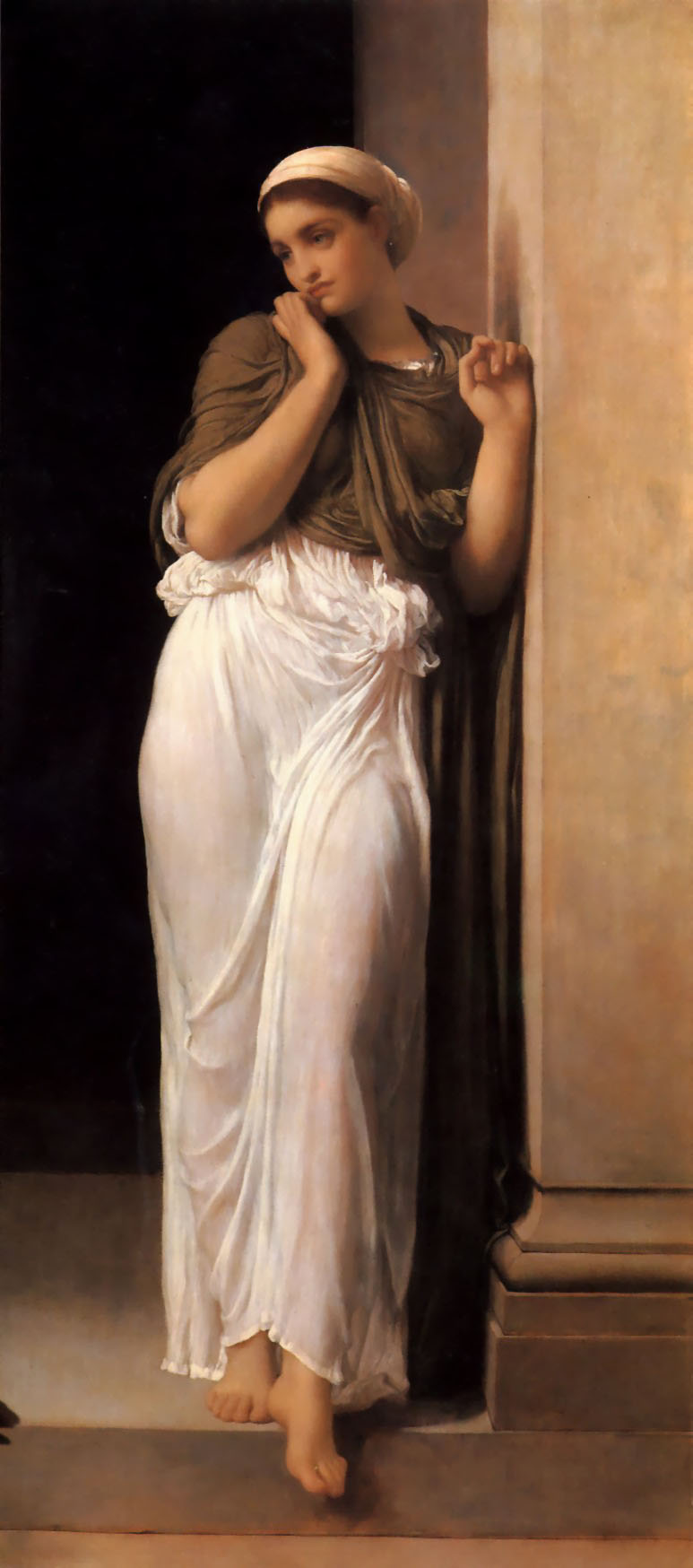
Nausicaa by Frederic Leighton

4. Nausicaa

After leaving Calypso, Odysseus is shipwrecked on the island of Phaeacia, where he is awakened by Nausicaa (daughter of King Alcinous and Queen Arete) and her handmaidens as they wash their clothes at the seashore. He emerges from the forest, completely naked, and the servants all run away terrified. Nausicaa remains and agrees to help him, giving him some of the laundry to wear and advising him to go to her parents' house and make his case directly to her mother, Arete. She and her maids go ahead of him as she doesn't want to give rise to gossip by walking with a stranger. He does as she says, which is a good move because apparently Arete is much wiser than her husband, and when Odysseus wins her trust, she allows him stay with them as a guest. In return for their hospitality, Odysseus recounts his adventures to the court - this forms a substantial proportion of The Odyssey itself. Alcinous then generously gives Odysseus a ship to help him return to Ithaca. 

Margaret Atwood interprets all this in her inimitable fashion in The Penelopiad thus:

"After seven long years there of kissing and woo,
He escaped on a raft that was drove to and fro,
Till fair Nausicaa's maids that the laundry did do,
Found him bare on the beach - he did drip so!" 

Nausicaa is young and very pretty, and she is presented as a potential love interest. She may have had unrequited feelings for Odysseus, but he wins Arete's sympathy and she is determined to help him get home to his wife and child, rather than being tempted to dally with yet another romantic entanglement. There is a deep affection between the two of them, however - she tells him, 'Never forget me, for I gave you life' (which is oddly maternal) - and of all the women he met on his adventures, Odysseus never tells Penelope about Nausicaa. Some accounts say that Nausicaa eventually married Odysseus' son, Telemachus. Could this be a rare occurrence in classical literature of a man actually respecting a young and beautiful woman?

Ulysses and the Sirens by John William Waterhouse

5. Sirens

According to legend, sirens are beautiful seductresses who lured sailors to watery graves with their stunning singing voices. Apparently the sailors, bewitched by the voices, would steer their ships too close to the rocks and end up wrecked. In other versions (particularly Indian myth), their sweet sounds lull the sailors to sleep, and then the Sirens set upon them and tear them to pieces. 

They were believed to look like a combination of women and birds in various different forms. In early Greek art they were represented as birds with large women's heads, bird feathers and scaly feet. Later they were represented as female figures with the legs of birds, with or without wings, playing a variety of musical instruments, especially harps and lyres. Originally sirens were shown to be male or female, but the male Siren disappeared from art around the fifth century BC. Because we all know that only women can fulfil the role of evil tempter, right?

Homer tells that Odysseus wanted to hear the Sirens, and so he acted on the advice of Circe (yep, her again) getting all his sailors to plug their ears with beeswax and tie him to the mast. He ordered his men not to release him no matter how much he ranted and raved. As he passed the sirens he screamed for his men to untie him. In the words of Simon Armitage's translation he begged,

"Untie me now. Now. Untie me, you bastard scum. 
Zeus, hear me. I'll sacrifice everything in your name.
All my flocks and herds, all my lands and estates...
All my servants and slaves... these men... take them...
My son, Telemachus... my wife, Penelope...
Take them all but guide me into these voices...
Zeus, kill me afterwards, but show me their faces...
I CAN'T LIVE WITHOUT KISSING THE MOUTHS OF THE SIRENS."
The extreme feelings make him pass out and when he comes to, the ship is some distance off from the Sirens and his men are standing around him. When he asks why they didn't untie him despite his curses and threats, they reply, "We couldn't hear you. Beeswax - remember." Thus Odysseus becomes the only man to have heard the Sirens and lived. Sound familiar? And yes, I do recall the 1994 film, Sirens, loosley based on the life of artists Norman Lindsay and starring Hugh Grant, Tara Fitzgerald, Sam Neill, Elle Macpherson, Pamela Rabe, Portia de Rossi, and Ben Mendelsohn, which should have been so much better than it was.

Friday, 25 June 2021

Friday Five: Footballer at the Euros or Figure from Mythology


At a costume fitting and general bonding session (for the play I am directing and co-producing, The Penelopiad), I devised a game to entertain those waiting for their session. I made it as topical as possible, and the rules are simple. Is the character a footballer playing at the Euro 2020 tournament or a character from international mythology? Play along at home (without cheating) and I'll put the answers in the comments.

Six Questions: Football or Myth?
  1. Dolberg - 23-year-old Danish striker who just scored his first ever goal at a major tournament OR Multi-headed  Norse goddess with a beautiful singing voice and wings?
  2. Alastor - Spanish left-winger feared for his combative attitude OR Minor Greek God of family feuds?
  3. Yarmolenko - Left-footed Ukraine forward who plays his football in the English premier league OR Mesopotamian minor wizard god with transformative powers?
  4. Kanté - French central midfielder widely praised for his work rate and defensive acumen OR African deity known for skill and assistance with fertility and childbirth? 
  5. Saraswati - Finnish goalkeeper renowned as a penalty-saving specialist OR Hindu goddess of learning, wisdom and speech?
  6. Dazhbog - 36-year-old Austrian defender with record number of international caps OR Slavic river god in charge of dishing out wealth and bringing in the sun?

Friday, 18 June 2021

Friday Five: More of the Women in The Odyssey

I'm in the middle of rehearsals for The Penelopiad by Margaret Atwood, which is a retelling of The Odyssey, focussing on Penelope, who was left behind while Odysseus went off to war and then travelled around having adventures rather than returning to her in a timely manner. I'm co-producing and directing the play which will be on at the Courtyard Studio in Canberra from 7-17 July. I have always loved mythology and the value of storytelling, so have thoroughly enjoyed providing a bit of context to some of the characters mentioned in the text. This is Part Two (Part One is here).

Helen of Troy (1898) by Evelyn De Morgan 

1. Helen of Troy, also known as beautiful Helen, Helen of Argos, or Helen of Sparta, was said to have been the most beautiful woman in the world. The myths relate how she was born (hatched from an egg) after Zeus 'visited' Leda (wife of Tyndareus) in the form of a swan and 'seduced' her. Helen's appearance inspired artists of all times to represent her, frequently as the personification of ideal human beauty. Images of Helen started appearing in the 7th century BC, with her abduction by Paris (or escape with him) being a popular motif.

In her youth, Helen was abducted by Theseus. He liked the look of her so with his mate Pirithous, the the king of Larissa, he went to Sparta, kidnapped Helen and brought her back to Aphidnae, a small city outside Athens, to be taken care of by his mother. Pirithous then decided he would like Persephone, goddess of the Underworld, for his wife, so the two mates popped down to Hades (the place) to kidnap her. Things didn't go so well, however, as Hades (the god) threw Theseus into prison and let his dog, Cerberus, tear Pirithous to pieces. Meanwhile, Helen's brothers, Castor and Pollux, invaded Aphidnae, rescued Helen and brought her back to Sparta.

When it was time for Helen to marry, many kings and princes from around the world came to seek her hand, bringing rich gifts with them, or sent emissaries to do so on their behalf. Menelaus, her future husband, did not attend, but sent his brother, Agamemnon, to represent him. Tyndareus was afraid to select a husband for his daughter, or send any of the suitors away, for fear of offending them and giving grounds for a quarrel. Odysseus was one of the suitors but had brought no gifts because he believed he had little chance of winning. 

Odysseus promised to solve the problem if Tyndareus would support him in his courting of Penelope, daughter of Icarius, and Tyndareus readily agreed. Odysseus proposed that, before the decision was made, all the suitors should swear a most solemn oath (known as the Oath of Tyndareus) promising to provide military assistance to the winning suitor if Helen were ever stolen from him. After the suitors all swore the oath, Menelaus was chosen as Helen's husband. For some, this marriage marks the beginning of the end of the age of heroes, as Zeus planned to obliterate the race of men and heroes in particular, using the Trojan War as the means to this end.

Cut to Paris (the Trojan prince), who was appointed by Zeus to judge some kind of Greek Goddess Beauty Competition between Hera, Athena and Aphrodite. Aphrodite promised Paris that if he chose her, she would reward him with the most beautiful woman in the world, Helen, as a bribe. Surprise! Paris chose Aphrodite, and incurred the wrath of Hera and Athena, but won the prize, carrying off Helen and kicking off the Trojan War as all the sworn suitors set out to reclaim her. 

This abduction or elopement is deliberately ambiguous, depending on which side you're on and which motif you wish to pursue - in medieval illustrations this event was frequently portrayed as a seduction, whereas in Renaissance paintings it was usually depicted as a rape. This ambiguity continues through her relationship with Paris, Menelaus, and the warriors of Troy. Some tales claim Helen revelled in her fatal mischief, tormented the Greeks inside the wooden horse and rejoiced over the carnage of the Trojans; others suggest she was distraught and racked with guilt at being the cause of so much death and destruction, and was desperately lonely because so many people (particularly women) held her responsible and hated her.

According to some accounts, Greeks and Trojans gathered to stone her to death, but Menelaus demanded that only he should slay his unfaithful wife. When he saw her, however, she dropped her robe from her shoulders and the sight of her beauty caused him to let the sword drop from his hand, and the couple were reunited. 

Helen a la porte scee (1888) by Gustave Moureau

In stories, Helen is a prize; a possession; a temptress and seductress; she forces men to act a certain way and her beauty has been portrayed as potent and destructive. But here's the thing; she is always passive - things are done to her and because of her and for her, but never by her. She is born from rape, abducted, captured, stolen, rescued, contested, and never gets to tell her own story. We know that she is beautiful, but not a lot else, and if beauty is in the eye of the beholder, then she is a blank canvas on which we project our own ideology. Gustave Moreau portrays her as faceless in his painting of her witnessing the destruction of Troy. 

In The Penelopiad, Margaret Atwood refers to Helen as "the sceptic bitch" and "poison on legs". She redresses the balance, however, in her 1995 poem, Helen of Troy Does Countertop Dancing, in which Helen understands that her 'beery worshippers' would like to 'watch me/ and feel nothing. Reduce me to components/ as in a clock factory or an abattoir./ Crush out the mystery./ Wall me up alive/ in my own body." If we're talking about Helen's influence on poetry and plays, we cannot ignore Chritopher Marlowe's lines from his 1604 tragedy Doctor Faustus, in which the titular character sells his soul for (among other things) a night of passion with Helen of Troy, and when he first catches sight of her remarks,

"Was this the face that launch'd a thousand ships,
And burnt the topless towers of Ilium?
Sweet Helen, make me immortal with a kiss.
Her lips suck forth my soul: see where it flies!"

Odysseus Wants to Embrace the Ghost of His Mother (1901) by Jan Styka 

2. Queen Anticlea

Odysseus’ mother Anticleia is a shady character in the Odyssey; we meet her only in the Underworld, where Odysseus has gone to seek the advice of the dead prophet, Tiresias. Initially Odysseus rebuffs his mother as he is waiting for the prophet to approach, but after speaking with Tiresias, he allows Anticleia to come near and lets her speak. She asks him why he is in the underworld while alive, and he tells her about his various troubles and failed attempts to get home. Then he asks her how she died and inquires about his family at home.

Anticleia says that she died from a broken heart, longing for him while he was at war and having given up hope of ever seeing her son again. She also says that Laërtes (Odysseus' father) "grieves continually" for Odysseus and lives in a hovel in the countryside, clad in rags and sleeping on the floor. Penelope has not yet remarried but is overwhelmed with sadness and longing for her husband while Telemachus acts as magistrate for Odysseus' properties. Odysseus attempts to embrace his mother three times but discovers that she is incorporeal, and his arms simply pass through her. She explains that this is how all ghosts are, and he expresses great sorrow.

Odysseus’ futile attempt to reach out to her could be seen as an indication of his distant relationship with his mother. His warm memories of planting trees in the family’s orchard with his father is not matched by any such memories of his mother.

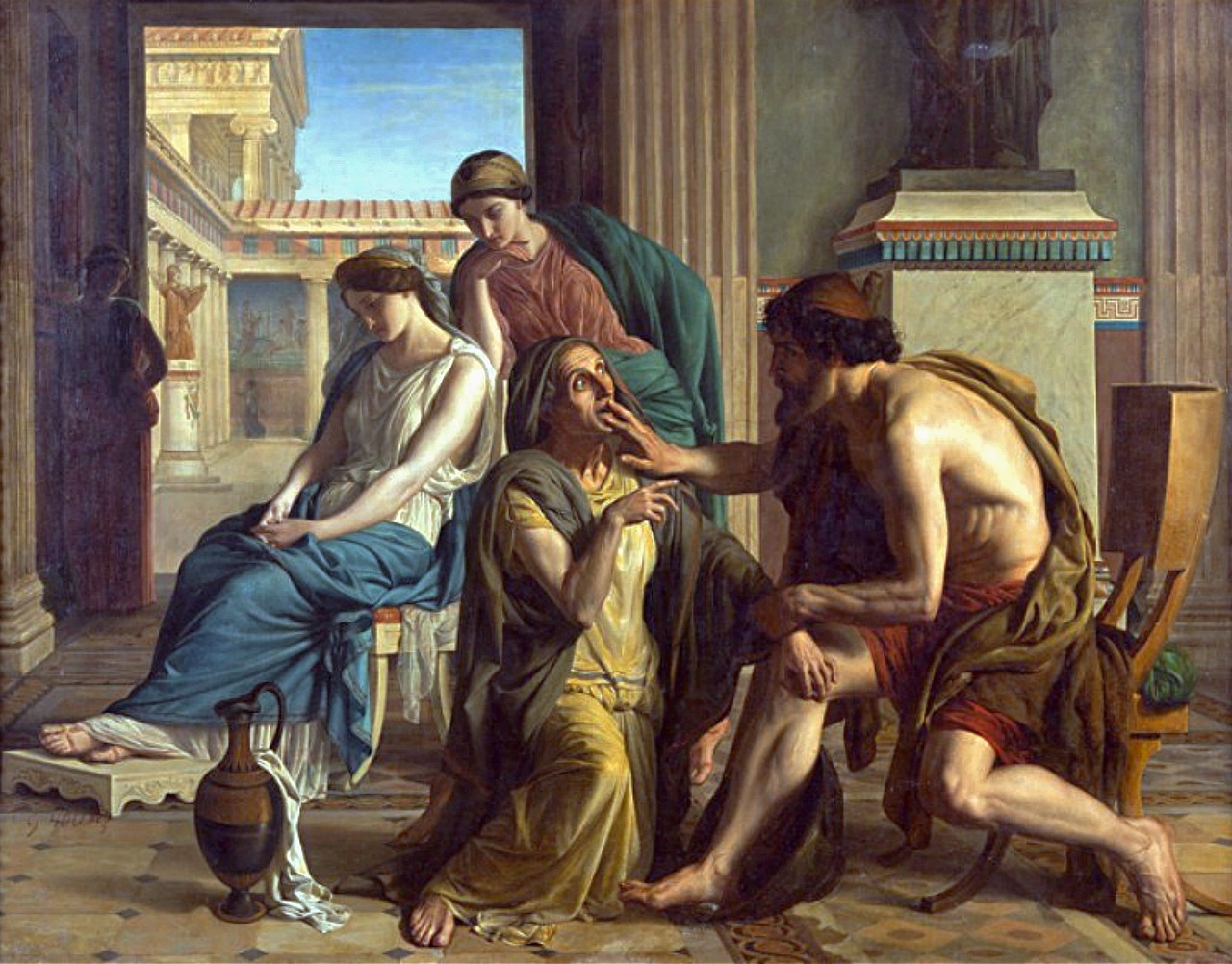
Ulysses Recognised by Eurycleia (1849) by Gustave Housez

3. Eurycleia

As a girl, Eurycleia was bought by Laertes, Odysseus's father. He treated her as his wife, but she was never his consumated lover, so as not to dishonour his real wife, Anticleia. She later nursed Telemachus, Odysseus's son. The name Eurycleia means 'broad fame', while Anticleia means 'anti-fame'. The tension between the meanings of their names can be seen to reflect the tebsion between the aspects of Odysseus's life.

Odysseus was born to Anticleia, a noble woman, but nursed and raised by Eurycleia, a lower-class maid. Odysseus's fame came from his role as a noble hero paralleled to his role as an anonymous beggar. His heroism was essential for capturing Troy; his skills as an orator and a schemer as well as his strength and tactics on the battlefield were instrumental in the success of the Greeks. However, he disguised himself as a beggar at critical moments, such as when he entered Troy and killed the unsuspecting Trojan soldiers, and when he returned to Ithaca and killed Penelope's suitors.

Eurycleia was the only person to recognise him without him first revealing himself (as he did to Telemachus) when he returned home after the Trojan War. She then informed him which of his servant girls had been unfaithful to Penelope during his absence, conspiring with Penelope's suitors and becoming their lovers. His son, Telemachus, hanged the twelve maids that Eurycleia identified.

Eurycleia supports Telemachus in much the same way as she had Odysseus before him, giving Telemachus provisions and supplies before he left for Pylos to seek out news of his father. She swore not to tell Penelope he had left until twelve days had passed, as Telemachus did not want his mother to be any more worried than she already was, or indeed to prevent him from going.

Some classicists argue that the woman who anoints Jesus in the Gospel of Mark is a direct reference to Eurycleia. She is the only one to recognise Jesus, and what she has done will be widely known in the same way as Eurycleia is the only one to recognise Odysseus and whose name means 'widely known'.

Artemis, Goddess of the Hunt, a Roman copy of the original by Leochares circa 325BC
4. Artemis

Artemis, daughter of Zeus and Leto, is the twin sister of Apollo and a goddess of the moon. She was the patron and protector of young girls, and was believed to be able to both bring disease upon women and heal them of it. She was worshipped as one of the primary goddesses of childbirth and midwifery, and was one of the most widely venerated of the Ancient Greek deities: her temple at Ephesus was one fo the Seven Wonders of the Ancient World.

Her Roman equivalent is Diana and she is also known as being a hunter. Homer calls her either 'Mistress of the Animals' or 'She of the Wild', and she is often referred to as 'arrow-pouring' or 'deer-shooting'. Just like her brother she may occasionally be called 'bright' or, even more illustrative of her function as a moon goddess, 'torch-bringer'. Her symbols included a bow and arrow, a quiver, and hunting knives, and the deer and the cypress were sacred to her. 

Women gods and demi-gods traditionally followed one of two paths: sultry or chaste: Artemis was definitely in the latter camp, preferring to remain a maiden and swearing never to marry. This chastity could be interpreted as cruelty or frigidity (fancy not giving her self away to anyone who desired her!) especially by Ovid in his Metamorphoses. When Actaeon stumbled upon Artemis while she was bathing, she was so enraged that he had seen her naked that she turned him into a stag and whipped his hunting dogs into a fury until they turned upon him and ripped him to pieces.

Her legacy lives on in the Artemis Program, formally begun in December 2017 under the Trump administration with the stated intention of landing the first woman on the Moon. Together with commercial and international partners, NASA intends to establish a sustainable presence on the Moon 'for private companies to build a lunar economy' (i.e. to establish commercial mining) and to prepare for missions to Mars. The scale of and motivation behind this project are quite literally out of this world. 

Calypso (1869) by Henri Lehmann

5. Calypso

If Helen of Troy is the face that launched a thousand ships, then Calypso is the name that launched almost as many products, including ships. Tributes to her come in the form of a drink (rum, peach schnapps, orange juice and grenadine), a dance, a style of music, video games, software companies, space craft, British Navy ships, an underwater camera, and a 1942 British minesweeper that was later repurposed as an oceanographic research ship operated by Jacques-Yves Cousteau.

The name means to cover, conceal or hide, and in Greek Mythology, she is a nymph who 'detained' Odysseus on the island Ogygia for seven years when he was attempting to return home to his wife, Penelope in Ithaca. In some accounts this 'detainment" resulted in two children. In others, Odysseus pines for his wife until Athena intervenes and begs her father, Zeus, to order the release of Odysseus from the island.

Zeus orders the messenger Hermes to tell Calypso to set Odysseus free, as it was not his destiny to live with her forever. She is furious and points out the double standards that allow gods to abduct females willy-nilly, but that punish goddesses who have affairs with mortals. Eventually she reluctantly concedes and sends Odysseus on his way after providing him with wine, bread and the materials for a raft. She then takes up the same position on the rock looking out to sea and pining for him, as he had previously sat longing for his Penelope.  In The Odyssey, this is the section of the adventures that begins the tale, before it plunges back into flashback, thus positioning it as an important highlight of the journey.

Friday, 28 May 2021

Friday Five: Depictions of the Greek Underworld

I have been exploring the Greek underworld - not literally, obviously - but because The Penelopiad by Margaret Atwood, the play I am directing and co-producing, is partially set there.

The underworld itself - sometimes known as Hades, after its patron god - is described as being either at the outer bounds of the ocean or beneath the depths or ends of the earth. It is considered the dark counterpart to the brightness of Mount Olympus with the kingdom of the dead corresponding to the kingdom of the gods. The Underworld is a realm invisible to the living, made solely for the dead.

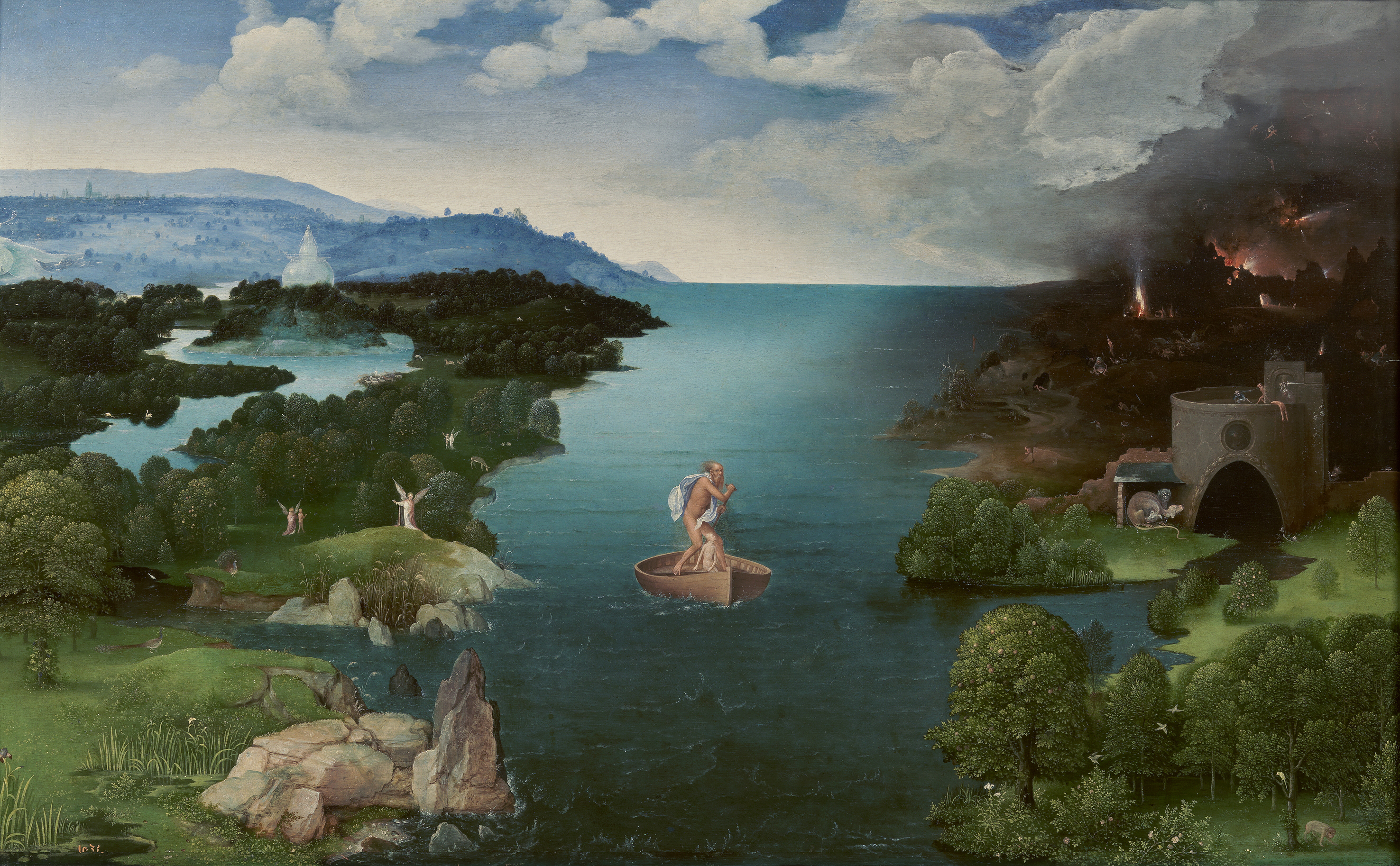
Landscape with Charon crossing the Styx by Joachim Patinir

The Greeks had a definite belief that there was a journey to the afterlife or another world. They believed that death was not a complete end to life or human existence.

In the Greek underworld, the souls of the dead still existed, but they are insubstantial, and flitted around the underworld with no sense of purpose. The Greeks accepted the existence of the soul after death, but saw this afterlife as meaningless. In the underworld, the identity of a dead person still existed, but it had no strength or true influence. The dead within the Homeric underworld lack menos,or strength, and therefore they cannot influence those on earth. They also lack phrenes, or wit, and are heedless of what goes on around them and on the earth above them. Their lives in the underworld were very neutral, so all social statuses and political positions were eliminated and no one was able to use their previous lives to their advantage in the underworld.

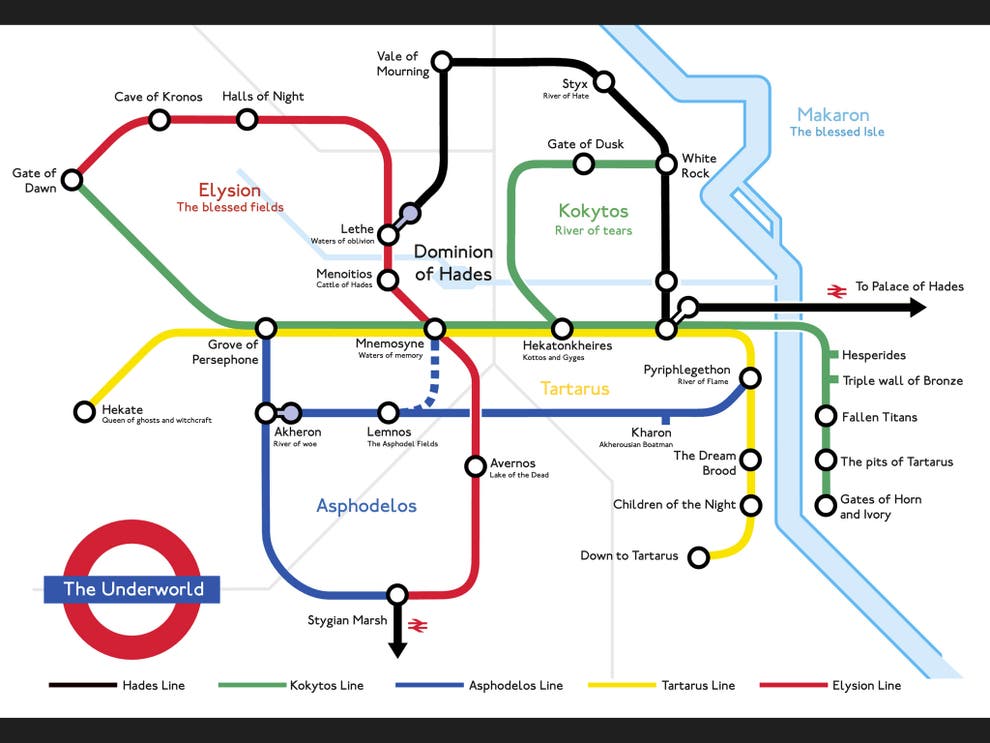
Generally speaking, the Greek Underworld can be thought of as being made up of three different regions; Tartarus, the Asphodel Meadows and Elysium.

An alternative view of the London Underground tube map by the Iris Project

While Tartarus is not considered to be directly a part of the underworld, it is described as being as far beneath the underworld as the earth is beneath the sky. It was thought to be the deepest region of the Underworld, ad a place where it would take an anvil nine days to reach if allowed to fall from the rest of the Underworld. It is so dark that the “night is poured around it in three rows like a collar round the neck, while above it grows the roots of the earth and of the unharvested sea.” – Robert Garland, The Greek Way of Death

Tartarus is the region of the Underworld normally associated with hell, and was the area where imprisonment and punishment was undertaken; as such it was the normal location of the imprisoned Titans, Tantalus, Ixion and Sisyphus. Zeus cast the Titans along with his father Cronus into Tartarus after defeating them. Homer wrote that Cronus then became the king of Tartarus. While Odysseus does not see the Titans himself, he mentions some of the people within the underworld who are experiencing punishment for their sins.

Aneas and Sibyl in the Underworld by Jan Brueghel the Younger
The Asphodel Meadows was a place for ordinary or indifferent souls who did not commit any significant crimes, but who also did not achieve any greatness or recognition that would warrant them being admitted to the Elysian Fields. It was where mortals who did not belong anywhere else in the underworld were sent. It was where the majority of the deceased would end up, for it was the region of indifference. Having drunk from the River Lethe the deceased located here would forget their previous lives, but would spend eternity in a greyness of mindlessness.

While in the underworld, the dead passed the time through simple pastimes such as playing games, as shown from objects found in tombs such as dice and game-boards. Grave gifts such as clothing, jewellery, and food were left by the living for use in the underworld as well, since many viewed these gifts to carry over into the underworld. There was not a general consensus as to whether the dead were able to consume food or not. Homer depicted the dead as unable to eat or drink unless they had been summoned; however, some reliefs portray the underworld as having many elaborate feasts. While not completely clear, it is implied that the dead could still have sexual intimacy with another, although no children were produced. The Greeks also showed belief in the possibility of marriage in the underworld, which in a sense describes the Greek underworld having no difference than from their current life.

Fields of Asphodel by Brian Doers
Elysium, or the Elysian Fields, was a place for the especially distinguished. It was ruled over by Rhadamanthus, and the souls that dwelled there had an easy afterlife and would spend an eternity of pleasure free from work and strife. Usually, those who had proximity to the gods were granted admission, rather than those who were especially righteous or had ethical merit, however, later on, those who were pure and righteous were considered to reside in Elysium. Most accepted to Elysium were demigods or heroes. Heroes such as Cadmus, Peleus, and Achilles also were transported here after their deaths. Normal people who lived righteous and virtuous lives could also gain entrance such as Socrates who proved his worth sufficiently through philosophy. It is the region of the Underworld where mortals were supposed to aspire to and the most closely associated with paradise.

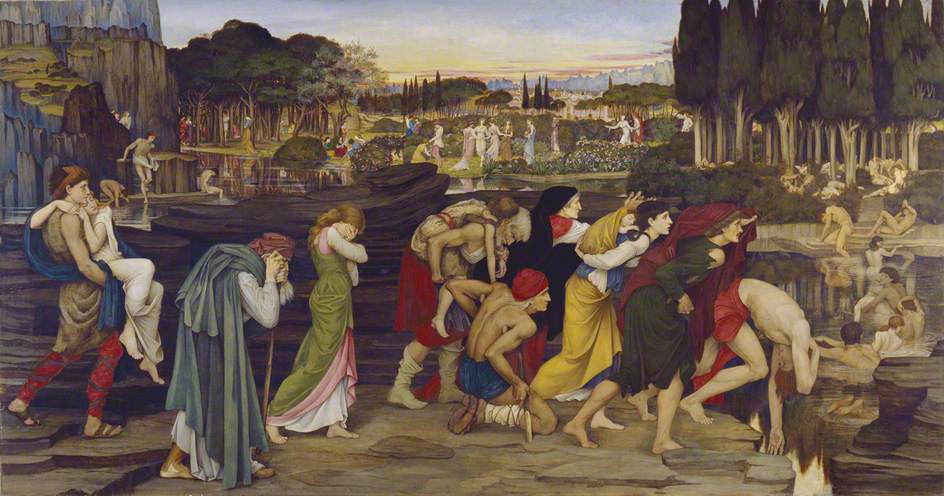
The Waters of Lethe by the Plains of Elysium by John Rodham Spencer-Stanhope

The idea of progress did not exist in the Greek underworld – at the moment of death, the psyche was frozen, in experience and appearance. The souls in the underworld did not age or really change in any sense. They did not lead any sort of active life in the underworld – they were exactly the same as they were in life. Therefore, those who had died in battle were eternally blood-spattered in the underworld and those who had died peacefully were able to remain that way.

Overall, the Greek dead were considered to be irritable and unpleasant, but not dangerous or malevolent. They grew angry if they felt a hostile presence near their graves and drink offerings were given in order to appease them so as not to anger the dead. Mostly, blood offerings were given, because they needed the essence of life to become communicative and conscious again. This is shown in Homer's Odyssey, where Odysseus had to give blood in order for the souls to interact with him.

Hades itself was free from the concept of time. The dead are aware of both the past and the future, and in poems describing Greek heroes, the dead helped move the plot of the story by prophesying and telling truths unknown to the hero. The only way for humans to communicate with the dead was to suspend time and their normal life to reach Hades, the place beyond immediate perception and human time.

It sounds as though social strata was rigidly imposed even back then and even in death.

Friday, 30 April 2021

Friday Five: Women of the Odyssey

I'm in the middle of rehearsals for The Penelopiad by Margaret Atwood, which is a retelling of The Odyssey, focussing on Penelope, who was left behind while Odysseus went off to war and then travelled around having adventures rather than returning to her in a timely manner. I'm co-producing and directing the play which will be on at the Courtyard Studio in Canberra from 7-17 July. I have always loved mythology and the value of storytelling, so have thoroughly enjoyed providing a bit of context to some of the characters mentioned in the text. 

5 Female Characters mentioned in The Penelopiad

Pallas Athena (1898) by Gustav Klimt
1. Athena, also spelled Athene, in Greek religion, is the protector of Athens, and the goddess of war, handicraft, and practical reason – her Roman equivalent is Minerva. She was essentially urban and civilised, the antithesis in many respects of Artemis, goddess of the outdoors.

 She was the daughter of Zeus, produced without a mother – the myths tell how she emerged fully-formed from Zeus’s head, after he swallowed Metis (the goddess of counsel) when she was pregnant with Athena. Being the favourite child of Zeus, she had great power.

She represents the intellectual and civilised side of war and the virtues of justice and skill. In the Iliad, Athena is the divine form of the heroic, martial ideal: she personifies excellence in close combat, victory, and glory. The qualities that lead to victory are found on the aegis, or breastplate, that Athena wears when she goes to war: fear, strife, defence, and assault. Athena appears in Homer’s Odyssey as the Odyssey’s goddess guardian. As the guardian of the welfare of kings, Athena became the goddess of good counsel, of prudent restraint, and practical insight as well as of war. She is often depicted in art with armour, a golden helmet, a shield, and holding a spear. Her armour is the aegis made, in some accounts, from the skin of a Giant, hung with tassels of gold, and featuring the head of the Gorgon given to her by Perseus.

Athena became the goddess of crafts and skilled peacetime pursuits in general. She was particularly known as the patroness of spinning and weaving. That she ultimately became allegorized to personify wisdom and righteousness was a natural development of her patronage of skill.

Circe Offering the Cup to Ulysses (1891) by John William Waterhouse

2. Circe is a sorceress known for her vast knowledge of potions and herbs, and her ability to use these enchantments to transform her enemies, and those who offended her, into animals. In myths she is known to turn an Italian king who spurned her advances into a woodpecker, and when a sea-god preferred the nymph, Scylla, to her, Circe poisoned the water where her rival bathed and turned Scylla into a dreadful monster.

In the Odyssey she is described as a beautiful goddess surrounded by tame wolves and lions. She lures any who land on her island to her home with her lovely singing while weaving on an enormous loom, and then drugs them so that they change shape. When Odysseus visits her island, she invites his crew to a feast and turns them into swine - Odysseus is protected by Athena from drinking the drugged wine that effects the transformation, and he is able to rescue his men, although he then remains on the island for over a year and has several sons by Circe.

She became representative of the results of drunkenness and gluttony over abstinence and self-control. Because she made men lose their reason and act like lustful beasts she was accused of witchcraft and considered the archetypal seductress and whore - clearly female sexual desire was perverted and the poor men couldn't possibly remain chaste and faithful in the face of such evil. 

It has been argued that the fairy Titania, in William Shakespeare's A Midsummer Night's Dream, is an inversion of Circe. In this case the tables are turned and she is made to love an ass after, rather than before, he is transformed into his true animal likeness. Naturally, feminist interpretations reveal her in a more flattering light, and in her poem of 1870, the English poet Augusta Webster posits that when she met Odysseus and his men Circe did not turn them into pigs but merely removed their disguise which made them seem human.

The Three Fates (circa 1855) by Paul Thumann

3. The Three Morai also known as the Three Fates, are three goddesses who determine the course of human life. According to Thomas Bullfinch in Bullfinch's Mythology, they are described as the daughters of Night – to indicate the darkness and obscurity of human destiny – or of Zeus and Themis (Law), that is ‘daughters of the heavens.’ They were Clotho, who spun the thread of life; Lacheisis, who held it and fixed its length; and Atropos, who cut it off.”

Stephen Fry in his book, Mythos, instructs, "Their name derives from a word that means ‘portion’ or ‘lot’ in the sense of ‘that which is allotted to you’. ‘It was not her portion to be loved’, or, ‘It was his lot to be unhappy’, are the kinds of phrases Greeks employed to describe attributes or destinies apportioned by the Moirai. Even the gods had to submit themselves to the Fates’ cruel decrees.”

He continues, “The Fates seldom allowed glory and triumph without the accompaniment of suffering and sorrow... The Greeks felt that for every individual there was a personal, singular moira that could be expressed as a mixture of necessity, doom, justice and fortune. Something between luck and kismet.” Isn't it interesting that the Greeks had a world of gods doing terrible things to humans (raping, abducting, torturing...) and it's the women who get blamed?

The Delphic Sibyl (detail from the Sistine Chapel) (1509) by Michelangelo
4. The Oracle “answers from the gods to questions from mortals seeking knowledge or advice on the future. They were usually given in equivocal form so as to fit an event. Also the places where such answers were given forth by a priest or a priestess.” - Thomas Bullfinch

“In a trancelike state of prophetic ecstasy the priestess would sit out of sight on her interrogator, above a chasm in the ground which channelled down to the womb of the earth itself, and call her ambiguous prognostications up into the chamber above where the anxious petitioner awaited her proclamation… Oracle never lies, but nor does (s)he ever give a straight answer, finding it amusing to reply with another question or a riddle so obscure as only to make sense when it is too late to act upon it.” - Stephen Fry

Lilaia the Naiad (2013) by Annie Stegg

5. Naiads are water nymphs of lakes, rivers and fountains. They derived their vitality and in turn gave life to the water in which they dwelled. Generally speaking, Naiads were not considered to be the most helpful of nymphs, for they could be vengeful when angered.

Sunday, 26 July 2020

All Things Come to Those Who Wait: The Penelopiad


The Penelopiad
 by Margaret Atwood
Canongate
Pp. 196

Margaret Atwood’s Penelopiad is part of The Myths series (other authors include Chinua Achebe, A.S. Byatt, Alexander McCall Smith, Ali Smith, and Jeanette Winterson) which offer alternate approaches to the tales we think we know. This novella is a companion piece to Homer’s Odyssey, providing a female-forward counter-narrative to the story of Odysseus’s quest with his heroic journey and the intervention of the Gods in the lives of mortals. Myths are universal and timeless stories that reflect and shape our lives, and Margaret Atwood provides sardonic asides and a contemporary characterisation of the woman left behind.

Penelope’s experience of remaining, running the estate and defending herself from suitors has always seemed the more interesting part of the story (in the way same way as it was in Cold Mountain) but the focus is usually on the male counterpart and his fantastic adventures. Penelope addresses the reader directly, with a wonderfully clear voice and deadpan delivery, as she wants to set the record straight and present us with her side of the story. She has fought hard for the right to speak, as she sets out from the striking first lines: “Now that I’m dead I know everything. This is what I wished would happen, but like so many of my wishes it failed to come true. I know only a few factoids that I didn’t know before. Death is much too high a price to pay for the satisfaction of curiosity, needless to say.”

She begins with her birth, and the disappointment of realising that her mother, a Naiad, doesn’t really care for her, and her father, fearing a prophecy, throws her into the sea not expecting her to survive. She is understandably bitter: “It never hurts to be of semi-divine birth. Or it never hurts immediately.” She proceeds to write about her marriage to Odysseus and consequent move to his home in Ithaca. Odysseus leaves to fight a war, brought about by Paris of Troy who ‘steals’ Helen from Menelaus. Women are chattels; pawns in men’s battles. Penelope is abandoned for years without protection and with a troublesome son, Telemachus, who doesn’t seem to understand her compromised position or to offer to help her in any way. She weaves a shroud that she unravels at night, delaying her marriage decision until its completion, using the only weapons available to her; cunning and an aptitude for craft. Finally, when Odysseus returns, he and Telemachus slaughter the suitors and hang twelve of Penelope’s closest maids, who have been sleeping with them. The reason for this is never really explained, allowing Atwood free rein with her interpretation of events.

Penelope and her Suitors by John William Waterhouse

Atwood explains in the introduction, that she has recreated the hanged maids as “a chanting and singing Chorus which focuses on two questions that must pose themselves after any close reading of The Odyssey; what led to the hanging of the maids, and what was Penelope really up to?” The Chorus that the maids form provides commentary and diversion as was archetypal in Greek theatre, interpreting the action through song ranging from rap and sea shanties to light operetta and skipping rhymes, which are typically topical: “we are the maids/ the ones you killed/ the ones you failed / we danced in air/ our bare feet twitched/ it was not fair.”

If there is one thing more interesting than the story, it is in the telling of it, and here Atwood aligns with and diverges from the traditional Greek structure like a twisting river. She incorporates the gods and their intervention in human lives, but she is critical of their motives. She plays with the concept of Homeric epithets and constant repetition: hell is gloomy; death is dark; Odysseus is wily; Penelope is faithful; Helen is beautiful; everybody weeps. Penelope is also aware of the injustice of simple labels, and declares that she wants to flesh out her character, and to defend herself from the one-dimensional moral paragon which has been foisted upon her.

Penelope by Leandro Bassano

Penelope hears accounts of Odysseus’ adventures from the poems and the songs of the minstrels, who embroider the facts to please her. In the art of storytelling, there are different versions, and Odysseus fabricates as much as anyone on his return. “He was always so plausible. Many people have believed that his version of events was the true one, give or take a few murders, a few beautiful seductresses, a few one-eyed monsters. Even I believed him, from time to time.” As with the wonderful Life of Pi, if the outcome is the same does the ‘truth’ matter, or does it all come down to personal preference? Stories were told in the past to help explain events; they are used in the present to conceal and obfuscate.

The chorus of maids delivers an anthropology lecture at the end; a device Margaret Atwood has used in both The Handmaid’s Tale and The Testaments. It makes the stories more scholarly and academic, tying together the interpretations and connections, such as the returning king motif and the overthrow of a matrilineal moon cult.

In Margaret Atwood’s version, Penelope is a suitable match for Odysseus. She knows all about his cunning and tricks. “I knew he was tricky and a liar, I just didn’t think he would play his tricks and try out his lies on me. Hadn’t I been faithful? Hadn’t I waited, and waited, and waited despite the temptation – almost the compulsion – to do otherwise?” As Atwood explained in an interview when the book was published in 2005, “There are two ways of fending things off it you don’t want them to happen. One is by force – which is not available to her. The other is by guile. So she has to use guile. And that is also Odysseus’s big stock-in-trade. When in doubt, lie. But lie well.” As this is a reinterpretation of a myth and there is no standard truth, it is impossible to say that Margaret Atwood has lied. But she has re-invented. And she has done it very well indeed.
Penelope by Dante Gabriel Rossetti