Showing posts with label Athena. Show all posts

Tuesday, 12 October 2021

How Beauteous Mankind Is!: Circe


Circe by Madeline Miller
Bloomsbury
Pp. 333

The retelling of classical stories and myths from the female perspective is currently all the rage (The Penelopiad by Margaret Atwood; The Silence of the Girls by Pat Barker; A Thousand Ships by Natalie Haynes) and Madeline Miller is part of this welcome revolution. Here she tells the story of Circe, a semi-goddess often described as a witch, best known for her role in Homer’s Odyssey, where she detained Odysseus and his men, turning some of them into swine. Miller relates this tale in the first person, providing a back-story and reasons for Circe’s behaviour, like the unravelling of a fairy-tale.

Circe (1911) by Beatrice Offor

Circe is the daughter of Helios, Titan god of the sun and, from childhood, she is ridiculed for not shining brightly enough in his eyes. Her name means Hawk because of “my yellow eyes, and the strange, thin sound of my crying”. The gods think her voice is weedy and screechy, but it transpires it is simply like that of a mortal. She is fascinated by humans and shares an affinity for them with Prometheus, who shaped man out of mud. As a child, Circe asks Prometheus what a mortal was like and he tells her, “There is no single answer. They are each different. The only thing they share is death.” She questions how they bear the burden of this knowledge and he replies, “As best they can”.

Bored with the smooth symmetry of the gods, Circe loves the diversity of humans. She is fascinated by mortals, and her words are like those of Miranda in Shakespeare’s Tempest or reminiscent of Doctor Who, who admires mortals but is not one. She has no god-like powers, although she does have knowledge of herbs and potions; medicine to be used for healing and harm, the Greek word for which is pharmakis, ‘a preparer of drugs, a poisoner, a sorcerer’, from which we derive the word pharmacy, and which wisdom led her to be called ‘witch’.

The Wine of Circe (1900) by Edward Burne Jones

Just as she studies the mortals, she also philosophises about the gods. She knows that they are cruel and curious, and that they rule by fear through a hierarchical chain that recalls various political parties and governments.

The gods also “love their monsters” because it gives them something to threaten mortals with, and something for heroes to challenge. They look down upon mortals and heroes, and enjoy toying with them – the Trojan War and its consequences are all a result of their petty squabbles – and they like to see what the mortals will do next when put into impossible situations. “Gods love novelty… They are curious as cats.” These gods are equally childlike and cruel, with a unique morality. “They do not care if you are good. They barely care if you are wicked. The only thing that makes them listen is power… They take what they want and in return they give you only your own shackles.” They also punish those who help mortals; they want the mortals to be afraid because they give better offerings.
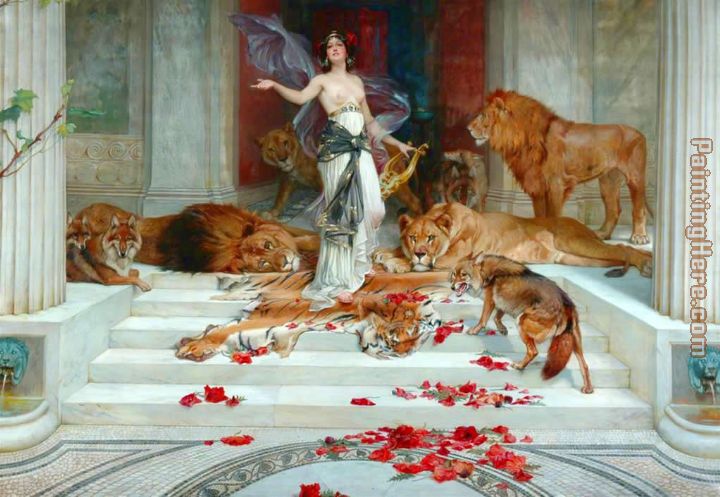
Circe (1889) by Wright Barker 

The most important thing to these gods is their reputation. They are similar to the Knights of King Arthur, who vied for quests to prove their honour, but these gods want only fame – they don’t care how they come by it. Most mortals also want fame above anything: when Odysseus travels to the underworld to consult Tiresias, the blind seer, Achilles tells him it is better to live a quiet life than die a hero’s death. He disagrees. When Telemachus turns down Athena’s offer of adventure, she is bewildered. “There will be no songs made of you. No stories. Do you understand? You will live a life of obscurity. You will be without a name in history. You will be no one.”

Miller uses the style of Homeric language and epithets about Helios, “My father’s chariot slipped into the sea and began to douse itself in the waves” but she also has an individual style as she reinterprets classic myth from a modern angle and damns the ostensible glory of the gods.

After displeasing her father, Circe is exiled to an island, Aiaia, which she cannot leave, but she can receive visitors (including Hermes, Jason and Medea, Daedalus, and, of course, Odysseus). She becomes a magnet for reckless and randy sailors (these are the ones she turns to swine as they try to rape her) and her island a place for disgruntled fathers to send their disobedient daughters, like some mythical convent. She casts her feminist viewpoint on her treatment. “Brides, nymphs were called, but that is not really how the world saw us. We were an endless feast laid out upon a table, beautiful and renewing. And so very bad at getting away.”
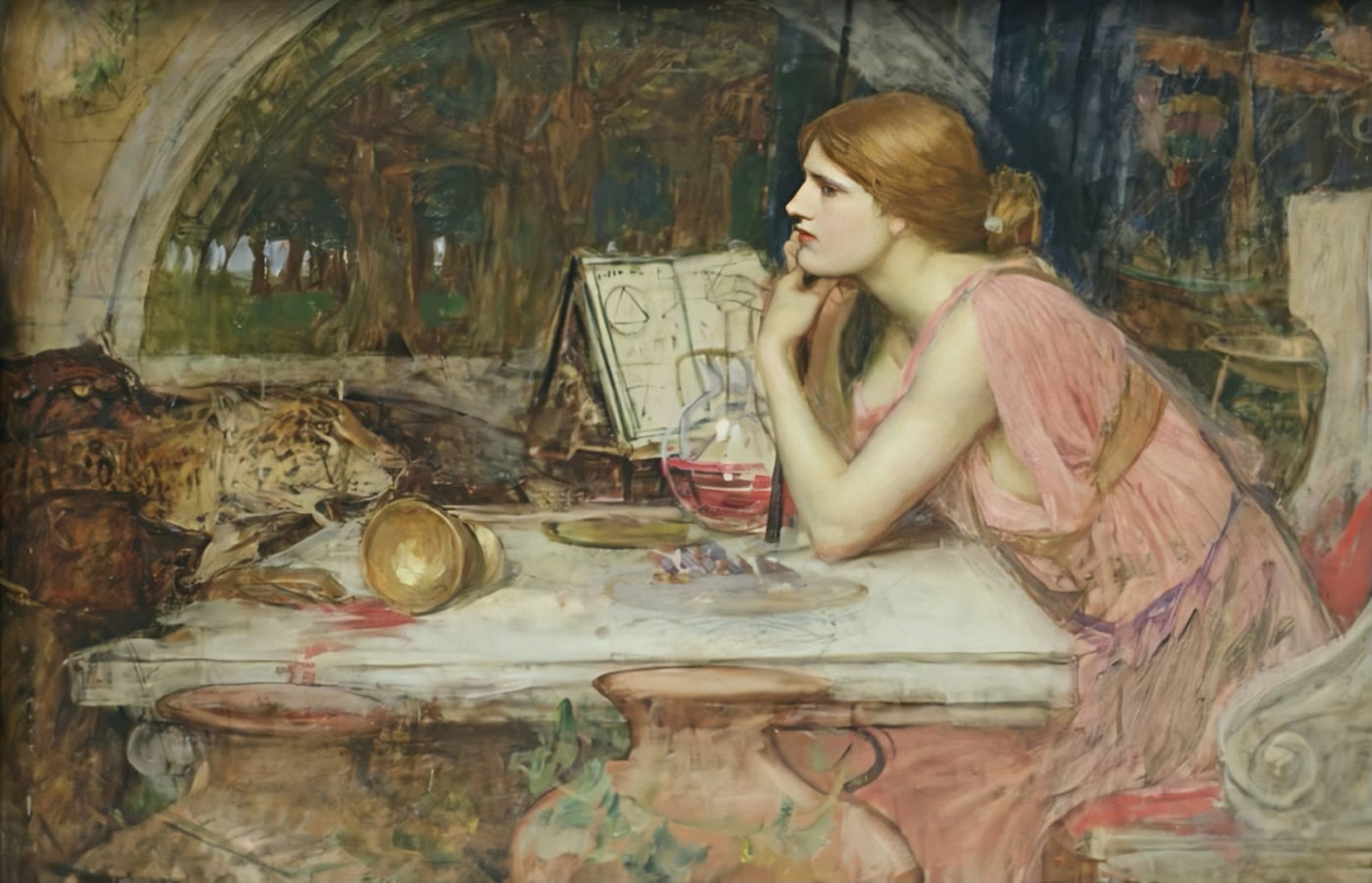
The Sorceress (1911) by John William Waterhouse 

Circe’s story is one that has only previously been told through the eyes of others and the tangential effects she has on their narrative. Miller presents us with another side to wily Odysseus, “The spiral shell. Always another curve out of sight.” She also shows us a fresh perspective on Penelope when Odysseus’ wife and son visit Circe on Aiaia, and the use of the word ‘weaving’ to describe spells and craft unites the women through something other than the lover and mother trope.

Circe is immortal, and she sees many changes, but she does not wish to see destruction. During her early experiments, Circe discovers the limits of her powers. “However potent the mixture, however well woven the spell, the toad kept trying to fly, and the mouse to sting. Transformation touched only bodies, not minds.” To her mind the greatest transformation is life into death. The idea that there is an undying spirit is comforting; it is the same as a story which can be endlessly retold. And this is a version I would be more than happy to hear again.

Circe and Her Swine (1896) by Briton Riviere

Friday, 30 April 2021

Friday Five: Women of the Odyssey

I'm in the middle of rehearsals for The Penelopiad by Margaret Atwood, which is a retelling of The Odyssey, focussing on Penelope, who was left behind while Odysseus went off to war and then travelled around having adventures rather than returning to her in a timely manner. I'm co-producing and directing the play which will be on at the Courtyard Studio in Canberra from 7-17 July. I have always loved mythology and the value of storytelling, so have thoroughly enjoyed providing a bit of context to some of the characters mentioned in the text. 

5 Female Characters mentioned in The Penelopiad

Pallas Athena (1898) by Gustav Klimt
1. Athena, also spelled Athene, in Greek religion, is the protector of Athens, and the goddess of war, handicraft, and practical reason – her Roman equivalent is Minerva. She was essentially urban and civilised, the antithesis in many respects of Artemis, goddess of the outdoors.

 She was the daughter of Zeus, produced without a mother – the myths tell how she emerged fully-formed from Zeus’s head, after he swallowed Metis (the goddess of counsel) when she was pregnant with Athena. Being the favourite child of Zeus, she had great power.

She represents the intellectual and civilised side of war and the virtues of justice and skill. In the Iliad, Athena is the divine form of the heroic, martial ideal: she personifies excellence in close combat, victory, and glory. The qualities that lead to victory are found on the aegis, or breastplate, that Athena wears when she goes to war: fear, strife, defence, and assault. Athena appears in Homer’s Odyssey as the Odyssey’s goddess guardian. As the guardian of the welfare of kings, Athena became the goddess of good counsel, of prudent restraint, and practical insight as well as of war. She is often depicted in art with armour, a golden helmet, a shield, and holding a spear. Her armour is the aegis made, in some accounts, from the skin of a Giant, hung with tassels of gold, and featuring the head of the Gorgon given to her by Perseus.

Athena became the goddess of crafts and skilled peacetime pursuits in general. She was particularly known as the patroness of spinning and weaving. That she ultimately became allegorized to personify wisdom and righteousness was a natural development of her patronage of skill.

Circe Offering the Cup to Ulysses (1891) by John William Waterhouse

2. Circe is a sorceress known for her vast knowledge of potions and herbs, and her ability to use these enchantments to transform her enemies, and those who offended her, into animals. In myths she is known to turn an Italian king who spurned her advances into a woodpecker, and when a sea-god preferred the nymph, Scylla, to her, Circe poisoned the water where her rival bathed and turned Scylla into a dreadful monster.

In the Odyssey she is described as a beautiful goddess surrounded by tame wolves and lions. She lures any who land on her island to her home with her lovely singing while weaving on an enormous loom, and then drugs them so that they change shape. When Odysseus visits her island, she invites his crew to a feast and turns them into swine - Odysseus is protected by Athena from drinking the drugged wine that effects the transformation, and he is able to rescue his men, although he then remains on the island for over a year and has several sons by Circe.

She became representative of the results of drunkenness and gluttony over abstinence and self-control. Because she made men lose their reason and act like lustful beasts she was accused of witchcraft and considered the archetypal seductress and whore - clearly female sexual desire was perverted and the poor men couldn't possibly remain chaste and faithful in the face of such evil. 

It has been argued that the fairy Titania, in William Shakespeare's A Midsummer Night's Dream, is an inversion of Circe. In this case the tables are turned and she is made to love an ass after, rather than before, he is transformed into his true animal likeness. Naturally, feminist interpretations reveal her in a more flattering light, and in her poem of 1870, the English poet Augusta Webster posits that when she met Odysseus and his men Circe did not turn them into pigs but merely removed their disguise which made them seem human.

The Three Fates (circa 1855) by Paul Thumann

3. The Three Morai also known as the Three Fates, are three goddesses who determine the course of human life. According to Thomas Bullfinch in Bullfinch's Mythology, they are described as the daughters of Night – to indicate the darkness and obscurity of human destiny – or of Zeus and Themis (Law), that is ‘daughters of the heavens.’ They were Clotho, who spun the thread of life; Lacheisis, who held it and fixed its length; and Atropos, who cut it off.”

Stephen Fry in his book, Mythos, instructs, "Their name derives from a word that means ‘portion’ or ‘lot’ in the sense of ‘that which is allotted to you’. ‘It was not her portion to be loved’, or, ‘It was his lot to be unhappy’, are the kinds of phrases Greeks employed to describe attributes or destinies apportioned by the Moirai. Even the gods had to submit themselves to the Fates’ cruel decrees.”

He continues, “The Fates seldom allowed glory and triumph without the accompaniment of suffering and sorrow... The Greeks felt that for every individual there was a personal, singular moira that could be expressed as a mixture of necessity, doom, justice and fortune. Something between luck and kismet.” Isn't it interesting that the Greeks had a world of gods doing terrible things to humans (raping, abducting, torturing...) and it's the women who get blamed?

The Delphic Sibyl (detail from the Sistine Chapel) (1509) by Michelangelo
4. The Oracle “answers from the gods to questions from mortals seeking knowledge or advice on the future. They were usually given in equivocal form so as to fit an event. Also the places where such answers were given forth by a priest or a priestess.” - Thomas Bullfinch

“In a trancelike state of prophetic ecstasy the priestess would sit out of sight on her interrogator, above a chasm in the ground which channelled down to the womb of the earth itself, and call her ambiguous prognostications up into the chamber above where the anxious petitioner awaited her proclamation… Oracle never lies, but nor does (s)he ever give a straight answer, finding it amusing to reply with another question or a riddle so obscure as only to make sense when it is too late to act upon it.” - Stephen Fry

Lilaia the Naiad (2013) by Annie Stegg

5. Naiads are water nymphs of lakes, rivers and fountains. They derived their vitality and in turn gave life to the water in which they dwelled. Generally speaking, Naiads were not considered to be the most helpful of nymphs, for they could be vengeful when angered.