Showing posts with label Caribbean. Show all posts

Friday, 7 August 2026

Friday Five: Books Read in July


Flesh by David Szalay (Vintage) - Some people love prose that is 'brilliantly spare' as it depicts the vicisitudes of life as they occur to a central figure with very little passion, emotion, or even dialogue - a grunted assent being about the height of the mains character's  communicative powers. Others find the austere minimalism limiting and tedious, as in this novel of István. Our protagonist is a Hungarian émigré living in London to whom adventures happen (largely incorporating sex and violence), from which he learns nothing until he ends up back in the place where he started living with his mother and staring at the television. It is a wheel of fortune narrative through social and economic strata from the army to security work, drug deals, riches and temporary acceptance, and while some may claim his is a masculine tragedy, his determined lack of personal development undermines any sympathy for his individual odyssey. 
Thirteen Steps Down by Ruth Rendell (Hutchinson) - This novel is dedicated to P.D. James, “with affection and admiration”, which serves as an introduction to a style of thriller that is equally reassuring to read and disturbing to consider. Written in 2004, this stand-alone novel features delusional people haunted by the spectre of Rillington Place and John Christie. Michael (Mix) Cellini is obsessed with Christie and chats to him as a friend. He also fixates on Nerissa Nash, a model whom he stalks while imaging their future life together. She, meanwhile, dreams about a neighbour, Darel, who disregards her as flighty; in Ruth Rendel’s world, we all want attention and don’t really know each other. Fame or infamy are interchangeable to Mix as he reads about the serial killer and rapist, admiring his notoriety. He admits that he wants Nerissa, “For herself, of course, but also for the fame she’d bring him.” Noting that neither man sees Nerissa as a person but rather as an object or a symbol of something, the opposing attitude is encapsulated by Darel’s view of her. “Someone belonging in that so-called elite must be empty-headed, ignorant, tasteless and shallow.” Meanwhile, Mix’s landlady is a cantankerous old woman lost in reveries of the past in which a doctor came to care for her mother many years ago, and Nerissa visits a clairvoyant who peddles spells and crystals. The novel is full of pretence and self-delusion in a world where, “thousands of people disappear every year and are never found.” This is very isolating and a sad comment about the loneliness and insular world of the individual rather than the richness and fulfilling aspect of belonging to a community.
Homecoming: Voices of the Windrush Generation by Colin Grant (Vintage) - Colin Grant interviewed about 100 people and transcribes their words verbatim, with a little bit of editing into themed sections. He held writing workshops with Caribbean people through an Arts Council England project, Writing Everyday Stories of Diverse Britain, in Manchester, Leeds and Birmingham. Due to this method, it can often seem like a dissertation or the raw data wating to be shaped into something more interesting. Naturally not all the voices are the same and they can feel quite differently about their experiences. "There are as many accounts of the generosity of the British population as there were of insincerity. Topics covered include employment, racism, parenting styles, colonialism, American influence and feelings of displacement. When they arrived, they found it cold, grey, cramped and bland – especially the food and the clothes; and the houses were damp and dark – they brought colour, spice, music and style (including hair), making noise at the cricket rather than sitting and applauding politely, and dancing through the streets in carnivals. “Almost everyone I interviewed was disappointed by the blandness of what was on offer when they came to the UK, especially the food.” Some were nostalgic for home and even tried to return but they realised there were more opportunities for them in Britain adn that they were often unwelcome or the victims of violence back in the Caribbean. Grant concludes, “The Caribbean world did come to Britain and forced a realignment of the culture. The achievements of the Windrush generation are many. But the afterglow of their presence is found in their children and grandchildren who have ‘stopped talking tripe’ and have moved from the margins to the centre. Along the way they redefined the very notion of what it is to be British.”

Tuesday, 13 June 2023

Who's Using Who?: The Muse


The Muse by Jessie Burton
Ecco
Pp. 390

The parallel stories in this novel lead the reader to wonder just exactly who is whose muse? It begins in London in 1967 when aspiring Caribbean writer, Odelle Bastien, finds employment at an art gallery, falls under the tutelage of the enigmatic co-director Marjorie Quick, and is seduced by the charms of Lawrie Scott who appears to have a valuable painting to assess. Interwoven chapters focus on the story of Olive Schloss, daughter of Harold and Sarah, who becomes involved with wannabe artist, Isaac Robles, while in Arazuelo in Spain, 1936. Isaac also dreams of being a revolutionary much to the chagrin of his half-sister Teresa who works as a housekeeper for the Schloss family and just wants to avoid trouble.

Of course the names and dates recall the Windrush generation, the Spanish Civil War and the treatment of Jews leading up to WWII. Meanwhile, there are themes of unrequited love, parent-child relationships, and the difficulties of creative women wanting their art to be taken seriously. Lots of people are manipulating each other and hiding secrets in order to score points. It all becomes somewhat messy and incoherent as the author tries to pack too much detail into her story (there is a bibliography at the back to prove she has done her research) and it doesn’t tie together very well. Although the descriptive passages are fantastically evocative, the characters are all one-dimensional and the story itself is unengaging and predictable. In both stories there is a sense of dislocation, privilege and misunderstanding, the notion of shared responsibility and mutual history, and overwhelmingly, the dangerous man trope.

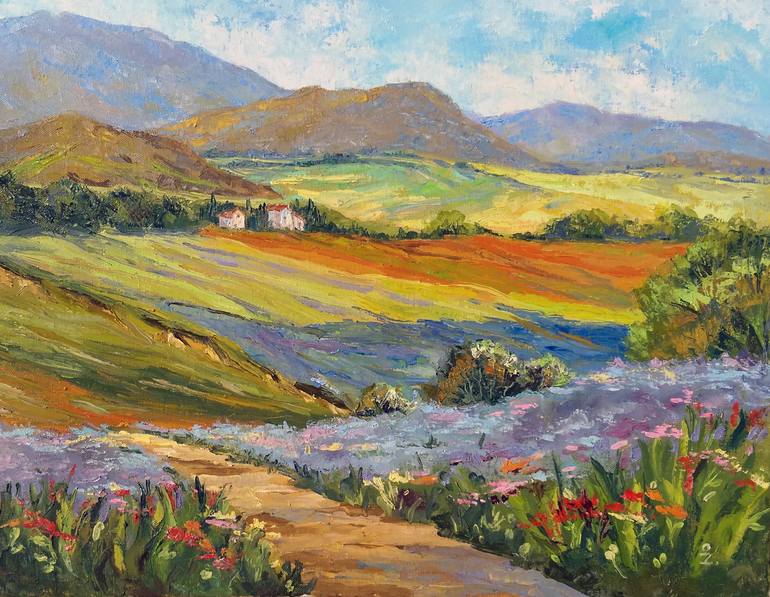
Spanish landscape by Olga Zaitseva

Olive paints pictures and asks Isaac to take the credit for it, aware that her art-dealing father won’t admire it if he knows the true artist. When Isaac protests she should own the paintings, she rejoinders, “Do you know how many artists my father sells? Twenty-six last time I counted. Do you know how many of them are women, Isaac? None. Not one. Women can’t do it, you see. They haven’t got the vision, although last time I checked they had eyes, and hands, and hearts and souls. I’d have lost before I even had a chance.” Of course, this is the provenance of the painting that falls into Lawrie’s hands – there is no mystery to this novel. Olive argues, “They believe it’s Isaac’s painting, and that’s all that matters isn’t it? What people believe. It doesn’t matter what’s the truth; what people believe becomes the truth.”

The attempt at post modernism and attitudes to post-truth are as lazy as the themes of stolen art in Nazi times and the blatant dramatic irony of the impending Kristallnacht. Other descriptive aspects of the prose, however, are a highlight of the novel making the evocative images of Arazuelo in July seem like a painting. “From the hills came the dull music of bells as the goats overtook these smaller sounds descending the scree through the gauze of heat. Bees, drowsing on the fat flower heads, farmers’ voices calling, birdsong arpeggios spritzing from trees. A summer’s day will make so many sounds, when you yourself remain completely silent.” The novel is competent but the craftsmanship is on clear display.

Friday, 30 January 2009

Calypso Cafe

We’ve seen the bright blue and yellow building on Taranaki Street as we drive home – in fact it’s quite hard to miss it – and I’ve often thought I would like to try it out. It’s called Calypso and is purportedly Wellington’s only Caribbean restaurant.

Last night I had an hour between work and rehearsal, and Him Outdoors was working late, so we met there for dinner. The colours, reminiscent of golden sands and seductive oceans, lured us into a sense of calm despite the busy location next to the main road. It’s bright, cheerful and spacious, with décor almost like a fast food place and the food is reasonably priced, but very different.

The dishes display the fresh ingredients and tropical produce of the island region. Apparently the local cuisine is a fusion of Native American, African, European and Asian flavours, adapted to the produce of the tropics. Him Outdoors was expecting something like goat curry, but there are plenty of curry places already, so they (and we) tried out something new.

The service was friendly and attentive without being pushy. Our waitress was keen to point out what ingredients they use and how they cook them. A basket contained breadfruit and plantain, or Caribbean banana, so we could see what they looked like in the raw. Plantains are firmer and lower in sugar than dessert bananas and are treated in a similar way to potatoes in tropical regions.

I had a seafood gumbo which was rich and hearty with plenty of seafood and vegetables, including okra – one of my favourites. Him Outdoors had a beef and corn stew with chunks of meat and baby sweet corn and breadfruit in coconut milk on the side which he also declared to be delicious. Our meals came in clay pots with pyramids of yellow rice and peas, and a hot dipping sauce. The portions were certainly substantial.

There was no need for desserts, although the puddings listed on the blackboard all looked enticing (and coconut-laden) but I’m pretty sure I’ll go back and try them again. Next time I’m also going to have one of their cocktails ($10 and rum features heavily). Last night they had a special concoction called ‘Obama-rama’ but sadly, being as we both had to concentrate for the next couple of hours, we had to give this a miss.

For some reason, I've had Blue Bayou in my head ever since - beautiful song, The Roy Orbison version - not the Linda Ronstadt one, which is way more screechy and less powerful to me.