Showing posts with label Spain. Show all posts

Friday, 10 April 2026

Friday Five: Boycotting Eurovision


Due to the presence of Israel in the Eurovision Song Contest, despite their 'participation in the conflict in Gaza', five countries have boycotted the event - not sending a contestant or televising the spectacle - complaining about the hypocrisy of banning Russia while allowing Israel to compete. So, here's the who's who of who's not.

There's no danger of getting the wrong outfit for Daði Freyr & Gagnamagnið
  1. Iceland - Iceland have been represented at the Eurovision Song Contest 37 times since its debut in 1986. Since the introduction of the semi-final round (in 2004), Iceland has failed to qualify for the final nine times, including four years consecutively (2015-2018). To date, Iceland is the only Nordic country not to have won the contest. They have quite an odd record, actually, having achieved second place twice (in 1999 and 2009), losing out to Sweden and Norway respectively, but also having finished in last place four times, including 1989 when they received the dreaded nul points. Most recently they are best known for the banger of a single, Think about Things by Daði Freyr og Gagnamagnið, which was all set to represent Iceland in 2020 until the contest got cancelled due to COVID. It might have been their best attempt at the top spot as the song was a viral sensation and the band were adored for their catchy electropop, standout dance moves, awkward adolescent vibe and quirky personalised sweatshirts.
  2. Ireland - It should be no surprise that Ireland have boycotted the contest this year, as they have form at protesting over this issue - down with this sort of thing. In 2024 Bambie Thug (who was one of my favourites) came sixth overall and was only allowed to perform after they removed make-up from their body which spelled out 'Ceasefire' in a Medieval Celtic script. The national broadcaster, RTE, which would normally televise the competition, has announced it will screen the satirical Father Ted Eurovision episode of 1996 instead. They are quite a big omission as along with Sweden, they have won the competition the most times (seven), although not since 1996. To be honest, I'm still traumatised by Johnny Logan's What's Another Year? from 1980. 
  3. The Netherlands - Along with France, Luxembourg and the United Kingdom, the Netherlands have won this contest five times previously, most recently in 2019 when, incidentally, the contest was hosted by Israel in Tel Aviv. In 2024 Joost Klein qualified for the final with the relentlessly poppy Europapa, which came second in its semifinal and was hotly tipped to win the competition. However, following a backstage incident between Klein and a production staff member shortly after the semifinal performance, the Netherlands was disqualified from the final. The investigation into the incident was closed on 12 August due to a lack of evidence. This is the only time that an entrant has been disqualified during the contest.
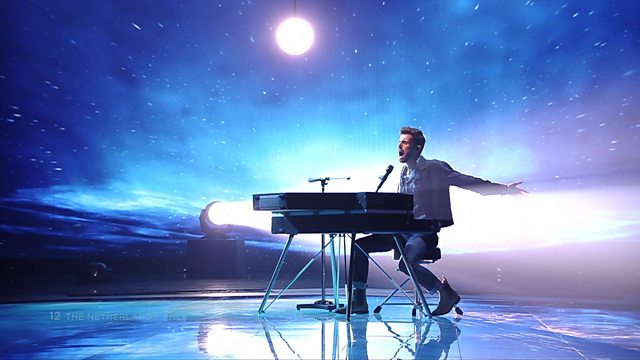
  4. Duncan Laurence wins Eurovision for the Netherlands in 2019 despite seemingly hand-syncing his keyboard playing
  5. Slovenia - Slovenia debuted at the Eurovision Song Contest in 1993, and since the introduction of the semi-finals in 2004, they have qualified for the final eight times. They have not made it into the top ten since coming seventh in 2001. In 2025 they stated they would reconsider participation in the contest if the European Broadcasting Union did not respond adequately to concerns surrounding the 'transparency of the vote', referring to Israel's televote win n 2025. Obviously, no such assurance was received, and the general director of Slovenia's national broadcaster stated that their questions were ignored and, "we clearly won't be going to the Eurovision Song Contest'. With all due respect, I'm not sure anyone will particularly notice their absence.
  6. Spain - Now, Spain, on the other hand... They are one of the Big Five (along with France, Germany, Italy and the United Kingdom), so now it is a Big Four. The aforementioned countries are the ones who contribute the most money to the European broadcasting Union and it is arguable that without these contributions, the contest would be financially unable to proceed. In return for this, they receive automatic entry into the final. This can actually work against their entry, with other countries feeling sour about giving them votes, or it might just be that their songs aren't all that good. (The UK entries for 2024 and 2025 both received no points from the public vote, although the juries brought them out of last place). Spain are no strangers to Eurovision controversy - they have two of only three non-winning entries who have been allowed to perform a second time. In 1990 the orchestra and backing track began the song out of synch, causing the singers to miss their cue, and in 2010 their performance was interrupted by a chap named Jimmy Jump known for pitch invasions and disruption of other entertainment events in order to show Catalan support. 
One of these people was not part of the act, although it made no more or less sense of the song.

Friday, 24 May 2024

Friday Five: Cocktails in Spain


Now that we have dealt with the Sangria, Aperol Spritz and Vermouth, there are still some cocktails to highlight from our trip to Spain - yes, it was a while ago, but the memories are lasting.

 A couple of these are instrinsically linked for me with the venue. Cafe Madrid in Valencia is allegedly the 'best cocktail bar in the city and a byword for quality'. Or so it says on the website. It continues that is the 'epicentre of bohemian, artistic and literary life in Valenica' and 'the best place to have an aperitif and relive those artistic moments in an eclectic space with an industrial feel where art continues to play a transcendental role'. The decor is certainly divine combining elegant chandeliers with industrial chic.


Cafe Madrid is also allegedly the birthplace of Agua de Valencia, 'a zingy and tasty cocktail made with freshly-squeezed Valencia oranges, cava and a special twist.' The 'special twist' appears to be either vodka or gin. 


Another place we loved was L'Ascensor in Barcelona. It's a funky bar with access through a lift door and a great range of cocktails. Service is friendly and knowlegable and we made several visits during our stay to chat to the staff, eat, and, of course, drink.

From the outside
From the inside
1. Agua de Valencia
2. French 75 and 3. Sazerac
4. Catalan Martini (Coffee, crema catalana liqueur, ratafia, rum Barcelo) and 5.Penicilin Ascensor
Him Outdoors with Penicilin Ascensor (Laphroaig 10 Years, honey, lemon, ginger beer)
6. Rom Fashion (Flor de Cana 12 Years, bitter orange marmalade, bitters)  and 7. Mediterrani (Vodka, grapefruit juice, fresh orange juice, lime, Olive lemonade, sugar)

Tuesday, 13 June 2023

Who's Using Who?: The Muse


The Muse by Jessie Burton
Ecco
Pp. 390

The parallel stories in this novel lead the reader to wonder just exactly who is whose muse? It begins in London in 1967 when aspiring Caribbean writer, Odelle Bastien, finds employment at an art gallery, falls under the tutelage of the enigmatic co-director Marjorie Quick, and is seduced by the charms of Lawrie Scott who appears to have a valuable painting to assess. Interwoven chapters focus on the story of Olive Schloss, daughter of Harold and Sarah, who becomes involved with wannabe artist, Isaac Robles, while in Arazuelo in Spain, 1936. Isaac also dreams of being a revolutionary much to the chagrin of his half-sister Teresa who works as a housekeeper for the Schloss family and just wants to avoid trouble.

Of course the names and dates recall the Windrush generation, the Spanish Civil War and the treatment of Jews leading up to WWII. Meanwhile, there are themes of unrequited love, parent-child relationships, and the difficulties of creative women wanting their art to be taken seriously. Lots of people are manipulating each other and hiding secrets in order to score points. It all becomes somewhat messy and incoherent as the author tries to pack too much detail into her story (there is a bibliography at the back to prove she has done her research) and it doesn’t tie together very well. Although the descriptive passages are fantastically evocative, the characters are all one-dimensional and the story itself is unengaging and predictable. In both stories there is a sense of dislocation, privilege and misunderstanding, the notion of shared responsibility and mutual history, and overwhelmingly, the dangerous man trope.

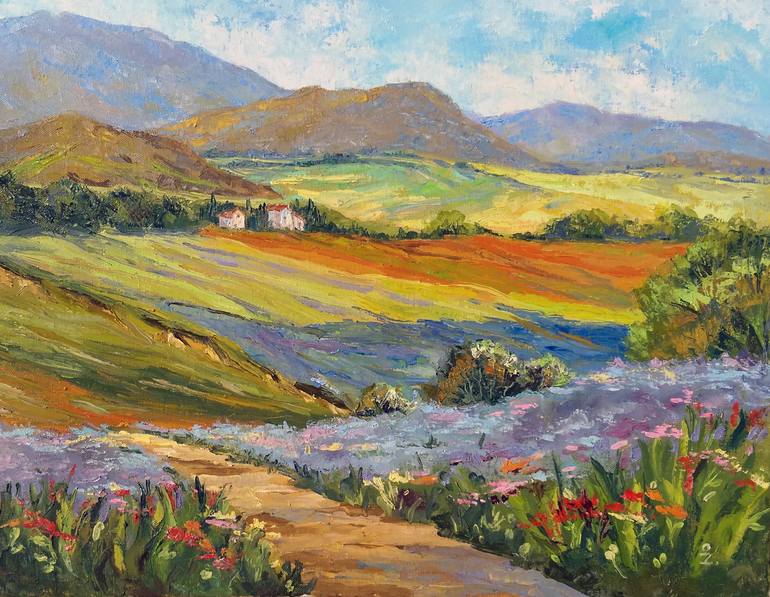
Spanish landscape by Olga Zaitseva

Olive paints pictures and asks Isaac to take the credit for it, aware that her art-dealing father won’t admire it if he knows the true artist. When Isaac protests she should own the paintings, she rejoinders, “Do you know how many artists my father sells? Twenty-six last time I counted. Do you know how many of them are women, Isaac? None. Not one. Women can’t do it, you see. They haven’t got the vision, although last time I checked they had eyes, and hands, and hearts and souls. I’d have lost before I even had a chance.” Of course, this is the provenance of the painting that falls into Lawrie’s hands – there is no mystery to this novel. Olive argues, “They believe it’s Isaac’s painting, and that’s all that matters isn’t it? What people believe. It doesn’t matter what’s the truth; what people believe becomes the truth.”

The attempt at post modernism and attitudes to post-truth are as lazy as the themes of stolen art in Nazi times and the blatant dramatic irony of the impending Kristallnacht. Other descriptive aspects of the prose, however, are a highlight of the novel making the evocative images of Arazuelo in July seem like a painting. “From the hills came the dull music of bells as the goats overtook these smaller sounds descending the scree through the gauze of heat. Bees, drowsing on the fat flower heads, farmers’ voices calling, birdsong arpeggios spritzing from trees. A summer’s day will make so many sounds, when you yourself remain completely silent.” The novel is competent but the craftsmanship is on clear display.

Wednesday, 14 July 2010

End of the World (Cup) as we know it


So the World Cup is over for another year. I will miss it. I won’t miss the vuvuzelas, but I will miss the World Cup. Football begins again soon, though – Liverpool’s first real game is in less than a fortnight as they kick off their Europa campaign.

People have said that the World Cup wasn’t very exciting this year. That is because they are rugby supporters. This year seemed to be all about defence, and I used to play right back, so I am happy enough with that. It was all very well to display your silky skills up front, but if you were leaking goals at the back then you weren’t going to get through to the next round.

Spain may not have scored the most goals, but they conceded the fewest and that’s why they lifted that amazing 18 carat gold trophy. New Zealand have the distinction of being the only unbeaten side in the 2010 World Cup – that will be a pub quiz question for many years to come, in this country at least.

The media here is paranoid that football is edging out rugby in the popularity stakes. Actually, they call it ‘soccer’ (although the New Zealand Football association officially calls it football, along with every other country, apart from America), and refuse to give it the correct status as the beautiful game; more watched globally than any other sport.

The media make a lot of money out of rugby, so they don’t want to admit that more people are interested in football. New Zealand are top of the IRB World Rankings – there are apparently 95 countries that play rugby, approximately 20 of them competitively (Namibia and Romania are included in the top 20). 207 countries play football – a quarter of the way down that list we find New Zealand at 54, after gaining 24 places from their strong World Cup performance.

Glamour attaches itself to the All Blacks – there is a myth in this country that real men are hard and stoic (think monosyllabic and unresponsive – like your stereotypical Yorkshireman). They are afraid of emotion as it might demonstrate weakness (i.e. personality), so despise the fact that footballers hug each other in delight after scoring. A true New Zealander merely does a war dance and sticks his tongue out at the opposition – much more mature.

More children play football – just look at the sports fields of any city in the country on any weekend, but then they are lured away to the oval ball. Just in case this might not happen, they are reminded that they must worship the scrum. When the FIFA World Cup was on the television and graced the front cover of the SKY magazine – it is after all the most watched event in the world – the Kiwi press wrapped a picture of an All Black around it. They weren’t even playing any games that month. Running scared? I’d say so.

Sunday, 4 July 2010

Semi-Final speculation

Reports of the demise of European football have been somewhat previous. We heard so much about the dominance of South American football, and yet there are three European teams in the quarter-finals. Sure; the superstars have fallen by the wayside – Anelka; Cannavaro; Rooney; Ronaldo etc. – but the team-play rather than silky skills are rising to the top, and that is exactly what I like to see.
First up – Brazil v The Netherlands; the one everyone expected the world champions to win, including the world champions themselves. Expectation is a terrible thing – ask England – and the Netherlands quietly went about the business of puncturing Brazil’s illusions. Having scored a goal from an error (Felipe Melo was credited with the own goal), the Netherlands defended well and even managed to score again.

I heard the expression ‘Kuyt to the rescue’ and mention of his impressive work rate on several occasions. Just as Ferdinand might as well be christened ‘Given-away-by’, I seriously began to think that Kuyt’s sobriquet is ‘Unselfish-play-by’. Is there a prize for the most assists? If so, he should definitely be awarded it – perhaps it could be called the golden sock.

Melo’s game went from bad to worse when he was sent off for a dirty foul, stamping on the hamstring of Arjen Robben that could have ended his career. Actually, everyone in a blue shirt had a pop at Robben who spent most of the match flying through the air or rolling on the ground. The match became increasingly ill-tempered towards the end as Brazil were no longer the impressive exponents of the beautiful game and cards flew for deliberate hand-balls and simulation – forty fouls were given in all and Brazil showed more Gallic than Latin temperament problems; I can’t see Germany doing that.

The commentator quipped, “If Brazil are going out of the World Cup they are going out with a fight – quite literally.” He also referred to the Dutch defence as resembling “an orange jelly, just wobbling there – no wonder they’re nervous.” He must have so much fun thinking these things up...

I watched the Ghana v Uruguay game propped up in bed with a couple of female friends in a hotel room; there was honestly nothing dodgy about this (although the discussion about how nice the Ghanaians looked in their red and yellow strip against the bright green turf was a little iffy).

There was everything dodgy about Luis Suarez hand-balling Dominic Adiyiah’s definitely goal-bound extra-time shot off the line. He was given a red card and sent off. Ghana were awarded a penalty as the last action of the game – Asamoah Gyan should have scored and Ghana should have been in the semi-finals. He hit the cross-bar and they’re not.

The match went to penalties, the first of which Gyan took and scored with commendable coolness. Mensah and Adiyiah couldn’t convert their penalties – only one Uruguayan missed, and it’s all over for Africa. Penalty shoot-outs are a lottery: exciting when your team isn’t involved; sickening when they are. One of my friends was demanding, “Why can’t the ref just give a goal?” It’s a fair enough question, and I’m sure she’s not the only one asking, but them’s the rules and although there will a call for them to be changed in future, for now Uruguay are justifiably into the final four.


Asamoah Gyan was understandably distraught. So, slightly less understandably, were my tender-hearted maternal friends. “He’s not your son” I pointed out. “Yes, but he’s some poor mother’s son” one of them snuffled, somewhat illogically. I have seen this happen to England before and wasn’t going to waste my tears on other countries’ sons.

Speaking of cheating hand-of-God South American nations, I thought I might have split loyalties when it came to Argentina v Germany; who do I dislike least? After all; we’ve fought wars against both these countries (okay, so it might be hard to find a country that Britain hasn’t found itself in conflict with over the centuries). As it happened, all it took was one look at the puffed-up pigeon-chested Maradona to make up my mind and have me screaming at the TV, “Come on Germany!”

And they are a good young side with decisive passes and innovative play – of course, the word ‘clinical’ is never far from any description of the Fatherland, and it was a definitive demonstration of what to do with that unpredictable beach ball – split the defence and put it in the back of the net – but it was sublime to watch.

I like Lionel Messi and I like Javier Mascherano; in them I think Argentina has the best striker and defensive midfielder in the world, but as we have seen; this isn’t a tournament for individuals; it is a exhibition of cooperation and the Germans worked together as a tight unit, yes, alright, even an efficient one. There was added satisfaction in the fact that we put two goals past them and Argentina couldn’t even manage one. England don’t look quite so woeful in that light.

And then there’s Spain... People have been calling them under-performers, but they are through to the semi-final after grinding out a 1- 0 victory against Paraguay. The game had end-to-end missed penalties, disallowed goals, retaken penalties, unawarded penalties, squandered free kicks and one of the tightest mid-field contests seen so far in this tournament. Spain may not have set the footballing world alight, but you don’t have to play pretty football to win.

The only bet I have that is still vaguely alive is for Torres to pick up the golden boot. It doesn’t look like it’s going to happen, but he could always prove me wrong by bagging a swag of goals against Germany and progressing through to trounce the Dutch (assuming, as I do, that they beat Uruguay) with yet more bulging of the old onion bag. Like I said, it doesn’t look like it’s going to happen.

Wednesday, 2 July 2008

Euro 2008: final

Yes, I'm pleased that Spain won Euro 2008. If I were a betting person, I'd have put money on them from the start. They played with enough flair up front combined with a solid enough defence to keep out the other big names.

And of course there's Torres. Liverpool need to hang on to him and I sincerely hope they do. As long as they are in contention to play in the European Champons League, they have a good chance.

The final was a great game. People (especially those who don't 'get' football) will say that a 1-0 scoreline is a bit dull, but then, as I said, they don't really 'get' football. Lehmann played a blinder and (with the help of Frings' knee) is the reason the score wasn't higher.

Apparently Lehmann has since complained about the 'biased referee'. This rather tarnishes his excellence, as ref-baiting is usually the last refuge of the sore loser or the New Zealand rugby fan - or is that the same thing? Roberto Rosetti is Italian with a Croatian mother, isn't he? Why on earth would he be on Spain's side?

I loved the entire spectacle despite wishing ardently that we were there. If it took Spain 44 yearts since their last win at a major football tournament, maybe we can repeat the feat. I'm looking forward to the World Cup qualifiers now!

Friday, 20 June 2008

Euro 2008: Who to support?

I am still smarting from England's absence, but I have been enjoying the football played at Euro 2008. It really is the beautiful game, and I don't have to bite off all my nails when my team step onto the pitch, because they're not there.

I don't have to shout rampant biased things at the referee and the opposition, but can instead appreciate each pass, save, volley, free kick, defensive header, crunching tackle, tactical run and, of course, the goals.

But I find sport more interesting if I'm supporting one side or the another. For the record, I'm backing Spain to win the tournament. True, their wordless national anthem is a little underwhelming, but they have the most Liverpool players, including the outstanding Fernando Torres.

It felt strange, this morning, watching the football and wanting Germany to beat Portugal. Football brings out tried and tested stereotypes, and long lost prejudices, largely based on cinematic portrayls and a couple of World Wars fought long before I was born.

So in the end it came down to a question of whom do I dislike more; Michael Ballack or Cristiano Ronaldo? No contest. Ballack may be a fouling, diving, aggressive, dirty player, but Ronaldo is a petulant, whining, cheating, arrogant, selfish, vain, indulgent, tantrum-throing, spoilt, self-obsessed, pouting prima donna.

Sure, he can be a stylish player, but the whinger (and no, that's not a typo) believes he is more than the team, whether that be Portugal or Man Utd. He may be a talented footballer but he is a disgrace to football, and for that reason alone I cheered on Germany.