- The Morningside by Téa Obreht (Weidenfeld & Nicolson) - The Morningside is an apartment building in a future dystopian world in an unnamed country where rising sea levels have flooded much of the land. Silvia is an eleven-year-old child whose mother manages the apartment. They are refugees who have arrived as part of a humanitarian scheme which sends children to school but offers little else in the way of welfare. She encounters another girl, Mila, who seems to have much more privilege, and they have adventures which are hauntingly unpleasant. The world created is sketchy as seen through a veil of imagination and terrifying fairy tales (Silvia's aunt Ena tells her magical folktales) and the young person narration shifts the reader’s focus. This is true magical realism in which the reader should go with the flow rather than swim against the (rising) tide.
- Bury My Heart at Wounded Knee by Dee Brown (Vintage) - Written as social anthropology, this book studies each Native American tribe's relation to and treatment by the American government. The litany of lies, deceptions, broken promises and massacres are overwhelming as the settlers keep pushing West, plundering resources and dispossessing the Indigenous population of their land and livelihood. We know the names of Sitting Bull, Crazy Horse, Red Cloud and Geronimo, and this fills in their stories with ever-depressing detail. It has an elegiac tone as it focuses on defeat and victimisation. "Their musical names remained forever fixedon the American land, but their bones were forgotten in a thousand burned villages or lost in forests fast disappearing before the axes of twenty million invaders." While this book, first published in 1970, undoubtedly changed the way Native Americans were viewed (savages and brutal warriors), the narrative maintains a tragic death of their culture rather than propounding the vibrancy of their survival.
- Psykhe by Kate Forsythe (Vintage) - This begins as an interesting history then rapidly descends to teen-fantasy quest using the myth as a narrative structure. Natalie Haynes, Kamila Shamsie and Madeline Miller are all doing interesting things with myth – Kate Forsythe is not. She tells the story of Eros and Psyche as a template for the Beauty and the Beast fairytale, set in the fifth century BC. Her focus on Estruscan life draws unfavourable parallels with Ursula Le Guin's Lavinia, as she offers up recognisable history without contemporary interest, and the fantastic descriptions of lavish settings are strangely underwhelming, like those of biblical tales. She then attempts to retrofit feminism with passages about the lack of self-determination for women, but succumbs to a conventional narrative in which the supposed passion and desire present more like coercive control. "He had never let me see his face; he had come and left in darkness, he would not let me know his name. I had been kept locked in, forbidden to see or speak to anyone else.” It is rather perfunctory and lifeless and adds little to the ever-increasing canon of mythical revisionism.
- The Safekeep by Yael van der Wouden (Penguin) - Living in a colonised country, one notes strong parallels with the themes in this novel of contested ownership and possession. Isabel lives in the family house in the Netherlands with no real understanding of its origin or how they came by it. She and her younger brother, Hendrik, mockingly discuss their older sibling, Louis, knowing that he will inherit the home when he marries, and that Isabel merely inhabits it on suffrance until that time comes. When Louis, dumps his graceless girlfriend, Eva, on her doorstep, Isabel is initially repulsed by and later drawn into a relationship with her, which is almost Chekovian in its repressed passion and unspoken trauma. There is aching loneliness and explosive sexuality in this stifling millieu of 1960s middle Europe with a focus on atmosphere and undercurrents rather than superficial storytelling.
Showing posts with label Native Americans. Show all posts
Friday, 10 July 2026
Friday Five: Books Read in June
Wednesday, 6 November 2019
Innermost thoughts: Someone Like Me
Someone Like Me by M.R. Carey
Orbit
Pp. 500
In many ways this novel by M.R.
Carey reminds me of those by Stephen King. It is rooted in reality with a
strong dose of pop culture. The relationships seem true and sympathetic, with
natural dialogue and some elements of humour. The concept of split
personalities, or multiple characters in different dimensions, is a good one,
and the supernatural elements creep in subtly. It would make a great film, with
strong visuals and spooky scenes, but the ending is ultimately unsatisfactory
and leaves the reader (or potential viewer) wondering how on earth they are
ever going to get away with telling that story to the police.
It begins with a
sadly familiar tale of domestic violence, as Liz Kendall is being strangled by
her ex-husband, Marc. It appears that has another character inside her, Beth,
who comes out after years of abuse to fight back. The abuse is documented as
part of an on-going case: “That was a lot less exciting and TV-movie-forensic
than it sounded.” The author is aware that this is commonplace and that we have
seen it all before in modern culture, so he has to make it about more than
‘just’ domestic violence.
We sympathise
with Liz; she is poor with two kids to raise (Zac and Molly), an abusive
ex-husband and a terrible medical insurance policy. When she is first ousted by
Beth, there may be sympathy for her too, as Beth has been repeatedly killed by
Marc in different times and other realms. We feel for her absence and all the
things she has missed, as she hugs Molly, “It was the first human contact Beth
had experienced in what felt like a hundred years that wasn’t born out of
violent rage.” But Beth will then use anything to survive, even at the expense
of the children, and we begin to wonder about her motives.
Meanwhile, Zac’s schoolmate,
Fran, is also one of these people who is aware of the multiple options of things
happening in different futures or pasts, and she recognises the duality of
Zac’s mum, Liz/Beth. When she was a child, Fran was abducted and taken to the
Perry Friendly Motel by a man (Bruno Picota) who saw two personalities in her
and tried to kill one. Throughout the trial that led to his incarceration in an
asylum, he became known as the Shadowman because he constantly referred to
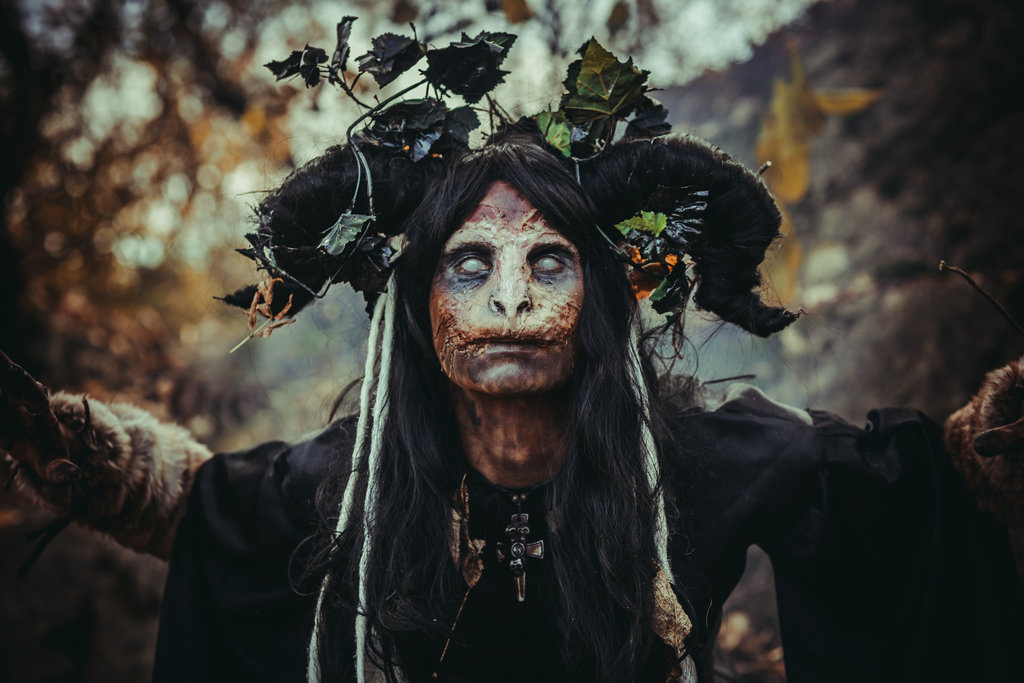
shadows that move independently of their host or ‘skadegamutc’ from Native
American culture. He describes this (in a transcript that Fran and Zac
conveniently locate) as “the ghost of a witch. A ghost, but it’s got magic. An
evil spirit. And you can’t ever see where it might have come from. You just see
that it’s there.”
Like
Stephen King, Carey incorporates Native American
elements, pop culture references, ‘innocent’ children involved in violent and
spooky situations, cinematic and comic book devices (he used to write comics
for DC including Lucifer and Hellblazer), and a denouement at a creepy,
deserted motel. The genre-crossing thriller ghost story is domestic in scope
with science-fiction undertones, but there are sufficient similar themes to
those found in Fellside, which I read
earlier this year, that I don’t think I need to read any more of Carey’s novels
for a while.
![]() |
| Skadegamutc or forest witch |
Fran also has an
alter-ego who is a cartoon fox with a sword and armour, Lady Jinx from Knights of the Woodland Table. Fran
comes to understand that Picota was obsessed with split personalities or
detached characters, who have been separated from the original. He thought he
had killed one of hers. Did he?
As in Fellside, M.R. Carey takes us to a world
of psychologists and criminals as he explores the dark places of the mind. Is
this what happens to the brain when it tries to shield the body from pain, or
to remove the memories of experiences that are too traumatic to confront? Are
these supernatural elements based on self-delusion, or is medication involved?
There is enough ambiguity to interest the reader as the novel crosses from the
solid world we know to the less certain one we fear.
Subscribe to:
Posts (Atom)


