The Australian National Maritime Museum has a fantastic exhibition of shipwrecks, recreated in Lego with information about the ships, the disasters and the recovery missions. We went earlier in the year when we visited Sydney, and really enjoyed it from a number of perspectives; scientific, historic, educational and entertaining. Here are six of the best for the Friday Five.
1. Vasa: wrecked on 10 August 1628
 |
| Vasa |
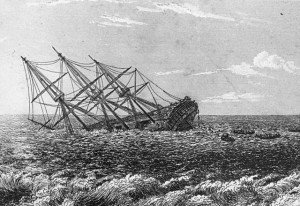
Vasa was brand new - the pride of the Royal Swedish Navy, their most expensive project ever. In 1628, fresh from the shipyard, she set off down Stokholm harbour, with gleaming paint and pristine sails, cheered in by crowds from the shore. She travelled about 1,300m (less than three times the distance around a footy oval), was hit by a light gust of wind, tipped over, and sank.
The ship settled on the sea bed at a depth of 30m. Her masts stuck up above the surface, and many survivors clung to them until they could be rescued. Thirty people were killed, most trapped inside the ship and unable to escape. Vasa stayed where she sank, mostly forgotten once the enquiries and arguments about the sinking were over. Then, 333 years later, the mighty warship was raised from the depths. Today, the world's best-preserved 17th century ship draws the crowds again, at the Vasa Museum in Sweden.
Vasa was rediscovered in 1956 by private researcher Anders Franzén, using a simple grapnel hook towed behind his small boat. He'd been trolling Stockholm harbour for two years looking for it. Whenever he snagged something, he'd lower a special device to take a sample. When he finally pulled up some old black oak, he persuaded the navy to send a dive team to investigate, and Vasa was found.
Instead of investigating the vessel under water, the entire ship was salvaged. Navy divers spent two years digging six tunnels under the ship and pulling massive steel cables through them to suspend the hull in a basket. The cables were taken to two floating pontoons and gradually Vasa was freed from the mud, lifted and moved into shallower water. Vasa was so well preserved that once the gun ports were sealed, and thousands of tonnes of mud and water pumped out, the hull actually floated. So, 333 years since her first fateful voyage, Vasa 'sailed' again.

Vasa sank because someone left her gun ports open. A light gust of wind tipped the unstable ship, the gun ports dipped below the surface, water rushed in and the ship was doomed. Several issues combined to make Vasa unstable. For one, it was too fancy. The king had ordered 700 ornate carvings to decorate his prized ship, but their weight made her top-heavy. By the time these were salvaged, they were mostly all black. Scientists viewed samples under an electron microscope to work out what colours the paint would have been. They found strong, vibrant colours with lots of gold. Vasa was designed to dazzle.

The Lego replica was design by Greg Koutoumis and Will Durkatz, and built by Greg Koutoumis, Darren Ballingall and Jordan Hocking. They write that 'the intricate works on the outside of the ship meant that there was all manner of crazy and unusual parts used. Great examples are the ice creams and micro figures. The ship had a lot of 'gold' details. Unlike the real ship, we of course can't paint Lego bricks, so we are really limited in what parts come in gold, and often we are forced to use some really unusual parts. Making the 'lions' at either end of the ship was a great example, using many parts like golden bananas, musical instruments, clips, pans and even a pair of golden binoculars!"
A fun Minifigure detail is Anders Franzén who was the 'super fanboy' who was dedicated to finding Vasa and actually recovered the first piece of wood from the ship!
2. Batavia: wrecked on 4 June 1629
Like Vasa, Batavia was on her maiden voyage when disaster struck, but had made it a lot further - to the other side of the world. Batavia left Holland in October 1628 carrying trade goods, chests of coins, building supplies and more than 340 people. She was taking them to her namesake, Batavia (now Jakarta, capital of Indonesia), where she was to buy spices to take back to Europe.
Batavia was built as a new flagship for the Dutch East India Company (Vereenigde Oostindische Compagnie, or VOC). The VOC's ships were specially built to sail to Asia and back. They were small enough to cope with the Netherlands' narrow waterways and sandbanks, but strong enough to last four or five round-trips between Asia and Europe.
Francisco Pelsaert commanded the fleet, above the resentful Captain Jacobsz, who plotted with merchant Jeronimus Cornelisz to steal the ship and all the money. but before they could attack, the ship hit a reef at the Houtman Abrolhos islands off Western Australia. The survivors and some supplies were ferried to nearby islands, but there was little food or water. Pelsaert took the ship's longboat to the mainland to look for water, but having no luck, sailed the 3,000km to Batavia for help.
Cornelisz seized the moment and took command of the supplies, weapons and survivors. In the weeks that followed, he and his followers murdered around 125 men, women and children. He was eventually captured by some of the soldiers he'd stranded on another island. When Pelsaert returned three months after leaving, he punished the murderers and rescued the survivors.
In the 1970s, archeologists from the WA Museum began excavating the wreck of the Batavia, and later investigated the graves on the islands. Their ongoing research into this mix of both land and underwater sites reveals more and more of this fascinating and gruesome story.
Archeologists recovered 166 sandstone blocks weighing about 27 tonnes from the Batavia wreck. The blocks had been used to ballast the ship, to help with her stability, but their carefully carved shapes showed they were clearly more than that. As they were trying to work out what they made, they came across the keystone, a distinctively shaped piece from the top of the arch. It matched drawings of the waterport, the gateway to the Castle Batavia, the home of the VOC Governor General for the East Indies. The VOC couldn't source the stone in Indonesia or the Netherlands, so they had it made in Germany and shipped out to Batavia.
Now the archeologists knew what to aim for, but they still had to put it together. Some of the pieces were numbered which suggested how they might stack up. But many weren't, and the blocks were really heavy, so it was hard to swap them around and try different formats. The archeologists made a scale model, which was obviously much easier to play around with, and the museum featured a foam replica of blocks for kids of all ages to try out their construction efforts.


This Lego replica of Batavia was designed by Liam Tullett, Will Durkat and Greg Koutoumis and was built by Liam Tullett, Greg Koutoumis, Stephan Froden, Luke Cini and Gus McLaren. They write, "The most difficult aspect of the build were the masts and sails. Whilst using brickbuilt sails looks great, it does make them a lot heavier than cloth sails. This meant the masts had to be built using pieces with a hollow centre to allow for the addition of metal rods that run the length of the mast, all the way into the base, to keep the boat secure. For the sails I designed them using plates facing outwards to achieve a smooth, flowing shape, and allowed the sails to be slightly filled by the wind."

"The cutaway shows the cargo on board the ship. All of the Minifigs were a lot of fun to add, there's lots of animals, funny scenes and hidden details among the chaos! You can see Commander Francisco Pelsaert talking to Lucretia Jans, leaving merchant Jeronimus Cornelisz to start planning a mutiny behind his back."
"Building the details on the back of the boat was challenging as there aren't many specific detailed elements in gold. It meant we had to get creative, using unusual elements such as crowbars, roller skates and frogs! We also used an octagonal diamond tile in Transparent Opalescent, a new and very uncommon colour."
3. Pandora: wrecked on 29 August 1791
 |
| HMS Pandora |
In 1791 the Royal Navy's HMS Pandora sank after hitting the Great Barrier Reef near Cape York. She had been heading home to England after a five-month hunt for His Majesty's Armed Transport Bounty and her mutinous crew. The navy was unimpressed with the mutiny on the Bounty in which Fletcher Christian stole the ship from Lieutenant William Bligh, and didn't want other sailors to copy the Bounty crew. To show that you couldn't get away with mutiny, even on the other side of the world, it sent a heavily armed ship on a special mission to track them down.
Pandora first sailed to Tahiti, where its crew captured 14 mutineers who'd split from Christian, and learned that two other mutineers had died. Pandora then set off to find the other nine and spent nearly four months searching the South Pacific with no luck. The 14 prisoners were kept shackled in a cramped cell built on the quarterdeck, that they called Pandora's box.
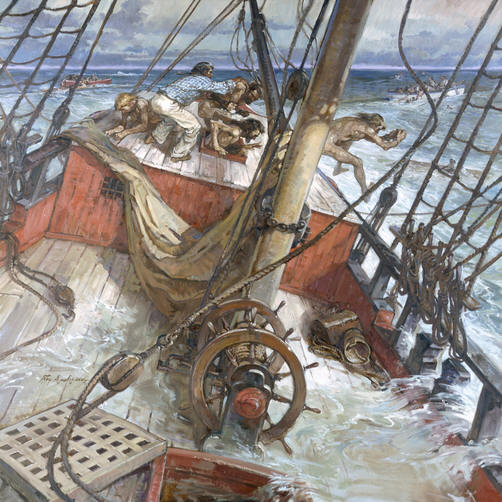
When heading for home, Captain Edward Edwards launched a boat to scout out a safe route through the Barrier Reef. They found a gap, but while manoeuvring to pick up the boat, Pandora hit a submerged outcrop of coral. The crew battled to save the ship, and did get it off the reef, but then it sank. The survivors - 89 crew, 10 prisoners and a cat - spent three days on a barren sand cay while the prepared the ship's boats for a long voyage. The they set off for Timor. Eighteen days and 2,200km later, they made it.

HMS Pandora is one of Australia's best-preserved shipwrecks. It is not a typical Barrier Reef wreck; it didn't remain stuck on the coral to be pounded to pieces by waves. Instead, Pandora's crew managed to refloat their ship and anchor it in deep water while they battled to save it. Unfortunately one of the pumps failed and they couldn't stop the water rushing in. The ship sank, virtually intact, onto the seabed, where it was gradually covered by sand. Only about a third of Pandora has been excavated. The rest remains hidden, preserved in place, saved by the sand.
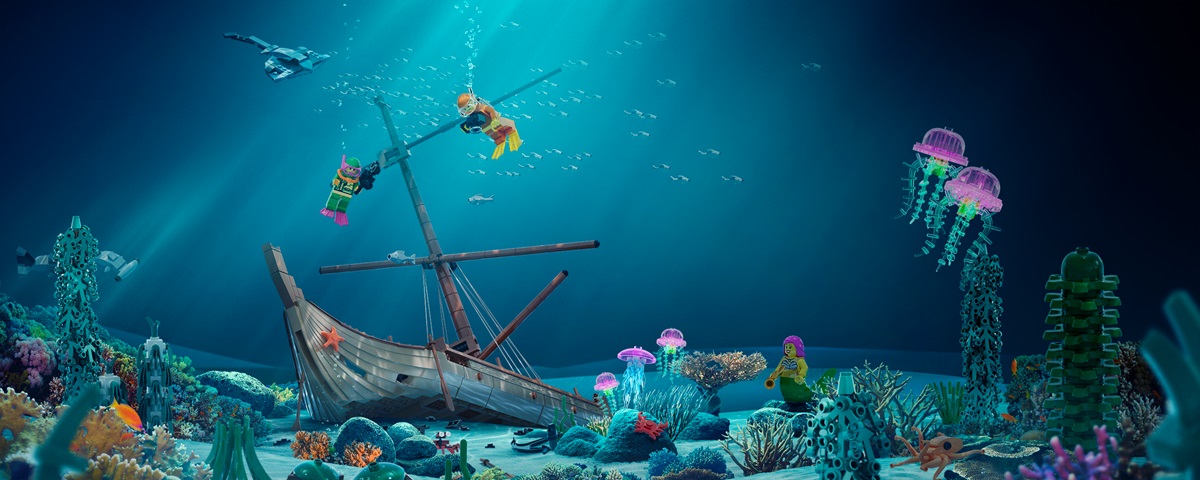
This model (designed by Darren Ballingall, and built by Darren Ballingall, Greg Koutoumis and Stephan Froden) needed to capture the various ways that the wreck was excavated archaeologically, so that each process could be observed and understood. It is built using a larger scale that is normally used. Instead of the scale used for Lego Minifigures, it is for figures that are 15 bricks in height, much bigger than the usual four blocks. Using this scale means all of the other items had to be built larger too, which took a lot of re-imagining of parts.
"Using photographs taken at the actual archaeological dig, we laid out the wreck's debris on the model just as they were found on the wreck. All of the broken bits from the wreck are rusted and crusted in coral and sea life. The divers were built to create the appearance of defying gravity, to seemingly float in the water."
4. Terror and Erebus: trapped in ice September 1846
Royal Navy ships HMS Terror and HMS Erebus set off rom England in May 1845 to search for a route around the top of North Africa into the Pacific - the fabled 'Northwest Passage' through the Arctic. In July they visited the Whale Fish Islands off Greenland, and were spotted by some whaling ships near there. It was the last time the 129 explorers, led by Sir John Franklin, were ever seen by Westerners.
More than 30 expeditions hunted for them, but few found any trace. The clues uncovered, from deserted campsites, cairns and graves, showed the ships had become stuck, frozen into the ice, in September 1846. The ships were eventually abandoned when their surviving crew set off to find help. They never made it.
In recent years, searchers used modern technology to survey large areas, focusing on locations suggested in local Inuit oral histories. HMS Erebus was finally found in September 2014, HMS Terror two years later. Both ships are remarkably intact, but weather and ice only allow a short 5-6 week window each year for researchers to visit. There are still many mysteries about what happened to the ships and their crews, and the search for answers continues.
Finding the wrecks answered some questions about the doomed expedition, but raised many more. Terror and Erebus were navy 'bomb ships', designed to fire heavy motor bombs over high defences on shore. They were built super-strong to cope with the recoil from their weapons, which made them perfect polar explorers, as their thick hulls could cope with the crushing ice. To make them even tougher they had iron plating added to their bows (fronts), which were also reinforced with 2.4m-thick wood. The ships were the first in the Royal Navy to have steam-powered engines and screw propellers, which drove them at speeds of up to 7.5km/h. HMS Terror had an on-board library with 1,200 books (not particularly relevant to the ability to withstand extreme pressure, but interesting nonetheless).
Before heading north with Sir John Franklin, they'd been to the Antarctic in 1839, on the James Clark Ross expedition, which discovered the Ross Ice Shelf and the Trans-antarctic Mountains. Ross named the Antarctic volcanoes Erebus and Terror after his sturdy ships. Before setting off to find the Northwest Passage, Sir John Franklin spent six years as Lieutenant Governor in Van Diemen's Land (now Tasmania). He had a pretty tough time there. In the 1840s there was a financial depression and conflict over a new convict labour system.
Franklin's informal style was not popular with some senior civil servants. He struggled as a politician and was recalled to Britain in 1843. Franklin accepted the Arctic expedition to try to redeem his reputation, but according to a note found by one of the search parties, he died in 1847, while the ships were stuck in the ice. He was 61 years old. The inscription on a statue of Franklin in Franklin Square, Hobart (erected in 1865) includes the quote from Tennyson's poem for the explorer:
"Not here! The white north hath thy bones
And thou heroic sailor soul
Art passing on thine happier voyage now
Toward no earthly pole ."
The Northwest Passage wasn't successfully navigated until 1903, when Norwegian explorer Roald Amundsen made it through. Eight years later, he was first to reach the South Pole. Today, tourists can cruise the route, and climate change is transforming it - in 2007, for the first time in recorded history, there was almost no sea ice in the passage at all.
This model was designed by Ry Catania and built by Ry Catania, Jordan Hocking and Darren Ballingall, who write, "It was important to show the sense of desolation and emptiness. We decided to design the entire icescape using SNOT (Studs Not On Top) techniques, with the flat side of the bricks facing up, to create a smooth and icy surface. This technique shows the landscape to appear vast and open. Studs were instead used as texturing to produce hills, mounds, dips and cracks in the ice."
"To complement the desolate expanse of ice, both ships were designed in 'Microscale' size, using micro-figures to help provide a sense of scale and also tell a story. Building the smaller ship details in Microscale was a fun challenge, as we needed to think of different ways to utilise Lego pieces to represent objects of a smaller scale."
5. Titanic: wrecked on 15 April 1912
Like Vasa and Batavia, RMS Titanic sank on her maiden voyage. On 10 April 1912, the world's largest ship, the 269-metre-long RMS Titanic set sail on a journey across the North Atlantic from Southampton, England to New York City. RMS stood for Royal Mail Ship, as it was contracted to carry post for the British Royal Mail.
Late at night on 14 April. Titanic hit an iceberg on its starboard side and freezing water gushed in at 7,000 litres a minute. It was designed to stay afloat if four of its forward compartments flooded, but it appears as though the iceberg opened six of them. In just over two and a half hours, Titanic sank, and 1,496 passengers and crew lost their lives.
Titanic radioed other ships in the area, but the closest vessel that answered was RMS Carpathia, 93 km away. She arrived about four hours later and rescued the 712 survivors who'd made it into lifeboats. Titanic had only 20 lifeboats rather than the 48 needed to save everyone on board. Anyone floating in the icy ocean soon died from the cold.
Titanic was lost, but as one of the most famous shipwrecks in the world, and star of countless books and films, she was never forgotten. Then, on 1 September 1985, a team led by oceanographer Robert Ballard and French explorer Jean-Louis Michel discovered Titanic's wreck about 600 km southeast of Newfoundland, Canada. They had been searching for over a week towing a submersible camera on a sled behind their ship. Ballard said,
"The Titanic lies now in 13,000 feet of water on a gently-sloping alpine-looking countryside overlooking a small canyon below. It is a quiet and peaceful place - and a fitting place for the remains of this greatest of sea tragedies to rest."
RMS Titanic broke in two as she sank. The bow section plummeted 3.7 km to the seabed at nearly 40 km/h, almost as fast as it had been steaming when it hit the iceberg. It hit the bottom so fast it was driven nearly 19 metres down into the mud. The stern section sank more slowly and landed over half a kilometre away.
The iron and steel wreck is slowly crumbling away and can be damaged by visiting submersibles. Archaeologists and explorers have documented as much of it as possible, to create a record before there's more damage or disintegration.
This model was designed by Eamon Riley, Lauren Brown, Luke Cini, Will Durkatz and Gus McLaren, and it was built by Eamon Riley, Lauren Brown, Jordan Hocking, Greg Koutoumis and Adam Jones. They write,
"The bubbles coming out of the bow of the ship help to communicate the motion of the ship sinking.
The smokestacks/ funnels of the ship are built with a method called SNOT (Studs Not On Top). This allowed us to create smooth surfaces all the way round the funnels rather than leaving studs exposed.
On the dark red part of the hull, we used different sized wedge plates and elements to replicate damage that would have occurred from colliding with the iceberg. Although the damage was subtle, it was enough to send the Titanic to its grave.
We used Minifigure legs as ventilation pipes. This element usually doesn't serve much of a purpose other than their intended design as legs for figures, so being able to use that element is quite nice."
6. Rena: wrecked on 5 October 2011
Just after midnight on 5 October 2011, MV Rena ran straight into Ōtāiti (Astrolabe Reef), a reef 27 km of the coast of New Zealand, at full speed (over 30 km/h). There she stuck, titled to one side, spilling pollutants into the sea. So began New Zealand's worst maritime environmental disaster.
The 236-metre-long Rena was carrying more than 1,300 shipping containers, eight of them full of hazardous materials, such as pesticides and strong acids, as well as 1,700 tonnes of heavy fuel oil and 200 tonnes of marine diesel.
After the grounding, up to 350 tonnes of oil escaped, plus a lot of cargo from the containers, including plastic beads, latex gloves, packets of milk powder, timber and furniture. Drifting and submerged containers became shipping hazards. By 9 October, the oil slick spread 5 km from the wreck. The next day it began washing ashore, devastating wildlife. Eventually Rena broke in half and the back part slid off the reef and sank.
New Zealand's Transport Accident Commission report concluded the Rena grounding was entirely the fault of the crew, who had altered course to try to save time. Modern technology may mean fewer ships are lost without a trace, and more crews are rescued, but shipwrecks today can have a huge impact on our environment. The Rena wreck site isn't an archaeology project (yet) but it still has lots to teach us.


The MV Rena wreck wasn't just an environmental disaster; it also had a huge cultural impact on local iwi (tribes). They were worried about the effects of the oil spill and debris on the environment, especially the health of the kaimoana (seafood) . Kaimoana is of great importance, not only for sustenance and well-being, but also culturally and ceremonially. The grounding and pollution also had significant negative impacts upon the mauri (life force) of the Ōtāiti reef. In Māori culture, people share the mauri with their local environment. They are connected and what affects one also affects the other.
Some of Rena was salvaged, but parts of the ship are still on the reef, affecting its mauri. Local iwi feel the mauri will never be fully restored while the wreck remains on Ōtāiti, especially as it still contains pollutants that may be released. And others worry that trying to recover the wreck would cause further damage and risk lives. There is a sense that the environment is restoring itself by colonising the wreckage.
It's a difficult issue. The mauri of Ōtāiti has been significantly diminished by the impact of Rena and by damage caused during the salvage operation, but there's no agreement on whether it's possible to restore it and, if so, how. Scuba divers say marine life is now flourishing around the wreck and tests found that Rena-related shellfish contamination was no longer an issue. Despite the ongoing issues, in 2016, a government enquiry found that Rena could be left on the reef.
This model was designed by Luke Cini and Will Durkatz, and builtby Luke Cini, Ry Catania and Liam Tullett, who write,
"It made the most sense to start the construction with the ship itself as we were unsure how it would interact with the brick-built water. Once the ship was complete, we were able to find a suitable wedge plate that would marry up the diagonal angle of the ship with the square-built water on the base. Having the ship on a lean also complicated the matter, as the tapering effect caused many gaps that were difficult to fill with square Lego pieces.
Once we had the main hull of the ship built, we were able to begin building the containers. This was the most time-consuming part of the build, as there was a lot of detail we wanted to include to give the shipping containers a realistic look. We got creative with various printed and shaped tiles to represent the various logos that were seen on many of the containers. It also became challenging when it was time to build containers that were on a precarious lean. We found hinge bricks came in handy to get the perfect angles."

When MV Rena was wrecked, hundreds of shipping containers were lost overboard and not all were recovered. Ships don't have to be wrecked to lose their containers - sometimes they just fall off. In 2019, approximately 226 million shipping containers went to sea, but some didn't reach their destinations. The World Shipping Council estimates an average of 1,382 containers are lost at sea each year.
In 1997, one such container held 4.8 million pieces of Lego. It was lost when a freak wave hit the container ship Tokio Express off southwest England, tilting it 60 degrees one way then 40 degrees back. The Lego container was one of 62 containers that fell overboard. Today, even after more than 25 years, Lego is still washing up on British and Irish beaches. This Lego was given to the museum by the Cornish Plastic Coalition. They collected it on a piece of driftwood as an educational display. I think that brings us neatly full circle.