Showing posts with label Samuel Beckett. Show all posts

Friday, 19 July 2013

Friday Five: 1950s Drama

When I first heard I had got the part of Ann in Edward Albee’s At Home at the Zoo, I thought I’d better do some research around the play. Albee wrote the one-act play The Zoo Story in 1958, centring on two men meeting on a bench in Central Park. Peter has gone there to read his book and he is accosted by Jerry, a transient who wants to talk.

Criticism of the play focussed on the fact that Peter wasn’t a fully fleshed-out character, so Albee wrote a first act, Homelife, in 2004. This act explored the domestic scene and Peter’s interaction with his wife, Ann, suggesting reasons for his behaviour during his later encounter with Jerry. Albee has not allowed The Zoo Story to be performed without Homelife (and vice versa) since.

The 1950s was a fascinating decade for drama. I discussed this with my mother (she’s great at literary debate and was frequenting London theatres at this time, so knows her stuff) and she pointed out that theatre in America was very different from theatre in Britain at this time. Britain was reacting to a Tory government, which always makes for interesting drama, as Churchill’s Conservative Party won the 1951 general election (with fewer votes but more seats than Labour) and Labour did not return to power until 1964.

Unemployment was steady, the system did not allow social improvement and many chose to fight against this system and bring attention to the working and middle classes. Within ten years, British theatre had shocked the establishment and moved a world away from the likes of Noël Coward and Terence Rattigan. Before the 1960s kitchen sink dramas, the stages in the 1950s were full of social alienation, working class realism and a move towards Absurdism. Many of the playwrights of the 1950s were left-wing and angry. In 1950s theatre in context, StageWon, Dan Hutton explains, 
“The defining play of this era, however, and arguably the one which changed British drama forever, was John Osborne’s Look Back in Anger. It has gone down in theatre folklore as the piece which singlehandedly managed to pull British drama out of the innate Victorian traditionalism of the first part of the 1900s and into the 20th century. Charting a few days in the life of the now infamous Jimmy Porter, it was panned by many critics but spawned one of the most famous reviews of all time by Kenneth Tynan in the Observer, who said they he “could not love anyone who did not wish to see Look Back in Anger”.”
Whereas the anarchistic Angry Young Men (and Women – Shelagh Delaney’s A Taste of Honey is a classic of the era) were particularly British, some of these themes were also being developed in American dramas. Arthur Miller and Tennessee Williams may have been a little more structured, but Hutton argues it was clear that “a precedent had been set for plays from which meaning was difficult to extract”. Plays began to appear meaningless with lack of plot and action; the death of the narrative led to confused and bewildered characters, and probably audiences.

So, besides reading around Albee and the historical period against which these plays were set, I have been discovering and re-reading some great work of the era.

5 Quintessential 1950s playwrights: 
  1. Arthur Miller – The Crucible (1953); A View from the Bridge (1955) – looping dialogue in which characters desperately try to explain things to each other and are rarely understood
  2. Samuel Beckett – Waiting for Godot (1953); Endgame (1957); Krapp’s Last Tape (1958) - a massive step in the direction of the absurd
  3. Tennessee Williams – Cat on a Hot Tin Roof (1955); Orpheus Descending (1957) - terribly conficted characters doind desperately brutal emotional things to one another
  4. Harold Pinter – The Dumb Waiter (1957); The Birthday Party (1958); The Caretaker (1959) - the plot disappars into dialogue and the theatre of menace is born
  5. Eugène Ionesco – The Lesson; The Chairs; The New Tenant (1953) – one-act plays which he described as ‘anti-pièces’ or anti-plays; extended sketches of nonsense as words overwhelm the characters to create a sense of unease

Friday, 9 July 2010

Worth the Wait

Waiting for Godot
(Theatre Royal Haymarket Productions)

St James Theatre, Wellington
30 June – 2 July

“The acting was fantastic, the set was great, but I don’t think I really like the play.”


“I didn’t really like it at the time, but I’ve thought about it so much since and seen many more layers the more I think about it.”

“There are many ways to interpret the play, and this production really accentuated the comedy.”

“I think this is perfection – I’m not sure that I ever need to see that play again.”

The above comments are from my friends who saw the recent production of Waiting for Godot in Wellington. I can agree with all of them. It’s a ‘difficult’ play. Ostensibly nothing happens – a couple of old blokes wait around for a man who never comes. A messenger tells them that Godot is sorry that he won’t be able to come today, but can they come back again tomorrow. They do so. We get the impression that they may have been doing this for some time now and may continue to wait forever.

People admire Beckett’s formidable reputation: they respect Waiting for Godot; they study it; they wrestle with it; they fear it; and they appreciate it. But do they really like it? After all; what’s to like (see synopsis above)? There is no real character development, no explanations, and no glib back-story: the characters merely are what they do and say, and that really isn’t very much. I have heard this described as “an actor’s play” but it could equally be “a directors’ play” because the interpretation is everything – and director Sean Mathias has worked with his actors to produce a sumptuous production.

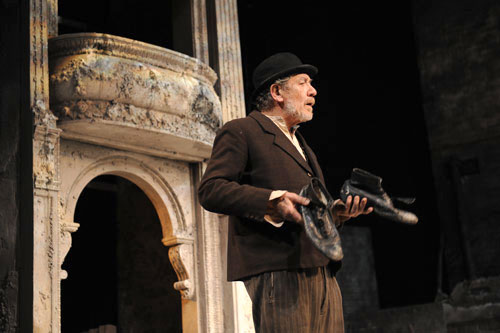
Estragon (Gogo) – Ian McKellen – and Vladimir (Didi) – Roger Rees – are perfectly balanced like children on a see-saw that have rocked to a stand-still. Didi seems to be the practical, protecting one, while Gogo is the entertainer or whiner, depending on his mood. Didi tries not to laugh, due to a weak bladder and unspoken prostate complaint, but Gogo frequently has him in stitches. To pass the time as they wait, they try conversing, arguing and contradicting each other. Their verbiage is delightful and it is refreshing to hear Ian McKellen talk in his natural Lancashire (not Yorkshire as I have seen reported – he was born in the same hospital as Him Outdoors) accent.
 
The two old men are totally in-synch, and we believe theirs is a relationship that has blossomed over the years with equal parts affection and irritation. They are clearly afraid of being alone but even the talk of hanging themselves from the emaciated tree is done in a quirky and flippant manner. The humour masks the sinister, nightmare quality that can seep through this play. As Didi tries to explain to Gogo that they were here yesterday and what they did, Gogo’s inability to remember is not as dark as it could be – nor is the fact that he is beaten every night – by what or whom we don’t know, but it doesn’t seem to matter as much as it could.


Across their radar stumble Pozzo and Lucky. Matthew Kelly (yes, the one from Stars in their Eyes) is sensational as Pozzo. He uses his imposing height and commanding voice to tower over the cowering old tramps. But although he is the one literally cracking the whip and pulling the strings, he is helpless and lonely, demanding companionship from the macabre Lucky (Brendan O’Hea) who is anything but. He can command Lucky to sing, dance or think, which he does with energetic aplomb. These two are defined by this chilling master/servant relationship with an unidentified tipping point.

The raw emotion is paramount as the characters behave like vaudevillian clowns – Lucky even appears with white-face and big blackened eyes. The physical theatre is excellent from the business with the bowler hats and boots (as explicitly specified in the stage directions), to the shuffle dance and mocking imitations. This isn’t a long play on paper, but it lasts for over two and a half hours and the repetitions begin to feel increasingly surreal.

The silences are substantial as the men inhabit their feelings: anxiety; hope; fear; anger; frustration; sadness; envy; need; hunger. They cross the boundary between mental sensation and physical state. We have animal sensibilities but we are human in our need to relate. We are only who we are in relationship to each other, and how that relationship develops depends on the part we choose – yes, choose – to play. The theory that we can choose to determine our own development is the definition of existentialism, of which this play is regarded to be one of the greatest proponents. As ever, the great man was right: we are all merely players; and one man in his time plays many parts.

The set (designed by Stephen Brimson Lewis) deserves an individual mention as the ruined theatre confronts us. Is the rubble the aftermath of some violent event; should we be worried about the absence of Godot? Is it an indication of the deconstruction of the theatrical experience – no longer content to follow a traditional plot that troops through its chronological stages and sends us away satisfied with a happy ending? The spindly tree, frigid moon (lighting designer – Paul Pyant) and discordant sounds (sound designer – Paul Groothus) leave us aching with longing for something, but what? There really are more questions than answers in this play.

In essence, this raises the question of how we validate our existence. If I have been for walk, read a book, shopped for groceries, done the washing, paid the bills and written a couple of letters, I will still answer ‘nothing much’ when someone asks, ‘what have you done today?’ We spend a lot of time waiting for something exciting and diverting to happen to us – when it doesn’t, can we really say we have lived, or just existed? I think we can consider this production of Waiting for Godot to be one of the most exciting and diverting to happen in a long time.