Showing posts with label The Last Supper. Show all posts

Tuesday, 25 May 2021

My Newest Favourite Thing: Ken & Julia Yontenani

Five years ago I went to an exhibition at NGA Contemporary. The gallery closed the next day. It's not my fault, honest - the gallery on the Lake Burley Griffin waterfront was only open for 18 months with articles at the time citing 'the federal government's continued efficiency dividend imposed on several cultural institutions' or 'relentless government cutbacks' as the reason for the closure. Anyway, I was clearing some photos from my phone because it's full (hard to believe, I know, being as it's still got photos from five years ago on it...), and I came across these from the exhibition so I thought I would share.

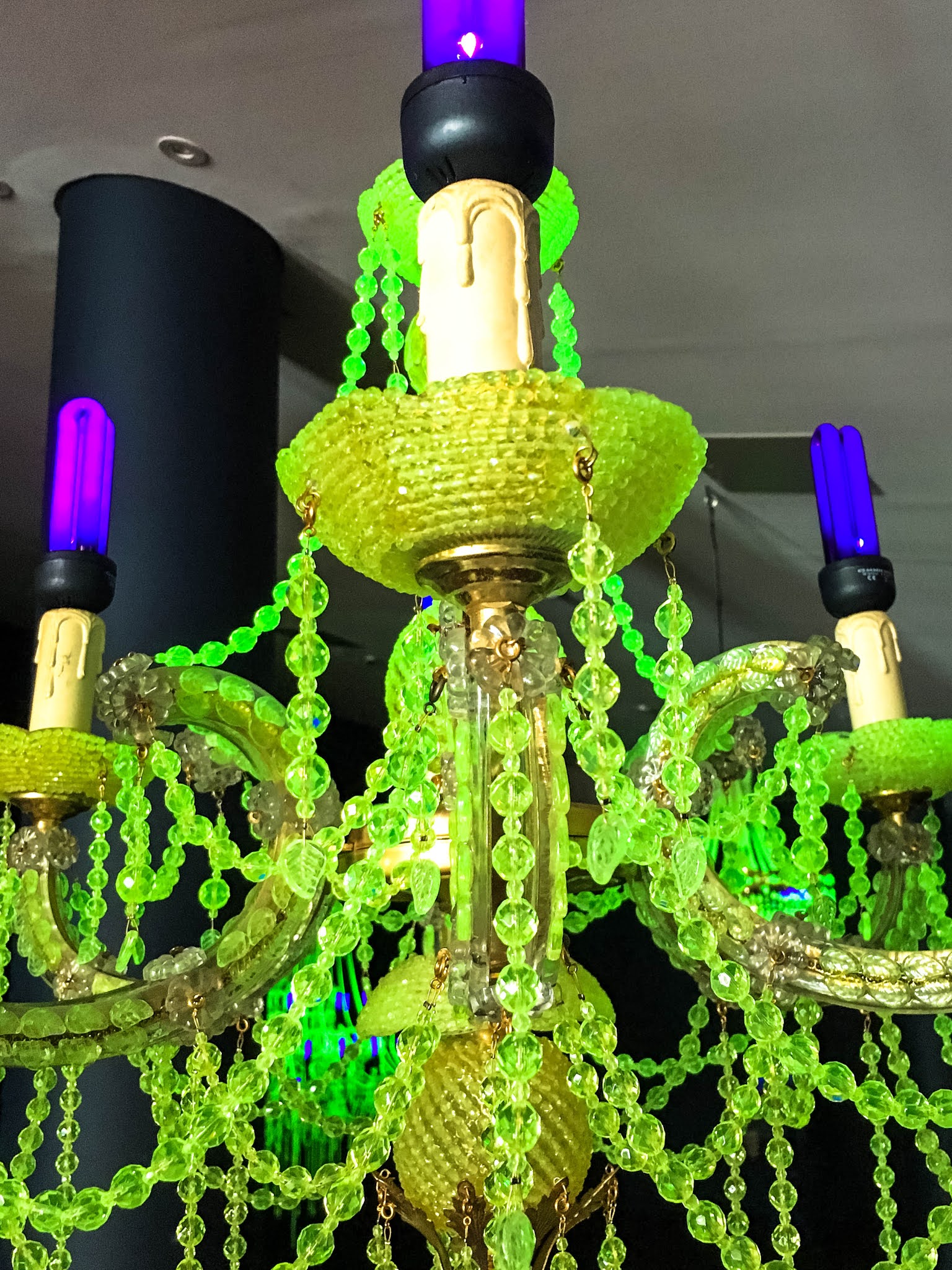
In two major installations, artists Ken and Julia Yonetani explore the notion that although the world appears rich in natural resources, the well-being of the planet is held in precarious balance. The first exhibition, Crystal Palace: The Great Exhibition of the Works of Industry of all Nuclear Nations is a provocative response to the Fukushima Daiichi nuclear power plant disaster in Japan in 2011. In an installation of chandeliers reconfigured to emanate UV light, and decorated with specially sourced uranium glass, each chandelier represents a country that operates nuclear power stations and is of a scale relative to that country's nuclear output. 

The idea of using the chandelier was sparked when the Yonetanis were entranced by the displays in the shop windows while on a bus ride in London. Tempted by the opulent beauty of antique chandeliers and their history in the evolution of electric light, they envisioned a contemporary take on The Great Exhibition of 1851 in the Crystal Palace, which aimed to showcase the world's latest technologies (those of the Industrial Revolution). This set the stage for the artists' idea of nuclear nations of the world.

Faced with the challenge of how to represent radiation, they hit upon using uranium glass beads and ultraviolet light bulbs that make the green of the beads fluoresce in the dark. The work is aesthetically astounding, accessible and engaging. Uranium glass contains very small traces of uranium within the glass, is legal and poses no health risks. While their chandeliers are entirely safe, the idea of recycling a uranium by-product that glows in the dark appealed to the artists. 

‘You can’t see, smell or perceive radiation with your senses, but it becomes visible in our works when illuminated with ultraviolet lights,’ say the artists. ‘Presented in darkness, the glass chandeliers and tubes glow with an eerie bright green light indicating the presence of radiation. We hope to prompt viewers to react in their own way to this radioactive presence.’

The blurb says that there are many cross-cultural layers of meaning and paradoxes in this installation that combines significant environmental issues within a floating glowing dream-world. I think it's pretty. 

Alongside these opulent chandeliers sits The last supper, a nine-metre table made of over one tonne of groundwater salt sourced from the Murray-Darling Basin featuring a variety of foodstuffs in the form of an exquisite banquet. Drawing its title from Leonardo's great Renaissance mural of the same name, this work plays with the idea of the final meal - the endgame of how we utilise our natural resources. 


The artists' use of salt came out of a residency working with scientists at the Murray-Darling Freshwater Research Centre, where their research was focused on the question of how to deal with rising salt levels in the water irrigating crops in a region regarded as a food bowl. Their initial concerns broadened, however, to include the impact of salinity in a a global sense, noting the subject of salt has been fraught since the beginning of human existence. ‘Here salt is a metaphor for the death of the land, sacrificed in the production and consumption of what has become The last supper,’ explain the artists.


On a practical level, the medium of salt posed great difficulties for the artists due to its solubility. After experimenting with smaller works, the creation of a nine-metre salt banquet table replete with an array of foodstuffs and objects was a labour of love and a great challenge. It connects with a tradition of still-life and banqueting subjects in the history of art as well as with different religious and cross-cultural traditions.As the artists have said,
"Although the work isn't necessarily a religious comment, The Last Supper is obviously connected to biblical stories, and salt is very much connected to not only the bible but a lot of religions, including in Japan - it's seen as a very sacred material."

The incongruity of the salt creations of edible treats is most market on the supposedly sweet things, and it also carries over into a work which combines the two installations, in a piece that meets the viewer as they enter the gallery. Grape Chandelier (2011) is made of salt and metal, although it looks like an exotic style of beaded curtain one might find in the tropics. 

"Historically in Europe the chandelier was often considered as reminiscent of the shape of grapes. In this chandelier, we have cast more than 5,000 grapes with salt. The grapes were sourced in the Mildura region, known for its wine production. The issues of irrigation, wine production and salinity all go hand in hand in this region. Hence we put them all together in this work, which is actually our first chandelier-inspired work, made before the Crystal Palace series. We began drawing on the idea of the chandelier as a symbol of luxury from the Renaissance era with this work." - Ken and Julia Yonetani

Monday, 10 January 2011

Stanley Spencer

At the Stanley Spencer Gallery in Cookham, the exhibition in the little building is Stanley and the First Mrs Spencer, reflecting the influence of Hilda Carline on his work. I really like the way he interjects religious scenes into everyday compositions, often with particular reference to his local village - or is it the other way round?

I like The Scarecrow, Cookham (1934). The Royal Academy rejected two of his paintings before accepting this one; his consequent resignation challenged the Academy's attitude to modern art. Spencer painted from what he knew and he said of this scarecrow, 'Left and deserted as it was, it seemed daily to become more a part of its surroundings. In the evening he faded into the gloaming like a Cheshire cat.'


In paintings such as Hilda and I at Burghclere (1955), he aints scenes of domestic harmony - the whole family (including the cat) is highlighted by every detail of pattern and texture. In Domestic Scenes: At the Chest of Drawers (1936) he presents himself as a diminutive man dominated by an exaggeratedly large woman - a recurring theme through his work. His Self Portrait (1923) and Hilda's Portrait of Stanley Spencer in the same year show the same view but demonstrate their quite different techniques.

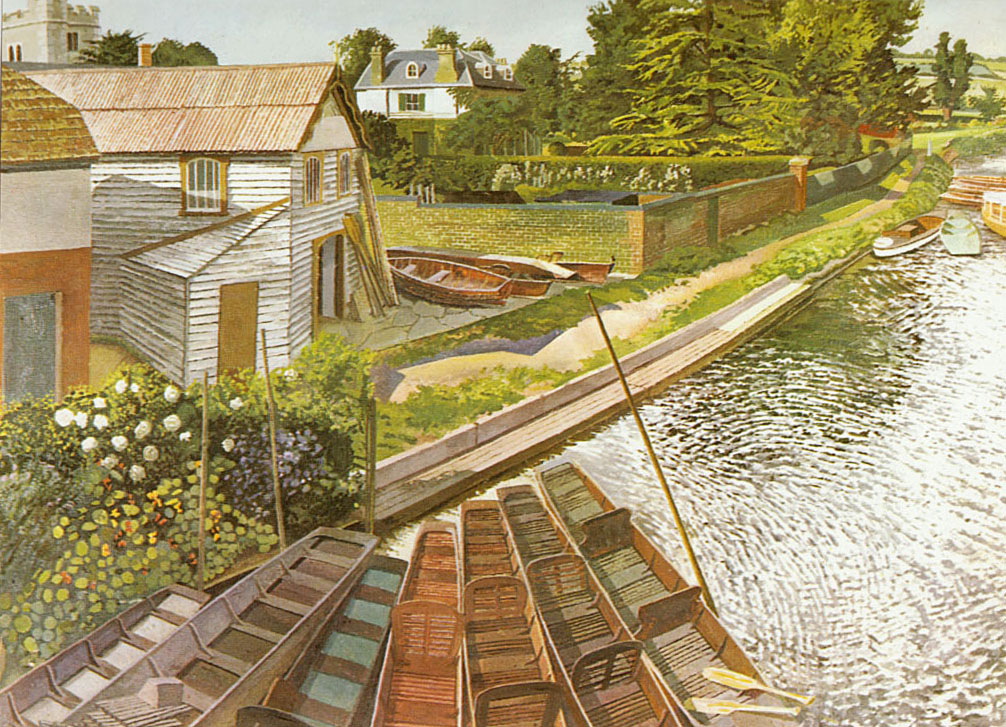
View from Cookham Bridge (1936) is another favourite of mine, possibly because the quintissential summer view of the riverside of Cookham is full of naturalistic detail: the punts in the foreground; the currents on the river; the boatyards and hedgerows full of flowers; more formal walled gardens and grassy fields in the distance; the belltower of the church peeping over an uneven red roof... It's all so very familiar.

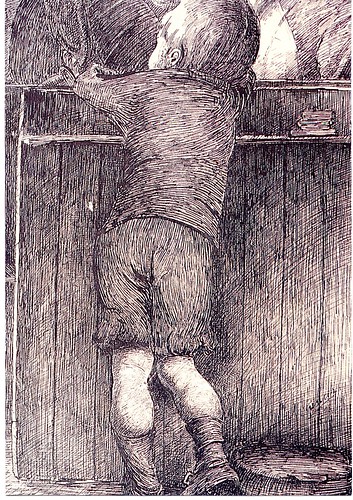
Roy (1907) is a delightful pen-and-ink drawing of a young boy leaning over the back of a pew in the village church of Holy Trinity. Spencer returned to similar motifs after many years, so there is a similar figure in In Church painted in 1958.

Spencer didn't live to complete his final work - Christ Preaching at Cookham Regatta (1952-9). This is a massive canvas and there are pictures of him paiting it while up a stepladder. Christ preaches to the assembled villagers (some wealthier folk in boats, while others picninc on the banks) from a basket chair in the old horse ferry barge. In 1952 Spencer made sixty chalk drawings as the basis of this picture to be transferred to the canvas to create a complex figure study.


The exhibition notes explain, 'Spencer grew up in the golden age of the Thames Regatta, when the river became not just a route for commerce, but a place of entertainment and leisure. Rowing and other skills, previously the province of paid watermen, became popular pastimes for amateurs. Attracting 10,000 people at its peak, the regatta at Cookham followed an established pattern, with races followed by a concert and fireworks. As in Spencer's Regatta series, fashion dictated that gentlemen wore white strousers, striped flannel coats and straw hats, and ladies elaborate hats and full-length dresses.

Another of his deservedly famous paintings, The Last Supper (1920) has pride of place on the wall. Christ sits before the wall of the grain bin in a Cookham malt house. It is beautifully simple, illuminated by golden light, and the disciples' outstretched legs and bare feet meet in the middle under the table in an earthy and rustic fashion.


Far more stylised, Wisteria at Englefield (1954) is full of exquisite, painstaking detail. It apparently took him five weeks to create this stunningly realistic image of chestnut, wisteria and ceanothus both highlighting and obscuring the red brickwork of Englefield House.

The Gallery also includes studies for the Sandham Memorial Chapel at Burghclere. This chapel was built specifically to house Spencer's war paintings - arguably his finest achievement. I particularly like Map Reading, in which an officer consults his orders and map while the men rest during a pause on a route march, and Bedmaking, as seen by Spencer at a hospital ward where he was ent to recover from malaria.

Other paintings in the series include such commonplace activities as filling the tea urns, washing and shaving, eating bread and jam, sorting the laundry, scrubbing the floor, and filling water bottles. The pictures capture the camaraderie and companionship of the men rather than the horrors of war.


Before going home I went for a walk through the village with its intricately tiled roofs, large green and friendly pub, then I strode through through brick alleyways and across fields of wheat and stubble accomapnied overhead by wheeling red kites. Sir Stanley Spencer described Cookham as 'a village in heaven' - indeed, if there are villages in heaven, they look like this.