Monday, 4 January 2016

Body Art

More than a Body: Organic Perception
Fredrika Rose

Tuggeranong Arts Centre

This exhibition from last year features watercolours, sculpture and installation by Fredrika Rose, winner of the 2013 Emerging Arts Support Scheme (EASS) Award.


Her work explores biological aspects of our lives, such as a print which resembles a wallpaper design of imaginary bacteria as if seen through a microscope. The colours and intricacies drip bodily fluids and reveal natural features such as mountains, flowers and rainbows. The juxtaposition of the earth's grandeur with the minutiae of cellular activity draws parallels between botany and biology.


Some of the pieces explore the self-destructive capacity of the human body, such as these pieces incorporating silk, human hair and alpaca hair. The positioning of the three items recalls the ceramic flying ducks favoured of interior decor of certain demographics. Rather than being comforting and homely, however, the installation has connotations of hatching eggs and aggressive cancerous growths.


Fredrika likes to challenge the viewer by contrasting the weird and fantastic; matching dark humour and shocking spectacle. Dressing up animal skulls in pearls and feathers is a heightened memento mori reminding us that all beauty must die, but that organic adornment will transform into alternate energy. In other words decomposition is creation. It's an intriguing concept.

Other sculptures are made from medical accoutrements, such as colostomy bags and drips, coiled on themselves and arranged to resemble a bunch of flowers. The artificiality is pronounced and obvious, but the human mind likes to interpret inanimate objects naturally.


Other aspects of her work in this exhibition are blatantly physical, which both attract and appall. The surreal style is simultaneously playful and voyeuristic bringing curiosity to a corset-styled torso, or a technical design inspired blueprint for human plumbing.

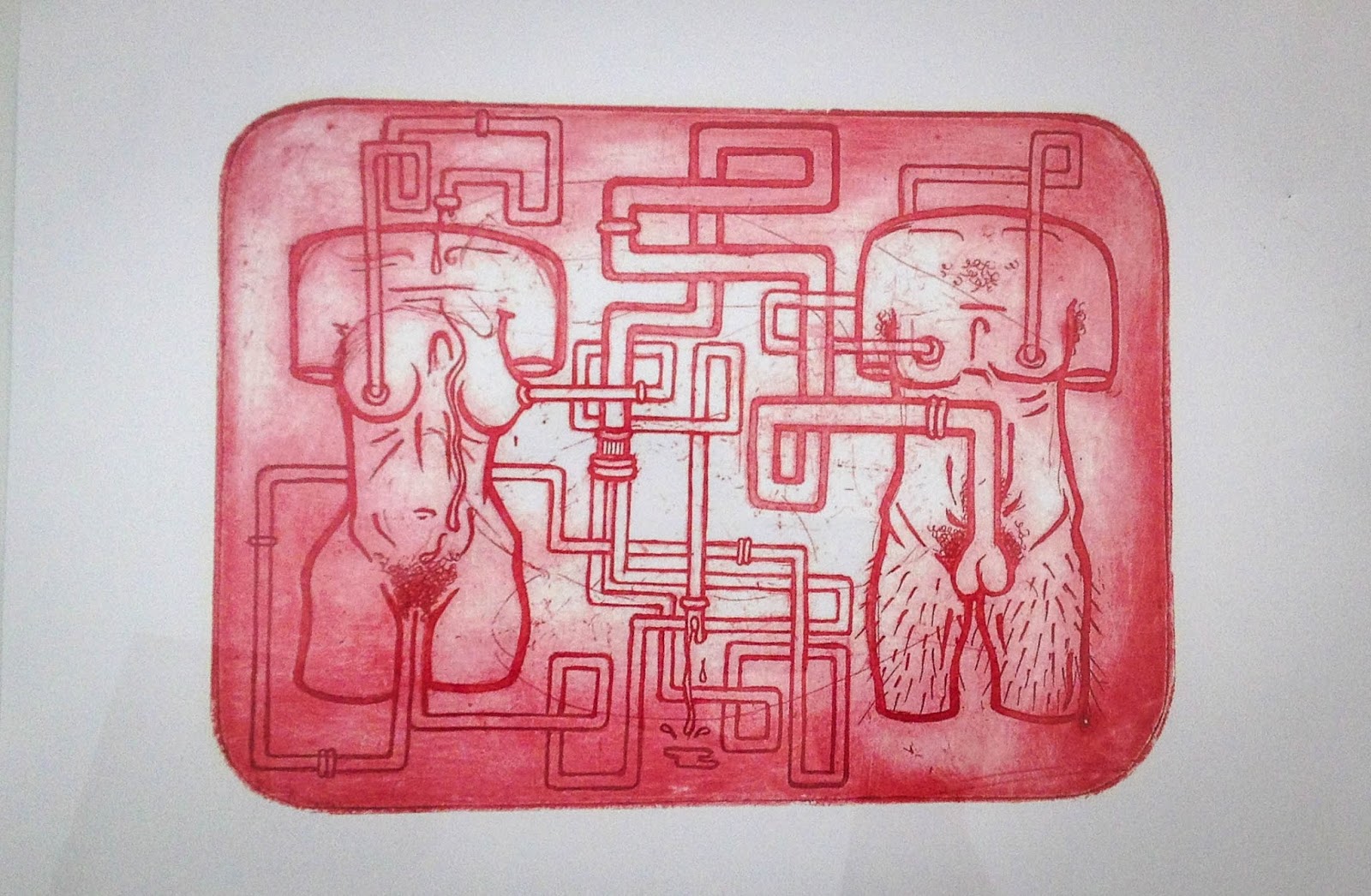
Plumbing
Her artworks are often surrealist in style, but she can also draw Michelangelo- style anatomies when she wants. Even in these, however, her restless curiosity is apparent.

Friday, 1 January 2016

Friday Five (Six): Favourite Films of 2015

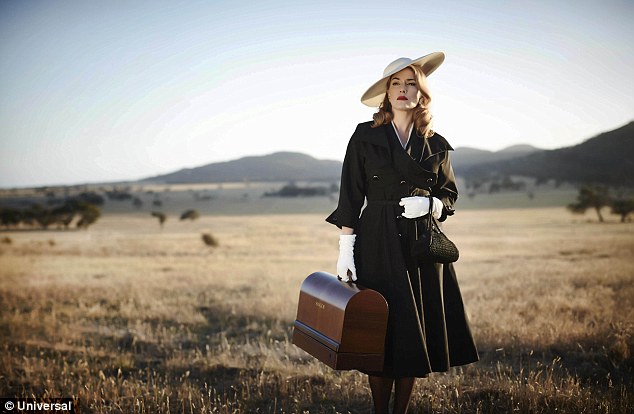
Kate Winslet in The Dressmaker
Obviously I have not seen everything that was released in 2015, but I totted up the number of this year's films I have seen and there are twenty on the list. So I have whittled it down to my favourites (in alphabetical order). And, yes, there are six, but as I've said before: my blog; my rules.

6 Favourite Films of 2015

  1. The Dressmaker – A glorious multi-genre Australian film directed by Jocelyn Moorhouse, with roots in fantasy, Western, black comedy and revenge drama, with the most outstanding costumes you’ll see this year. Kate Winslet is fabulous as the woman who returns to the town that spurned her as a child in a blend of Mary Poppins and Chocolat but without the songs or the saccharine.
  2. Mr Holmes – Ian McKellen is wonderful as the curmudgeonly retired detective with a passion for bee-keeping and a need to tell the truth about his last case, even if it doesn’t paint him in the most flattering light. His interactions with young Roger (Milo Parker) are heart-warming, and his oblivion to the feelings of Roger’s mother (Laura Linney) is equally affecting. Director Bill Condon has a great cast, and he makes the most of them in a reflective work.
  3. Selma – David Oyewolo portrays Dr Martin Luther King as flawed and conflicted despite his firm belief in civil rights. If you put your family in danger for your convictions, does that make you a hero or a martyr? Director Ava DuVernay poses this question as the film focuses on the specific 1965 incident of the Selma/Montgomery marches in Alabama. This cohesive narration avoids the potential of a rambling biopic, while the superb acting and direction make it a confident and assured work of cinema.
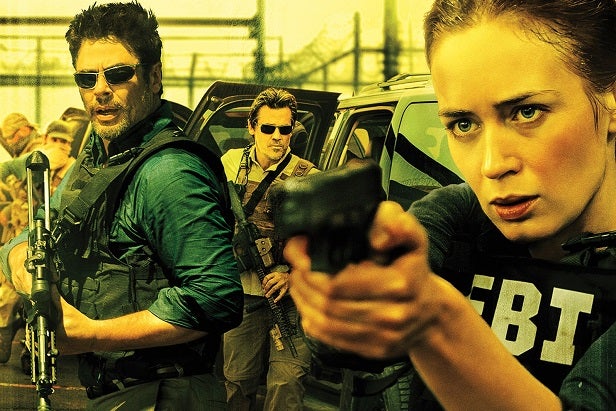
  4. Benicio del Toro, Josh Brolin and Emily Blunt in Sicario
  5. Sicario – Emily Blunt is the viewer’s Everywoman as she gets mired in an FBI operation to bring down the leader of a powerful and brutal Mexican drug cartel. She is unsure of who is in charge and the ethics of their actions, as is the viewer. Denis Villeneuve directs terrifically tight action sequences full of anxiety and tension. Benicio del Toro and Josh Brolin are also excellent in the frustrating thought-provoking drama.
  6. Testament of Youth – This is highly recommended quality film-making; one of the best adaptations of a book I’ve seen, and I loved the book! Alicia Vikander is excellent as Vera Brittain, who remains stoic at the heart of the dramatic narrative. Huge plaudits must be awarded to director to James Kent for handling this iconic memoir of WWI from a woman’s perspective with such subtle charm.
  7. Youth – Deliciously studied performances from Michael Caine, Harvey Keitel and Rachel Weisz at a luxury lodge in Switzerland also populated by Maradona, Miss Universe, an actor studying for a role (Paul Dano), and a couple that never speak, make this a marvel of cinema. Paolo Sorrentino directs with a masterful touch; the sound and the scenery, and the superb supporting cast all combine to make this simply sublime.
Michael Caine and Harvey Keitel in Youth

Friday, 27 November 2015

Friday Five: Women in Books

Recently I read How to Be a Heroine, Or, What I've Learned from Reading Too Much by Samantha Ellis, in which the author revisits the books she read as a child and young woman to see if she still admired the same female characters who had a profound effect on her in her youth.

I will return to this book in a later post, but it made me think about my childhood literary heroines, and whether I still feel the same way about them. The answer is yes - does this mean I had great taste back then, or rather, that I've never grown up?


5 Literary Heroines from My Younger Years:
  1. George from The Famous Five books by Enid Blyton: George firmly believes her gender shouldn't prevent her from doing what she wants; she tackles 'the great outdoors' with gusto and is unashamedly physical; she is greatly concerned about animal welfare; her personal integrity crosses class boundaries; she is intelligent without being intellectual; she is fiercely loyal towards her friends. Sure, she scowls a lot, but I still wanted to be her (way more than I ever wanted to be Pollyanna). And I wanted her rowing boat. And her island. 
  2. Becky Sharp from Vanity Fair by William Makepeace Thackeray - I love the novel, and her cheeky, irreverent adaptability. She is a social outsider, who uses cunning and charm to claw her way to respectability, yet never achieves it. She is also radically non-maternal; one of the few female characters who doesn't go all pathetic and uninteresting once she's had a baby. And she had a thoroughly modern moniker, unlike Pamela, Clarissa or Hester.
  3. Susan Pevensie in The Chronicles of Narnia by C.S. Lewis: as the eldest sister, she is compassionate enough to care for her family and brave enough to fight for them and stand up for her beliefs. She has arrows that never miss their target (who wouldn't want those?) but she is the voice of reason and commonsense - often she prefers to take the easy route rather than plunging recklessly into battle - even as a child, I saw the virtue in that. At the end of the series, she doesn't enter Narnia with the others, because she is more interested in 'nylons and lipstick and invitations'. In other words, she discovers sex and and drugs and rock and roll (or real life, if you prefer), and gets to grow up.
  4. Jane Eyre, from the eponymous novel by Charlotte Brontë: she's honest, forthright and powerful, acting with dignity and grace even when burning with shame and rejection. And she addresses the reader directly. She may be plain and unrefined, but she has nothing at all to hide
  5. Anne Frank - this is sort of cheating because she was a real person, but I first read her diary as though she were a fictional character, and I related to all her family frictions and teenage pretentiousness, even if I (thankfully) have never had to deal with Nazis battering down the door. Her words and ways to live have a power she could never have expected. 

Friday, 20 November 2015

Friday Five: BFF


The British Film Festival 2015 has been and gone. I wanted to see every film shown as part of the programme (with the exception of the family comedy one), but time constraints and other commitments meant that I couldn't. Some, such as Suffragette and The Program) are coming to the screens on general release, so I will catch them then. Here are the films that I did get to see:

5 Films I Saw at the British Film Festival:
  1. Dare to Be Wild - A young Irish woman (Mary Reynolds played by Emma Greenwell) decides she want s to win the Chelsea Flower Show, so she does. Her garden is meant to celebrate wild places and Celtic mysticism, so there’s lots of soft lighting and swirly music. The story is supposedly true, although it’s full of one-dimensional characters and paint by numbers plotting, but what a glorious canvas: it looks beautiful but it’s a bit twee.
  2. Queen of the Desert - When I was a child Gertrude Bell was my heroine, as I loved her independent spirit and her refusal to be bowed by convention. After watching this film directed by Werner Herzog with Nicole Kidman playing Gertrude, she still is. The story is completely simplified, Robert Pattinson is somewhat laughable as T.E. Lawrence, and the lack of protective eye-wear in the midst of sandstorms is shameful, but it’s still rather lovely. The sweeping scenery shots are rapturous, and Damian Lewis gets to play a bit-part.
  3. Bill Written by those responsible for Horrible Histories, this is a version of William Shakespeare’s lost years that appeals to all levels. The cast of six play all the roles with a dash of pantomime wit, and there are gags aplenty with a smattering of Shakespearean quotes thrown in for good measure. It’s no Shakespeare in Love but it’s funny enough without being original.
  4. Elstree 1976 - If you were an extra in the original Star Wars film, would it change your life? Would you travel to all the conventions getting embroiled in the debate over whether you deserved to be there signing autographs or is that just for the ‘stars’? Would you rather be a recognisable face or wear a sweaty Storm Trooper helmet? How would you feel if your voice was dubbed throughout, or your scenes cut from the final edit? These questions and more are posed and answered in this unusual but intriguing documentary which interviews several actors connected with the cultural icon, and offers a nostalgic look at how sci-fi films used to be made.
  5. Absolutely Anything - A light-hearted, reasonably entertaining comedy about a ‘random earthling’ (Simon Pegg) who is granted absolute power by the Intergalactic Council (animated figures voiced by the remaining Pythons). Of course he initially uses it for personal (and sexual) gratification, trying to get his beautiful neighbour (Kate Beckinsale) to fall in love with him. There’s nothing here you’ve not seen before (it’s similar to A Fish Called Wanda), but it features solid performances, clear direction, some clever scriptwriting, and Robin Williams as the voice of Dennis the dog in his final film, which is particularly affecting.

Friday, 13 November 2015

Friday Five: Beer Day Out


There were many brewers at Beer Day Out this year, and many beers to be drunk. the following are five of the ones I sampled.

5 Beers at Beer Day Out:
  1. Threesome; Nomad Brewing Co./ Beavertown/ Birra Del Borgo - You would expect a collaboration beer between these three to produce something pretty special and you wouldn't be disappointed. UK malts (including Maris Otter) provide backbone for Aussie bush tucker - muntries (emu apples) and bush tomatoes - and it's rounded out by ageing for six months in grappa barrels. It tastes as intriguing as it sounds
  2. Inappropriate Touching; Hawkers/ Edge/ Kaiju!/ Evil Twin/ Baird - Collaboration beer with smoked malt and some sweetness
  3. Brett Porter; Bridge Road Brewers - It's sour and it's dark and it shouldn't work but it does - marvellous chocolate bitterness
  4. The Vandal; Panhead Custom Ales - fresh, bitey, in-your-face Kiwi IPA
  5. Blacktop Oat Stout; Panhead Custom Ales - dark and tasty with a roasty bitterness; a fine example

Friday, 6 November 2015

Friday Five: A Good Year for the Roses


We have roses in our garden. We didn't plant them, but still we reap the benefit of their perfumed blooms. Much has been written of roses: they are literal and metaphoric flowers. Here are five of my favourite quotes about roses:

5 Quotes about Roses:
  1. 'A rose is a rose is a rose.' - Gertrude Stein
  2. 'What's in a name? That which we call a rose/ By any other name would smell as sweet.' - William Shakespeare
  3. 'The worker must have bread, but she must have roses too.' - Rose Schneiderman
  4. 'What though youth gave love and roses/ Age still leaves us friends and wine.' - Thomas Moore
  5. 'For women are as roses, whose fair flower/ Being once display'd, doth fall that very hour.' - William Shakespeare

Friday, 30 October 2015

Friday Five: Artistic Expression

I stumbled across an exhibition at Belconnen Arts Centre called Landscapes of Decay. It features work by artists from a collective called Random9. Working in a range of mediums, they use this exhibition to explore the influence of disintegration. The exhibition is curated by Liz Taggart-Speers, and the following statement is quoted in the catalogue:
"Disintegration is a subtle whispering, a barely realised theme of everything in life. It is as finely woven into the textures of humanity as birth, creation, war, sex and love." 
As our world continually decays, erodes and transforms, we have an artistic desire to capture the ephemeral nature of our existence. Despite the expression 'as old as the hills', landscapes are impermanent. Their living nature makes them vibrant and precious, and the ability to transform with time inspires these artists to attempt to capture their essence.

From the trees branching out of seats of learning in Dianne Libke's sculpture (the dictionary supporting the found wood are enclosed within a bell jar, preventing them from access to oxygen and carbon dioxide), to Camallie Guest's black and gold pigment wash and charcoal image of a peacock with feathers named for disasters caused by human intervention, the implications of the artwork are there for the viewer to interpret. I imagine that the latter with its colour scheme of the images painted for posterity onto Greek vases and the like juxtaposed with the stereotype of shrieking vanity suggests we should be ashamed of having caused such destruction to humanity and the environment.

Melinda Brouwer's ceramic boulders remind me of the peculiar rock formations in Tidbinbilla, or the Snowy Mountains. Her work investigates the changes caused in the environment by weather, seasons and the passage of time. Similarly, Naomi Somerville's cold-worked cast glass hints at melting polar ice and all the consequences that entails.

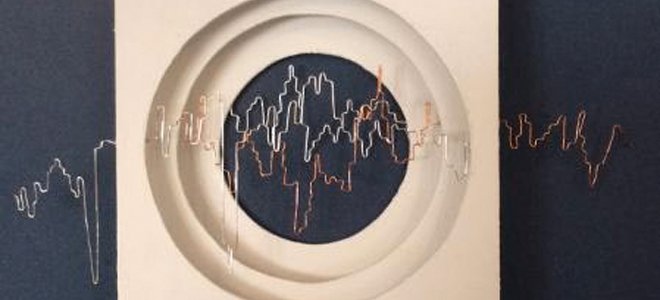
Meanwhile, although the word 'decay' has such negative connotations, Maria Klingner sees a more positive message in transformation and ageing, representing the ups and downs in the rhythms of a baby's heartbeat, captured in a piece of jewellery. She says she likes to examine 'the dynamic connection between adornment, creative expression, daily rituals and embedded memory'.

Five Pieces of Artwork from the Exhibition, Landscapes of Decay:

Memento Senescere... To Grow Old (2015) by Dianne Libke
Promenade of Failed Ideologies (2015) by Camallie Guest
Untitled (2015) by Naomi Somerville
In Utereo (2015) by Maria Klingner

Boulders (2015) by Melinda Brouwer