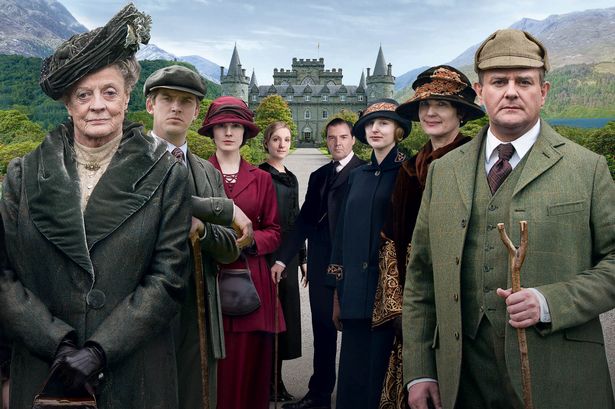
- The building itself - Although there has been a castle on the shores of Loch Fyne since the 1400s, the present Inveraray Castle wasn't built until the late eighteenth century (the entire village of Inveraray was moved in the 1770s to give the castle a more secluded setting). Inspired by a sketch by Vanbrugh, the architect of Blenheim Palace and Castle Howard, it is baroque, Palladian and gothic in style, and was architecturally ahead of its time. There is a difference between a castle and a palace mainly that a castle is built for defence (with thick walls, heavy gates, high towers, parapets or slits in the walls, gatehouses, moats and the like) and a palace is just for showing off. I'm not sure if Inveraray ever had to go all defensive, but it has got a moat.
- Family home - Inveraray Castle is the ancestral home of the Dukes of Argyll and the seat of the Clan Campbell. In the picture turret, there is information about the history of the Campbells' once the most powerful clan in the Highlands. There are pictures of the present Duke as Marquess of Lorne, his wedding to Eleanor Cadbury (yes, of the chocolate empire), and their son Archie, the present Marquess of Lorne. There are two other children as well and they all live here, although presumably not in the part of the house that is open to the public. It can't be pleasant having a load of commoners traipse through your house gawping at your things, but the upkeep on these places can't be cheap either.
- Highest ceilings - The dramatic armoury hall soars to 21 metres in height - the highest ceiling in Scotland. The central ceiling displays the impressive family crest, and on the ceilings on either side are the crests for the various cadet branches of the Campbells. The armoury itself displays a spectacular collection of arms, including more than 1.300 pikes, swords, muskets and other weapons. Displayed in elaborate patterns adorning the walls are 16th and 17th century pole arms and roundels of Brown Bess muskets dating from around 1740, with spandrels of muskets alternated with Lochaber axes. The latter and 18th century Scottish broadswords date from the time of Queen Victoria's first visit to Inveraray in 1847. The showcases contain pieces of relevance to the Campbell Clan and their historic connection with Britain. A highlight of the collection is the dirk and sporran belonging to Rob Roy MacGregor (1671 - 1743).
- Antique Spanish Silver Neff - In the elaborate dining room, there is a gorgeously ornate model silver sailing boat on the dining table. The neff (originally spelled 'nef') is an ornamental model ship made specially for the dinner table. They are usually quite elaborate with masts, sails, rigging and various figures on board. Early examples (13th - 16th century) were drinking vessels (do you see what I did there?) or receptacles for dining implements. Nefs originated from the continent and were used in France, Germany, Spain and Italy, but most nefs found today were made in Germany at the end of the nineteenth century. Traditionally the dining table nef was made in two sections and the top half was removable so that the hollow hull could be used to contain the spoon, knife, napkins and spices of the host. When the use of great dining halls waned, the hull was fashioned to hold wine, sweetmeats or a variety of special condiments.
- Artwork - There is amazing artwork throughout the house, from the displays of Campbell family portraits through history to the lavishly painted interiors. There is art by Thomas Gainsborough, John Hoppner, and French artists Girard and Guinard, whose only work survives at Inveraray, in the painting of the walls and ceilings, which is of a quality unparalleled in Britain at the time. Girard was one of the principle decorative artists employed by the young Prince of Wales when decorating his grand residence, Carlton House.
- Furnishings - the tapestries, furniture, and chandeliers are all remarkable and opulent. The dining table, by Gillow of Lancaster, dates from about 1800, the outstanding ormolu-mounted sideboards are from the late 18th century, and the Waterford chandeliers (of which there is one large one in the dining room and a smaller pair in the drawing room) are circa 1830. The glorious Tapestry Room still retains the original set of Beauvais tapestries in the setting specifically designed for it. The delicate tapestry dining chairs with gilding by Dupasquier and original Beauvais tapestry upholstery were commissioned by the 5th Duke on one of his visits to France in the 1780s.
- Hidden Room - There's a fabulous concealed door from the Tapestry Drawing Room that leads to the China Turret. The entrance is ingeniously concealed by a pair of double doors covered with tapestry panels integrated into the design on the Tapestry Room. This used to be a library and while it now houses a very fine collection of Oriental and European porcelain (including Japanese Imari-ware, of the early 18th century, a Meissen dessert service, and a large Derby dinner service from the early 19th century), I feel sad that it is no longer a secret place for hiding away and reading. It is presided over by a portrait of the 3rd Duke of Argyll in the robes of Lord Justice-General of Scotland by Allan Ramsay.
- Lerner & Loewe - In the Salon is a grand piano on which Lerner and Loewe composed the songs for the musical My Fair Lady while they were staying as guests at the castle. Since the early 1780's the main displays of Campbell family portraits have been arranged here, and it is possible to follow the family through history starting with a portrait of the 1st Duke and going right up to the Marquess of Lorne. The family famously switched their allegiance from Charles II to Oliver Cromwell and, then at the restoration, back to the monarchy.
- Wedding Dress - The North West Hall contains a collection of costumes worn by the family through history to the present day. The display includes the Coronation robes of HRH Princess Louise, the robes of the Knight of the Thistle and the present Duke's uniform of the Royal Company of Archers. A more recent addition is the stunning cream gown designed by Bruce Oldfield and worn by the current Duchess at her wedding to the 13th Duke in June 2002.
- Spooky Stories - The ghostly bed in this room is elaborately carved and belonged to the MacArthurs of Loch Awe. Legend has it that a young Irish harpist was murdered by the Duke of Montrose's men in 1644. The bed was moved to the present castle from the old Inveraray Castle and the boy's ghost was so attached to the bed it travelled with it. When a member of the family is about to die, it is said that harp music is heard coming from the room. Other resident ghosts are said to include the 'grey lady', only seen by daughters of a Duke of Argyll, a floating boat or ‘Galley of Lorne' which floats away on the horizon on the death of the Duke, and a raucous kitchen maid.
- Drums - The Clan Room conveys the many fascinating historical aspects of the great Clan Campbell, from its origins right through to the present day, with the Duke of Argyll as Clan Chief or MacCailein Mor. The room includes the remarkable and detailed family tree which adorns the South Wall and traces the Campbell lineage and its various branches of the family from the present day back to Colin the Great in 1477. A map of Scotland shows the lands possessed by the Clan at the height of their power. In addition to most of Argyll, the Campbell strongholds stretched as far East as Taymouth in Perthshire, a castle which in many ways replicates Inveraray; North to Cawdor Castle in Inverness-shire; and South to the now ruined Louden Castle in Ayrshire. There is also a fine collection of military drums loaned by the Caledonian Schools Trust.
- Kitchen and cafe - The original kitchen at Inveraray Castle was last used by the current Duke's grandmother, Duchess Louise in the 1950s. It features seven fireplaces for different methods of cooking, two stewing stoves, two baking ovens, a hot plate, boiling stove and a roasting fire with working spit which would have originally been operated by a fan in the chimney. Visitors can also see a fine collection of copper utensils known as "batterie de cuisine" together with various utensils of the Victorian, Edwardian and pre-war eras. The current cafe is run personally by the Duchess of Argyll, it serves up a mouth-watering menu using the best of Argyll ingredients (I can recommend the scones for afternoon tea).
- The gardens - The castle's beautifully maintained gardens and estate offers wonderful walking with stunning Highland views. The garden covers sixteen acres of which around two acres are formal lawns and flowerbeds, the remainder being parks and woodlands (full of squirrels and deer). The gardens feature daffodils around Easter, bluebells in May, and rhododendrons throughout the summer. The climate in Argyll with its yearly average rainfall of 230cm (90 inches) is ideally suited to rhododendrons and azaleas. Conifers also grow well in the poor acidic soil of a high rainfall area as can be seen by the fine specimens such as Cedrus Deodars, Sequoiadendron Wellingtonia, Cryptomeria Japonica and Taxus Baccata.
- Downton Abbey - If it looks familiar, it might well be because in a 2012 two-hour Christmas special, the Grantham family and staff travelled north to the home of their cousins, the Marquess and Marchioness of Flintshire in their mythical Scottish home, ‘Duneagle Castle’. The castle was closed to the public for a week during filming, but apparently the loss of tourism revenue was made up for by the fact that the cast and crew stayed in the village of Inveraray. Locals were thrilled with the star sightings, and the star who stirred more excitement than any other was Dame Maggie Smith. We're not quite the Granthams, but I don't think we're a bad-looking bunch (although with slightly more fleece, puffer jackets and denim).
Friday, 27 November 2020
Friday Five: Inveraray Castle
Monday, 23 November 2020
Craft is a Feminist Issue: The British Textile Biennial
"Cross-stitch is the oldest form of embroidery and can be found all over the world. Many folk museums show examples of clothing decorated with cross-stitch, especially from continental Europe, Asia, and Eastern and Central Europe."
![]() |
| Heartfelt and You See Food, I See Numbers by Caren Garfen |
![]() |
| Detail from Heartfelt |
![]() |
| Identity Crisis and That's How the Cookie Crumbles by Caren Garfen |
![]() |
| Detail from That's How the Cookie Crumbles |
"There's a debate about art vs craft that has been going on for centuries, and it's intrinsically connected to the concept of a patriarchally dominant social paradigm. It goes something like this: 'Men are great and they make art and are powerful and strong, whereas women are meek and should sit at home crafting things like embroidered homewares.'"It'is all a bit ridiculous, but that storyline, which I have somewhat paraphrased, has led to the idea that only certain media (painting and sculpture for example) should be labelled as art, and that crafts like cross stitch cannot achieve such spiritually lofty goals. Suffice to say, this is not the case. Just believe me when I say that any medium can be used for art as it's the creative expression that makes the difference."
![]() |
| Images by Crapestry |
"Contemporary commercial tapestries might be argued to be the exemplification of superficial chintz; spectacularly vapid, vividly dull, unquestioningly conformist, gaudily bourgeois, and at the same time unyieldingly time-consuming. The subject matter is often romanticised, uncritical and both exploits and reinforces established stereotypes. The outcome? Standardised 'precious things' cherished by the softly smiling, callous fingered Grandmas of the world, harmless old dears who quietly revel in the creation of 'cheeky terrier' and 'dewy chrysanthemum' cushions or 'God bless this house' picture frames. No mention of mortality, no depiction of suffering, nothing surprising, nothing funny."Crapestry capitalises on cross-stitch orthodoxies, exploiting their established themes. Some crapestries are funny, some are sad, and some may cause offence; but that's fine. Even the desperately sad crapestries make many people laugh, whether by a curious schadenfreude or simply because they are unaccustomed to encountering troubling subjects addressed through the medium of tapestry; its incongruous."
"The gradual crackling of the Iron Wall which began in the 1980s brought refreshing gusts of the westerly wind not only to adults. The growing thirst for superior ideals and freedom of speech was accompanied by an inexorable hunger for material novelties and commodities. It was not consumerism in today's sense when we are spoiled by both the excessive supply and the possibility to buy almost anything our eyes and heart desire. Back then we, the Soviet Generation X, were hungry indeed. It was a time when we took turns chewing the same piece of bubble gum with our classmate, biting into the red wrap of basically the only available option, the Lithuanian-made Paršiukas Čiukas (Chook the Piggy) gum, to tint it red, while the Estonian Kalev gum was extremely hard to come by. Then the corroded iron wall began to erode rapidly and real Western wonders entered the world of deficit.
"Among the first arrivals were the Donald Bubble Gum, valued not only for their main pre-coloured chewable content but also the inlays with adventure comic strips. We were ready to sacrifice for these wonders as much as the Native Americans or the Aborigines had been willing to exchange the last pelt for European glass beads and add a bonus gold nugget to that. In other words, giving away all the money our parents gave us for the summer holidays for a carton of Donald Bubble Gum was seen as a fair deal.
Just as the dollar assumed a very important role among the adults, bubble gum inlays did the same in the parallel children's world. It was not a vain childish whim, as these pieces of paper were not less valuable than the adults' paper bills. It was the children's hard currency which could be traded, exchanged for other commodities, gambled away, and, most importantly, used to buy status, peers' respect, friendship and popularity.
"The other Donald, who seems to surpass Donald Duck and his fellows in popularity and influence, brings out these real childhood memories, which may look like cartoons to those who were born in the post-Soviet years or who have never lived this side of the Iron Wall. The two Donalds have some traits in common. Both of them attract the masses, generate a huge income, and are excellent at blowing bubbles. Yet there is also a fundamental difference - while Donald Duck has made walls fall, the other Donald is busy building them."
"I am strongly influenced by the world of media. I work on the slip of meanings relating to highly iconic images, using diverse media and techniques. I am passionate about the art of embroidery using it to produce several cycles of works of great visual impact and subtle conceptual charm."
Friday, 13 November 2020
Friday Five(ish): Films Watched in October
- The Big Step (Il Grande Passo) (2019) - Beautiful and gentle story about estranged brothers who find a friendship and commonality while trying to deal with abandonment, rejection and an obsession with the moon. The storytelling is simple and improbable, encouraging us to dream big and aim high.
- Corpus Christi (2019) - Despite being bookended by brutal acts, there are moments of deep reflection in this film. A young man pretends to be a priest in a small Polish village rather than face his probationary position as a convicted criminal. As he soothes the sick and navigates toxic conflicts in the community, his actions raise questions of penance and punishment; reconciliation and redemption; atonement and absolution. The subtlety of acting, design and direction allow the themes to shine through and the questions remain unanswered long after the film has finished.
- It Comes at Night (2017) - Some people in a house in the woods (including Joel Edgerton) are hiding out from a mystery illness and protecting their own little family unit. They are joined by another family unit (including Riley Keogh) and grief, guilt, suspicion and paranoia all ensue, leading to strange goings-on. It could well be a stage play with limited characters and settings, and an interesting sense of development, written and directed by Trey Edward Shults.
- Love Sarah (2020) - At one point someone says, "London is the most multi-cultural city in the world", and then the film proceeds to be as stereotypically Anglocentric as possible. The mainstream middle-class (and mainly white) characters set up a cafe in a posh (litter-free) part of London (Notting Hill) and interact with the foreigners only to condescend and steal their native recipes. To suggest that the best Matcha Mille or baklava in town is made here is patronising in the extreme: cultural appropriation and colonial oppression at its zenith. The cast are good, but they have poor ingredients to work with (and any shade of realism has gone AWOL: those uncovered cakes are screaming Health and Safety risk). There are a couple of other sub-plots that go absolutely nowhere, and although it looks nice, it collapses in on itself like a failed souffle (and that simile is as tired and lazy as the film).
- The Meg (2018) - It’s like Jaws turned up to eleventy-stupid but without any of the subplots or subtlety. The Stath doesn’t quite get to punch a giant shark, but he does stab one in the eye. The special effects are pretty good and far more convincing than the so-called ‘love interest’, which has about as much appeal as a damp squib.
- Ready or Not (2019) - With this film, directors Matt Bettinelli-Olpin and Tyler Gillett have done for the humorous horror genre what Knives Out did recently for the comedy thriller. It self-knowingly exposes every trope, yet still remains fresh, fun, and highly entertaining. Samara Weaving is great as the vengeful bride who is forced to protect herself from her in-laws on her explosive wedding night, and the ending manages to be unexpected.
- A Street Cat Named Bob (2016) - Starring Luke Treadaway and Bob the cat, this is a delightful film. Roger Spottiswoode directs an adaptation of the true story of James Bowen, who manages to rehabilitate his life of drugs with the help of a cat. No longer homeless due to the proceeds of his book, Bowen now dedicates his time to helping numerous charities that involve homelessness, literacy and animal welfare. The film is a highly-sanitised version of life on the streets of London, but it is remarkably feel-good (SPOILER ALERT: Nothing bad happens to the cat) and clearly a lot of people wanted to be involved as the minor credits are full of British regulars (Joanne Frogatt, Anthony Head, Ruth Sheen, John Henshaw, Nina Wadia).
Monday, 9 November 2020
The Sting in the (Fairy) Tale: The Bee and the Orange Tree
We are
welcomed into the literary world of seventeenth-century France where writers
tried out their stories and poems before a receptive audience at a salon and
asked for their feedback. Marie Catherine encourages female authors and, “She
had wanted to create a place where women might recite their works, rejecting
the cruel satirising of female writers by famous men of letters – Molière,
Boileau, Perrault. She felt it her duty to lay bare the dark and piquant
potential of women unafraid of their own minds.” She advises one young protégé,
“An author must be brave. You can say whatever you like in your writing. It’s
your opportunity to reimagine the world as you would have it turn.”
She is
justifiably proud of her tales, and enjoys creating stories of fabulous
kingdoms, ageing monarchs and ambitious offspring; heroic quests; magnificent
palaces; miniature worlds – many containing hidden messages of daring triumph.
She is principally concerned with the plight of women and fears that marriage
and children do not necessarily serve their best interests. The dichotomy of a
woman needing protection yet seeking freedom is explored through the character
of Angelina who leaves a convent to act as a companion to Marie Catherine. There
are several anachronisms, and many other sentiments seem borrowed from our own
age and grafted onto a previous time, such as gender fluidity and double
standards, meritocracy and fashion influencers.
A
couple of subplots feature the Affair of the Poisons and the public executions surrounding
the incident at the court of Louis XIV, and Angelina’s father, who is estranged
from Marie Catherine after a spell in the Bastille. The novel is written as
though it expects to be read aloud, perhaps in one of the salons Marie
Catherine conducts. The language is rich and the sounds of the words work well
together with poetic assonance and alliteration. It builds drama and tension;
then deflates it with a stroke of the pen. Catherine devotes herself so much to
her art, that her language becomes that of physical creation, and her struggle
with writer’s block is like a fairy-tale itself: “If it were her last act, she
would again seduce the gods of story to toss their net of wonders at her feet,
to strew their gifts before her, and out she would pluck one starfish, one
mushroom, one invisible cloak, one prince dressed as a pauper, one naked king.
Oh, she would take it all and rush, her apron lifted and bulging with treasure,
back to her desk to make sense of the hoard.”
Friday, 6 November 2020
COVID 19 Friday Five: Even More ISO TV
![]() |
| I would watch Keeley Hawes in anything; so would Richard Madden in Bodyguard |
- Bodyguard (7plus) - I think Keeley Hawes is excellent and will happily watch her in anything from Life on Mars or Line of Duty to The Missing or The Durrells, so when I saw she had a starring role in a British police political thriller, I wasn't going to miss it. The Jed Mercurio-written drama has garnered rave reviews and high ratings from critics and viewers alike. Hawes is Julia Montague, the Home Secretary battling corrupt politicians, international terrorism and secret schemes to overthrow the government. Richard Madden is David Budd, the special protection officer who is charged with keeping her safe, but he has issues of his own, including PTSD from Afghanistan, burning resentment and a tendency towards anger. Nothing is as apparent as it seems, and story arcs are not always concluded in conventional ways - sometimes irritatingly so - but it is both bright and dark, and ultimately binge-worthy.
- Dracula (BBC One and Netflix) - sexy and hysterical; the three-part series is as if three different script-writers and directors had a go at bringing together a story. In truth, the drama-horror series was developed and written by Mark Gatiss and Steven Moffat, but there is indeed a different director for each installment (Jonny Campbell; Damon Thomas; Paul McGuigan). We follow Dracula (Claes Bang) from his origins in Eastern Europe to his battles with Van Helsing (Dolly Wells) and her descendants. It's all slick and sensual, but the middle episode, confined to a boat with a claustrophobic sense of impending doom and psychological terror, is my clear favourite.
- Sex Education (Netflix) - We binged two whole seasons of this show one wet weekend, and I'm still trying to work out why I was so invested in watching a series about teenagers and their hormones. Forays into adulthood are fraught with angst and we all remember our own with less than fondness, so to watch others deal with feelings, emotions and sexual expectations is probably better than having to relive our own experiences. Asa Butterfield stars as an insecure young lad at a highly progressive high school doling out advice he has gleaned from his sex therapist mother, Gillian Anderson, who has her own unresolved relationship conflicts. Although it is a British series (created by Laurie Nunn; a variety of British accents; filmed in Wales), the aesthetic is highly mixed with an American-style high school and education system, but beautiful British scenery and sensitivity. The time period in which it is set is also deliberately disorientating with many modern references, but fashion, decor and bicycles from the 80s. It's an intriguing and generous mash-up; sort of like The Breakfast Club meets Gregory's Girl. Strangely recommended.
- Staged (ABC iview) - And now, for our times, this is a lock-down comedy about actors who desperately want to act, but the theatres are closed, so they take out their frustrations and their theatrical rivalries over Zoom meetings. David Tennant and Michael Sheen play hyper-real versions of themselves which are equally irritating and fabulous. The six episodes are only fifteen minutes long (the perfect length for a Zoom call) and prove that you can pack a lot in if you know what you are doing. The pair were due to star in a production of Six Characters in Search of an Author on the West End but the pandemic has put paid to that. Not wanting to let this opportunity slip through his fingers, their director Simon Evans (who also wrote the script) attempts to get them to rehearse over the internet, if only they can overcome their distractions, boredom and egos to read the first scene. There are some brilliant cameo appearances from Samuel L. Jackson, Nina Sosanya, Adrian Lester and Dame Judi Dench, and evidence-based research (Him Outdoors and me) proves this is entertaining fare for theatre and non-theatre types alike.
- Vanity Fair (BBC First) - I love the novel; I love the character of Becky Sharp; and I love this adaptation by writer Gwyneth Hughes. Olivia Cooke is bold and beguiling (unlike many insipid heroines of period drama) and all her relationships, with Amelia (Claudia Jessie), Jos (David Fynn), George (Charlie Rowe), Rawdon (Tom Bateman), Martha (Sian Clifford), Sir Pitt (Martin Clunes), and Aunt Matilda (Frances de la Tour) are honest and brilliantly played. It's colourful and gaudy and breathtakingly bedazzling. The fact that each episode is opened by a top-hatted Michael Palin orchestrating the carousel at the titular carnival can't do any harm either.
![]() |
| Michael Sheen and David Tennant in the lockdown drama for our times |
![]() |
| Olivia Cooke is brilliant as Becky Sharp in Vanity Fair |