Friday, 29 March 2013

Friday Five: Disney Favourites

The Jungle Book
I believe it's time for school holidays again. Do children ever actually go to school these days? It seems that they're always on holiday, and I know this because the films showing at the cinema cater entirely for them on their weeks and months off from the strenuous business of colouring in and sitting nicely on the mat.

As I haven't got children, I don't really watch children's films. The ones that I do see are either too mawkishly sentimental and obvious, or, even worse, they try to hard to also amuse the grown-ups with winks and nudges that go entirely over the young person's head. I think this is a bit patronising - adults have films of their own to enjoy, so in a children's film you would think they could at least focus entirely on their target audience. Having said that, Hugo was one of my favorite films of 2011, so feel free to ignore my not-so-well-structured argument.

Hugo
And Him Outdoors refuses to watch animation. He claims that nothing can beat Tom and Jerry so they might as well not try. I have seen Up, The Simpsons, South Park, and films from the Shrek, Toy Story and Wallace and Gromit franchises. Usually I watch these on the plane or with other friends when Him Outdoors is busy doing other more important things, or running up hills.

Naturally when I was a child I watched children's films and I wasn't so cynical that I had grown to sneer at Disney. Indeed, I liked Walt Disney films, especially the ones about animals. I wasn't particularly fussed about the princesses waiting for their princes to rescue them from wicked stepmothers or dwarves. It's not really any surprise that all my favourites are from more than forty years ago - when I was the right age to be the target audience.

5 Favourite Disney Animated Films.
  1. Jungle Book (1973)
  2. Sword in the Stone (1967)
  3. Pinocchio (1940)
  4. 101 Dalmatians (1961)
  5. Peter Pan (1953)
101 Dalmatians

Tuesday, 26 March 2013

Quote for today: the future of feminism


‘Why did we bother fighting all those feminist battles? I know with teens the brain is not yet fully formed, but 90 per cent of young women wanting their blood sucked is not where we hoped the future was heading.’ – Bea in Nothing Personal by David Williamson

Friday, 22 March 2013

Friday Five: Things Found in Books

Because of a (self-imposed and not very strictly enforced) ban on buying any more books until we have decided that we are never moving again and I haven't got to cart boxes of them around the world, I have been borrowing a lot of books from the local library.

I love libraries. I love the thought of sharing literature and information and the wonderful joy of reading. You can get so much from a book. You can learn about new worlds and introduce yourself to new ideas, or you can escape into comfortable and familiar narratives or even just look at the pictures as you turn the pages.

Yes, indeed, libraries are a wonderful invention and have been going strong for almost 5,000 years. That's pretty impressive.

However, on a more prosaic level, there are some things I have found in these borrowed books that have not entirely thrilled me. Although finding someone else's shopping list or scribbled notes to self doesn't bother me at all (and, in fact, can be quite interesting), I would just like to put out a plea here for people to return books in the state in which they would like to find them, or at the very least, try to make sure they don't contain any of the following:

5 Things Found in Library Books:
  1. Sand - we all know that the stuff gets everywhere, and you can accept that when you've had a nice holiday by the beach. But when you haven't, and you still end up with gritty little particles all over the sheets, it can be annoying.
  2. Dead insects - probably preferrable to live insects, but still... I suspect one recent volume I borrowed (The Timeless Land by Eleanor Dark, since you ask) was deliberately used to squish mosquitoes.
  3. Food - particularly tomato pips for some reason, and unidentifiable sauces - at least I like to think they're sauces, otherwise I would recoil in horror.
  4. Lists of today's checked-out items - they contain your name, membership number and other personal details. I'm not interested in stealing your identity, but others may not be quite so scrupulous.
  5. Hair - mainly (but by no means exclusively) from the head.

Wednesday, 20 March 2013

War Artists

Some weeks ago we went to the Australian War memorial. We had been once before, but barely made it around the First World War section. It's a big museum and there is a lot to take in. This time we concentrated on the Second World War section. I have somewhat of a fascination with war art, so that was my main focus.

Munitions workers by Lyndon Dadswell
This sculpture by Lyndon Dadswell presetns the wartime labourer as a heroic figure and reflects the need for both men and women to shoulder the burden of munitions productions. The simplified forms and exaggerated proportions of the figures convey a sense of permananece and strength, reminiscent of the work of Socialist artists.

There are examples of work on show from a number of prisoners of war who turned their hand to creative arts. For example, an embroidered blanket worked by Corporal Cliff Gatenby, who was captured on Crete.

Corporal Cliff Gatenby's embroidered blanket
In Stalag 383, Gatenby covered his army-issue blanket with embroidery 'for something to do', although he had never sewn before. He began by sewing his name and number on the corner of the blanket followed by a kangaroo. Thread came from old pullovers, socks, scarves and towels. By the end of the war the blanket was entirely covered and included scenes of his camp and his service in the the Middle East.

The work below was painted at Stalag VIII-B, a German prisoner of war camp where Sergeant Arthur Nichol was captured and imprisoned.

Fight by Sergeant Arthur Nichol (1914-1965)
On 30th June. 1943, the 58th/59th Battalion launched an attack on Bobdubi Ridge, New Guinea. The fighting was fierce; the Japanese poured machine-gun fire from fortified and camouflaged positions. The battalion managed to secure a position on the ridge within two days. From there they were able to capture Old Vickers position in 28 July, driving the Japanese from the ridge. The capture of this position was a major action in the Wau-Salamaua campaign.

Taking Old Vickers position, Bobdubi Ridge, 28 July 1945 by Ivor Hele
Hele was an official war artist and his painting shows the Australians struggling up the steep slope to take the Japanese bunkers and trenches. The grey-toned ridge and cloud-covered mountain range in the distance provide a sense of altitude and the inhospitable landscape. Old Vickers was the key to the ridge, and its capture opened the way to Salamaua.

Ballet of Wind and Rain by Colin Colahan
Ballet of Wind and Rain was painted in Holland late in the war (February 1945) when Colahan travelled into recently-liberated regions of war-torn Europe. In this painting the artist has captured a group of four airmen, moving across an airfield, during a fleeting moment. Colahan's biographer, Garry Kinnane, wrote, 'the feeling of space and the elements - the wind, rain and light playing on the bodies of the airmen, who are positioned like a chorus line - make a lyrical and memorable arabesque out of an otherwise mundane event.'

The unusual title of the work refers both to the choreography of the figures and the theatricality of the composition. The idea that a ballet was created through the colour, movement and atmospheric effects of the scene as it presented itself to the eye, recalled the use of  musical terms such as 'symphony', 'arrangement' and 'harmony' in the titles of a number of paintings by Whistler. Clearly Colahan was more interested in capturing the human drama posed by this wartime subject, than in painting major military events.

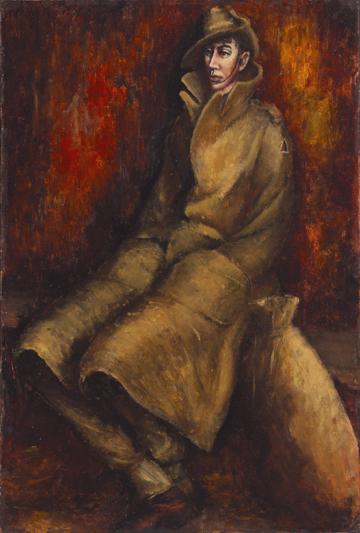
Soldier by Russell Drysdale
Albury Station became a notable source of inspiration for Russell Drysdale. As the intersection where the railway lines changed gauge between Victoria and New South Wales, it became an important stopover for Australian servicemen. Troops were often stranded there for hours, and Drysdale observed them huddled in groups, sleeping or chatting to one another. Soldier captures the loneliess and uncertainty of a tired soldier waiting for the train to take him to his next posting.

I am particularly interested in the female official war artists and the subject matter they recorded. They attempted to present Australia at war as a nation including people from different genders and backgrounds, bestowing importance onto otherwise ordinary sitters.

WAAAF Cook (Corporal Joan Whipp) by Nora Heysen
In this portrait of Corporal Joan Beatrice Whipp, the cook from the Women's Auxillary Australian Air Force is preparing bully beef. A comparison between the initial drawing of WAAAF Corporal Whipp and the finished painting shoews how Nora Heysen has exaggerated the cook's powerfully built arms and increased her relative size within the picture to make her a more imposing presence.

Whereas the drawing probably captures what Heysen remembers of her character - 'she was such a jolly person and she got on very well with the men and she was such a good cook' - on the painting she is depicted as serious and even formidable. Heysen had previously ben censured for not making her war art stern enough.

Morning after night shift by Dore Hawthorne
Morning after night shift is one of a series of 40 works by Dore Hawthorne titles 'Factory Folk'. The series depicts life and work at the Lithgow Small Arms Factory where the artists worked from 1942 to 1945 assembling Breen light machine guns. Hawthorne signed each painting in the series with the pseudonym 'Brendorah' - a conflation of her name and the weapon she made in the factory.

A friend of hers, Nancy Hall, wrote, 'Dore felt the ugliness of materialism and pollution as keenly as she felt everything that was fine and beautiful, and much of her painting and writing was a great cry of protest.'
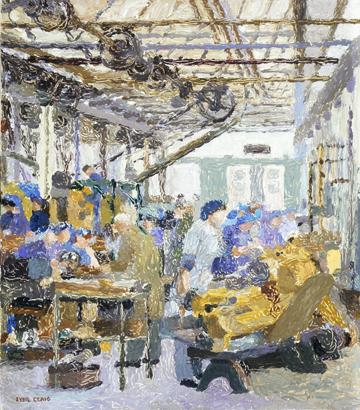
No. 1 projectile shop (Commonwealth Ordnance Factory, Maribyrnong) by Sybil Craig
Sybil Craig's colourful and impressionistic work captures the activity of women operating electric lathes to perform single tasks on 18- or 25- pounder shells before these are passed on to the next operator. To protect them form the machines and the dirt they wore overalls and snoods over their hair.

With the escalation of the war and much of the male workforce away fighting, women replaced men in the factories. As process workers they were trained for specific operations that were often dangerous and onerous. The war affected everyone, and it's good to see this fully represented.

Friday, 15 March 2013

Fiday Five: Exceptions

I have a slight confession to make after yesterday's post. I know I wrote you should always read the whole thing before forming an opinion - or at least broadcasting one - but there a couple of occasions when I haven't. These are exceptions to the rule. I remember there were always plenty of those in English, and French, and Latin, and things my mum told me I couldn't do. So here are some of mine:


Friday Five: Exceptions
  1. If I start a book I will always finish it - with the exception of The Hobbit and Ivanhoe. I found both of them deadly dull.
  2. I never patronise McDonald's - apart from that time in the Philippines when I had the world's worst diarrhea and I knew they would have clean toilets and sanitised food.
  3. I dislike all American soft rock/ anthemic ballad music - but I will sing along and even dance to Guns N' Roses. I know; it's simply inexplicable.
  4. I never drink cold fizzy lager - unless I'm on holiday somewhere hot. You know who you are, Fiji Bitter.
  5. I will support all English teams in global sporting competitions - apart from Manchester United.

Thursday, 14 March 2013

The Whole Damn Thing


A couple of weeks ago I read an article in The Canberra Times by Chris Wallace. She was writing of the furore created by knee-jerk journalistic reaction to Hilary Mantel's mis-quoted comments about Kate Middleton. Wallace still called her that, although she must be Kate Windsor or some such now, mustn't she? Or did she keep her name? That would be quite radical, but is entirely beside the point.

The point is not even Mantel's speech in question, given as the first of the London Review of Books' Winter Lectures at the British Museum and reprinted in full. The point is the haste of pundits and plonkers to comment on stuff about which they know nothing. The internet exacerbates this with abundant examples of trolling and ignorance.

It seems to happen a lot with literature, however. Governments and various authoritative bodies have often banned books because they don't like their substance or content. Usually they haven't read them. The people who pronounced the fatwa against Salman Rushdie claimed it was due to the blasphemy inherent in The Satanic Verses, which of course they had not read. 

Folk frequently dismiss artforms such as opera or ballet, without ever having seen one. Similarly some claim to despise football without ever having been to game. Pundits are falling over themselves to mock the new Pope, yet most of them know nothing at all about Catholicism and have certainly never read the Bible. Some people vote for political parties without the faintest clue of their policies.

The internet spawns opinions - everyone seems to have one on just about everything. And yet many of them can't have a coherent conversation about the thing they claim to hate. And it is always hate. Softer sentiments don't stand out from the crowd. Sure, it can be fun to make sweeping statements (and of course I've done it), but I think perhaps we should be more conscientious about trying to uncover the whole story before spitting forth spiteful comments.
"Readers have responsibilities, not just writers. Paying proper attention and reading the whole damn thing before rushing to condemn is the least courtesy writers are owed." - Chris Wallace

Saturday, 9 March 2013

Quote for Today: The Sound of Electric Guitar


"There's only one thing better than the sound of an electric guitar, and that's the sound of two electric guitars." - Johnny Marr