Friday, 16 May 2014

Friday Five: Feathered Fruit Felons


Nearly all the fruit from our garden has been devoured by the birds. I don't really mind as we have more than enough for our own use (I managed to save sufficient peaches for the wheat beer), and I like being visited by our feathered friends.

5 Birds that eat our fruit:
  1. Cockatoos eat the pine cones
  2. Rainbow lorikeets eat the plums
  3. Eastern rosellas eat the peaches
  4. King parrots eat the apples
  5. Wattlebirds eat the grapes


Friday, 9 May 2014

Friday Five: Bob Hoskins


Bob Hoskins, according to his Wikipedia entry (so it must be true), was an English actor known for playing cockneys and gangsters - sometimes both at the same time! His death last week, leads naturally to introspection about some of his great acting roles. 

All of the obituaries mention Who Framed Roger Rabbit, which was perhaps the film that made his name (voice, and gorgeously round face) globally recognisable. The combination of animation and live action in that film was remarkable and deserves acclaim. It also launched his career as a friendly uncle type and he went on to delight children's audiences with roles such as Badger in Wind in the Willows, Smee in Hook, and Geppetto in Pinocchio

At the time it was released in 1988, however, I was anti-Hollywood, cartoons and anything that stank of cheesy Americana, so it was never a favourite of mine. I appreciate that it was arty, ground-breaking and full of inside jokes, but I preferred (and still do) my films to be a little more subtle and thought-provoking.

5 Favourite Bob Hoskins Films (in chronological order):
  1. Felicia's Journey (1999) - Before he became a cuddly Cockney, Bob Hoskins could be a creepy chappie, and never more so than in this psychological thriller. His turn as the sinister middle-aged caterer with chilling secrets reminds us that he used to play gangsters in the likes of The Long Good Friday and that he was a fantastic embodiment of Shakespeare's ultimate villain, Iago.
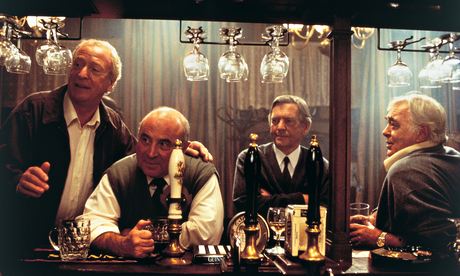
  2. Last Orders (2001) - one of those rare occasions where the film adaptation is as good as the (very good/ Booker Prize-winning) novel. It's all about the characters, as the group of drinking buddies and the son of the recently deceased Jack take his ashes to scatter them in the sea at Margate. Tom Courtenay, David Hemmings, and Ray Winstone join Bob in this last journey, and flashbacks include the brilliance of Michael Caine and Helen Mirren (as Jack and his wife). It's poignant, funny and beautiful.
  3. Vanity Fair (2004) - Bob Hoskins is frequently described as a character actor, and he does pop up in convincing cameos in everything from Dickens to Shakespeare. His turn as Sir Pitt Crawley in this frock romp is a generously understated example of why he is such a gift to directors and producers; making all the characters look even better.
  4. Mrs Henderson Presents (2005) - Playing the antithesis of his creepy old man role in Felicia's Journey, Hoskins provides the perfect foil to Dame Judi's rapier in this sweet, sentimental period piece full of warmth and wit in potentially seedy circumstances, as the Windmill Theatre introduced (sanctioned) nudity to the British stage.
  5. Made in Dagenham (2010) - I have a soft spot for this film because I saw it with a really good friend in a really good cinema. It's also about the struggle for equal wages for women, so of course I am going to appreciate the subject matter. It's full of working-class good will and solidarity, which makes you nostalgic for a time when people actually cared about each other, even though it probably never quite existed. Hoskins plays the union rep who is overwhelmed by the proximity of so many gobby women, but he remains the lovable cockney character we have come to recognise, posing the question, who will play these roles now? (Answer: Probably Ray Winston whose career seems to be following a similar path.)

Friday, 2 May 2014

Friday Five: Refractometer

Him Outdoors checking specific gravity - or something...
Earlier this week, I discovered this word in relation to wine and beer. Imagine my surprise to discover that a refractometer has multiple applications. It is used for measuring the index refraction, which describes how light (or other waves) travels through a medium, such as air, glass, or water (and sometimes appears to 'bend'). 

There is a very specific scientific formula to work this out, known as Snell's Law, or you can just use a handy device that was prepared earlier. Honestly, it's not as dull as that sounds, because look what it can do (hopefully not the same one doing all of it)!

5 Applications of a Refractometer
  1. When making wine or beer, it helps to determine the amount of sugar which will be converted to alcohol.
  2. Gemstones can be authenticated by how much light passes through them, as measured by this handy device.
  3. A refractometer is used in drug testing of urine samples.
  4. In marine aquariums, the saline content of the water can be determined by using a refractometer.
  5. Optometrists use them to determine visual acuity and correct vision. 

Wednesday, 30 April 2014

Elioth Gruner: The Texture of Light

Elioth Gruner: The Texture of Light
Canberra Museum and Art Gallery, 8 March - 22 June, 2014

Another new Australian painter to me (and probably my mother, whom I know learns about antipodean art through this blog) is Elioth Gruner (1882-1939). He was born in New Zealand but immigrated to Australia as a young child and lived in Sydney for most of his life. Many of his earlier paintings are of beach scenes, full of people, waves and movement.
Bondi Beach (1912)
He was influenced by Impressionism, and through the development of his art, blobs of paint and evident brushstrokes give way to a flatter, broader canvas. I like his groupings of individuals, many of whom can be seen turning to look at the artist with a bold and unapologetic gaze, as though questioning the viewer and making them feel like they are the intruder in this idyllic scene.


The Beach (1918)
detail from The Beach

Elioth Gruner is most known for his texture of light at all times, and in all climates and seasons. His poplars, picnickers and bathers are set against a very Australian environment. It may not contain the reds of the central desert, but the modest, rolling hills provide a modernist take on quintessential aspects of the Australian landscape.


In the Orchard (1920)
In the Orchard, detail
Travelling trough New South Wales and the Canberra region, Gruner painted en plain air, and made his reputation with the Emu Plains series, which he exhibited in the Society of Artists' Annual Exhibition. The magnum opus of this series is Spring Frost, which is part of the Art Gallery of New South Wales collection, and regularly wins audience votes as the favourite painting in the gallery.

Spring Frost (1919)
detail from Spring Frost
Summer Morning (1916)

Gruner 'discovered' the Canberra region in the early 1920s and loved the quality of the light. He was drawn to the quiet grandeur of dry plains and bare hills ringed with ancient mountain ranges. The crisp dry air of the region gives it clarity of light and a sense of distance. I particularly like the paintings of the Murrumbidgee Ranges and Weetangera, because these are the hills I run over, with gold and green fading to blue and grey as sheep graze in the long grass and smoke drifts in the distance.


Murrumbidgee Ranges (1934)

Weetangera, Canberra (1937)
Self-portrait (1915)

Friday, 25 April 2014

Friday Five: Victorian Alpine weekend

Last weekend we went to the Victorian Alps area for a few days and had a great time. Here are the edited highlights.

5 Highlights of the Easter weekend:


Happy and hoppy at Bridge Road Brewers
  1. Two breweries and a winery - Bridge Road Brewers at Beechworth and Bright Brewery at Bright (oddly enough) both craft some excellent brews. My favourites were the Bling IPA from the former and the Razor Witbier from the latter. Bridge Road has a particularly pleasant ambiance and is tucked down a side alleyway, opening into a sun-drenched courtyard.
    Amulet Winery, with sheep
    Amulet winery makes sensational sparkling tipples from prosecco and moscato to Beechworth cider. They host a Highland Games next weekend, which apparently involves lots of fun, booze and caber tossing.
    Squeezing through boulders at Chalwell Galleries
  2. Mt Buffalo - we went for a walk/run around this brilliant lump of rock that opens out into a massive plateau. There is a part of the track which squeezes between massive boulders, called Chalwell Galleries.
    The Horn, Mt Buffalo National Park
    The highest peak on the plateau is called The Horn, which is a cue for much giggling and striking views. 

    Beechworth town centre during the Golden Horseshoes Festival
  3. Beechworth - the beautiful little town (population 2,645) is reminiscent of Arrowtown with its Easter Festival, including 'biggest crowd for the smallest parade in Australia' and the deciduous trees turning fabulous colours in the crisp autumn climate.


  4. The heritage - the area is famed for its goldrush history (gold was discovered here in 1952); its links to Robert O'Hara Burke (leader of the ill-fated Burke and Wills expedition) ; and Ned Kelly connections - the notorious bushranger was imprisoned here and tried at the courthouse.


  5. A number of culturally significant buildings line the main street and a cute little museum is full of information about all of these disparate of history.

    Warning: Here Be Hippies


  6. Shopping - Him Outdoors likes to talk to strangers and, as we pottered about the shops, cafes, museums and galleries of the district he chatted to everyone including talking to the ladies at the museum about the possibility of reinstigating a famous wheelbarrow race, and the bloke in the Trade Aid shop about the necessity and humanity of a national pensions scheme. For the record, we bought cycling gear, brewery merchandise, poncy soap, licorice root (for the beer), and lots of food and drink.
Him Outdoors with a Ned Kelly pie

Friday, 18 April 2014

Friday Five: What People Read

Neanderthal Man at the bus stop by Sam Bosma
These are the results of a totally non-scientific survey (I suspect all of my surveys are conducted in this manner) of reading material for people on buses. It does not include kindles and i-phones. I've seen lots of people reading those, but the very nature of them precludes me from seeing the title, so this is my paper-based observation.

5 titles I have seen people reading on the bus:
  1. Persepolis: The Story of a Childhood - Marjane Satrapi
  2. The Black Echo - Michael Connelly
  3. Tourism Management 4th edition - David Weaver
  4. In Search of My Father - Marion Elizabeth Fawkes
  5. Australian Road Rules