Showing posts with label Albert Tucker. Show all posts

Tuesday, 8 October 2013

Australian Galleries 1

"Painting is an argument between what it looks like and what it means" - Brett Whiteley
Having been confounded by contemporary art in the Art Gallery of New South Wales, I reassured myself with work that I actually like. Each time I come to Australian art galleries I familiarise myself more with local artists, themes and styles. I have just included in this post some of my favourites.

Whiteley's return to Australia in 1969 heralded a new preoccupation with colour and beauty. Inspired principally by Matisse, but also by his house at Lavender Bay on Sydney Harbour's north shore, he created a series of large scale paintings of expansive interiors and views evoking the marine beauty of the harbour. I like this expansive blue canvas dotted with boats and the faint white line-drawing of the bridge.

The Balcony 2 (1975) by Brett Whiteley
John Olsen is possibly best known for creating the mural, Salute to Five Bells, in the Sydney Opera House, inspired by Kenneth Slessor's poem. He wrote of this painting:
"Five bells was my first commission to paint in situ to cover a wall … I didn’t hesitate. I brushed a line around the core theme, the seed-burst, the life-burst, the sea-harbour, the source of life. Inside and around this core, I painted images drawn from metaphors and similes in [Kenneth] Slessor’s poem of our harbour city, and from my own emotional and physical involvement with the harbour, and with my young family in Watsons Bay …I wanted to show the Harbour as a movement, a sea suck, and the sound of the water as though I am part of the sea ... The painting says directly what I wanted to say: ‘I am in the sea-harbour, and the sea-harbour is in me’." - John Olsen
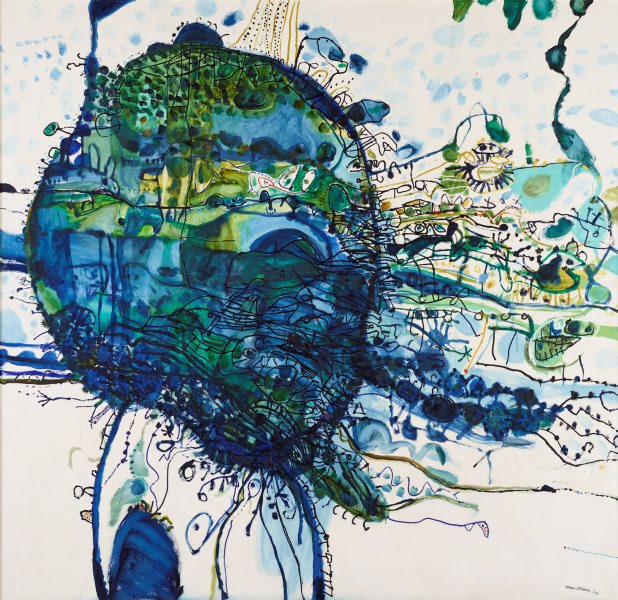
Five bells (1963) - John Olsen

John Brack uses repeated angular forms for his painting of a woman mid-conversation. Communication is usually a positive thing but in this sepia tinted rendition it is strained and isolating. The viewer, positioned as a direct and close observer, is drawn into the stark geometry of the composition.
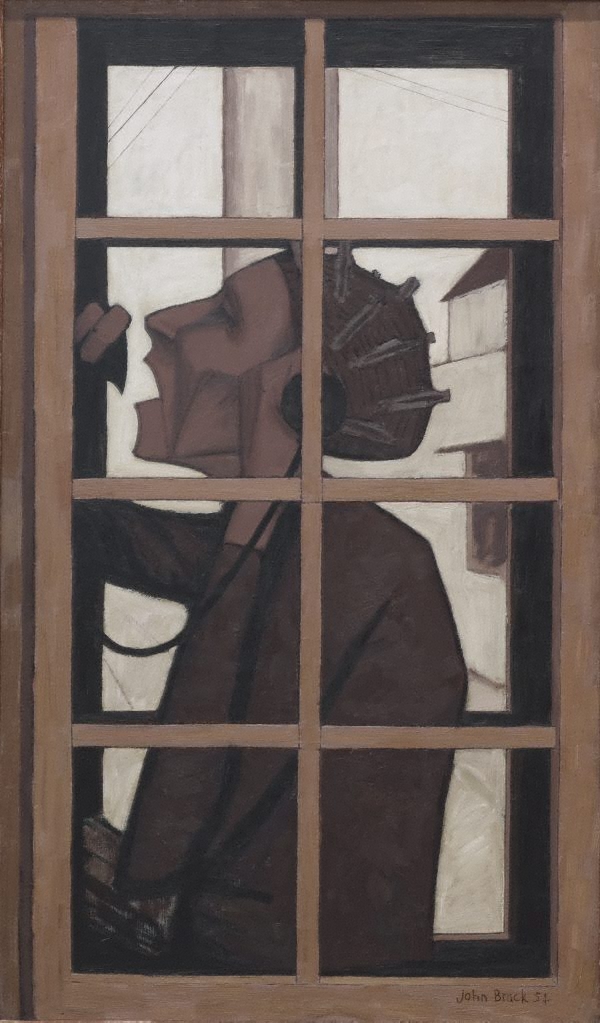
The Telephone Box (1954) by John Brack
Arthur Boyd's Nebuchadnezzar on fire falling over a waterfall features a bright meteor plunging toward a waterfall in the Austalian bush, with its distintive greens, olives, blues and yellows. The figure's splayed fingers recalls the Old Testament punishment of Nebuchadnezzar who was punsihed by God by being driven insane, ‘his nails like birds’ claws’ (Book of Daniel). There are further similarities with both the legend of Icarus and the self-immolation of Vietnam War protestors.

Nebuchadnezzar on fire falling over a waterfall (1966-68) by Arthur Boyd
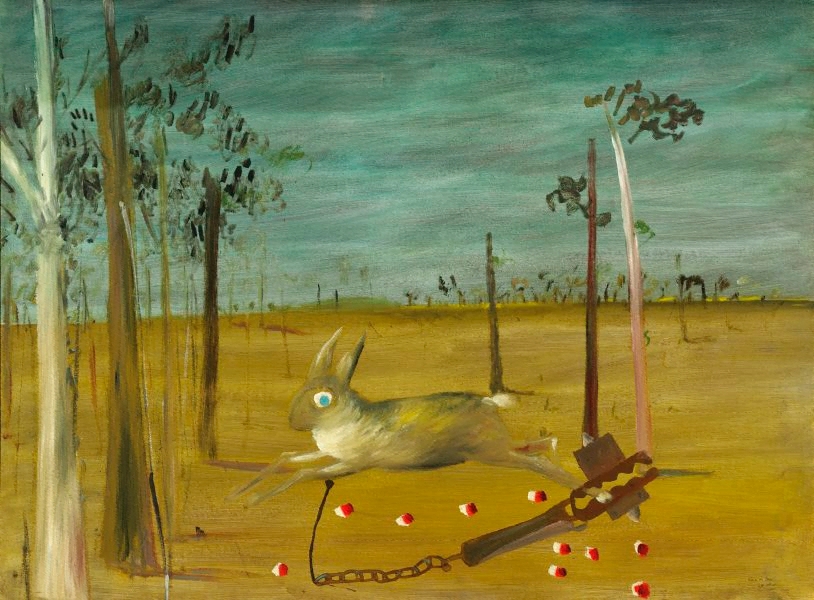
"With its startling blue eye conveying fear, pain and a desperate struggle for freedom, Hare in Trap is powerfully autobiographical. Nolan himself suggested that the hare’s eyes relate to an incident during a car trip to northern Victoria, when the painter and his father came across a hare caught in a trap – the resultant look in his father’s blue eyes struck Nolan vividly. This beautiful, enigmatic painting, which can be read as a self-portrait, is revered universally by scholars and Nolan’s admirers as one of his finest masterpieces."


Hare in Trap (1946) - Sidney Nolan
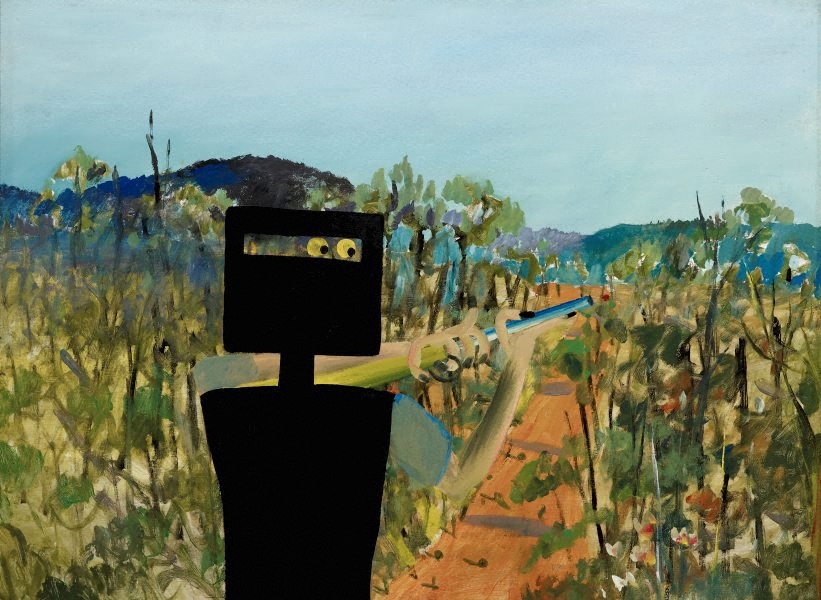
First-class marskman shows the isolated figure of Ned Kelly in the solid black armour that is Nolan’s most inventive pictorial device, its flat abstracted shape incongruously placed against a landscape of lyrical delicacy. The title refers to an incident which took place in Victoria’s Wombat Ranges, when Kelly and his gang were practising their marksmanship, firing hundreds of rounds at surrounding trees from a bullet-proof hide-out.

First-class marksman (1946) - Sidney Nolan
Albert Tucker, friends with Sidney Nolan, was impressed with the photographs the latter brought back from the 1952 Queensland drought. Many of them show the harsh effects of the climactic conditions in dessicated carcasses.
Apocalyptic horse (1956) - Albert Tucker
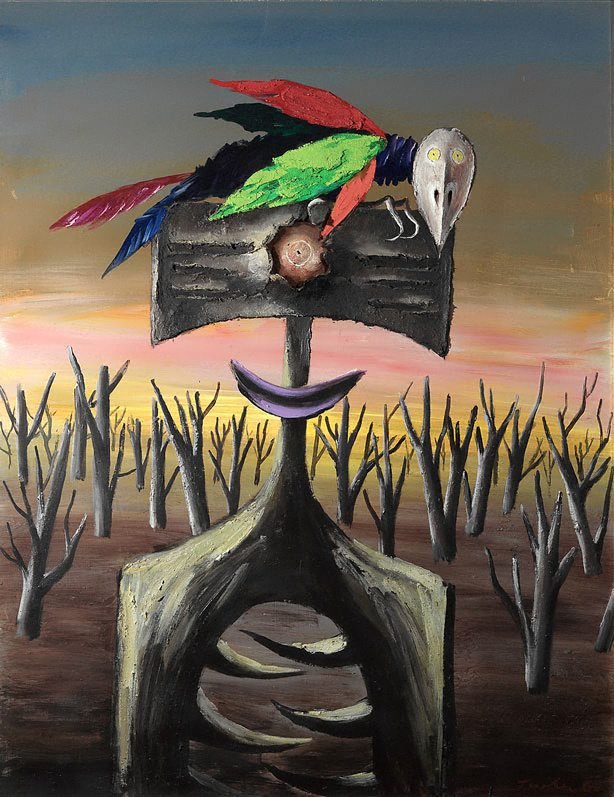
Faun attacked by parrot 3 is a direct reference to Nolan's style, with the exposed ribs and square head against the bleak landscape of burnt tree trunks echoing the paintings of the Ned Kelly series. The bright-feathered parrot, however, with the 3D beak and quirky face is typical of Tucker.

Faun attacked by parrot 3 (1968) - Albert Tucker


Monday, 5 November 2012

Australian Portraits 1880-1960 (Part Three)

The portraits of the Forties and Fifties explore the question, 'who am I?' None of these artists made their living by painting portraits. They liked instead to depict themselves, friends, family and colleagues rather than 'important people' from whom they would get a commission. Sometimes they chose disreputable subjects, such as criminals, murderers and outlaws.


Sidney Nolan's Daisy Bates at Ooldes (1950) is a remarkable study of an eccentric character who created her own mythologies. Daisy Bates was most recognised for her work as a journalist and welfare worker with Aboriginal communities. This is an imagined portrait of her in beekeeping gear, in the centre of an expansive and seemingly hostile landscape, with its red earth, hillocks and dead trees. What was Sidney Nolan thinking? Who knows? It's often difficult to tell.

For example, this monochrome version of Ned Kelly (1946) has blurred eyes as if they are shifting too fast to capture. Nolan's more famous Kelly series features the bushranger with a tin hat with the eyes the only things visible, so this is the inverse or the negative. There is no landscape or back story in this posthumous portrait, although the surrounding circle may suggest a noose. The image resembles a photo of Ned Kelly when he was aged 18.

 The Head of a Soldier (1942) is a Dali-esque portrait by Sidney Nolan of a man with bloodshot eyes in an Australian army uniform. The model was Captain Bilby, Nolan's commanding officer. Nolan tried to avoid the army but ended up serving between 1942 and 1944. He depicted the soldier stripped of any form of identification, and the portrait lays bare Nolan's strong personal reaction to Australia's involvement in the war.

Man's Head by Albert Tucker is a portrait of a man in a collar-less shirt, with a crooked, craggy face, wiry hair and fleshy lips. Tucker used his art to convey his anger and distress at the darker aspects of humanity, either through social-psychological landscapes, or portraits such as this one based on newspaper photographs of criminals. This man was charged with kicking a small dog to death.

His portrait of Sydney Fox (1946) is an eerie, psychologically disturbing image. The lop-sided lazy eye, the smooth sallow skin, and the blue and yellow hues suggest bile, anger and depression.

Sydney Fox was an English serial killer who murdered his mother in 1929 in an attempt to obtain money from her life insurance policy. At the age of 31 in 1930 he was the last man hanged in Maidstone Prison, Kent. This portrait is based on Fox's police photo.

Jude Rae's Interiors (1956) is a series of portraits of  fellow Canberra artists with their eyes closed to negate the aphoriosm that eyes are the windows to the soul. The subjects, by closing their eyes, render themselves vulnerable, but they are also complete in their interior world. This art-work is quiet, reflective and poetically intense.

The Girls at School (1959) by John Brack is odd. Three girls in their gingham dresses and school cardigans stand against a brick wall, one holding a bunch of daisies. Their neat hair, pulled off their face and tied back in pig-tails emphasises their flat faces and slightly down-turned mouths.

Brack was a skilled draughtsman and master of composition. He depicted his daughters in a bold, stylised way, by limiting the colour palette as if in a sepia photograph, and by flattening the frame.

It's quite a disturbing finish to the exhibition, and suggests that these Australians aren't all of such a cheerful, sunny disposition as many of us have been led to believe!


Wednesday, 31 October 2012

Australian Portraits 1880 -1960 (Part Two)

Moving on to The Modernists 1920 - 1940.

The artists in this period experimented with a degree of abstraction, a concern with composition, form and colour, and with a shallow picture plane and cool, crisp precision.

Stella Bowen's portrait of Mary Widney (1927) is rendered in bold lines and depicted from viewer sees the subject in a 3/4 profile and also her image from behind as she is reflected in the mirror.
Meanwhile, Grace Cossington-Smith's Study of Head, Self-Portrait (1916) reveals the influence of Post-Impressionism in its high-key palette of pinks, blues, greens, and animated brush strokes.

My new favourite artist is Nora Heysen - ok, she's been around for a while, but she's new to me. I love her London Breakfast (1935) as she sits in her dressing gown, hunched forward over the paper with a tea-cup in hand and the breakfast things still on the table. It's gentle and soft but somehow still honest as I imagine her taking a moment to herself before hurrying on with the day.

The boy in the bathing trunks in Elise Blumann's Charles, Morning on the Swan (1935) seems to be almost stepping out of the frame. He has no face but lots of form against the rippling sea. The canvas has a flat, patterned surface, and the broad rhythmic brushstrokes and network of hatch marks are clearly visible.
Margaret Preston's Flapper (1925) is another favourite. The artist has emphasised the flat patterned surfaces of the clothing set against a shallow picture plane. The subject's rosy cheeks and bright expression suggest she is painted as a progressive young society woman, but her homely woollen dress and knitted tights are at odds with the model of the flash bohemian flapper of the 1920s.
Eric Wilson did not clutter his portraits with background detail. All attention is focused on the subject and the meticulous realism of The atist's mother (1937) is almost photographic in its detail. With her hat and coat on, and her gloves and umbrella in hand, she looks as though she is just about to go out and is only delayed by her son's request to pose.

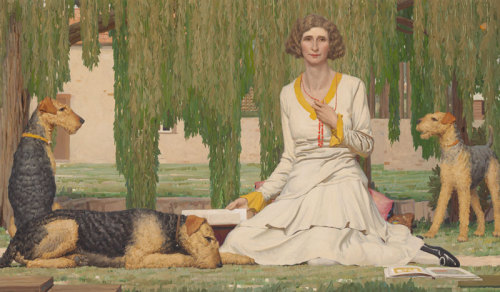
In Christian Waller with Baldur, Undin and Siren at Fairy Hills (1932), Napier Waller has painted his wife sitting on the grass with three airedale terriers, beneath the willow trees with books and cushions. She sits fully dressed in stockings and shoes, playing with her necklace. The wide canvas is full of details to the edges - if this were a photograph we would say it was beautifully cropped.

Christian became a book illustrator and printmaker while her husband became a printmaker and worked with murals and mosaics. In the 1930s he began to work almost exclusively in stained glass and mosaics, using a classical and formal style. This was painted at a time when he was becoming a man of the world while she was retreating into an esoteric religion. Knowing that, there seems to be some distance implied in the portrait.

Roy de Maistre was a pioneer of Australian Post-Impressionism and Abstraction. In his Self Portrait (1945) the central focus is the well-stoked fire, symbolising the belly of the artist, and suggesting a passionate and creative spirit. The bold, flattened forms and intersecting planes show the influence of cubism upon the work.

Albert Tucker, on the other hand, was influenced by the Expressionists, whose strong images responded to the social realities of the Depression - he became one of a group of Melbourne artists known as the Angry Penguins. His Self Portrait (1937) reveals a deeply penetrating gaze, foreshadowing the emotionally charged images he produced in the 1940s. The high forehead, swept back hair, mean scarf over jacket and tie, big eyes, sharp nose, full lips, one raised eyebrow, head tilted forward with chin down but eyes up, all combine to produce the effect of a knowing but quizzical look.