Showing posts with label portrait. Show all posts

Wednesday, 18 December 2024

My Newest Favourite Thing: The Percivals, Perc Tucker Regional Gallery

While we were in Townsville, I popped into the Perc Tucker Regional Gallery, mainly because it had air conditioning and was cool, but enjoyed the bonus of The Percivals exhibition. 

Described as North Queensland's own biennial portrait exhibition, the competition, began in 2007, is open to all Australian artists to showcase their talents. There are prizes for paining and photographic portraits, and also one for animal portraits. How could I resist?

I have included the comments from the artists in quotes below each picture.

Immigration - Annunciation 2023 by Nazila Janangir
"The original inspiration for my work is a famous theme from Italian Renaissance paintings. The actual composition emerged from da Vinci's portrayal of the Annunciation. Revisiting the scenario, I tried to re-enact the event to tell the story of my immigration to Australia.

"Borrowing from the distant master, I depicted my subjects in an outdoor space, however, more contemporary, liberated, and alive. The double portrait of Gabriel and Mary also morphed into a double self-portrait; a metaphor for the announcement of the incarnation of a new persona.
"The depicted scene is one of the gardens at the University of Western Australia in which soaring pine trees embrace an elegant white elephant palm. This robust, fleshy palm with its ray-shaped leaves symbolises what the ancient rock has offered me since I reached Australia: an exotic life experience full of drama, passion and emotion saturated with huge everyday light."

In-between Jobs 2024, by Karlalise Horstmans 
"My middle-aged husband, a loyal devoted family man and the sole income earner of a family of five, sat at our dining table, forlorn, weary from a three-month hunt for work, His sombre manner and downturned face contrasted sharply with the bright world outside. In that moment, he preferred the shadow of our family room to the promise of a bright day. This painting was designed to evidence his mood in colour and expression, to emphasise his age in form and posture, and to reveal his circumstances in choice of clothing and his placement within the domestic scene. I also wanted to contrast the interior gloom with a bright lit exterior (which he ignores), to signal how fully he is affected by the relentless burden of providing for our family, and how deeply he shoulders the heavy responsibility. He is pensive, weary in contemplation."

Selves 2023 by Sarah Hickey
"This portrait explores Gabriel Garcia Marquez's assertion that 'Human beings are not born once and for all on the day their mothers give birth to them, but life obliges them over and over again to give birth to themselves'.

"Inspired by Matryoshka dolls, the image represents the concept of duality: a higher self and inner critic, a mother self and a child-like persona, the internal vs the external. I wanted these personas to coexist, interconnect and harmonise with one another. 

"In this piece a larger self protectively cradles a smaller version. Two avian guardians sit on my shoulders - a connect to spirit - while we both hold a sword-like paintbrush. Granny squared blankets and Suzani motifs symbolise life's cyclic nature, the knitting of time, and the enduring importance of change and growth."

Reverie 2024 by Marco Pennacchia
"In my painting Reverie, I aim to capture the profound emotional depth hidden within my inner self, serving as a manifesto for personal freedom often suppressed in today's society. Emerging from a culturally restrictive background, I grapple with expressing my inner femininity, a predominant theme in this oil artwork. Delicately veiled by linen fabric, the subject's forms and facial expressions subtly emerge, symbolising the complex emotions concealed within. 

 "Reverie portrays my vulnerability confronting fears and insecurities while revealing my true self to the world. It explores the dichotomy between external appearance as a visual facade and the intrinsic essence that defines our humanity. Through this introspective piece, I challenge viewers to contemplate the depths of their own inner selves and the courage required to embrace authenticity in a society that often demands conformity."
How the Light Gets In 2023 by Seabastion Toast
"Over two decades ago, Karlee Rawkins and I embarked on our undergraduate life together. While life led us down different roads, fate has brought us back to the same community once more. 
"In creating this portrait, I sought to capture the essence of Karlee's world - a world illuminated by the winter light streaming through the windows of her home. This play of light and nature serves as a symbolic representation of her work, which delves into the profound connections between wildlife, nature, and the human psyche.
"Amid the chaos of family life, she radiates a meditative serenity, an unwavering devotion to her craft always at the forefront of her mind. Her life and art are inseparable, a testament to her enduring commitment.
"In the distant doorway, you'll find her son's silhouette, a powerful symbol of her transformation from a solitary studio artist to a loving mother, disability-rights advocate and artist."
The Man Under the Hat 2024 by Barbara Cheshire
"Prior to interviewing Bob Katter, the only knowledge I had of this man was the negative comments the media printed and that perhaps he was a man of the land. However, talking to the folk from Northern and Western Queensland and with the man himself for a considerable time, a different and intriguing picture emerged. This active hands-on helper who looks out for Queensland has a wicked sense of humour and is smart as whip. You only need to flip through the book he has written to appreciate his knowledge. Although Bob tells it like it is despite the possible backlash, he is the longest-serving member of Parliament and an interesting subject to paint."
Self Portrait with Purple Gove 2023 by Christine Wrest-Smith
"This painting reflects the level of concentration I adopt when painting a self-portrait, requiring the scrutiny and objectivity needed to study one's image. 

"I was drawn to the idea and risk of wearing a white shirt while working - the medium and process of oil paint being the natural enemy of the clean and crisp shirt.

"Many artists wear gloves when painting for health reasons; the skin is porous and some pigments need to be used with care. But the wearing of gloves has potential narratives on offer. 

"As I initially considered the inclusion and colour of my gloves for this work, a meaning and purpose sprang to mind. 

"The colour purple symbolised the Suffragettes women's movement at the beginning of the 20th century, so for me, the very appropriate context for my purple gloves is to represent the strength of women in every aspect."
Bereavement (Dad's death mask on his death bed) 2023 by Lisa Ashcroft
"My father died last year. I arrived just an hour after his passing due to a flight delay.

"As I stood by his bedside, his body still retained warmth, but his once gentle and serene face was now contorted and twisted, his body bent and buckled by the ravages of dementia. He was no longer the man I knew, stripped of his geniality and senses.

"In that surreal moment, time seemed to slow down, enveloping us in a scene reminiscent of a Caravaggio painting. The room closed in around us, every detail magnified.

"The pattern on the bedspread resembled a tide of crucifixes, reminding me of his upbringing in a Catholic orphanage. memories of his life achievements and accolades flooded my mind, mingling with the raw onset of grief.

"My father, Philip Ashcroft, was immortalised in my mind's eye as I witnessed his final moments. This painting captures the essence of his passing - a raw, honest portrayal that was emotionally wrenching to create.
Rise 2003 by Christine Baker

"The work is about playing it safe and keeping a regular job. The raincoat symbolises protection from the weather but also protection from taking a step into the unknown. The older figure at the top always wanted to be an artist but worked a regular job for security. the young adventurous soul always remained within and finally the older soul took the step to become an artist."


Self-Portrait in Water 2024 by Sam Scoufos
"I have been experimenting with using various liquids as a means of creating spontaneous gestures within my work. This purposeful, distorted self-portrait is a challenge to myself on what a photograph can be. The refracted and reflected light playing off the peaks and troughs of the water project a familiar image of reflection. Yet, during this suspension of movement, the water reveals a distorted and often grotesque image of self. The way in which the image appears is also reminiscent of agitating a developer tray and revealing a black-and-white darkroom print."
A Portrait Within Art 2023 by Christine Hall
"I selected Pam Walpole, a highly regarded contemporary landscape artist, to be part of my book titled 'Artists in Studios'. She has won many awards, more recently the Pamela Whitlock Prize. I am endeavouring to portray Pam as part of the work - leaving a fraction of herself immersed in the art. Capturing an inner portrait of Pam with her expressive brushstrokes - her face mesmerised and hands give an insight into the passionate depths the artist can transport us to. 

"The process of an artist remains unique and individual. the symbiotic relationship between the art of photography and the artists' work complement each other."
Umbrella Man 2024 by Dane Beesley
"The sharp lines of his black suit speak of professionalism, yet their sombre hue betrays a deeper truth. The weight of expectation, the pressure to provide, and the expectation to succeed plague his mind. This is a portrait not just of an individual but of a system that demands conformity, leaving countless others navigating its labyrinthine paths in search of a place to belong."
The Party 2022 by Andrew Rovenko
"The Rocketgirl's journey started as a stress response to the pandemic restrictions, but lasted way beyond that, as the little astronaut kept exploring her surroundings, feeding the child's curiosity, learning about the universe and looking for her place in it. 

"This image is one of the memories from small but magical worlds discovered in our backyard at the strangest of times. Looking at the world through the eyes of a child reminds us of one special power we all have but often forget after becoming grown-ups: the power to imagine."
These two ceramic works were part of a different exhibition entirely, but I really like their colour, boldness and sense of fun.

Ceramic Head II (Cat Lady) 1990 by Robert Burton
Gaia 2015 by Nadja Burke

Tuesday, 16 June 2020

2018 Archibald Prize Junior Version

In previous posts, I have presented my favourite portraits from the touring Archibald Prize, as I saw the exhibition at the marvellous Orange Regional Art Gallery. 

As part of the exhibition, budding artists from the Central West, between the ages of 5 and 18 were invited to submit a portrait for the Young Archie Central West competition. The portrait was to be of a person who is special to them; 'someone who is known to them and plays an important role in their life'. 

Here are some of the adorable and heart-warming hilarious results. I am really impressed with all the young talent on display and I just can't help but be cheered at the thought that perhaps this is what we really look like to the small people. I hope the portraits make you as happy as they made me.

Babushka by Charli Hobbs

The above portrait was the winner of the 15-18 years category. Charli's rationale is extremely touching.
"My piece of artwork is to replicate my grandmother born 1958. She was 22. She made a big move to be close to my family in 2015. I didn't really see her much before but now she plays a big roll [sic] in my life. She has always supported me and it's just right for me to paint this pic to say thanks."
Awww!
 

Tuesday, 2 June 2020

The 2018 Archibald Prize - Part Four

Further to previous posts, here is the fourth installment in my visit last year to see the touring Archibald Prize at the marvellous Orange Regional Art Gallery. The Archibald Prize is awarded annually to the best portrait 'preferentially of some man or woman distinguished in art, letters, science or politics, painted by any artist resident in Australia.' Often I don't know the subject, so I really enjoy finding out about the people as much as I appreciate the artwork itself.

Treatment, day 49 (sorbolene soak) - Nicholas Harding

In a room full of colourful portraits, the stark black-and-white rendering of this one, really stands out. It's craggy and straightforward at first glance, but a close inspection reveals lines and years of knowledge and expression. The self-portrait was made after the artist was diagnosed with cancer at the base of his tongue. He commenced seven weeks of treatment at Lifehouse, keeping a visual journal to record the process. After 35 sessions of radiation and seven doses of chemotherapy, his treatment finished on day 49. At the time of the exhibition, he was cancer-free.
"One of the compounding side effects of the radiation is the burning of the skin, so when my neck was blistered and bleeding it would be treated with sorbolene, Flamazine cream and ice-cold wet bandage wraps. On the last day of treatment I took a selfie on my iPhone during one of these regular sorbolene soaks and later did a drawing from it, which I used for this self-portrait. Once the colour was removed, it achieved the stark quality I was after."
Herb and Flan by Julian Meagher

There is something fabulously flamboyant about this portrait. The presence of the galah lightens what might otherwise be a sombre palette with dark greys and blues. The subject has piercing blue eyes and a gaze that is full of inquisitive intelligence and confidence.  This is Richard Flanagan, a man whose novels have received numerous honours and awards (including the Commonwealth Writer's Prize in 2002 for Gould's Book of Fish and the Man Booker Prize in 2014 for The Narrow Road to the Deep North). 
"He is one of my favourite novelists but it is his writing and interviews on literature, the environment, art and politics that particularly make him one of Australia's most important voices. Herb, Richard's writing partner, was pretty insistent that he be included in the painting."
Self Portrait by Amanda Davies

I knew nothing at all about this person, but I liked the shiny forehead and the natural skin without enhancements or embellishments - it struck me as a stark, almost communist-style depiction where modern expressions of beauty were to be discouraged, as the inner personality shone through. It turns out that this is a recent self-portrait in a new series of figurative paintings 'addressing the theme of decay and remedy, where the relationship between body, mind and emotion is heightened'.
"In response to a story where an elderly woman mistakenly applied toothpaste to her face instead of moisturiser, I put toothpaste on my face and washed it off numerous times. Toothpaste is very astringent. It gets in your eyes and it stings. Taking hundreds of self-timer photos, I felt numb, exhausted, and relieved afterwards. This self-portrait is drawn from the en of that process and reveals a shifting emotional state between distress and relief.

"I set up situations in my studio that engage the tradition of theatricality in painting - performance being part of the process in developing my work. Here the figure lies horizontally - the position for sleeping, dreaming, healing and dying - yet the painting is exhibited vertically, eliciting a sense of disorientation.

"At the point of decay, the perceived boundaries of the body dissolve ad our sense of self can shrink or expand, allowing us to experience the edge of the self as elastic."
Self-portrait after George Lambert by Yvette Coppersmith

I'm including this one not because I like it (it's fine but doesn't particularly appeal to me) but because it won the Archibald Prize, showing how much (or, rather, little) I know about art. To me, the posture is unnatural, the subject a little bland (with that trout pout beloved of insipid teenagers in selfies, thinking cheekbones are a substitute for personality), and the focal point seems to be the golden curtains behind the subject, rather than the subject itself.  Apparently I am wrong.

The artist, Yvette Coppersmith, has had five previous entries into the Archibald Prize and she is drawn to the self-portrait because, 'it allows me to work from life, with intense absorption in the painting process'. Her theme is female empowerment and she originally wanted to paint Jacinda Ardern, the Prime Minister of New Zealand. I believe the rationale is more impressive than the painting.
"Ardern wasn't available but I thought I might channel something of her in my self-portrait... I had several reasons for asking Jacinda Ardern, but through her role she expands what an image of a young woman can signify - inspiring others to think beyond any perceived limits of their own image in relation to the contemporary political landscape. 

"[George Lambert's] style was academic, yet he supported the avant-garde in Australia and painted portraits of his artistic contemporaries Thea Proctor and Hera Roberts - both independent, self-possessed style makers at a time of burgeoning female empowerment. In referencing George Lambert's style, it's like an outfit slipped on, creating a fixed image of an ever-changing self."
Guy by Ann Middleton

Or perhaps I am in tune with the public after all, because this portrait of Guy Pearce by Ann Middleton won the People's Choice Award. And I like it a lot too. It is a familiar face, but I think the artist captures his expression with all its quirky sensitivity, intelligence and sense of fun. Perhaps it is the blank background which draws me in to focus purely on him; perhaps it is the light which illuminates half of his face, recalling the comedy/ tragedy theatre masks; perhaps it is his naked torso indicating a certain vulnerability; whatever it is, I find this portrait deeply affecting and extremely personal.
"I see profound depth of emotion and some sadness in Guy's eyes, however, his gaze is direct and bold. It was this curious melding of uncompromising determination and a certain boyish sweetness that led me to ask if I could paint his portrait. 

"My portrait of Guy was inspired by early photographic portraits of Indigenous people using tintype photography, the otherworldly translucency of skin it imparts and the compelling directness of an unselfconscious gaze.

I painted Guy in the natural light of my studio. One side of his face is in deep shadow. Obscure and mysterious, it speaks of hidden difficult times. The other side is brilliantly lit. It is an uncompromising light, honest and unflinching. This extreme tonality enabled me to explore Guy's chameleon nature and his personal awareness of the light and dark within that makes him both an extraordinary actor and a kind, funny and unassuming bloke."
Insert headline here by Amani Haydar

Initially the bold print, bright colours, and wonky expression make this appear to be a child's drawing or collage which seems fun and frivolous. Closer inspection, however, reveals the subject has a determined focus and that she is holding an image of a woman holding an image. It has a surreal Russian Doll effect suggesting a mysterious background. The fact that the picture within the picture is a black and white photograph also hints at some sort of reportage or story-telling. I did not know who this person was, but I wanted to. I learned that this is a self-portrait in which the artist holds a photograph of her mother, who holds a photograph of her own mother.
"When my mum was murdered in her home by my abusive father on 30 March 2015, some media outlets circulated a Fairfax photo taken in 2006 while my mum was grieving the death of her own mother, who was killed in an Israeli airstrike while fleeing the southern villages of Lebanon. 

"I incorporated the photo, which I printed straight off the internet (you have to pay for a proper print) as a way of reclaiming my story from the headlines. By painting a self-portrait, I was able to reinstate its personal significance to me.

"I also saw it as an opportunity to challenge assumptions that women victims of crime are helpless, weak or subservient. I have used vibrant colour to convey a sense of hope, while the repetition of patterns echoes the repetition of trauma in my life, but also draws on the type of art found in mosques, which for me symbolises faith, survival and regrowth."

Wednesday, 6 May 2020

The 2018 Archibald Prize - Part Two

Further to a previous post, here is the second installment in my visit last year to see the touring Archibald Prize at the marvellous Orange Regional Art Gallery. The Archibald Prize is awarded annually to the best portrait 'preferentially of some man or woman distinguished in art, letters, science or politics, painted by any artist resident in Australia.' Often I don't know the subject, so I really enjoy finding out about the people as much as I appreciate the artwork itself.
Don by Mirra Whale
It was the colours in this portrait that caught my eye as they remind me of those 3D paintings or  that have fuzzy flashes of red and blue around the image to make it stand out when one dons special glasses. I had no idea who the subject is, but apparently he is the Honourable Don Harwin, the New South Wales Minister for Resources, the Minister for Energy and Utilities, and the Minister for Arts. The artist claims to be impressed with his "passion, curiosity and dedication to the arts."
"Painting Don, it became very evident that politics is never black or white. In some respects he stands in contrast to the seemingly conservative government he represents. For his portrait, I decided to take this notion further. Using a traditional portrait background, I applied colour to reflect not only his personality but his dynamic contribution to the arts."
Elisabeth Cummings in her studio at Wedderburn 1974 and 2018 by Noel Thurgate 
I really enjoy the kind and generous expression on this woman's face. I presume she is an artist because of the background to the portrait, and I like to see this in context - one should appreciate an artist at work as well as by their output. She appears confident and calm in her ability; her hands have seen much work and knowledge. The way in which the artist has incorporated the wood and other materials into his picture indicate that these have a specific relevance to the subject. I read that he was inspired by a 1974 photo of a young Elisabeth, aged 40, standing beside a tree trunk admiring the construction of her house/ studio in which she would make all the works for a future exhibition.
"Entering the studio, ideas and images immediately tumbled into place. The tree in the 1974 photo is the centre post supporting the roof. The very fabric of the building - stone, clay and wood - reflects the rich, earthy, materiality always evident in Elisabeth's palette. Numerous skylights reveal glimpses of trees and sky, and flood the interior with top-light, while Elisabeth quietly, calmly gets on with it, looking forward to starting the next painting."
The Letter - I really wanted to paint Germaine Greer but she said 'no' (self-portrait) by Stephanie Monteith
The purple and orange hues are exotic and the neat collection of oranges contrasts with the busy pattern of the tablecloth - it is an arresting blend of still-life and portraiture, with fruit, drink and flowers foregrounding the profiled figure. I became even more interested when I read that the artist wanted to paint Germaine Greer whom "I admire for many reasons".
"I made some requests and it became clear that it was unlikely to happen. And so, among other things, this painting is a metaphor for that stereotypical Archibald experience - the search for a desirable sitter... 
"I didn't want to paint myself for the Archibald but I was a convenient, available sitter. I prefer to work directly from life rather than photographs, and the time needed for this can be difficult for other people. To paint myself in profile like this required an arrangement of mirrors reflecting one another."
Uncle Ron Kennedy by Blak Douglas
What stands out to me here are the colours of the Aboriginal flag, and the instant recognition that this is an indigenous artist and subject. The image implies strata (in the background) and contours (in the hat) reflecting the connection to land. The rich reds and yellows contrast with the monochrome black and white to tell a story of appropriation and native representation. It did not surprise me, therefore, to learn that the subject is 'a celebrated Wiradjuri artist, renowned for his naive-style depictions of his mission upbringing'.
"Given Roy's past practice as an etching printmaker, I wished to honour this by depicting him in monotone. This is completely new to me and was much like attempting to speak a foreign language. Metaphorically though, I saw a spiritual man who now lives a lifestyle that is the polar opposite of his mission upbringing. Aesthetically, I've used a cracked acrylic surface - my trademark - around his face in the ochre colours of the earth. This represents the hardness of a man forged from an ancient past whilst living within a fractured present."
Self-portrait with studio wife by Del Kathryn Barton
This is just bonkers with swirling textures, busy colours and the inclusion of a pet. The peculiar perspective is dreamlike and the foreground focus on the hands implies a lambent creativity. The similarity of the slightly unfocused gaze of human and animal indicates a deep and supportive connection between them, which is separated from the viewer. I read that Del Kathryn Baton has won the Archibald Prize twice before and this is her fifth time as a finalist. She began painting this self-portrait halfway through her mother's two-year battle with terminal cancer, and the 'studio wife' in question is her French bulldog, Cherry Bomb.
"With my fierce little Cherry-Bomb-studio-wife keeping a look-out on my shoulder, I was taken aback when finishing the work by how child-like I look. Little-Del-the-daughter is very present.
"I completed the painting four months after Mum's death. My hands open in a state of uncertainty and loss. A single finger touches a giant leaf. This leaf, vibrating the life energy of the universe, is my departed mother.
"Cherry-Bomb is witness to and defender of my creative life. I remain forever grateful for her play-like-it's-the-end-of-the-world presence in my life, especially at a time of indescribable loss. Her deep eye contact is one of the most healing elements in my journey with grief."
Courtney Barnett and her weapon of choice by Melissa Grisancich
I like Courtney Barnett a lot; I like her music and her attitude.The first time I ever saw her, she was singing a duet with Billy Bragg (a cover of Sunday Morning by The Velvet Underground) and that was enough for me - my affection was assured. Her youthful energy is embodied by the childlike print of the wall behind her, while she cradles the guitar with a passion that her singer's cynical expression both reflects and refutes. She and the artist are friends; Gisancich writes,
"I'm a big fan of her music with its unique mix of rock, folk, indie and grunge. I also love her guitar playing, and see her as a strong representative of the positive shift happening for women in Australian music today. 
"Courtney was happy to sit, quietly playing a tune and looking round the room as if I wasn't there. She had a casual warmth about her that I wanted to capture. Her music and witty lyrics are quite colourful, so I have used a lot of colour. The background is inspired by 1930s Australian art-deco patterns, which often feature in my work." 

Sunday, 22 March 2020

The 2018 Archibald Prize - Part One


Last year when I was in Orange, I went to the marvellous Orange Regional Art Gallery to see the touring Archibald Prize exhibition. The Archibald Prize is awarded annually to the best portrait 'preferentially of some man or woman distinguished in art, letters, science or politics, painted by any artist resident in Australia.' Often I don't know the subject, so I really enjoy finding out about the people as much as I appreciate the artwork itself.

The Huxleys by Sally Ross
I like this painting because of the androgyny of expression and the converse ostentation of the muted colour palette. Garrett and Will Huxley are visual artists and performers, who form a band called SOS (Style over Substance) and have been known to dress as Bauhaus worms or inflatable balls. Apparently Sally Ross knew she had to paint them when she saw them in 2017 performing in Discordia; a show involving a 'prawn-worshipping, rose-beige-costumed cult'. As you do.
"I saw the mysterious potential for art/ civilisation to be expressed within the handsome duo's magical physical presence. This portrait is a homage to the pure folie of the Huxleys' performances, as well as hairstyles found in the portraits of Otto Dix and Diego Velasquez. I wanted a deliberately distant, expressionless pose that transforms their glittery bodysuits and cheap, teased wigs into a portrait evoking the timeless silhouettes of antiquity and 'old paintings' I so admire."
Study for a self-portrait by Angela Tiatia
The unfinished quality of this painting is arresting. The subject has an urban skateboarder's stance, which is excessively contemporary, contrasting with the retro pattern on the floor. The face is fierce, while the body is sketchy - there is clearly a lot of attitude emanating from the canvas. The artist (who was born in New Zealand in 1973 to a Samoan mother and Australian father) writes,
"When I started painting, I wanted to portray myself as powerful and confident, but found the process produced the opposite feelings of vulnerability and fragility in anticipation of being looked at and judged. It's the friction between these two states of power and vulnerability that I am most interested in within my art practice.
Study for a self-portrait explores the tensions that exist within the historical and contemporary notions of the gaze. In European art-history the ever-recurring treatment of women as passive objects for the male gaze. This is complicated further by the treatment of women of colour as the 'exotic other', which is fetishised in works by artists such as Paul Gaugin."
Self: Past, Present and Future by Kathrin Longhurst
I like the clarity of the gaze of this portrait; the expression is candid and unflinching, but open to wonder and new experiences. The overlaid images of a disassembled tank and binary text add an industrial and militaristic feel, which is heightened by the muted colour palette. It is, apparently, a depiction of the artist's daughter, whose DNA will effectively create a self-portrait representing her past, present and future.
"Born in East Berlin in 1971, I grew up at the height of the Cold War. It was a time without the internet, surrounded by propaganda, and we constantly feared invasion from the 'imperialist West'... The tank alludes to our contemporary volatile environment: a new Cold War. But today's experiences are shaped and intertwined with social media. While this technology offers us a chance to seek the truth and understand our shared humanity, it is a double-edged sword spreading misinformation, extremism and conspiracy theories.
"My daughter represents my future. Her generation will inherit our planet. I am projecting my dreams and hopes onto her: she is part of me but also her own person inheriting the legacy we leave behind."
Abdul by Jonathan Dalton
The subject of this painting is Abdul Abdullah, a multi-disciplinary artist, whom Jonathan Dalton greatly admires. I like the casual, relaxed posture, and the feet beside the whisky decanter and glasses - it really does look as though the subject was pausing briefly in the middle of a story to check that the audience was paying attention. Dalton writes,
"Abdul has an infectious energy and easy affability that makes it impossible not to like him. But he has these moments of near laser-like focus and intensity when something catches his attention. I wanted to capture that penetrating intensity in his stare but juxtapose it against a delicate and pensive hand gesture. 
Abdul came to my studio for a sitting where I had carefully prepared a staged set. After making an initial sketch or two, I took approximately 250 photographs. But, despite the work appearing somewhat photorealistic, it has a false perspective that would be near impossible to reproduce in a conventional photograph. This was done to draw the eye to Abdul and artificially heighten his engagement with the viewer."
Lunch in the Outback by Dee Smart
The colours and composition of this one are just eye-popping. From the delicately held sandwich to the ridiculous underpants on the head; from the wry smile and twinkling eyes to the irritating presence of the fly; the whole things draws me in and makes me want to know more. I find this work thoroughly engaging in both its simplicity and complexity. 

The accompanying panel tells me that the subject of this painting is Meryl Tankard, a dancer, choreographer and director. 'After starting her career with the Australian Ballet, Tankard spent six years as a soloist with Tanztheatre Wuppertal, the legendary company of German choreographer, Pina Baush. Returning to Australia in 1984, she began creating unforgettable works that crossed dance, theatre and visual art. More recently, she has focused on screen and film culture.' Dee Smart explains,
"I have painted Meryl in her original cocktail dress she wore on stage during a performance with Pina Bausch, when she explained to the audience how she dealt with flies, then showed them by shimmying out of her undies, which she put on her head."
I'm not actually sure how this would help, and I don't want to think about it too much because it starts to get a little disturbing, but I like the bright humour of the picture nonetheless. 

Alison Whyte, a mother of the renaissance by Paul Jackson
This is another painting to which I'm drawn due to the colours - that deep decisive red matched with the confident lipstick, and the beautiful rich hue of her auburn hair - combined with the frank intensity and wry humour in the eyes. It's both soft and wavy due to the contours of her tresses, and spiky and angular, on account of the pointed ruff. It's very sensual and sensory. Artist, Paul Jackson, chose actor Alison Whyte as his subject.
"Alison is an actor I have admired since seeing her on Frontline. It was also helpful that her face has an Elizabethan feel - hence the ruff, a typical fashion item of the day both in the street and on the stage of the Globe Theatre. From a technical point of view, it allowed me to throw under-lighting on her very fair skin to create a luminosity typical of Tudor Renaissance painting."

Thursday, 19 September 2013

Sides of Bacon: 3. Back

Francis Bacon: Five Decades
Art Gallery of New South Wales
17 November 2012 - 24 February 2013

Three Studies for Portrait of Isabel Rawsthorne
Frnacis Bacon embraced the triptych form, which gives many of his portraits the sensibility of mug shots with their front and two profile aspects. This was a format popular with devotional works and Christian altarpieces, which Bacon subverted, placing the secular (and what some considered ‘deviant’ images of homosexuality) in a religious arrangement designed to shock. This stylistic device also allowed him to construct a narrative through consecutive frames. Of Three Studes for Portrait of Isabel Rawsthorne he wrote “What I want to do is distort the thing far beyond the appearance, but in the distortion to bring it back to a recording of the appearance.”

Many of his triptychs are of George Dyer as he appears to work out his grief and anger on canvas. Three Studies of Male Back (1970) reveal a man reading or shaving reflected in a mirror, except in middle picture the mirror is symbolically a dark void. The figures in Triptych (1970) echo earlier themes of wrestlers but now the protruding spine points to vulnerability and the swinging hammock with distorted shadow and no background highlights loneliness and isolation.

Three Studies of male back (1970)

Triptych (1970)
Triptych (August 1972) seems to be a memorial as the figures on the outside are seated on a wooden chair while the one in the middle is in a foetal position. The flesh melts in puddles of pink and lilac, representing life flowing out of the body as shadows seem to escape from the figure.

Triptych (1972)
Bacon’s paintings of this period often feature mirrors and we see backs of heads and people examining themselves. He was also keen on radiology in this era, with its textbook blue circles pinpointing internal workings. In Triptych, 1973 there is an element of self-portraiture, of a figure looking critically at himself, at who and what he is. He examines his bodily functions (defecating and vomitting) and his inner demons. He claimed, “The sitter is someone of flesh and blood and what has to be caught is their emanation” but he often portrays his figures as though through glass tables with pornographic and sadomasochistic overtones.

Triptych (1973)
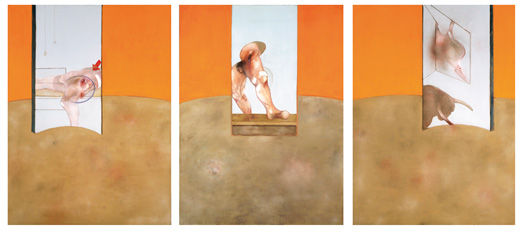
By the 1980s the sense of chaos and drama is replaced with a more sober control. Most of his friends were dead, and his paintings have become flat yet vibrantly coloured with solid, fleshy shadows. By 1987 the Triptych reveals bullfighters’ wounds as if seen through a blue window against a bright orange background.

Triptych (1987)
Francis Bacon’s work is puzzling both figuratively and literally. Confusion is created by his use of generic titles, renaming paintings with different titles, destroying of canvases, and inability to predict how many pictures he will exhibit so they cannot be included in a catalogue but arrive at the gallery with the paint still wet. Pictures of his studio reveal an overwhelming muddle and yet he insisted plaintively, “I work best in chaos”.

Perry Ogden's photo of Francis Bacon's studio