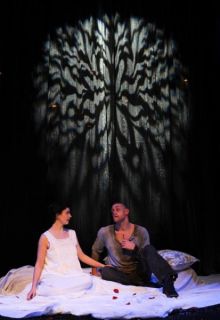
Showing posts with label Frankenstein. Show all posts

Friday, 24 July 2020

Friday Five: NT Live


The theatres are closed and many of us have been missing live performances terribly. Since the beginning of this pandemic, the National Theatre has been screening live productions of its plays, which has helped me get my fix. It's not the same as being there, but it certainly helps. I hope we all remember the importance of this artistic medium when we are able to face the world again, and that, just as the arts have supported us through this crisis with cultural sustenance, we support them right back with financial assistance. 

5 National Theatre Live Productions:


  1. Frankenstein (2011) - I watched both versions which played in tandem, one with Benedict Cumberbatch playing Dr Frankenstein while Jonny Lee Miller undertook the part of The Creature, and the other one where they swap roles and everything else remains the same. This is more than just a gimmick: BC's Creature is angry and bitter; his Creator deeply troubled, whereas JLM's Creature is more humorous and quizzical; his Creator angry and arrogant. The supporting set, costumes and acting from the rest of the cast are sublime and the experimental steampunk element that director Danny Boyle introduces is a clear forerunner to his Olympic Games Opening Ceremony the following year, with its stark aesthetic and musical underpinning by Underworld.
  2. One Man Two Guvnors (2011) - I took my parents to see this in London, with a different cast but the same production. It is positively frenetic, and James Corden is a tour de farce. The reverence with which the source material is treated, complete with knowing asides and dollops of dramatic irony make this a great piece of entertainment (director, Nicholas Hynter, dropped it into the middle of a 'serious high-minded season' for light relief). The perfect blend of verbal and physical humour will have them lol-ing in the aisles. 
  3. Present Laughter (2019) - actors are a tricky bunch: they are naturally dramatic but want to be taken seriously. Noël Coward probably knew this more than most, and his depiction of Gary Essendine, a highly-strung bi-polar actor with an entourage, is portrayed with infinite intricacy by Andrew Scott. I tried to find a male noun for a flamboyant person but they all alluded to the individual's sexuality rather than their mental state, and any term for throwing tantrums, being temperamental or emotionally demanding had a female gender bias such as diva or prima donna. According to modern media, male meltdowns are either comedy fodder or concerning spirals into mental illness; Matthew Warchus' contemporary production of this 1940s classic explores this dichotomy from a fresh angle, only occasionally tipping the scales too far in the balance of mania.
  4. Crossing party lines in This House
  5. This House (2013) - Party politics can often seem farcical, and so they adapt seamlessly to the stage in this premier production of the timely drama written by James Graham and and directed by Jeremy Herrin. The setting is the turbulent years of 1974-1979 in the UK, when Labour struggled to keep enough numbers in the Commons to pass bills and enact legislation. The tally of members is calculated on an ever-changing chalk board, including people being brought in from their death beds to vote, and promises of bigger offices and newer furniture. The party whips are metres apart in the corridor, and claustrophobically close on stage (while the auditorium doubles as the benches of 'this house' with members emerging from the audience) while they indulge in the literal fisticuffs and petty point scoring more at home in a school playground. It is a building full of bullies, bawdy humour and the fledgling sexism of the 70s, which makes a ripe background for satire and commentary on the class roots of the major parties.   
  6. Twelfth Night (2017) - The Shakespearean play best know for cross-dressing and gender fluidity is an obvious choice for blind casting. Initial reservations at seeing a Malvolia rather than a Malvolio are swiftly overcome by the skill of Tamsin Greig's acting and the sensitivity of Simon Godwin's directing. The twins are well matched through personality with Tamara Lawrance and Daniel Ezra displaying a similar sense of fun, and the Count (Oliver Chris) and Countess (Phoebe Fox) are both a lot more appealing and less pompous than in many productions. The festive element is heightened with party hats and feather boas, but occasionally teeters towards excessive camp. The slick set changes are remarkable, and a fountain on stage is always a highlight. 
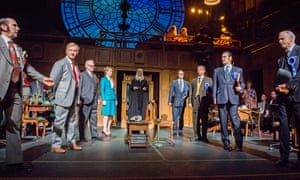
Tamara Lawrance as Viola and Oliver Chris as Orsino in Twelfth Night

Wednesday, 19 June 2013

Frankenstein: as Shelley Intended

Frankenstein by Nick Dear
Ensemble Theatre Production
Street Theatre, 7-11 May 2013

From the opening strains of the cello (composer Elena Kats-Chernin; cellist Heather Stratfold), which set the tempo and the heart racing, and underscore the rest of the action, this visceral, chilling, moving and powerful drama (director Mark Kilmurry) provides much to look at and even more to think about.

Everyone knows a version of the Frankenstein story, but they are probably more familiar with the cinematic depictions of the mid 1900s than the psychologically tortured Gothic melodrama that Mary Shelley wrote in 1817. Despite a reference to the Hammer House of Horror in the predominantly black and white costumes with occasional splashes of red, Nick Dear’s adaptation focuses mainly on the ethical elements of the legend.

Having tinkered with the divine right of creation by constructing a creature from dead human skin and organs, Doctor Victor Frankenstein (Andrew Henry) must suffer consequences. If one wants to create life; one should produce children, yet Frankenstein’s reluctance for intimacy with his finance, Elisabeth (Katie Fitchett) makes this seem unlikely.

Instead he manufactures the Creature, which is represented with startling brilliance by Lee Jones. Jones’ spasmodic movements suggest a twisted choreography. The ‘birth’ scene in particular is incredibly disturbing: actions such as discovering one’s fingers, toes and penis, while cute in a baby, are confronting in a nearly-naked adult.


When thrown out by his disgusted creator, the Creature stumbles upon the farm of a blind university professor (Michael Ross), who teaches him morals, literature and philosophy, unafraid of what he can’t see. He explains that society can breed cruelty; people gather together for comfort and companionship, but then massacre each other, just as soldiers destroyed the professor’s books.

The professor’s son and daughter-in-law (Michael Rebetzke and Olivia Stambouliah) share a loving marriage. The Creature is inspired by this example of equality but when he is introduced to them they recoil in horror and he seeks revenge for their repulsion. Although he wants to be good and loved, he is scorned and derided, which forms his character.

Shelley was greatly inspired by the contemporary doctrine of Calvinism – Calvin taught in Geneva where much of the novel (and subsequently play) is set – which teaches that people are born depraved and only achieve salvation through God. Other religions and philosophies of the time propounded that we are born pure, and learn evil through education and environment. The entire novel can be read as a debate on this issue, and Kilmurry’s direction certainly highlights this aspect.

Things in nature go together and need partners, so the Creature needs a companion and asks Victor for a wife. It is a concept familiar to the Shelley’s and forms the essence of Percy Bysshe Shelley’s poem Love’s Philosophy; “The fountains mingle with the river/ And the rivers with the ocean/ The winds of heaven mix for ever/ With a sweet emotion;/ Nothing in the world is single,/ All things by a law divine/ In one another’s being mingle –/ Why not I with thine?”

The bride that Victor creates is ‘perfection’ by early nineteenth-century standards of the ideal female: she looks great but doesn’t say anything. Women were considered second-rate and early feminist principles are prevalent in Frankenstein (many male detractors argued that Mary Shelley couldn’t possibly have written such a great work herself and must have had help from her husband).

Fitchett embodies this strength in the character of Elisabeth. She is determined to share her husband’s scientific experiments arguing (passionately and justifiably) that the only reason she cannot understand them is that women are not permitted to go to university. She is tired of perfection and searching for something other, claiming that the lakes and mountains are beautiful, but boring and the people are dull.

The handsome but austere settings of Switzerland and the North Pole wind and snowscape (with a brief foray to the Orkney Islands) are superbly executed through sound (Daryl Wallis) and lighting (Nicholas Higgins). Victorian light bulbs drip from the ceiling like stalactites, and the effects are exceptional from the pulsing accompaniment of the heartbeat to the flickering fire and woodland gobos.

The on-stage Foley art adds a nightmarish abstract dimension as actors recreate the sounds of grave digging, beatings and crackling flames. This enhances the clear and creative set design with a central scrim – the semi-transparent curtain occasionally closed like a hospital cubicle to screen the action while conversely highlighting dire imaginings.

The antagonistic symbiotic relationship shared by the Creature and his creator is made flesh by the spectacular acting of the principals and the co-ordinated cyclical design (Simone Romanuk). The final tableau of the North Pole connects us back to the beginning with its infinite succession of life, death, birth, creation and destruction; all reflected in the round black granite stage. It’s timeless, it’s brilliant and it’s truer to the original source material than any previous version of this classic tale.