Let's start with the opening ceremony. Wow; c'était fou! I loved it. There has been a lot of talk about it being disorganised and chaotic, but I loved the madcap nature of the event as it showcased Paris as it is, and if you don't like it, tant pis - which is as French as you get.

Firstly, it is the first time in the history of the Summer Games that the Opening Ceremony did not take place in a stadium. The idea was that it would bring the sports to the city; the athletes travelled down the Seine in a variety of boats, and the punters lined the quays (or les rives) for free to cheer on the participants and to enjoy the spectacle. Yes, it rained, but so what? It rains in France. There was a nice touch with a tri-coloured 'water fountain' smoke above one of the bridges, although there was some poor bloke strapped above it with an accordion and wings getting absolutely drenched.

The boats were an inspired touch. The flotilla appeared in French alphabetical order, which was fun to remember that Germany is L'Allemagne and Spain is Espagne. Several people in the Twitterverse were getting very confused, which is also fun. They were complaining that there was no Les Etats Unis or Australie, until it was pointed out that the next Olympics are in Los Angeles and the 2032 event in Brisbane, so those hosting countries are second last and third last respectively, before France brings up the rear.

All the boats are different shapes and sizes, looking like a reverse Dunkirk affair - the Americans have the biggest and flashiest; the French have the most stylish; and Bhutan have the most expensive - the three athletes representing Bhutan are aboard a 1964 vintage Murano, 'a Riva Yachts Venetian limousine tender built in mahogany and varnished to a high sheen'.

Brazil have a party boat, the Cambodian craft looks like it is about to get swamped, and the patched-up Refugee Olympic Team vessel would have been turned back by Tony Abbott. Many nations have to share with each other. Team GB (Tom Daly and Helen Glover doing flag waving duty and obligatory Titanic pose) share with Grenada, Guam and Guatemala. Because the TV commentators have absolutely no clue what is happening (other than that it is raining), they revert to their notes frequently. Hence I learn that Guatemala is one of the few countries to have won more Nobel prizes than Olympic medals, Lichtenstein's national anthem is the same tune as God Save the King, and Nepal is the only country in the world with a non-quadrilateral flag.

The athletes are all proudly wearing their national outfits (Belgium are either all in red, yellow or black; the Bermudans wear shorts that in Bermuda they probably just call 'shorts'), although as the day wears on and the rain increases many of them cover them up with fetching plastic ponchos. Bulgaria looks like they are about to go to war; Burkina Faso have good hats; Naby Keita is the flag bearer for Guinea; according to the commentators Guinea-Bissau is one of the 'new countries' who have never won a medal; insights into the Italians (in outfits by Armani) is that theirs is a country of 'great people; great food'.
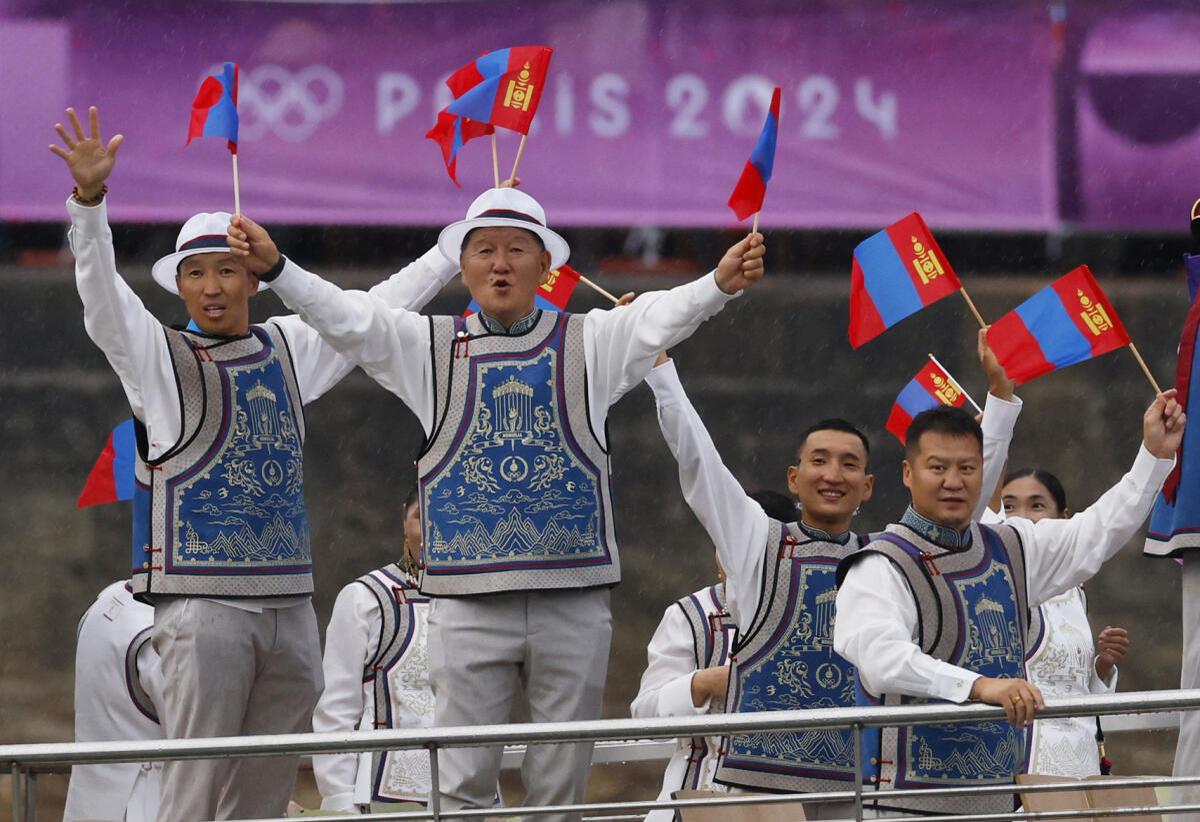
Mongolia have the best uniforms; Mozambique are wearing pop art jackets; the folk from Niger all salute as they sail past; Slovenia are literally bouncing, as are Sudan in a very small boat (not sure the optics are great on that one); USA, of course, has the largest contingent (over 500 athletes) and appear to be navigating the Seine on a cruise ship; France has the nicest boat, which is gleaming white and all lit up like an ocean liner.
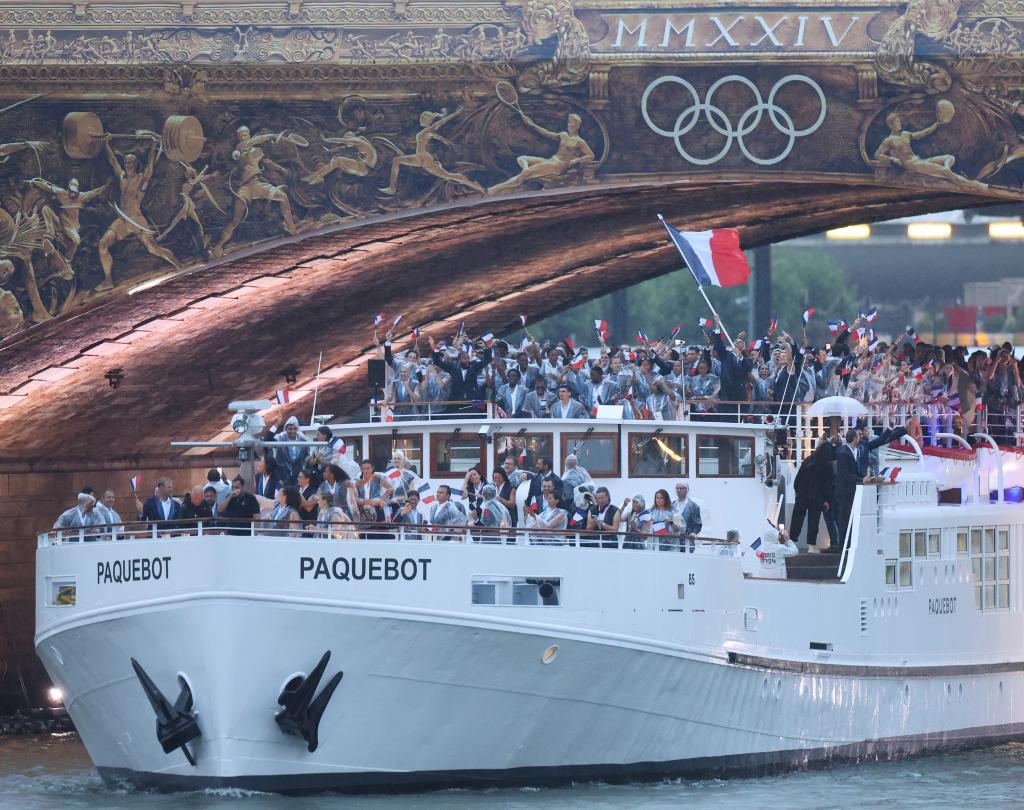
The ceremony was divided into sections to give it a rough thematic element. I shall try and explain what occured in some of them, but (due to the commentators not having a clue what was going on), I may well get some of this completely confused. Throughout it all there was some mysterious parcours torch bearer, who nicked the torch from a bunch of kids and then nipped about with it on the roof tops.
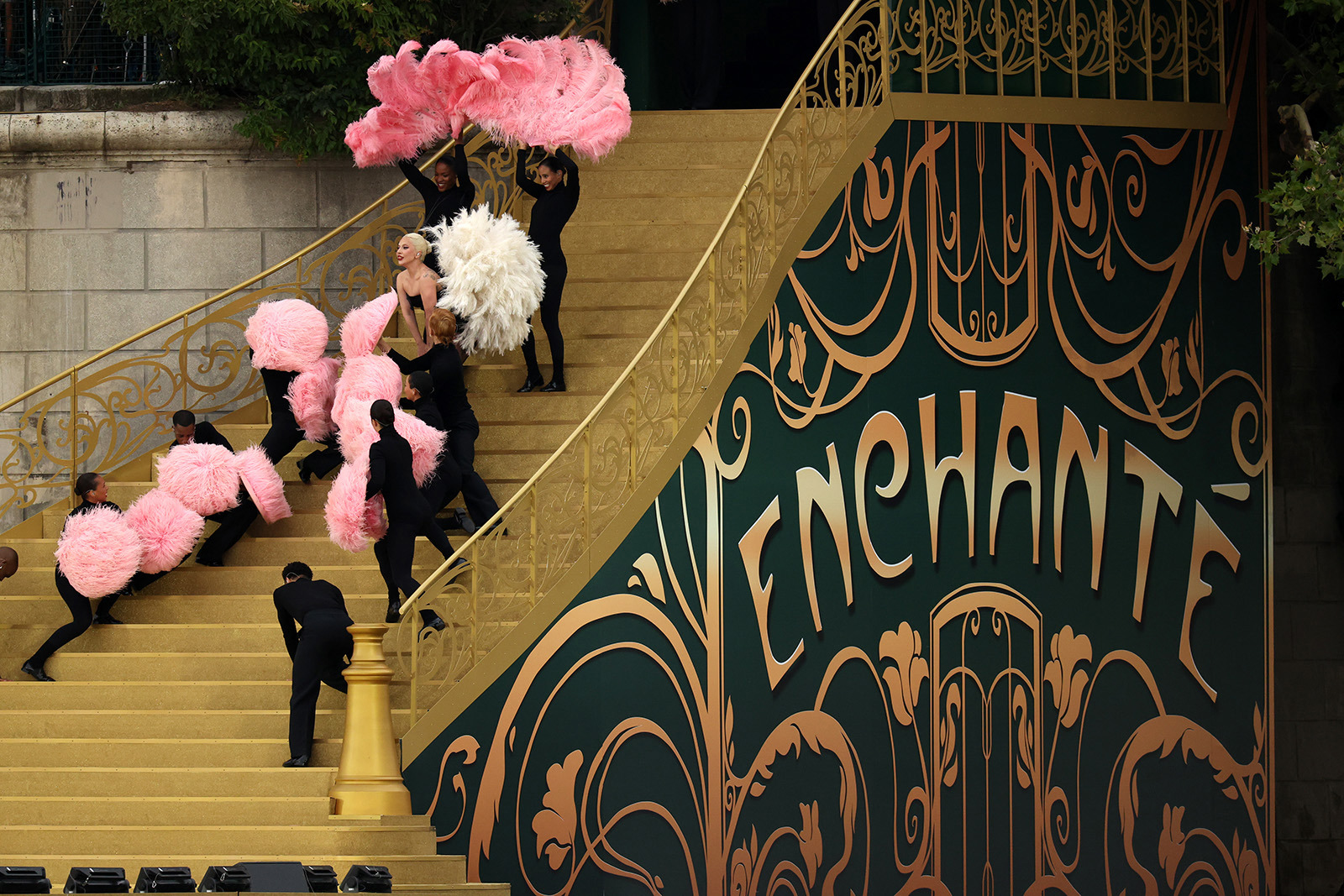
1. Enchanté - a sort of pink section in which Lady Gaga does a turn with flaming galas, fans and large pom-poms, which are apparently a girl's best friend as she imitates a French Marilyn Monroe, walking down golden steps with art nouveau Paris metro signs. It's all about 'culture, spirit and personality' apparently. There are dancers wearing cellophane hats and doing the can-can, which appears hugely out of time but that could be due to the way that sound (and light) travels in waves. There is a rugby sevens lift in a section called 'chic' and a tribute to French characters over the years, only marginally marred by the fact that no one appears to know who they are. The parcours ninja dude is now on a zipline.
:max_bytes(150000):strip_icc():focal(2830x0:2832x2)/GettyImages-2163818932-9043738f2a974a87b61922b3103d6315.jpg)
2. Synchronicité - there is a tribute to the workers who are restoring Notre Dame, involving much pirouetting and dancing on scaffolding. A golden wave is depicted on the buildings alongside the quay while an orchestra is back-lit in a window. We learn there is a special Louis Vitton case for the medals and that each one contains a piece of the Eiffel Tower, which must make one a little wary of climbing it now (or in fact of being anywhere near it), in case it falls down, what with all those bits removed. The medals are carried down the river in a boat manned by Martin Foucard (former biathlete and most successful French Winter Olympian of all time) and Michael Phelps - at least he can swim to collect the medals if they fall in. There's more celebrations of French craftspeople, some damp breakdancing on a pontoon in the river and a spot of ballet on the rooftops. More footage of Notre Dame, with a hunchback on the spire and a few Les Miserables references (that's Victor Hugo covered).
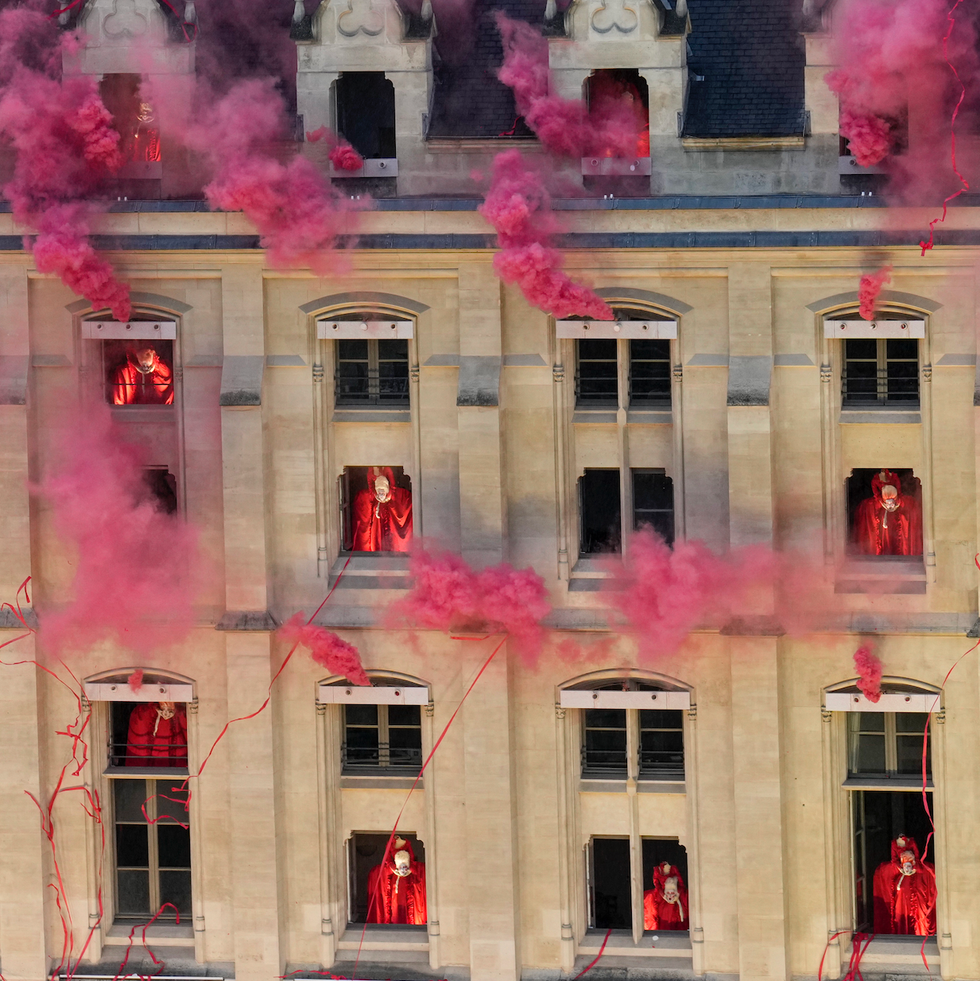
3. Liberté - and now we come to the revolution - oh, those crazy French celebrating decapitated bodies. The windows are full of headless Marie Antoinettes (the parcours dude watches on from across the river) with pyrotechnics, rock music (Gojira performing Mea Culpa (Ah Ca Ira) which is utterly fabulous), a woman singing opera (possibly The Marriage of Figaro) in the prow of a golden barge, blood red streamers being fired out of cannons, and people on poles above the Pont des Arts (the bridge with all the padlocks) à la Kate Miller-Heidke's Eurovision performance. Then cut to a quiet section in a library promoting love and literature, Verlaine in Harlequin outfits, wafting paper, references to Guy de Maupassant, Raymond Radiguet, Moliere, Choleros de Laclos and Marivaux, a chap on a highwire, the bright colours of the Pompidou Centre and non-too subtle allusions to love beween same sex couples and a menage a trois before a heart appears in the sky over l'ile de la cite.
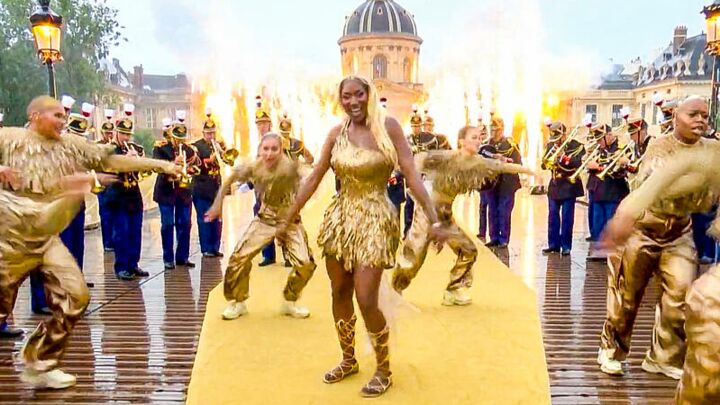
4. Egalité - This is represented by a brass band in military uniform marching across a bridge. The parcours bloke runs past and lights up a building; a golden catwalk appears on which there is RnB pop performed to the accompaniment of the military band.

5. Fraternité - The parcours chap is now in the Louvre (we had to go there) and he runs past various masterpieces, where the figures contained within the frames turn to look at him. Next thing, there are empty canvases, as all the people have popped out to head to the windows and overlook the river procession, where the athletes are now all shrouded in fetching plastic ponchos and some poor bloke is playing the piano in the driving rain which is literally bouncing off the keyboard. But wait, what's this? Oh no! La Gioconda has disparu! A periscope pops up and we discover that the Minions have stolen the painting and are doing field sports in a submarine. One of them throws a javelin which bursts the walls of the vessel, which floods and they all end up floating on the surface. We see through the spectacular clock face on the Musée d'Orsay and suddenly there is a balloon which floats up to the moon with the bullet casing in its eye (nod to Jules Verne) and Le Petit Prince is also there. This all culminates in a beautiful verion of La Marseillaise atop Le Grand Palais performed by mezzo-soprano Axelle Saint-Cirel.

6. Sororité - After the men, we have the women (plus ça change... but at least we have them). Famous iconic faces emerge from the water, echoed by golden statues on the quay. These include Olympe de Gouges (woman of letters, politican and activist; best known for her Declaration of the Rights of Women and The Female Citizen written in 1791 during the French Revolution; campaigned for the abolition of slavery and was guillotined in 1793), Alice Milliat (1884-1957; pioneer of women's sport whose successful lobbying on behalf of female athletes led to the inclusion of many more sports within the Olympic Games), Gisèle Halimi (1927-2020; lawyer, politician, essayist and activist; former deputy of the French National Assembly), Paulette Nardal (1896-1985; writer and journalist who became the first black woman to study at the Sorbonne), Jeanne Barret (1740-1807; the first woman to circumnavigate the globe - I read a great book about her by Glynis Ridley called The Discovery of Jeanne Barret), Chrsitine de Pizan (1364-1431; philosopher and poet and the first author to make a living from writing, among other works she wrote La Cité des Dames in which she extolled illustrious women and imagined a female government), Louise Michel (1830-1905; teacher, writer and feminist activist who took an active part in the events of the Paris Commune in 1871. She was deported to New Caledonia where she continued her fight against French colonialism), Alice Guy (1973-1968; one of the world's first female directors, her film La Feé aux Choux is considered the first narrative film), and Simone Veil (1927-2017; Holocaust survivor, politician and advocate for women's rights, particularly known for legalising abortion in France). We were also meant to have Simone de Beauvoir (1908-1986; philosopher, writer and feminist theorist most famous for writing Le Deuxièm Sexe), but her pedestal failed to rise due to technical difficulties, which I am trying desparately hard not to see as a metaphor.
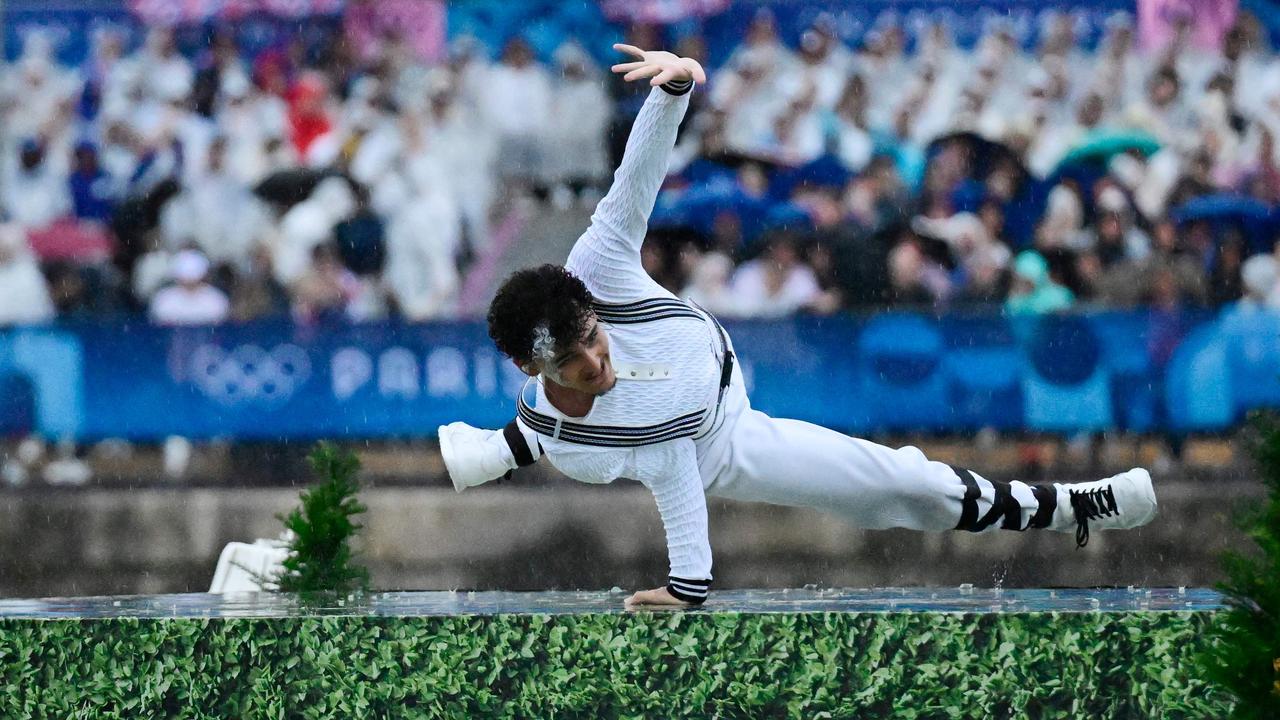
7. Sportivité - We have BMX, breakdancing, and skipping on a skate park designed to look like those exquisite French manicured lawns with topiary and everything. This is the section where they let the kids take charge; they dance in white outfits, Napoleon hats and Pierrot costumes; there are dancers with hoops and ribbons, skateboards and basketballs. No one thinks this is good except their parents. There is an opera singing breaker, an Algerian-French rapper (Rim'K) giving it large about how he doesn't want to be a super hero; just a super human, and lots of pretty light fountains. It actually all looks formidable from above with all the lights and the bridges lit with red, white and blue in strobe flashes.

8. Festivité - Ok, now this is one of the maddest bits of the cermony. A large bloke looks like a smurf lying in the middle of a fruit platter, while a drag-queen/ transvestite cohort cavort around them. It is meant to represent a feast in the spirit of the gods of Olympus and blue guy is Dionysis, god of wine, winemaking, fertility, festivity, madness and theatre (we know how those things go together, right?). It is meant to celebrate the tolerance and inclusion of the games, but already people are outraged that is is mocking Christianity and taking a swipe at The Last Supper. I mean, it possibly is; after all, all myths are connested, n'est-ce pas? To a sort of Jean-Michel Jarre-esque vibe we then have a catwalk on the footbridge where models (many of whom have a disability for inclusion and so we can allude to the Paralympics) strut their stuff. The designers are emerging artists and apparently iconic pieces from the collection will be available after the ceremony. Of course the parcours dude gets a look in here as well. The spectators all then get up and dance on the bridge and everyone has a jolly time.

9. Obscurité - The final countdown begins and as the stars of the European Union flag swirl around the Eiffel Tower, we get the banging beats of a techno dance part mixed with ballet. The house piano of Ride on Time and Be My Lover is throbbing through the city as 'caught up in the turmoil and faced with worries of the future, the young dance'. The theme of this opening ceremony is Ensemble unis pour la paix (we stand together and call for peace), which is apparently symbolised by a couple singing Imagine on a raft while their piano catches fire.
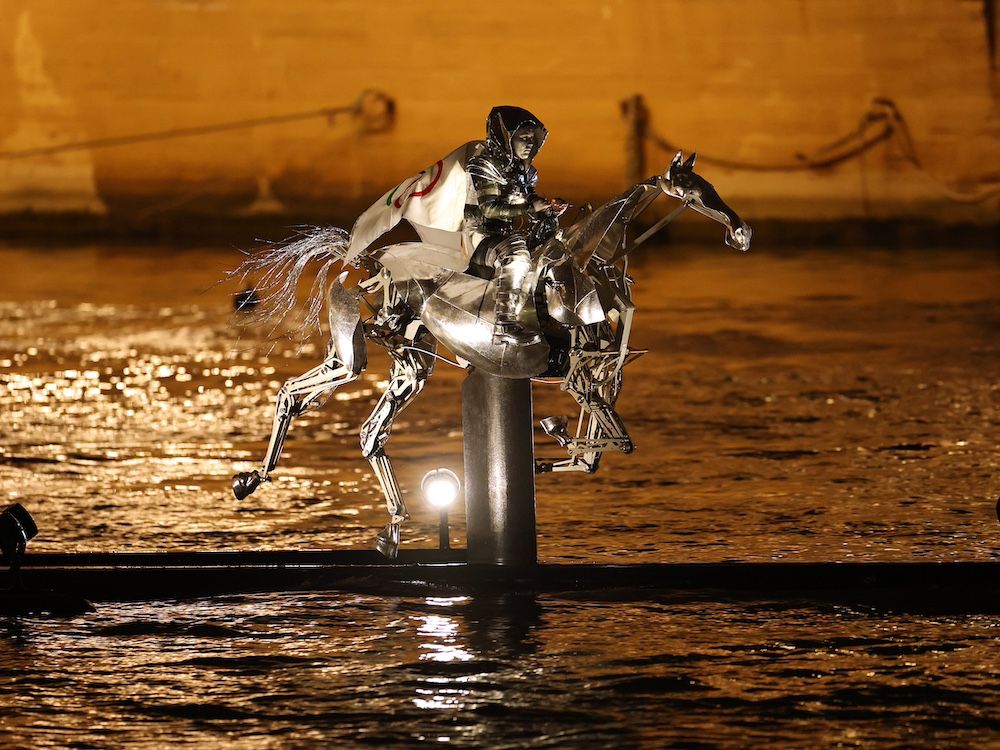
10. Solidarité - the parcours bloke is now on a metal horse with the Olympic flag which he parades down the middle of the river as if skimming across the water. With the glam rock music, the digital wings spreading out above the bridges, and the laser lighting effects, this bit is very impressive and it occurs to me that I have assumed the parcours chap is a chap, when in fact there is every possibility that they are Joan of Arc, or even the spirit of the Seine, Sequana. There is a tribute to former French Olympians and then many flag bearers carry their emblems beneath the Eiffel Tower. A real horse (with a rider) clip-clops across the bridge and a chivalric knight carries the Olympic flag up the steps onto an Eiffel-tower shaped stage. The flag is promptly raised and as it unfurls, it is noted that it is upside down. Oops. A choir sings the anthem of the Olympics (of course it has one) - the kids haven't got the words but the adults have and their sheet music is soaking.
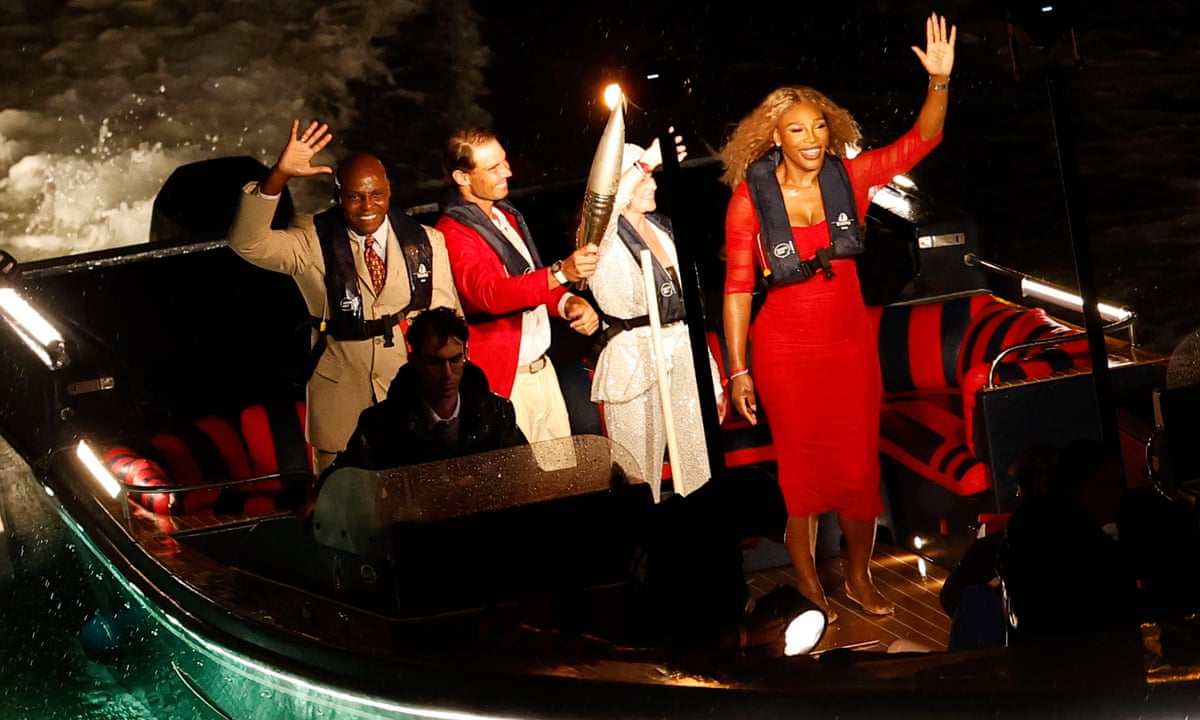
11. Solemnité - A segment attempts to show where they are getting those bits of the Eiffel Tower from (still deeply concerning) and then men in blue suits do speeches and swear Olympic oaths. The parcours dude comes up through the floor (it wasn't them on the horse after all; still deeply confusing) and hands the torch to Zizou, who passes it off to Raffa (no, he's not French but he is 14x winner at Roland Garos). Lights roam up and down the Eiffel Tower, with beams and sweeping arcs, that structure looks like it's dancing. She is stunning and magnifique. Raffa takes the torch back off down the river while the iron giraffe parties on. He's on a boat with Serena Williams (trying to wave but looking very ill), Carl Lewis and Nadia Comăneci. Meanwhile, back on the Trocadero stage a dancer and sign language interpreter perform Marc Cerrone's Supernature, and then disappear through the trapdoor through which parcours dude arrived earlier. Now Amélie Mauresmo has the torch (tennis players are everywhere), then Tony Parker (basketball), before being joined by a trio of Paralympic Champions, Nantenin Keita, Alexis Hanquinquant and Marie-Amélie Le Fur.

12. Eternité - the torch makes its way through the Carrousel du Louvre forecourt, the Tuileries and the Arc de Triomphe, passing through hands very quickly (they get about ten seconds each before they fall into a formation) and continue to a big balloon. The final leg of the relay is taken by Charles Coste, a French Olympic champion who was part of the cycling team pursuit in 1948. Born in 1924 (the year Paris last held the Olympics) the centurian is the oldest living French Olympic champion. He lights the torches of Teddy Rinner (judo) and Marie-José Pérec (sprinter) who light the cauldron, a ring of many LEDs and high pressure water sprays, which make the hydrogen-gas filled balloon rise into the night sky. It's tethered so it doesn't float off, and the French are very proud that it is the first Olympic cauldron to light up without the use of fossil fuels. The balloon is a nod to French inventors (particularly the Montgolfier brothers), and the spirit of daring and creativity.

Epilogue - Céline Dion belts out a version of Edith Piaf's Hyme à l'amour from Level One of the Eiffel Tower. It's a stunning performance, note perfect with shades of Evita, and then it's all over. You're welcome.


:format(webp)/cdn.vox-cdn.com/uploads/chorus_image/image/49546171/ChxnUSdWsAAr4sT.jpg-large.0.0.jpeg)
:max_bytes(150000):strip_icc():focal(999x0:1001x2)/boaty-mcboatface-2000-1c651a8686274a06b533c44bc57aa6a9.jpg)


