Di
Morrissey sets place extremely well. In her dozens of novels, the scenery and
landscape are immediate and infinitely better drawn than her characters or
plotlines. The Opal Desert is,
unsurprisingly, set in Lightning Ridge, Broken Hill, Opal Lake, and White
Cliffs, where most people are exceptionally friendly and we learn about the
precious stones and the community who mine them. The three women around whom
Morrissey tells her tale, Kerrie, Shirley and Anna, are all fairly predictable
stereotypes who overcome their personal obstacles in life-affirming ways, which
may not be realistic, but are heart-warming.
Kerrie
is our main character who realises, after her sculptor husband dies, how much
he absorbed her life into his, and that she doesn’t get on with his children.
For spurious reasons (a recommendation from a friend’s lawyer), she decides to
head to opal country to find herself and reconnect with her own artistic side. She
encounters a land rich with visual treasures, art galleries and bush art,
inspired by painters such as Pro Hart and Jack Absalom. She admires the light
and bright colours.
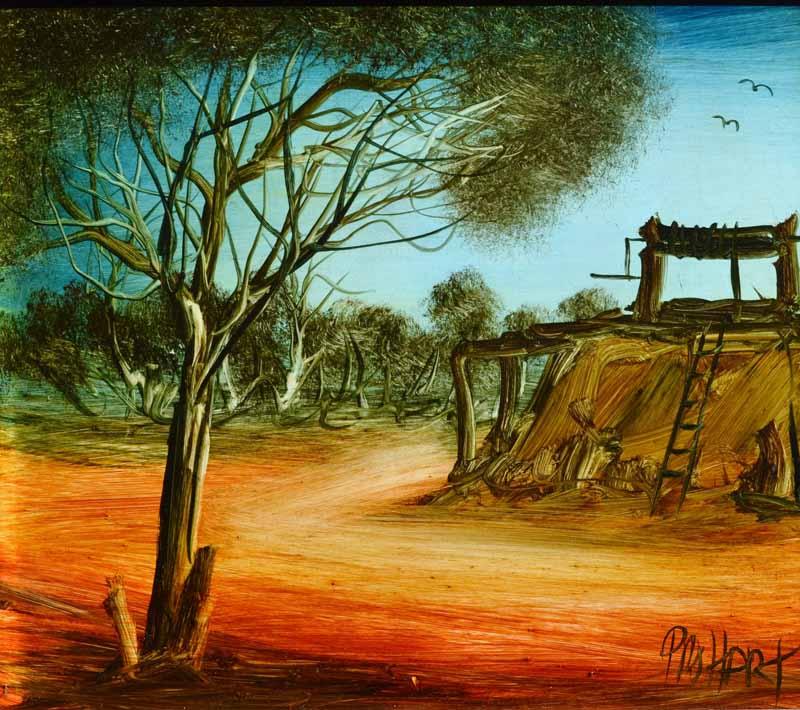 |
| The Windlass by Kevin Charles (Pro) Hart |
Naturally,
Kerrie also learns about the flash of opals – white, fire, black – and their
addictive appeal. She appreciates the act of opal mining because it is
“relatively small-time… unlikely to ever become a huge and invasive industry
like gas, oil and iron ore.” As well as the beautiful stones, she learns,
“Sometimes miners dig up fossils of shells and sea creatures, even dinosaurs.”
She is told that, “Australia is the only place in the world which has opalised
animal fossils. They’re not only beautiful, but important scientifically.”
There is some friction between those who want to collect the fossils for their
historical value, and those who want to break them up and create unique pieces
of jewellery for sale. This is an interesting aspect of the book and even
non-geologists will appreciate the basic descriptions of which rock formations
lead to which varieties of opals.
Our
next character is Shirley, an elderly woman who lives in a dugout she rarely
leaves (due to a mysterious past event), but she socialises with everyone.
“Shirley’s just Shirley, but she knows a bit about everything. She’s our local
historian, sort of. Lovely, lovely lady.” Shirley decides to record the stories
of the old miners so they might pay testament to a way of life that was fast
disappearing. “The mantle of keeper of the stories, the one who held remnants
of a life that might otherwise be forgotten, settled gently and easily on
Shirley’s shoulders.” Di Morrissey’s evocation of time and place make her a
type of archivist too.
People
who mine (and live underground) are often a little odd; they live on the
fringes and have personal reasons for being there. One character states, “I
like going out to the opal fields. Special people out there, too. There’re some
gems, some oddballs, some creative types and those with opal fever. It’s a
place that affects everyone. There are friendly people, and most don’t ask
questions, but there are also shady characters and blatant sexism. When the
young woman, Anna, is introduced, she has justifiable concerns about the
tactile and intrusive nature of some men she encounters. Others become
paranoid, afraid of gangs coming to steal their stones. “It’s not always
sunshine and glittering opals… the dark underbelly of the opal fields… murders,
mystery, ratters and ratbags.”

Beneath
the rose-tinted idealism, lies hidden bias and unconscious racism. Young
Shirley tells her partner, Stefan, “Our history comes from the continent
itself, the landscape, and the opportunities for people to carve their own
paths, using their skills and knowledge.” This becomes complicated when she ignores
Aboriginal history, “It must be stultifying being lumbered with thousands of
years of history. Here, in Australia, you have the opportunity to be creative
and original without the burden of the past. This country is like a clean
slate.” Clearly this was written before the words ‘young and free’ in the
Australian national anthem were changed to ‘one and free’ in an attempt to
‘foster a spirit of unity’, acknowledge ‘the fact that we have the oldest
continuous civilisation on the planet right here with First Nations people’ and
‘honouring the foundations upon which our
nation has been built and the aspirations we share for the future.’
 |
| Lightning Ridge |