 |
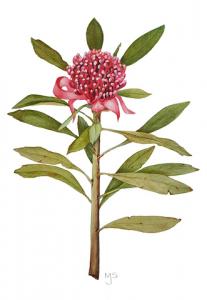
| Telopea specioissima by Margaret Steele |
Botanical art fascinates me; there is such a high level of detail and the lack of background showcases the specimen in an exemplary manner. The Friends' Botanic Art Groups were holding their 11th Annual Exhibition at the Australian National Botanic Gardens, so I went along to admire their work.
One of the curators explained to me that the Botanic Art Group consists of three groups each of which get together once a month at the gardens to sketch and paint. They are provided with specimens they wouldn't otherwise have access to and they do their initial work here, then augment it later at their leisure. Botanical art requires close attention to detail and each work can often take many weeks to complete.
Of course, there is a form and structure to botanical illustration which pleases me. The images depict the form, colour, and details of plant species and must be scientifically accurate, so the artists must understand plant morphology, but they often also have an artistic component. This marriage of art and science appeals to me, as well as the ability to discover the elements of creativity within a prescriptive framework.
Each BAG member is entitled to submit one work that is an artist’s choice but all other works have to be vetted by a team of judges comprised of botanists from the ANBG and botanical artists to ensure a high standard. Just having work accepted for exhibition is an honour. A commission from the sale of each painting goes to the Friends to support the ANBG, and the annual event has been increasingly successful in raising funds.
The artworks generally vary in price from $150 - $500, although there was an $800 price-tag on Magdalena Dickinson's watercolour Eucalyptus macrocarpa. It is a beautiful large picture with a soft wash rendering the budding flowers a sensual appeal - lush and rich; succulent and bold, they appear almost edible like a ripe juicy fruit. I didn't buy any artwork, but I did purchase a couple of raffle tickets, first prize in which is one of the pictures, so I may yet have something beautiful to hang on my wall (fingers crossed).
 |
| Callistemon sieberi by Kristen O'Keeffe |
I like the inclusion of aspects that help to inform the narrative, such as a bird or beetles to indicate size and the plant's position in the ecosystem, such as the above image by Kristen O'Keeffe. On her website (which features examples of her work and a blog), she explains that she loves the process of collecting specimens and working up compositions. She continues, "I find the medium of watercolour technically challenging but extremely enjoyable. In the future I would like to explore a more scientific approach in keeping with the traditions of botanical art where all aspects of a specimen are described to form part of a scientific record."
This particular exhibition was made all the more pertinent due to its focus on works featuring threatened and endangered species, many of which are in the Gardens. These fine representations are more than just works of art; if the species should be lost, the pictures will provide a scientific record. This seems to mirror the original use of botanical illustration to register 'new discoveries' as scientists and botanists explored the globe and presented their findings to their financiers.
The artists use a range of materials and methods including watercolours, coloured pencils and graphite, pen and ink, and scrapeboard. Their subjects feature banksia and eucalyptus; tamarind; orchids; waratah; pine nuts; karrajong seed pods. Marjorie Roche's Ephemera is crafted from graphite on pulped paper: the greys, browns and golds showcase the fleeting existence of leaves and seed pods. Meanwhile the entire development of the plant is recognised in Sue Grieves's watercolour, Eucalyptus youngiana. The colours of rich and vivid red to dark green depict the pods at multiple stages including closed, open, dead and empty.
One might have thought that development of photographic plates could make botanical illustration obsolete, but this has not been the case. A botanical illustrator is able to create a compromise of accuracy, an idealized image from several specimens, and the inclusion of the face and reverse of the features such as leaves. Additionally, details of sections can be given at a magnified scale and included in the margins around the image. For example, there are a couple of brown seed pods in the lower left quadrant of Maria Boreham's watercolour, Grevillea fleuosa which otherwise depicts the leaves and flowers in many shades of green. Also, Joan Pukis faithfully records the curved droopy leaves and little gum nuts, some with minor blemishes in greens and browns in her watercolour, Eucalyptus canalicilata while the pencil shadows are like ghost leaves in the background.
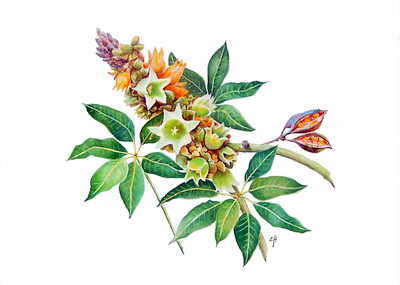 |
| Brachychiton sp. Ormeau by Eva Henry |
There are some of the more 'showy' specimens on display, such as Jann Ollerenshaw's Caladenia actensis/ Canberra Spider Orchid (a watercolour of the critically-endangered plant rendered very simply with exquisitely fine hatching detail in the fringes) or Vivien Pinder's collection of Sun Orchids (individual circles encompassing the flowers of different colours: gold; purple; pink; mauve and yellow; cream and splattered with russet). I admire them all - I have no artistic talent in this department and shall stick to the Performance Arts while appreciating the Visual Arts from a distance.
Most of these artists are female and I find it interesting that the art of painting flowers has passed from the predominately female highly-skilled practitioners of still-life paintings during the Renaissance (when women were generally excluded from painting grander subjects such as histories and allegories due to their gender) to the mainly male scientists of the eighteenth-century explorations, and back to the ladies of the Victorian era with their watercolour flower paintings. Confined by social restrictions to the seclusion of their home (and certainly not permitted to study the human figure in a life class), subjects such as still life and flowers were considered particularly suited to women.
Interest in botanical art is undergoing a resurgence as people like to connect with the natural world, and feel they are documenting plant life not only for art, but also for science and environmental research. Researching and recording that which we have before we lose it is of crucial importance to science and society alike. Painting plants has once again become political. And viewing the exhibition inspired me to look at the plants in a new light when I walked around the gardens taking photographs.