Friday, 14 May 2010

The Red Cross - will be there


“When I needed a neighbour were you there, were you there?
When I needed a neighbour were you there?”

This used to be one of my favourite hymns at school. I loved the idea of global benevolence; the thought that someone could give without judgement and without expecting to receive. I liked to think that was a basic tenet of society and that compassion for one’s fellow man was what raised us above beasts (that and an appreciation of art in all its forms).

When I was a child I joined the Red Cross. My sisters and I (although, strangely not my brother from memory) went to a hall every week and were taught first aid, basic hygiene and survival techniques. Some of the things I learned there – how to find clean water or tie a tourniquet – have never left me.

There were many occasions where we helped make up care-parcels; sometimes we sent hand-knitted socks and scarves to people in cold countries far away; sometimes we sent tins of baked beans and canned fish to the old folk’s home down the road. We laid a wreath at the cenotaph in memory of all the dead soldiers who fought for our freedom and we helped collect money to send to disaster-ravaged communities. The aim of the red cross is to help people in crisis, whoever and wherever they are.

The Red Cross is still one of the charities to which I give money through a monthly donation. I admire their egalitarian principles and their universal humanity. I am not alone – the movement has 97 million volunteers worldwide. As an example of what they do, you can’t go past the ‘Boxing Day Tsunami’ in which aprroximately 230,000 people lost their lives across 14 countries.

Since December 2004, The Red Cross has built over 51,000 homes, 289 hospitals and clinics, and 161 schools in tsunami-affected areas such as Indonesia, Sri Lanka, the Maldives and India. Regardless of faith or ethnicity, over 680,000 people now have access to an improved water source, 340,000 people have access to improved waste management facilities, and over 277,000 people have been certified or skilled in community-based first aid and psychosocial support.

Whether they are providing transport to make sure elderly patients keep their hospital appointments on the Kapiti Coast, providing facilities to collect essential blood donations, or providing shelter to those devastated by earthquake in Haiti, Red Cross volunteers are donating their time and skills to help those less fortunate than themselves. I don’t know about you, but to me that’s a credo worth following.

"Wherever you travel I'll be there, I'll be there,
Wherever you travel I'll be there.
And the creed and the colour and the name won't matter, I'll be there."


If you want to make a difference, start by making a donation.

Tuesday, 11 May 2010

Books read in December

Below are short reviews of the books that I read in December 2009. The numbers in the brackets are the marks I have given them out of five.

Life Stories – David Attenborough (4)
In 2009 BBC4 asked Sir David Attenborough to do a series of weekly talks on the radio. They were to last for ten minutes and be on any topic he chose. The results are gathered in this book which ranges over a host of subjects from various mammals, reptiles, plants, insects and birds. While it would be nice to hear his voice (and there is an audio version available) this book has illustrations, botanic sketches and photographs which enhance it in another dimension.

The book contains both interesting facts and well-written, amusing anecdotes. He relates myths that local cultures have been used to explain the presence of certain mammals, while content to admit that he doesn’t know all the answers himself. He is curious as to why humans have eyebrows or why we sing, as it serves no specific evolutionary purpose, and part of his love of life on earth is the constant search for knowledge. Curiosities and missing links hold great appeal for him and several of the chapters are concerned with extinct animals and fossils.

I grew up with David Attenborough’s nature shows on television. He was part of my childhood; simultaneously comforting, reassuring and educational. He’s an extremely likeable man and part of this appeal is that he shares his enthusiasm for natural history in a charming and accessible manner. His warmth, humour and sense of childlike wonder come through in this collection that reminds us we are privileged to share his life stories.

Hungry Hearts and Other Stories – Anzia Yezierska (3.7)
In this series of interconnecting short stories, Jewish immigrants from Poland and Russia come to America in the early 1900s with dreams of education, marriage and bettering themselves. They hunger for love, friendship, and self-improvement. Everyone hopes for a brighter future, leaving a life of poverty and repression behind, believing that America will be a panacea and right all past wrongs.

They are inspired by thoughts of freedom and democracy, is supposed to make everyone equal, but only if they have money. Of course, when the dreams confront reality, there is bound to be disappointment. Some struggle with the lack of community and the individualism that the supposed meritocracy creates. The immigrant story is one of steerage ships, sweatshops, unscrupulous landlords and bosses, keenly felt injustice, “dreams and the battle for bread”.

There are contradictions at every turn. America is the land of the free where people dream and hope, but it is also the land of rising food prices and crushing rents. Those without money have to accept charity often at the expense of their pride and dignity. In America you can lose your past and reinvent yourself, but the converse of this is that heritage is discarded. Can you have it both ways? There is further conflict with the next generation as they try to escape the past that defines them and, in doing so, reject their parents.

Education is a major theme among these stories, as many of the characters seek to ‘work themselves up’ and there is evident respect for teachers and men (and women) of learning. Anzia Yezierska writes in New York Jewish idioms and captures the voice of “my own people”. This collection was originally published in 1920 and Yezierska achieved great success when the book was snapped up by Sam Goldwyn and became a silent film. She was feted with an extravagant lifestyle but she missed her roots and fell from popularity during the Depression years, only to be rediscovered during the feminist 80s and Virago publishing. (I couldn't find a picture of that jacket, so I've used the Penguin one instead.)

Imperial Life in the Emerald City – Rajiv Chandrasekaran (4.1)
Rajiv Chandrasekaran spent two years (2002 – 2004) reporting in Iraq for The Washington Post on the 15-month American-led occupation of the country. To his mind, it was ill-conceived, badly-run and deeply unsuccessful. Jerry Bremer, the president of the Coalition Provisional Authority (CPA) was the viceroy of Baghdad who “had come to Iraq to build not just a democracy but a free market. He insisted that economic reform and political reform were intertwined.”

The CPA tried to rule Iraq following the fall of Saddam Hussein from the Green Zone, a bubble of Americana with American restaurants, bars, swimming pools, offices, convention centres and a hospital. Because so many hotels had been destroyed, the Americans moved into the Republican Palace, Saddam’s former home. They were removed from reality of the place they were trying to rebuild and few of them spoke the language or even met any Iraqis.

There were problems with priorities – what to do first? The schools and hospitals were in a terrible state, the factories and utilities were under-producing, and the economy was suffering. The CPA concentrated on traffic law, purging the country of the Saddam-supporting Baath party, and dissolving the security forces. When the Iraq army was reformed, many soldiers didn’t join but became insurgents instead because they felt they had been disrespected. Many of those who did join refused to fight insurgents in the streets because they believed in their principles and didn’t agree with the American orders.

The similarities between the Americans and Saddam are mentioned often. In Saddam’s regime, “Contracts were given to firms in countries supportive of Saddam instead of to suppliers who provided the best price or quality.” In Bush’s regime people were given jobs not because they had qualifications but because they were in with the right crowd. But the major differences were ideological. The Bush administration favoured privatisation, and the Iraqi people were against privatisation of government-owned enterprises. Bremer worried that popularly elected Iraqis might not produce a document “that endorsed a separation of mosque and state, provided equal rights for women, or enshrined any of the other elements sought by the White House, which wanted to be able to point to Iraq as a model of enlightened democracy in the Arab world.” So he controlled the way the elections were run. Capitalism and democracy were the main things the Americans wanted to achieve in Iraq, whereas the ordinary Iraqis wanted public order, safety, and basic utilities.

Chandrasekaran writes well and intelligently, creating what Richard Eyre in the Guardian calls, “a tragic tale of naivety, hubris, waste and wilful ignorance.”

Chocolate Quake – Nancy Fairbanks (2.3)
I quite enjoyed Crime Brûlée, which is another in this culinary crime series, and thought this might be interesting as it is set in San Francisco. It is pretty poor, however with no real feel or flavour of the city and the detective story is messy, uninteresting and riddled with errors, while the characters are clichés.

When Carolyn Blue arrives in town with her husband Jason, for a scientific conference, she phones her mother-in-law, only to find that she has been arrested for a murder at the women’s centre where she works. Jason does nothing to help his mother except to hire a private detective, Sam, to try and exonerate her. Carolyn immediately gets to work solving the murder with the help of the gay motorbike-riding Sam. There are way too many subjects to make this a clean story, and Carolyn bumbles about interviewing them with ridiculous ease and even finding the murder weapon, which the police had overlooked, in a drawer at the centre.

There are glaringly obvious errors in the narrative and the characterisation is sketchy and clichéd. This is not a good detective story and the culinary angle is far from sharp either. Even the description of the city is tacked on and echoes a tourist brochure rather than providing any insights. The hackneyed descriptions of earthquake tremors, hilly streets and the gay scene are pretty unpalatable and I doubt I will bother with any more of her stories.

Run for Home – Sheila Quigley (1.5)
This novel is set in a rough area of Sunderland, complete with regional dialect, swearing, drugs, human trafficking, organised crime and title from a Lindisfarne song. However, it is completely unrealistic with a terrible plot, unbelievable dialogue and woeful lack of characterisation. Quigley often resorts to telling rather than showing us what is going on.

The morals and attitudes are so traditional as to be reactionary with rants about drugs, homosexuality and the white slave trade. It sounds as if written by an over-earnest teenager or a middle-aged mother trying to be contemporary.

The story is hackneyed and predictable. The ‘baddies’ have in-depth discussions about their criminal past and future plans in front of others, which is not only convenient but totally unrealistic. The older children investigate their sister’s disappearance, finding out far more than the local constabulary, and the police are ever so impressed with their efforts. The coppers turn up to save the day just in the nick of time and even say, “Good going, kids.” It’s like something out of The Famous Five, but not as engaging.

The Last Kabbalist of Lisbon – Richard Zimler (3.8)
Richard Zimler was described by The Spectator as the American Umberto Eco, and with this murder mystery, complete with religious overtones, clues, symbols and illustrated manuscripts, he assumes the mantle with aplomb. The Last Kabbalist of Lisbon is partly an intriguing murder mystery with an historic background, and partly a novel that examines the nature of faith, and it weaves these threads so tightly together that they are indissoluble.

Jews were expelled from Spain in 1492 and many fled to Portugal, where the King forced them to convert to Christianity and become ‘New Christians’, to distinguish them from ‘Old Christians’, although many risked their lives by practicing their faith in private. Nine years later a violent riot turned into a massacre as the Old Christians burned the New in an attempt to appease God who had sent drought and plague to the city of Lisbon. Berekiah Zarco, one of the ‘New Christians’ is sent on an errand by his uncle Abraham (a master of Kabbalah) and returns to find him dead in the cellar next to a naked woman – also dead. The cellar, whose existence is known only to the secret prayer group, is locked from the inside causing Berekiah to believe they have been betrayed by a close friend. He sets out to solve the crime and avenge his uncle’s murder, but as he examines the facts he learns more about his uncle and himself.

His uncle taught him to illustrate manuscripts and he now learns that people are willing to sacrifice their lives to smuggle these books out of the country so that their faith can spread and their narratives be told. A people is the sum of their stories, and this is a novel of faith and of storytelling – who has the right to tell the story and which version do you believe? It seems almost natural that Berekiah would begin to question his faith. How could anyone retain it in the face of such horror? Without the assistance of his master he must become self-reliant and he chooses to fight for survival through words. Some of the semantic subtleties are lost in the translation (the novel was first published in Portuguese) which is a shame because language and words play an important role in the passing on of stories and faith.

Although at times the novel lacks soul and is in danger of becoming a mere riddle, Zimler maintains the intrigue to the end. It is almost too clever and is slightly pedantic as though the beauty of the illuminations is merely decoration for the dusty contents. You have to concentrate, like one of those magic eye pictures which seem impenetrable at first until the image burns itself on your retina. The question is, whether you have the patience to refocus.

Friday, 7 May 2010

The way the cookie crumbles

When I was living in Manchester I got knocked off my bike and dislocated my shoulder. I was taken by ambulance to the hospital (A&E in Manchester Royal Infirmary is not a place I long to be) where they assessed my head injuries – I had been wearing a helmet – and then made me wait in a cubicle before they could see to me after all the other emergencies – I popped my head out to go and be sick (a dangling arm can do that to you) and saw a man with half a pint glass sticking out of his face. It didn’t help matters.

The nurses were great and the doctor was calm and understanding – with all that violence and trauma going on all around them, they were impressively relaxed and I have only good things to say about them. Him Outdoors collected me with ‘What on earth have you done to yourself now?’ took me home and put me to bed. He had to go to work the next day and I assured him I would be fine.

It’s amazing what I suddenly realised I couldn’t do. I tried to get up in the morning and I couldn’t roll into a sitting position. Being the anal Libran that I am, I always make my bed first thing in the morning; I couldn’t. It took about half an hour to haul my clothes on and I decided to reward myself with a cup of tea (I had not long stopped being a student, after all) but I couldn’t open the carton and dropped it on the floor in my struggle. So I thought I would go and buy another one, but I couldn’t tie my shoelaces.

I broke down in tears and called my sister, who raced to the rescue on her white charger (well, it was a red Golf GTI actually), took me back to her place and looked after me. I tell this story because it is incredible to find what an injury can do to you – how you have to reassess your abilities and find alternative ways to do things (especially if you haven’t got a saintly older sister to help out).

The big things are obvious, but they lead to smaller issues which can be equally frustrating. If you are still able to perform your job, the doctors will say you are rehabilitated and you won’t get any further assistance on the National Health. At the time I was working in a book shop. I could still do that. But I couldn’t do handstands any more. This apparently is unnecessary to lead a full and happy life. I disagree, so I paid to go to a gym to build up the strength in my shoulder so that I can swing from bars, stand on my hands, and box – it was an excellent boxing gym.
 
Fifteen years later, things are fine most of the time, although my shoulders are slightly uneven and the left one sometimes aches when it rains. But I can’t rub butter into flour to make crumble or pastry. Not a big issue, you might think, but I love crumble – it’s usually so easy to make and comforting to eat – and so I was delighted to find a recipe that doesn’t involve all that rubbing. I serve it at dinner parties and it always gets a favourable reaction. In fact, last week my friend Scally-wag asked for the recipe – so here it is.


Apple and Peanut Butter Crumble

Ingredients:
4 cups peeled and thinly-sliced apples
1 cup sugar
1 cup standard flour
3 tablespoons butter
1 cup rolled oats
½ teaspoon ground cinnamon
1 cup crunchy peanut butter

Method:
Heat the oven to 180C
Grease a 22cm baking dish
Stir together apples, ¾ cup of sugar and ¼ cup of flour in a large bowl; spread into dish and dot with 2 tablespoons of butter
Combine oats, remaining ¾ cup of flour, remaining ¼ cup of sugar and cinnamon in a medium bowl; set aside
Place remaining 1 tablespoon of butter and peanut butter in a small microwave-safe bowl; microwave on high for 30 seconds or until butter is melted; stir until smooth
Add to oat mixture and blend until crumbs are formed
Sprinkle crumb mixture over apples
Bake 40-45 minutes or until apples are tender and edges are bubbly
Cool slightly
Serve warmed with whipped cream or ice-cream

Thursday, 29 April 2010

Ring out the bells


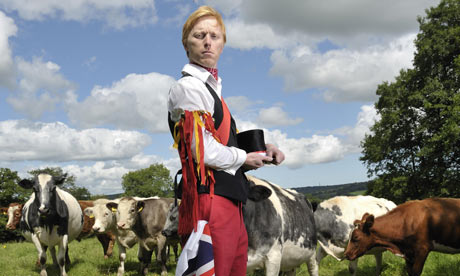
I have a confession to make: I love Morris dancing. Now that we’ve got that out of the way, we can focus on Morris: a Life with Bells On, a wonderful mockumentary that affectionately examines the ‘seemingly innocent pub pastime for bearded men with hankies.’ It is filmed through a series of interviews set up in such crisp conditions they appear like portraits done by old masters, where every item in the picture is significant.

This film had a very low budget (the American scenes are clearly not overseas, and the flight there is obviously a model aeroplane) but the production values are still very high and the cinematography is excellent. The changes in depth of focus and sharp close-ups are a welcome relief from the shaky blurred vision that plagues most documentaries. And green and pleasant lands and the Compasses Inn in Wiltshire, where most of the filming was done, make a fine backdrop to the action.

The story follows Derecq Maximillian Twist and his troupe of Morris men, the Millsham Morris. At 32, Derecq is at the peak of his dancing life. He may seem like a mild-mannered tractor mechanic from West Dorset but he is consumed by his passion for ‘the Morris’. Apparently, the term ‘Morris’ covers a multitude of sins and there are a variety of styles, including Borders, Rapper and Clog Dancing, but the Cotswold style is “the distillation of masculinity – it epitomises and embodies the essence and magic that is the essence of Morris.” So says Professor Compton Chamberlayne (Harriet Walter), Emeritus Professor of International Folk Dance at Cambridge. She exudes academic authenticity and is so convincing that you are left doubting what is real and what is absolutely made up?

Derecq introduces his team to the documentary maker, Jeremy (Aidan Mcardle) in a line-up like a proud sergeant showing off his troops to the Queen. They number Will Frosser (Jasper Britton), the foreman; Muff Barcock (Clive Mantel), Point Man 1, who has been “dancing for 40 years and still dances like a gazelle”; Plush Gurney (Richard Lumsden), Point Man 2, who came from ballroom dancing and struggles with his fitness; Boothby Pagnell (Adam Ewan), Point Man 3, who “came from ballet dancing but we won’t hold that against him – everyone has to dabble in the dark side” – besides, he has the top-five hanky work in the country; and Lydiard Spurling (Andy Black), Point Man 4, who is on a cultural transfer from Newcastle and no one understands a word he says.

You have to be asked to join, by showing sufficient calibre and letting your interest be known. Jean Baptiste (Dominique Pinon), substitute Point Man, “dances like a demon, especially after a couple of pints of cider” (i.e. Onan’s Revenge or Wookie’s Hole). A fabulous reconstruction reveals the tempest in which he was caught when he was a fisherman – he washed up on Dorset shore and decided to stay, and married the landlady of The Travellers’ Inn. With its well-drained, level ground, this is the perfect place to dance.

Between them Derecq Twist and Professor Chamberlayne explain that “Morris asks many questions of a man – mentally and physically.” It is apparently a dangerous, contact sport, not just about keeping fit; you need to have “nerves of steel and reactions like lightning’ and a dubious taste in jumpers. The Millsham Morris troupe has a nutritionist and is aware of potential injuries, such as splinters, chipped teeth and cracked knuckles. It is essential to warm up properly and get the blood flowing – they share a hilarious joint training session with the local basketball team – and they take it very seriously indeed; “It takes the three ‘p’s – ‘Passion, practice and a desire to be the best’.”

The dances themselves have evocative names such as Leeks on Fire; If You Please; Tubs of Lard for My Old Lady; A Farthing for the Frenchman to Pass By and Peaches on the Parson’s Nose. They are all demanding and it is recommended that you consult your physician before beginning a dance programme. But the most challenging of them all is the Threeple Hammer Damson in which there are 427 separate moves from all the Morris Dancing disciplines combined. It is too daunting for most – “It is not, nor should it be, easy to achieve” – but to dance it is Derecq’s greatest ambition.

Derecq is also interested in the world of dance outside Morris and attempts to combine other elements (such as Brazilian Maurizio). “Much is within; much without – it will take from anywhere.” He finds inspiration for his free form ‘New Morris’ from other cultures, people and cider, which is very important to interpretation. “The use of any drug is dangerous; organic cider particularly so.” There is a hint of Gareth from The Office as he introduces innovative styles and balletic jumps into his new code. “Someone will end up in hospital – guaranteed.”

With his pursuance of originality, however, he has “ruffled a few highly-placed feathers in the Morris world” and finds himself monitored for deviation. Quentin Neely (a delightfully pompous Derek Jacobi), in his city office overlooking the gherkin on the Thames, maintains that Derecq is bringing Morris into disrepute. Neely denies that Morris should be allowed to change and develop like any other dance; change is only a good thing if it is managed properly. His main objection is that the foreign influence is unwelcome. “Morris is, to its core, English, English, English!”

And so Derecq is rusticated – removed from Her Majesty’s Morris Circle – and forbidden to dance. The laws are reluctantly enforced by Endeavour Hungerfjord Welsh (Ian Hart) the squire of The Moss Side Morris. In DMs and braces they look as though they have stepped out of A Clockwork Orange but they show great sensitivity as they withdraw the staves and confiscate the hankies and ruggles. Seeing Derecq so dispirited is too much for Jeremy who breaks the cardinal rule of documentary making – “I intervened”.

Jeremy arranges for Derecq to fly to California and work with the outrageously camp Orange County Morris (OCM). Of course, he never actually leaves the studio and the backdrop is studiously fake as Derecq deadpans, “Beverly Hills is a bit like Torquay with traffic and palm trees – but a bit sunnier.” He finds the climate a bit of a shock – “I’m used to dancing in all weathers in Dorset, except sunshine.” Unfettered by tradition and with a rich benefactor, Miloslav Villandry (Greg Wise in a remarkable velour pants-suit), the OCM flout convention with their screamingly funny outfits and light-weight carbon-fibre staves.

With the help of their publicist, Sonja (Naomie Harris) with whom Derecq begins a relationship, they decide to incorporate Derecq’s skills into their act and perform to wild acclaim at the Sonomoa County Folk Festival. The practice scenes are like Dirty Dancing meets The Full Monty and the dancers explain that the UK and USA are ‘Two cultures divided by language but united through dance.’ Their routine is full of blinding lights, pelvic thrusts and gyrating rhythms calling upon Boyzone and Michael Flatley. Commercialised with trainers rather than clogs, the union flag intertwines with the stars and stripes, and the punters have never seen anything like it.
Spurred onto greater successes, the OCM turn professional, but Sonja accepts a job as a political press secretary and moves to Iowa. Derecq follows her there and the film drags in this section – at least one scene in a bowling alley could have been cut. There is no appetite for Morris in the mid-West and though he may teach it at weekends, he has sacrificed it to love. Jeremy wonders if his interference was a bad thing as it is terrible to see a formerly mighty Morris man reduced to the devil’s dance – line-dancing in Iowa. Derecq is just a West Country boy at heart – “I love to do a dance with the boys, and have a pint of cider and a game of cribbage afterwards.”

So does Dorset hold more sway over him than his new love? For some inexplicable reason, I actually found that I really cared! It’s not just the romanticised music (original score by Richard Lumsden), reminding me of Brassed Off, which is superb, right down to the rap version of a Morris tune over the final credits. It’s not just the sheer quality of the acting, the sublime scenery or the intelligent direction, although all of the above are outstanding.

Above all, the film weaves an excellent story around a much-maligned art-form. Celebrating the earth, the harvest and general fertility, Morris dancers who performed outside pubs in England were guaranteed a free beer – and who can argue with that? It is heartening to see many closet Morris fans shaking their bells in celebration, and it leads me to question why the public ridicule the Morris and revere the haka? Despite the popular perception, I’d rather take a fun fertility ritual than a threatening war dance any day.

Monday, 26 April 2010

Bye Bye Burnley

Of course it's always good to see Liverpool win, and it's great to see Stevie score a goal - the one he unleashed at Turf Moor today was so exceptional that even the Burnley fans stood and applauded. It was Liverpool's first Premier League away win in 2010. That previous poor away form has not helped them in their quest for Champions League football. There is now a slim chance that they might make the coveted fourth spot, although I don't hold out a lot of hope.

The 4-0 victory, however, is tempered with a touch of sadness as it finally consigned Burnley to relegation - they'll be back in the Championship next season. Him Outdoors is fatalistic - he's seen it all (and far worse) before and is just happy that his boys got the chance to play against the likes of Liverpool, Arsenal, Chelsea and the Red Shite (whom they beat - hurrah!). Also, they don't have the financial woes of Hull or Portsmouth and with some shrewd spending they could well be back up again very soon. I hope so.

Sunday, 25 April 2010

Come back; return home

For all members of the armed forces serving their country on foreign soil, I found this photo I took three years ago at the National War Memorial in Wellington. As long as there is war, it is ever-poignant.


Friday, 23 April 2010

What is England?

Wells & Young's advertise their Bombadier as the drink of England and they have some fantastic posters featuring all things English from bowler hats to pantomime horses. I particularly like Les Dawson dressed as Queen Elizabeth, although the Kiwis might get a bit upset about the rugby ball. It made me think about - What is England? What represents it? What do I miss about it? Apart from the people - it's the pubs, the football, the scenery, the history, the drama, the music and the humour - not necessarily in that order.


Wells & Young's have been campaigning to have St George's Day declared a national holiday for the past 15 years. So far they have had no luck, but their beer is still quite nice. I shall be sure to have a pint, and partake of a few other English ales on my national saint's day. Bottoms up!

Thanks to Neil Miller at The Malthouse blog for drawing my attention to these posters.