
Sunday, 13 June 2010
Early highs and lows

Thursday, 10 June 2010
Hedging my bets
England to win the World Cup (7:1)
Spain v Argentina final (20:1)
New Zealand to make it through the group (9:1)
Fernando Torres to collect the golden boot (13:1)
Peter Crouch to collect the golden boot (50:1)
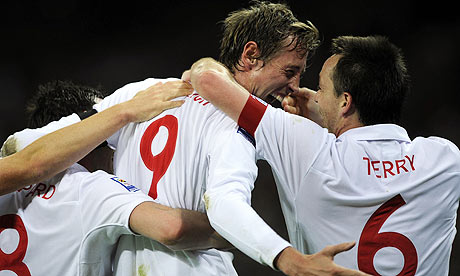
The girl at the shop laughed at me (well, she's Welsh so her team didn't even make it!) when I told her that I had to support England, New Zealand and Liverpool. She reckons that's actually a pretty common combination in this town. And I know Peter Crouch isn't Liverpool any more - but he should be. Actually I think Germany and Argentina are both in with a chance, and I wouldn't count out Italy either - and of course, you can never ignore Brazil - but I didn't want to bet on them.
So, we shall see. Whatever the outcome, I shall be glued to the screen for the next month. Bring on the beautiful game!
Saturday, 5 June 2010
Written worlds
The Letter Writer
Circa Theatre, Wellington, 7 – 21 March 2010
 Courtesy is a dying art. During the production, four phones went off (one twice) and there were two latecomers who shuffled noisily in after the play (one hour and forty minutes with no interval) had started. Apparently the art of letter-writing is also moribund. Mr Rouvesquen (Peter Hambleton) is a professional who helps people become more erudite although, with world-weary cynicism, he also tries to dissuade them from using his services.
From the beginning the tone is unsettled – comedy sits alongside something infinitely more sinister. The sliding doors and panels form a cosy and well-appointed office but they also create hiding places and darkened corners for fraught departures; the mood heightened by dramatic music (Stephen Gallagher) and tight lighting (Jennifer Lal). The scenes flow seamlessly into one another and techincal cues are often taken from musical notes rather than lines of dialogue, negating the importance of the spoken word.
Rouvesquen has a number of customers to whom he explains that words can both clarify and obfuscate. Asked to write speeches and letters for all occasions he has a price list in which ‘weddings are situated between baptisms and funerals, just above love letters – those are obsolete’.
With wonderful indecision Tim Gordon plays Mr Ralph who wants a father-of-the-bride speech, afraid that he will shame his daughter because he hasn’t mastered the words. Rouvesquen asks Ralph to speak naturally so that he can see the sort of man he is. “I need to assess your oratory abilities so that I don’t render you a Socrates in gumboots.” He is instructed to stop rambling, to eliminate gestures, and cut to the witty stuff without waffling. Clearly this is great advice for playwrights too, and Juliet O’Brien has taken it to heart with dialogue that is both precise and loaded with meaning.
Another client, Mrs Balia (a delightfully uptight Helen Moulder) requests an erudite codicil to her will, setting out the ‘whys and wherefores’ of who gets what. She is concerned that ‘unexplained wills create misunderstanding’, which she is anxious to avoid. It seems that ritual is very important and words are part of procedure. However, Rouvesquen abhors the absurdities of polite language – phatic communication – and speech patterns, pronunciation and grammar.
 He likes poetry, wine and music; hedonistic pleasures. When he is asked, “Are you alcoholic?” he replies complacently, “It’s possible.” He listens to music, which “enthuses your thoughts”, but it is always the same piece performed by different artists as he searches for perfection as the author imagined it. When he later descends into an alcohol-induced insanity, it is both chilling and seductive.
Into this slightly ridiculous and aesthetic world intrudes the refreshingly earnest Lansko, (Benoit Blanc), a refugee from a totalitarian state who wants to express his love for Leila (Anne Bardot), the girl he left behind and apply for political asylum and citizenship. To help with his powers of description, Rouvesquen gives Lansko a wine appreciation lesson; he explains that if you describe something with your imagination and your words, it gives you a new appreciation of the thing. While trying to explain the appeal to the senses, the dialogue revels caustically in humorous humbug.
 Words may be what we use to explain, but they are poor substitutes for emotion. The clearest indication of Rouvesquen’s feelings is when he guides Lansko’s hand, tenderly holding a pen to shape his signature. The scene between Lansko and Leila is touching and wordless as they huddle and snuggle beneath a tarpaulin. Fear is evoked through glances and movement that have nothing to do with words. Gordon also plays Enrix, a postman with cipplingly crude Tourette's. He cannot speak to others without swearing, but he can deliver their words in silence.
But words can also lie, pretend and hide things you would rather not see. When Rouvesquen learns something that he attempts to conceal from Lansko, you wonder at his motives, which can only have disastrous consequences. There is much that these characters would rather not face squarely and the denouement comes sideways from out of the shadows; harsh and unexpected. Some things will simply not remain hidden.
Circa Theatre, Wellington, 7 – 21 March 2010

From the beginning the tone is unsettled – comedy sits alongside something infinitely more sinister. The sliding doors and panels form a cosy and well-appointed office but they also create hiding places and darkened corners for fraught departures; the mood heightened by dramatic music (Stephen Gallagher) and tight lighting (Jennifer Lal). The scenes flow seamlessly into one another and techincal cues are often taken from musical notes rather than lines of dialogue, negating the importance of the spoken word.
Rouvesquen has a number of customers to whom he explains that words can both clarify and obfuscate. Asked to write speeches and letters for all occasions he has a price list in which ‘weddings are situated between baptisms and funerals, just above love letters – those are obsolete’.
With wonderful indecision Tim Gordon plays Mr Ralph who wants a father-of-the-bride speech, afraid that he will shame his daughter because he hasn’t mastered the words. Rouvesquen asks Ralph to speak naturally so that he can see the sort of man he is. “I need to assess your oratory abilities so that I don’t render you a Socrates in gumboots.” He is instructed to stop rambling, to eliminate gestures, and cut to the witty stuff without waffling. Clearly this is great advice for playwrights too, and Juliet O’Brien has taken it to heart with dialogue that is both precise and loaded with meaning.
Another client, Mrs Balia (a delightfully uptight Helen Moulder) requests an erudite codicil to her will, setting out the ‘whys and wherefores’ of who gets what. She is concerned that ‘unexplained wills create misunderstanding’, which she is anxious to avoid. It seems that ritual is very important and words are part of procedure. However, Rouvesquen abhors the absurdities of polite language – phatic communication – and speech patterns, pronunciation and grammar.

Into this slightly ridiculous and aesthetic world intrudes the refreshingly earnest Lansko, (Benoit Blanc), a refugee from a totalitarian state who wants to express his love for Leila (Anne Bardot), the girl he left behind and apply for political asylum and citizenship. To help with his powers of description, Rouvesquen gives Lansko a wine appreciation lesson; he explains that if you describe something with your imagination and your words, it gives you a new appreciation of the thing. While trying to explain the appeal to the senses, the dialogue revels caustically in humorous humbug.

But words can also lie, pretend and hide things you would rather not see. When Rouvesquen learns something that he attempts to conceal from Lansko, you wonder at his motives, which can only have disastrous consequences. There is much that these characters would rather not face squarely and the denouement comes sideways from out of the shadows; harsh and unexpected. Some things will simply not remain hidden.
Thursday, 3 June 2010
Who's Your Doctor?
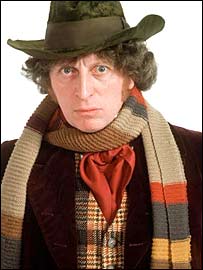
Like James Bond, there are the ones you fancy (Daniel Craig/Paul McGann); the ones that make you laugh (Roger Moore/Peter Davidson); the ones that are just plain wrong (Timothy Dalton/Colin Baker) and the ones who define the character (Sean Connery/Patrick Troughton).
Him Outdoors is a fan of Jon Pertwee – personally, I can’t see past Worzel Gummidge. Of course, this is a problem and the reason why some who you think brilliantly embody the role, leave before they become typecast.

I went off Dr Who – it was a kid’s series, right? – and although I kept an eye on the latest incarnation, it wasn’t until David Tennant assumed the mantel (with aplomb – is it possible to assume one without?) that I fell back in love with the franchise.
Of course, it’s Christianity 101 (a being that looks like us, but isn’t one of us, spans time and saves our souls over and over again – sound familiar?) but I love the simple storylines where nothing gets too complicated and it will work out alright in the end. And I love David Tennant; the man can act!


The baddies are excellent as well – along with the sexy sidekicks, that’s another James Bond parallel – and the other brightest star before he fell (classmates and equals in everything except the path they chose; again, I'm sure I've heard of that before somewhere...) is The Master. I must admit I would willingly go over to the dark side if John Simm were his embodiment.
So, what do we think of Matt Smith? On the evidence so far, I like him. His first episode in which he goes through a range of foods before finding that he likes fish fingers and custard reminds me of Tigger in Winnie the Pooh and his penchant for malt extract.
He wears a tweed jacket and a bow tie. He is arrogant and dismissive while still being compassionate and slightly naïve – he’s young, in other words. His scripts are good and he delivers the lines confidently. He has a floppy fringe and an edge, and no, I wouldn’t invite him home to mum; she’d fancy him too (she likes Johnny Depp. I told her to stick to her own… Paul Newman for example – she can have him – oh, and dad).
So far; so Gallifrey – but is he just what the doctor ordered? Only time will tell…

Thursday, 27 May 2010
Thrillingly threatening art
Séraphine Pick
Wellington City Art Gallery, 20 February – 16 May 2010
 If I had to use one word to describe the art of Séraphine Pick, it would be ‘disturbing’. Her paintings illustrate several stages of her development but the themes are constant. She includes spectral dresses, leaky baths and teetering suitcases in her psychologically charged dreamscapes.
Speak (1996) features two tiny central figures overwhelmed by their background. A year later, Insomnia suggests images of past relationships fraught with uncertainty, misunderstanding and emotional tension by positing half-erased doodles on a classroom blackboard.
Things become altogether more surreal with the half-forms of Room. The people with wings, skewed perspectives, and man with a rabbit head deliberately confuse and disconnect us. Pick deliberately undoes our expectations of hierarchy and perspective, piling vignette views on top of one another and causing our focus to shift restlessly from scene to scene.


The flowers, plants and birds (including NZ native ferns and toetoe along with large tropical orchids and a pair of huia) reclaim the landscape. The women look sideways and shifty in full-length ball gowns while the solitary male is naked; his genitals prudishly covered and he holds a limp lily in his hand. The entire affect is thrillingly threatening.

Pick moves on to the influence of Francisco Goya’s nightmarish malevolence with Phantom Limb (2007), Devil’s Music (2009) and Hole in the Sky (2009). The human figures look like zombies or clamouring demons. The crowd at a concert or children around a bonfire are profoundly unsettling. The colours and composition draw out their potential for violence and malignancy.
Once again Pick resumes the theme of domestic warfare with Burning the Furniture (2007). She seems to ask if there is any point in preserving symbols of the past. Personal effects are piled on the ground like a marital funeral pyre or a carefully-balanced arrangement while the figures positioned beside them seem disturbingly detached.

Her art is certainly confronting – if you like things that make you feel warm and content you should steer well clear, but if you fancy an artistic thrill, you could do a lot worse.
Saturday, 22 May 2010
Cream on top?
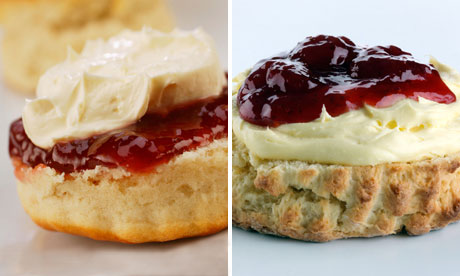
I used to think that whether you spread your scones with jam then cream or cream then jam was a North/South divide thing. According to this Guardian article, it's actually a Cornwall/Devon thing. It turns out, I am a Devon devotee - it's got to be cream then jam for me.
 A Kiwi friend pointed out that in New Zealand it is always jam then cream, because they don't have clotted cream (even double cream is hard to find), and if you just use whipped single cream, the jam will slide off if you put that on top.
This is why Devonshire teas should be trademarked. It's a divisive issue, but one of great importnace!
This is why Devonshire teas should be trademarked. It's a divisive issue, but one of great importnace!
Thursday, 20 May 2010
Levelling the playing field
Today I went for a run along the Kelvin Heights Track. I used to love this track; with its dips and twists and tricky terrain it gave me something on which to focus (other than tired legs and burning lungs). When I rode my mountain bike along it, there were three points where I had to dismount – I knew when I was getting fitter and my technical ability was improving when I could negotiate the steps, rocks and narrow hairpins with more ease.
 Admittedly I once took a corner too fast and went flying over the handlebars, chipping my front teeth as I fell. It’s actually a good job I did (come off that is) as the bike itself ended up in the lake. That was part of it – it was exciting and exhilarating and you had to concentrate on what you were doing.
Now the track is practically unrecognisable. It has been widened and levelled and smoothed out. There are no more rocks, steps, streams or light corners to negotiate. Toddlers on tricycles, parents with pushchairs and women in stilettos can amble along it. They scenery is still as stunning as ever, but you might as well stick it on a video and run on a treadmill. It’s boring. I suppose the only good thing about it is that it is now accessible to people in wheelchairs. It is accessible to everyone. And that’s the problem.
These days it seems that to avoid the charge of being elitist (apparently a heinous crime), we have to make everything available to everyone. Which brings me to tertiary education. There was a time in Britain when the top 2% of students went to university. Those wanting something slightly less academic and more vocational went to polytechnic (this was approximately the next 5%). If they passed all their exams and fulfilled their course requirements, they got degrees.
 There were no fees involved because the government could afford to subsidise the brightest (by which I mean most academic in this instance) 7% of the populace. Now anyone can go as long as they can afford it – no one fails but most get hefty debts with which to begin their adult life. Of course the government can no longer afford to pay everyone’s fees but never mind – it keeps folk off the unemployment figures for a few more years.
Where there used to be diplomas, certificates and apprenticeships for those wanting to pursue a career in the trades, now there are wall-to-wall degrees. We want everyone to have one because it ‘proves’ we are becoming more educated. So, you can get a degree in golf management, pet psychology, food and drink design, e-bay, and Klingon. I’m not kidding. A degree used to carry some weight; now it’s not worth the piece of paper it’s written on.
 By banning elitism, we are encouraging mediocrity, and it starts at school-level, both in the classroom and in the playground. Everyone who enters the race gets a certificate and spot prizes are more valued than performance – it really is the participation and not the winning that counts. This is all well and good, but don’t expect honour and glory, or medals and awards.
In allowing everyone to achieve, have we not simply lowered the standard of achievement?

Now the track is practically unrecognisable. It has been widened and levelled and smoothed out. There are no more rocks, steps, streams or light corners to negotiate. Toddlers on tricycles, parents with pushchairs and women in stilettos can amble along it. They scenery is still as stunning as ever, but you might as well stick it on a video and run on a treadmill. It’s boring. I suppose the only good thing about it is that it is now accessible to people in wheelchairs. It is accessible to everyone. And that’s the problem.
These days it seems that to avoid the charge of being elitist (apparently a heinous crime), we have to make everything available to everyone. Which brings me to tertiary education. There was a time in Britain when the top 2% of students went to university. Those wanting something slightly less academic and more vocational went to polytechnic (this was approximately the next 5%). If they passed all their exams and fulfilled their course requirements, they got degrees.

Where there used to be diplomas, certificates and apprenticeships for those wanting to pursue a career in the trades, now there are wall-to-wall degrees. We want everyone to have one because it ‘proves’ we are becoming more educated. So, you can get a degree in golf management, pet psychology, food and drink design, e-bay, and Klingon. I’m not kidding. A degree used to carry some weight; now it’s not worth the piece of paper it’s written on.

In allowing everyone to achieve, have we not simply lowered the standard of achievement?
Subscribe to:
Posts (Atom)